


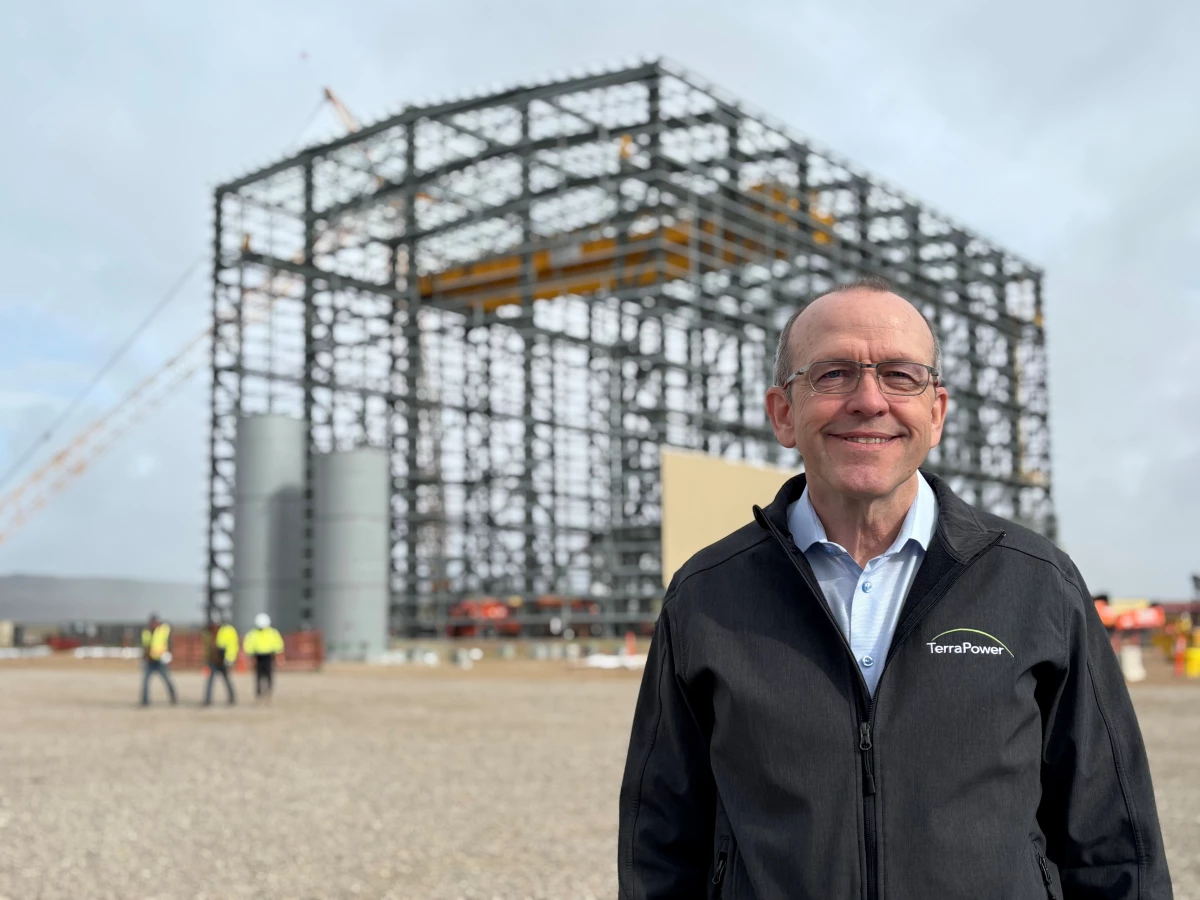
Kemmerer, WYO — The infamous Wyoming wind is whipping an American flag hoisted above the construction site of what’s only the fourth nuclear reactor to be built in the U.S. this century, and one of the first in a new generation of advanced designs.
“We’re building an advanced nuclear plant but so many aspects of the plant and of the business are the same as the sixty-year-old coal plant that’s down the road,” says Chris Levesque, Terra Power’s CEO, as he gestures to the west where the old Naughton plant stands.
The Washington state-based Terra Power, founded by Bill Gates, says this will be the first of many, part of a new nuclear renaissance they want to bring to long time energy exporting states like Wyoming. Levesque says the company’s “advanced reactor” technology makes nuclear plants safer and quicker to build.
“There is an energy crisis, it’s concerning,” Levesque says.
The recent beginning of construction here comes amid forecasts that an artificial intelligence boom means that data centers in the U.S. are going to need about 130% more energy by 2030. That’s according to the International Energy Agency.
To help meet that demand, Big tech companies and the federal government are partnering to invest billions of dollars in new nuclear power plants.
Nuclear boosters think its NIMBYism problem is in the past
The Nuclear Regulatory Commission gave Terra Power final approval to begin construction in March. This capped five years of studies and safety demonstrations and a decision to site the plant in Kemmerer, Wyoming which won bids over numerous other western towns.
“There is a whole different story to begin with, is communities vying for a nuclear power plant,” Levesque says. “The old story on nuclear was more of a ‘not in my backyard thing.'”
Levesque, who came to Terra Power after a career in the legacy nuclear industry, thinks new technologies and demand for low emission power is changing this. Almost everything here will be buried underground and they’ll use liquid sodium metal instead of water to cool the reactor.
“Milestones like this really show people that, yeah, this is a new technology but we’re doing it,” he says. “It’s real and people can start to work this into their plans.”
If all goes to plan and the plant is online by 2031, Terra Power says it will make enough electricity for a utility to power almost half a million homes – likely in nearby Salt Lake City. The company has also inked agreements with META for several more reactors to power the tech company’s data centers specifically.
“Since we were selected by the Department of Energy, we’ve had a project going for five years that’s switched administrations, switched parties, switched multiple controls of Congress,” Levesque says.
Rocky Mountain states join the race to win DOE nuclear hubs
A recent press release from the company marking the beginning of full-scale construction in Kemmerer included quotes praising the project from Wyoming Governor Mark Gordon and the state’s entire congressional delegation.
The Department of Energy pilot program that spurred Terra Power’s first project began during the first Trump administration. Then, the Biden-administration’s Infrastructure Law fronted half of the costs of construction, about two billion dollars.
Wyoming’s Republican Senators voted against that bill. But the state is eagerly courting nuclear energy plants and new uranium mines. So is neighboring Idaho, home to a federal nuclear lab, and Utah, where Governor Spencer Cox recently staged a press conference in the barren scrubland west of Salt Lake City.
“If you are serious about energy abundance, you have to be serious about nuclear energy,” Cox said, as he went on to unveil Utah’s application to be one of the U.S. Department of Energy’s new nuclear hubs.
It’s billed as a “nuclear life cycle innovation campus” where they’d enrich nuclear fuel, recycle it and store its waste, including one day possibly that generated by the Kemmerer plant.
Cox noted that nuclear already supplies roughly a fifth of all the electricity on the U.S. grid.
“This should not be controversial,” the Republican says. “America built the nuclear industry.”
Some environmentalists question how green nuclear is
But nuclear still is controversial, especially in the West with its legacy of abandoned uranium mines and radioactive waste particularly in Indian Country. And Salt Lake City was downwind from Cold War Era nuclear weapons test sites.
“This area has been considered a sacrifice zone for a long time,” says Lexi Tuddenham, executive director of Healthy Environment Alliance Utah, or HEAL.

Tuddenham is alarmed that Utah wants to site its proposed nuclear hub some ten miles from the western shore of the drying Great Salt Lake. She says nuclear is being rebranded as green but that ignores the ongoing problem of where to store its radioactive waste.
“Bill Gates is paying for this first one, we as taxpayers are also paying for this first one, I will say,” Tuddenham says. “But what about the next one and the next one? How much are we going to be on the hook for as taxpayers, as rate payers, as we go down this path?”
Terra Power says like conventional nuclear reactors, its plant in Wyoming will store its spent fuel on site until a permanent repository is approved by the feds. They say it’s safe and the “advanced nuclear” tech produces less waste than legacy plants.
An old coal town is eager for a nuclear rebirth
In Wyoming, the country’s top coal producing state, one thing that’s not in dispute is that Kemmerer is eager for any sort of energy boom. When the West Coast divested from coal, national headlines all but wrote off this town of 3,000 as dying.
“That’s what we were concerned about is no longer being an exporter of power, cause that’s a majority of our jobs,” says Brian Muir, city administrator in Kemmerer.

But today he says there’s relief and optimism around town. Hundreds of skilled jobs are being created. Due to the high demand for electricity, the old coal plant isn’t completely shutting either. Some of its generators are being converted to natural gas which will preserve about 100 existing jobs.
“I’ll just say, when Bill Gates came here, he talked about our high energy IQ,” Muir says. “We know about all forms of energy and the benefits and the costs and the risks and the footprints and all of that, we understand that.”
Muir says Kemmerer is already lobbying Terra Power to build a second nuclear plant here.
