A short-term spending bill to avoid a government shutdown will be voted on by the Republican-controlled Senate this week. The bill must pass and be signed into law by President Donald Trump before midnight this Friday to avert a government shutdown.
The bill narrowly passed the House of Representatives earlier this week in a 217 to 213 vote, with only one Democrat, Representative Jared Golden of Maine, voting yes. Only one Republican, Thomas Massie of Kentucky, voted against the legislation. Trump vowed to “lead the charge” to unseat Rep. Massie after his ‘no’ vote.
The bill would largely preserve the spending levels as they existed under former President Joe Biden’s administration. Key differences in the bill include cutting a billion dollars from the District of Columbia’s budget, and increasing military spending by $6 billion. The bill will also not include funds for any projects in lawmakers districts or states.
The short-term funding bill will need 60 votes to overcome a filibuster in the Senate. Republican Senator Rand Paul, R-Ky., has already said he plans to vote ‘no’ on the bill, which means Senate Republicans will need eight Democrats to move on to final passage, if no other Republicans oppose the bill. President Trump has made it clear on X, formerly known as Twitter, he plans to blame Democrats if the government shuts down.
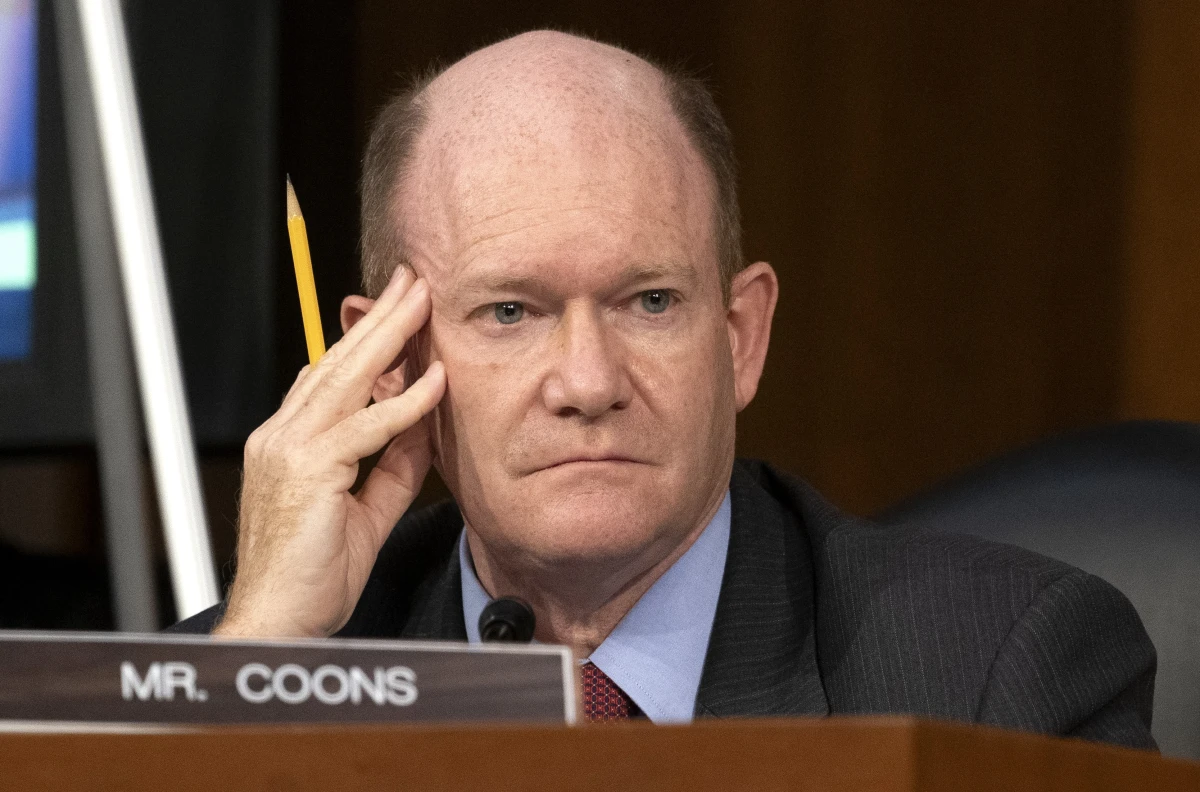
“President Trump and Elon Musk are already shutting down the government,” Senator Chris Coons of Delaware said on NPR’s Morning Edition.
Sen.Coons spoke to NPR’s Michel Martin about his decision to vote ‘no’ on the spending bill.
This interview has been edited for length and clarity.
Interview highlights
Michel Martin: Have you decided how you’re going to vote?
Senator Chris Coons: I’m an appropriator. I am going to vote against this dirty continuing resolution because I don’t want my vote to give an imprimatur to what President Trump is doing. We can and should find more efficient ways to spend federal government dollars, but the ways in which he is cutting veterans mental health services, tens of thousands of employees out of critical agencies that keep us safe and support our country. And the rising threats in recent comments from Elon Musk and others close to Trump to go after Social Security, Medicaid and Medicare alarm me and will not have my support.
The argument in favor is that, well, this is bad. And, well, almost every Democrat in the House and almost every Democrat in the Senate opposes what Donald Trump and Elon Musk are doing. The risks of shutting the government down may be greater because we don’t know what this unusual president might do to further break the guardrails. So court after court that has reviewed his abrupt and cruel spending cuts have said they were illegal or unconstitutional. President Trump is coloring outside the lines. And so I respect those senators who have real concerns about what more Trump might do in the midst of a government shutdown.
Martin: Republicans, starting with Trump, have made it clear they’re going to blame the Democrats for shutting down the government if that happens. What are the arguments for voting against it?
Senator Coons: President Trump and Elon Musk are already shutting down the government for the time he’s been president now just over 50 days. They have torn through agency after agency. A government shutdown is already underway and it’s being done piecemeal, without planning, without any kindness or decency to folks who’ve served as veterans and helped keep our nation safe and help run our Social Security agency. So first, the argument for not giving President Trump and Elon Musk more power to do more bad, to move money around at will, to shut down more organizations and to give it our vote.
Martin: Is this more about what’s in the bill or is it all about taking a stand against the actions of the Trump administration more broadly?
Senator Coons: It’s both. This is not what we call in the Senate a clean continuing resolution. It’s a dirty continuing resolution. It doesn’t have positive provisions that ensure that the president will follow the law or that ensure that there is a congressional role in oversight, as the president uses this as a slush fund to move billions of dollars here and there.
What a continuing resolution really means is that, yes, the funding levels are roughly similar to what they should have been last year, although with real cuts, to the District of Columbia government, but to lots of domestic agencies. But it also gives the president more range to move money around the federal government, around the country at will. And we’re already seeing him use that power to extract concessions.
Martin: Do you expect that all Democrats will vote against this bill as you have planned to and if they don’t? Does this further signal that the Democrats don’t have a coherent response to this administration?
Senator Coons: No Democrats in the Senate are going to fight for our appropriations bills that we’ve already done on a bipartisan basis that are ready for action. We’re going to work to get a vote on the floor of a 30 day continuing resolution to keep the government open while we finish our appropriations bills.
And Michel, let’s be clear. It’s President Trump who is already shutting down the government, and it’s Elon Musk who’s been cheering on those who want to shut down the government.
This story was edited by Kristian Monroe. The audio version of this story was produced by Nia Dumas and edited by Lisa Thomson.
Transcript:
MICHEL MARTIN, HOST:
A spending bill to avoid a government shutdown is headed to the Republican-controlled Senate for approval. It’s a step toward avoiding a partial shutdown that would start Friday at midnight. The measure would keep the government funded through September. It passed the House with a vote of 217-213. One Republican voted against the bill, while one Democrat voted for it. So now Senate Democrats have to decide what they’re going to do.
We’re going to put the question to Senator Chris Coons of Delaware. He is a Democrat who sits on the Senate Finance Committee, and he’s with us now. Senator, good morning.
CHRIS COONS: Good morning.
MARTIN: So in the House, as we said, they got the bill over the line with two votes to spare, but in the Senate, 60 votes are needed. Republican Rand Paul says he’s a no. So that means Republicans need as many as eight Democrats to pass it.
Before I ask you what you’re going to do, can you lay out the arguments for and against? I mean, the pro, obviously, is to keep the government from shutting down. Republicans, starting with Trump, have made it clear they’re going to blame the Democrats for shutting down the government if that happens. What are the arguments for voting against it?
COONS: Well, Michel, President Trump and Elon Musk are already shutting down the government. For the time he’s been president – now just over 50 days – they have torn through agency after agency. You’re about to talk about the Department of Education, where half its workforce has been laid off. So a government shutdown is already underway, and it’s being done piecemeal, without planning, without any kindness or decency to folks who’ve served – veterans – and helped keep our nation safe and help run our Social Security agency.
So first, the argument for not giving President Trump and Elon Musk more power to do more bad, to move money around at will, to shut down more organizations and to give it our vote, our support, I think is clear. The argument in favor is that while this is bad and while almost every Democrat in the House and almost every Democrat in the Senate opposes what Donald Trump and Elon Musk are doing, the risks of shutting the government down may be greater because we don’t know what this unusual president might do to further break the guardrails.
MARTIN: So…
COONS: Court after court that has reviewed his abrupt and cruel spending cuts has said they were illegal or unconstitutional. President Trump is coloring outside the lines. And so I respect those senators who have real concerns about what more Trump might do in the midst of a government shutdown.
MARTIN: OK. So the bill largely, actually, preserves spending levels as they existed under President Biden. Does the opposition come from what’s in the bill itself? And I do want to mention that the District of Columbia takes a big hit. It would cut a billion dollars from the district budget for the rest of the year. All of the city’s elected leaders say this would be a disaster. But is this more about what’s in the bill, or is it all about taking a stand against the actions of the Trump administration more broadly?
COONS: It’s both because this is not what we call in the Senate a clean continuing resolution. It’s a dirty continuing resolution. It doesn’t have positive provisions that ensure that the president will follow the law or that ensure that there’s a congressional role in oversight as the president uses this as a slush fund to move billions of dollars here and there. What a continuing resolution really means is that, yes, the funding levels are roughly similar to what they should have been last year – although with real cuts, as you mentioned, to the District of Columbia government – but to lots of domestic agencies. But it also gives the president more range to move money around the federal government, around the country at will, and we’re already seeing him use that power to extract concessions.
Look. The way that he is taking advantage of his tariff power to bluster and bludgeon and pick fights with our closest allies, which has sent the stock market tumbling, will be mirrored by how he will use this power – if this passes – to bluster and bludgeon against states and cities and programs that he dislikes…
MARTIN: OK.
COONS: …By abruptly cutting off funding.
MARTIN: So given all that – what you’ve just laid out here – what are you going to do? Have you decided how you’re going to vote?
COONS: I’m an appropriator. I am going to vote against this dirty continuing resolution because I don’t want my vote to give an imprimatur to what President Trump is doing. We can and should find more efficient ways to spend federal government dollars. But the ways in which he is cutting veterans’ mental health services, tens of thousands of employees out of critical agencies that keep us safe and support our country, and the rising threats in recent comments from Elon Musk and others close to Trump to go after Social Security, Medicaid and Medicare alarm me and will not have my support.
MARTIN: So if the Democrats as – well, as we’ve just discussed, and it has – it’s been made clear. The speaker of the House has made clear – Mr. Trump has made clear that if the government does shut down, they’re going to blame the Democrats. So – and you already laid out your objections to the bill, your argument that this just gives Mr. Trump even more license to abrogate both, you know, rule and law, as you see it. How are you going to navigate that?
COONS: This seems pretty clear to me. From the day he started with his DOGE exercise, Elon Musk and Donald Trump have been slashing federal programs, laying off federal workers by the thousands, and yet without any thought or eye towards efficiency and improving operations. My guest from Delaware to President Trump’s speech last Tuesday night was a two-tour Marine combat veteran, who was working in wildlife conservation and in the preservation of wetlands in Delaware for the U.S. Department of Agriculture, for their rural conservation service. He got an abrupt, unjustified firing notice on Valentine’s Day.
MARTIN: OK.
COONS: He is one of thousands and thousands of federal workers across the country who have been fired abruptly. More importantly or equally importantly, what they were doing has value…
MARTIN: OK.
COONS: …To our community and our country.
MARTIN: Understood, understood. Senator, if the government shuts down, let’s just – let me ask it this way, actually. It was an achievement for the speaker to persuade most Republicans to vote for this bill, even though we know that many of them had objections to it. Do you think that the Democrats will be similarly united on this? Do you expect that all Democrats will vote against this bill, as you have planned to? And if they don’t, does this further signal that the Democrats don’t have a coherent response to this administration?
COONS: No. Democrats in the Senate are going to fight for our appropriations bills that we’ve already done on a bipartisan basis that are ready for action. We’re going to work to get a vote on the floor of a 30-day continuing resolution to keep the government open while we finish our appropriations bills. And, Michel, let’s be clear. It’s President Trump who is already shutting down the government, and it’s Elon Musk who’s been cheering on those who want to shut down the government.
MARTIN: That is Senator Chris Coons. He is a Democrat from Delaware. Senator Coons, thanks so much for joining us once again.
COONS: Thank you.