


PHILADELPHIA — With hitters struggling, pitchers dominating, and officials wondering how to juice offensive production back to fan-pleasing levels, Major League Baseball was in crisis.
It was 1968, the so-called “year of the pitcher.” Across both the National and American Leagues, offense was at or near a record low in all sorts of measures: runs, hits, home runs, runners reaching base, slugging percentage, you name it.
In all of baseball that year, only six hitters managed a batting average of .300 or higher, an all-time low. In the American League, Boston’s Carl Yastrzemski won the batting crown with an average of just .301, a mark that still stands as the lowest ever to win a batting title.
Now, nearly six decades later, what’s old is new again: A batting average crisis is back.
You’d think today’s batters have more advantages than ever: They train year-round. They have the advice of well-staffed analytics departments on their swing and at-bat strategy. They can practice before each game on modern pitching machines capable of mimicking the arsenal of that day’s opposing pitcher.
Loading…
Yet, incredibly, none of that has been enough.
This year, the leaguewide batting average has slumped to .246. And the number of .300 hitters — a club whose size peaked at 55 in 1999 — is at risk of tying, if not breaking, 1968’s record low. As of Thursday, there were eight such hitters in the major leagues.
“It’s the toughest thing in all of sports to do, and it’s becoming tougher,” said Kevin Long, who has won two World Series as a hitting coach and now works for the Philadelphia Phillies, where shortstop Trea Turner appears poised to win the National League batting title with an average of just .305. “It’s hard to believe that this is where we’re at in our game.”
It’s the pitching
Hitters and coaches alike point to one dominant factor: Pitching is better than ever.
Pitchers today throw faster, and their pitches have more movement than ever. Starting pitchers are pulled from the game sooner — almost an entire inning earlier, on average, than a decade ago — because every team has a bullpen staffed with relievers who can throw in the high 90s, if not triple digits. Batters were more successful as they saw the same pitcher three or four times in the same game. Now, batters often see a starter only twice before someone from the bullpen.
“You used to want to get to the bullpen. I don’t know that that’s necessarily the case anymore, because you get to these bullpen arms, they’re all throwing 97 to 102,” said Long.
Pitchers have benefited from the introduction of sophisticated pitch tracking machines around ten years ago, and the advanced data they produced about pitches — like their spin rate and direction, and the precise angle and distance of the ball’s movement — have helped pitchers refine their arsenal.
Defense has also gained an edge, batters said. Fielders can study video of opponents broken down by pitch type and velocity. Analytics departments prepare cheat sheets for each fielder to carry with them during the game that advise on where to position themselves for each batter — and sometimes, for each pitch.
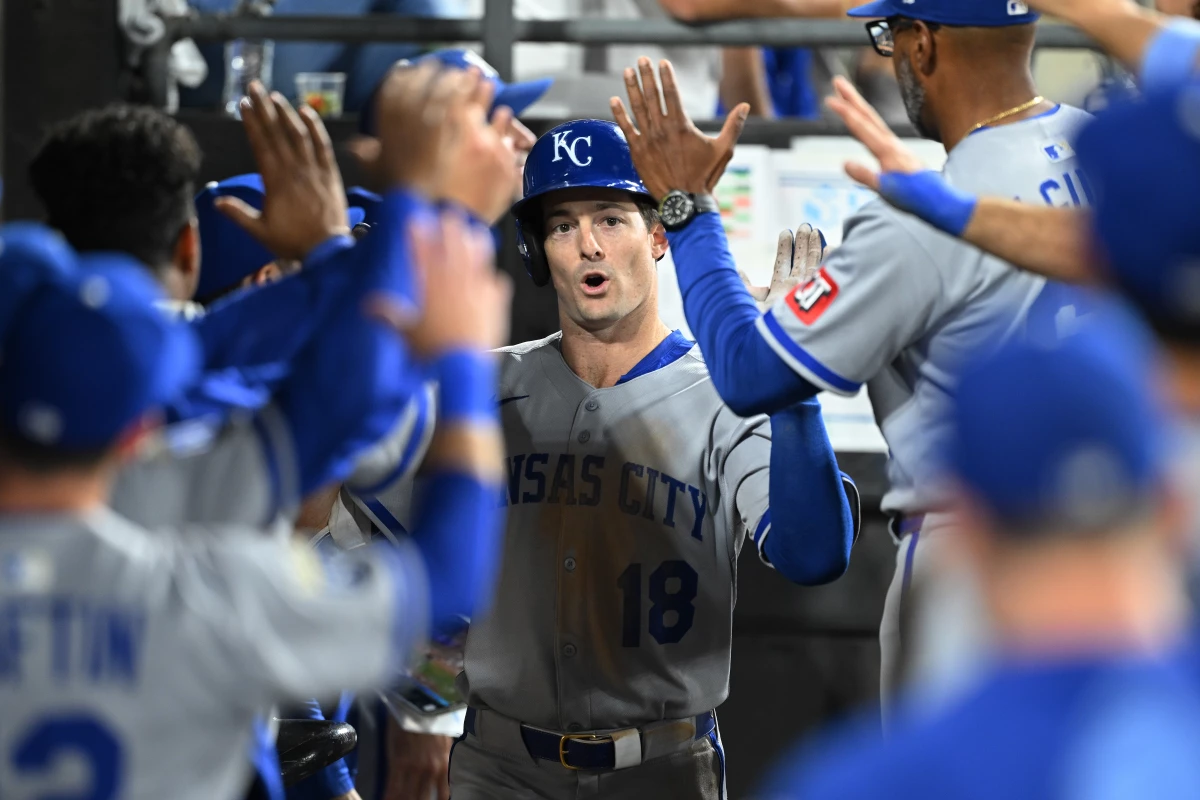
“For someone like me, I’ve had seven years worth of data for these guys to dig through,” said Mike Yastrzemski, Carl’s grandson and an outfielder for the Kansas City Royals (current batting average .228). “There’s a lot of information that’s out there for them that creates a very tough matchup for any hitter, no matter how good you are.”
Loading…
Phillies outfielder Harrison Bader, who made his MLB debut in 2017, says the rapid advances have forced hitters to play catch-up in their preparation and approach at the plate.
“It’s different every single day. It’s different every single at-bat. And, quite frankly, it’s different pitch to pitch,” said Bader, whose efforts this season have resulted in a career-high batting average of .283, which would rank 20th in the majors had he not missed time due to injury. “I think that’s what makes the art of hitting something that really is an art.”
Home runs are up, and strikeouts too
Hitting, too, has changed. More teams and players have come to prioritize hitting for power, rather than hitting for contact or for average.
The result is that, across the league, the rate of home runs per plate appearance has climbed by 50% or more over the past 50 years. And even as the batting average has declined, the number of runs scored per game, at 4.47, is still far higher than the 1968 low of 3.42. Batters today are hitting home runs in 3.1% of their times at the plate, compared to just 1.7% in 1968.
There are drawbacks to the power approach. Most visible are the strikeouts: Strikeout rates have climbed steadily since the mid-2000s. Hitters who loft the ball in an effort to hit it out of the park also hit more fly outs. And in the mid-2010s, as home run rates took off, the rates of other hits — especially singles — began to sag.

Still, faced with dominant starting pitchers like Pittsburgh’s Paul Skenes or Detroit’s Tarik Skubal, teams have largely decided that the scoring benefits are worth the cost of admission.
“If you think you’re going to go out there off of Tarik Skubal and put three or four hits together in an inning, good luck,” said Michael Massey, the Royals’ second baseman, currently batting .219. “What teams and what players have come to is they’ve said, ‘Well, guys have gotten so good that the reality is when he makes a mistake — because he doesn’t make many of them — we need to capitalize.'”
What could be next?
Baseball has a long history of tweaking the rules to put a thumb on the scale whenever pitchers or batters have gained too much of an upper hand.
After 1968, league officials decided something must be done. That winter, officials voted to lower the height of the pitcher’s mound by a third, from 15 inches to 10, and to shrink the size of the strike zone by lowering the top of the zone from a batter’s shoulders to his armpits.
The two changes had an immediate effect, along with the expansion of the league to include four new teams, which resulted in some pitchers who had previously been minor league-quality players coming to the majors to fill out four additional rosters.
No changes that dramatic are on the horizon today. A 2023 decision to limit defensive shifts resulted in a modest bump for batters that season, especially left-handed hitters, but batting averages have slipped back down since.
The difference: runs. In 1968, teams struggled to score runs as batters struggled to hit. Today, in spite of the lower batting averages, the number of runs scored per game, at 4.47, is still far higher than the 1968 low of 3.42.
Transcript:
ARI SHAPIRO, HOST:
There’s a saying that baseball is the only place where you’re considered great if you succeed only 30% of the time. Now in Major League Baseball, that famous benchmark – a batting average of .300 – has become an endangered species. NPR’s Becky Sullivan has the story.
BECKY SULLIVAN, BYLINE: I came to Philadelphia because the Phillies are one of the best teams in baseball. They’ve got a lineup stacked with some of the league’s best hitters, including shortstop Trea Turner, who is one of only eight guys in the Major Leagues with a batting average over .300.
KEVIN LONG: It’s the toughest thing in all of sports to do, and it’s becoming tougher.
SULLIVAN: This is Kevin Long, the hitting coach for the Phillies. He’s worked in the major leagues for almost two decades now. He’s won two World Series rings. But his job has gotten a lot harder over the last five years or so.
LONG: It’s probably a good time for me to retire maybe (laughter).
SULLIVAN: Chatting in the Phillies dugout, Long ticks off reason after reason why there are so few .300 hitters these days.
LONG: It was looked down upon…
SULLIVAN: Guys strike out more often.
LONG: …To strike out.
SULLIVAN: Hitters loft the ball hoping for homers, but that leads to more flyouts.
LONG: Well, those can be dangerous.
SULLIVAN: In the end, though, Long says you got to look at the guys throwing the ball.
LONG: Now, the biggest factor when we really look at it is the pitching.
SULLIVAN: This year, right-handers are throwing four-seam fastballs at an average speed of 95 miles per hour. Starting pitchers tend to get pulled from the game sooner – almost an inning earlier than they did even a decade ago – because now every team has a bullpen full of fast-throwing guys.
LONG: You used to want to get to the bullpen. I don’t know that that’s necessarily the case anymore because you get to these bullpen arms, they’re all throwing 97 to 102.
SULLIVAN: The last time there were this few .300 hitters, it was 1968. That’s a year that’s infamous in baseball history. It’s called the year of the pitcher. A league-wide offensive slump led to record or near-record lows in all kinds of offensive statistics – batting average, runs, hits, you name it. The best hitter in the American League that year was Carl Yastrzemski of the Boston Red Sox. His batting average of .301 is still the lowest ever to win a league batting title.
MIKE YASTRZEMSKI: You know, obviously I wasn’t playing at that time, so I’m not going to pass any judgments. But all I know is that it is very hard to get a hit in a major league game today.
SULLIVAN: This is Mike Yastrzemski, Carl’s grandson. He’s an outfielder for the Kansas City Royals, hitting .229 this season. He says modern analytics and scouting mean that anyone can pull up a video of literally any time he has swung the bat to find his weak spots.
YASTRZEMSKI: You know, for someone like me, I’ve had seven years’ worth of data for these guys to dig through. And so if they know they’re going to pitch me a certain way and they play their defense in a certain spot, it’s probably going to be a lot harder for me to get a hit.
SULLIVAN: Batters now have to do a lot more work to have success at the plate, says Harrison Bader. He’s an outfielder on the Phillies, hitting .283. He told me the way he prepares for games has had to change.
HARRISON BADER: It just really just depends, and it’s different every single day. It’s different every single at bat, and quite frankly, it’s different pitch to pitch. And I think that’s what makes, you know, the art of hitting something that really kind of is an art.
SULLIVAN: Even so, the game’s most elite pitchers, like Paul Skenes for Pittsburgh or Tarik Skubal in Detroit, have given up fewer hits than they’ve pitched innings. So maybe it’s no surprise the teams have decided to prioritize scoring over getting on base. Here’s Kansas City Royals infielder Michael Massey.
MICHAEL MASSEY: If you think you’re going to go out there off of Tarik Skubal and put three or four hits together in an inning, good luck. And so I think what teams and what players have come to is they’ve said, well, when he makes a mistake – ’cause he doesn’t make many of them – we need to capitalize.
SULLIVAN: Hitting for power instead of hitting for average has its trade-offs – strikeouts, pop flies. But boy, you can’t argue with the scoreboard. A home run changes that with just one swing at the bat.
(APPLAUSE)
SULLIVAN: In the stands, I find Eric Kondash and his two daughters, Alyssa and Olivia. They’re here for a family night – all of them big Phillies fans. I asked them to join the debate. Home runs or small ball, which is more fun?
OLIVIA KONDASH: Home runs.
UNIDENTIFIED PERSON: Home runs.
ALYSSA KONDASH: Home runs (laughter).
ERIC KONDASH: Well, yeah, I do. But I like to see a long inning with singles and doubles…
OLIVIA: Yeah.
KONDASH: …And moving runners.
OLIVIA: Excitement.
KONDASH: Of course, yeah, I want to see a home run. That gets everybody pumped. But get on base, manufacture some runs, play baseball, you know?
(SOUNDBITE OF ORGAN MUSIC)
SULLIVAN: To that, the Phillies say, why not both? In the second inning, the home team strung together a double, a walk, a single, then a sacrifice fly to score their first run. The next inning, Bryce Harper hit a 2-run homer to break the game open.
(CHEERING)
SULLIVAN: Becky Sullivan, NPR News, Philadelphia.
(SOUNDBITE OF MUSIC)
