


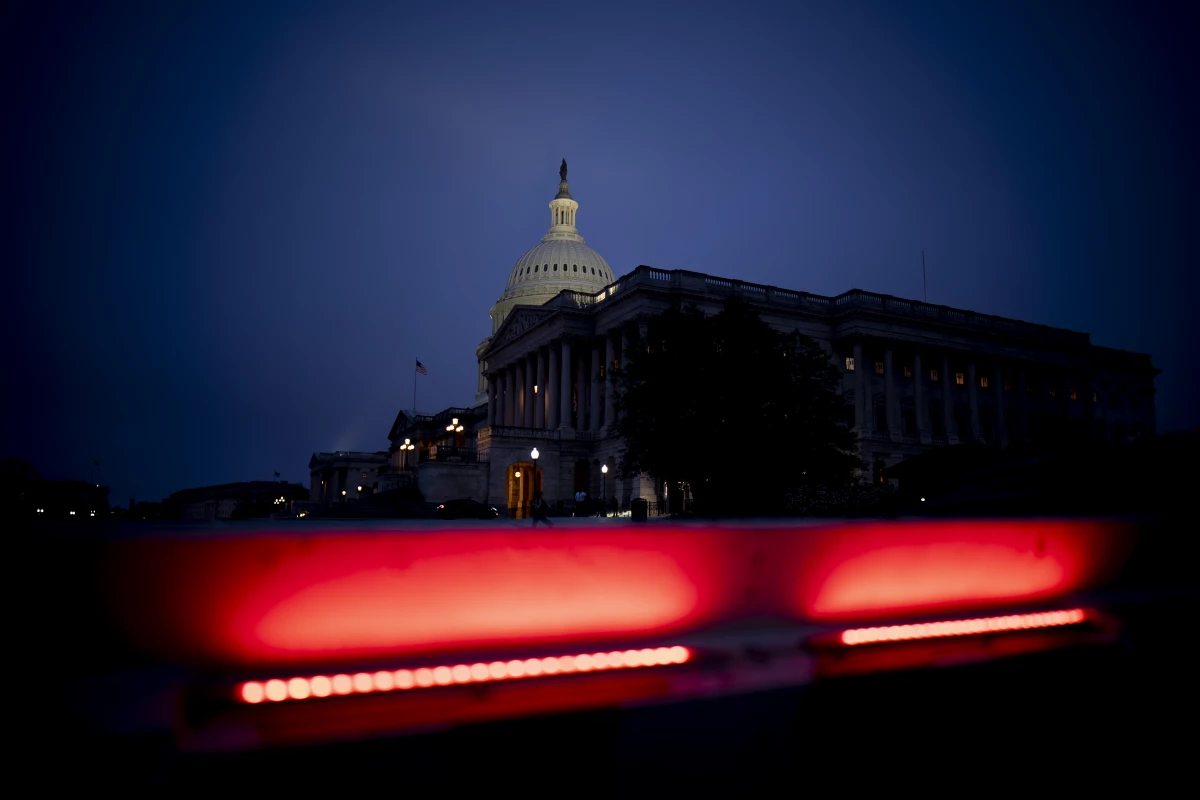
Pressure is building on Senate Majority Leader John Thune, R-S.D., to scrap the filibuster in order to pass President Trump’s voting regulation agenda, known as the SAVE America Act.
The filibuster is a longstanding procedural quirk of the Senate that can be used to block legislation by establishing a de facto 60-vote threshold to pass most bills. Because it is exceedingly uncommon in the modern Congress for a single party to have 60 Senators, the filibuster forces some amount of bipartisan legislating.
How the filibuster helps the party in the minority
Consider the current fight over the conduct of federal immigration officers.
After agents killed two American citizens in Minnesota this winter, Democrats — who are the minority party in the Senate — have refused to advance funding for Immigration and Customs Enforcement and parts of Customs and Border Protection until reforms are made to their practices. Democrats have asked for things like enhanced training, body-worn cameras and a prohibition on face masks.
Because of the filibuster, Republicans could not advance that funding on their own, so the Department of Homeland Security — the parent agency of ICE and CBP — has been shut down since Feb. 14. That led to employees of other, unrelated parts of DHS, including the Transportation Security Administration, to go weeks without pay.
Late last month, because of the filibuster, Democrats were able to extract a concession from Senate Republicans: the body unanimously advanced funding for all of DHS except for the agencies at the heart of the immigration fight. In the House, where there is no filibuster and legislation is passed with a simple majority vote, Republicans were able to act more or less on their own to pass a bill funding all of DHS.
Because the two chambers of Congress didn’t agree on an approach, DHS remains shut down. Republicans are now trying to circumvent Democrats and fund CBP and ICE using a tool known as budget reconciliation.
Why Senate Republicans are facing pressure to scrap it
The filibuster, in theory, wouldn’t be that hard to get rid of — because it is a product of the Senate’s own rules, it could be done with a party-line vote.
But in Washington, the next election is always just around the corner. What feels like a firm grip on power can, and often does, quickly slip away on election night. So, even when legislators are feeling high-and-mighty, they’re mindful of what life will be like in the minority.
So while some Republicans may not want to negotiate with Democrats, others inside the GOP are aware that they may want that leverage the next time they’re in the minority.
But President Trump is eager to pass a voter ID and proof-of-citizenship bill called the SAVE America Act. The bill, which has already passed the House, has not come up for a vote in the Senate — because it won’t attract enough Democratic votes to advance to the president’s desk for a signature.
So, the president is pushing Thune to end the filibuster and pass it on a party-line vote. He ramped up the pressure at the end of last month with several posts like this on Truth Social:
Mar. 22: “I don’t think we should make any deal with the Crazy, Country Destroying, Radical Left Democrats unless, and until, they Vote with Republicans to pass ‘THE SAVE AMERICA ACT.’ […] let Leader Thune clearly identify those few ‘Republicans’ that are Voting against AMERICA. They will never be elected again! In other words, lump everything together as one, and VOTE!!! Kill the Filibuster, and stay in D.C. for Easter, if necessary. MAKE AMERICA GREAT AGAIN! President DJT”
The heat is on — but it has been on for a long time
This pressure is not new. Democrats, under then Majority Leader Chuck Schumer, D-N.Y., weighed eliminating the filibuster to pass voting reform legislation of their own during the Biden administration. And activists of both parties, who don’t see compromise as realistic in the sharply divided American political landscape, have long hoped to see it finally done away with.
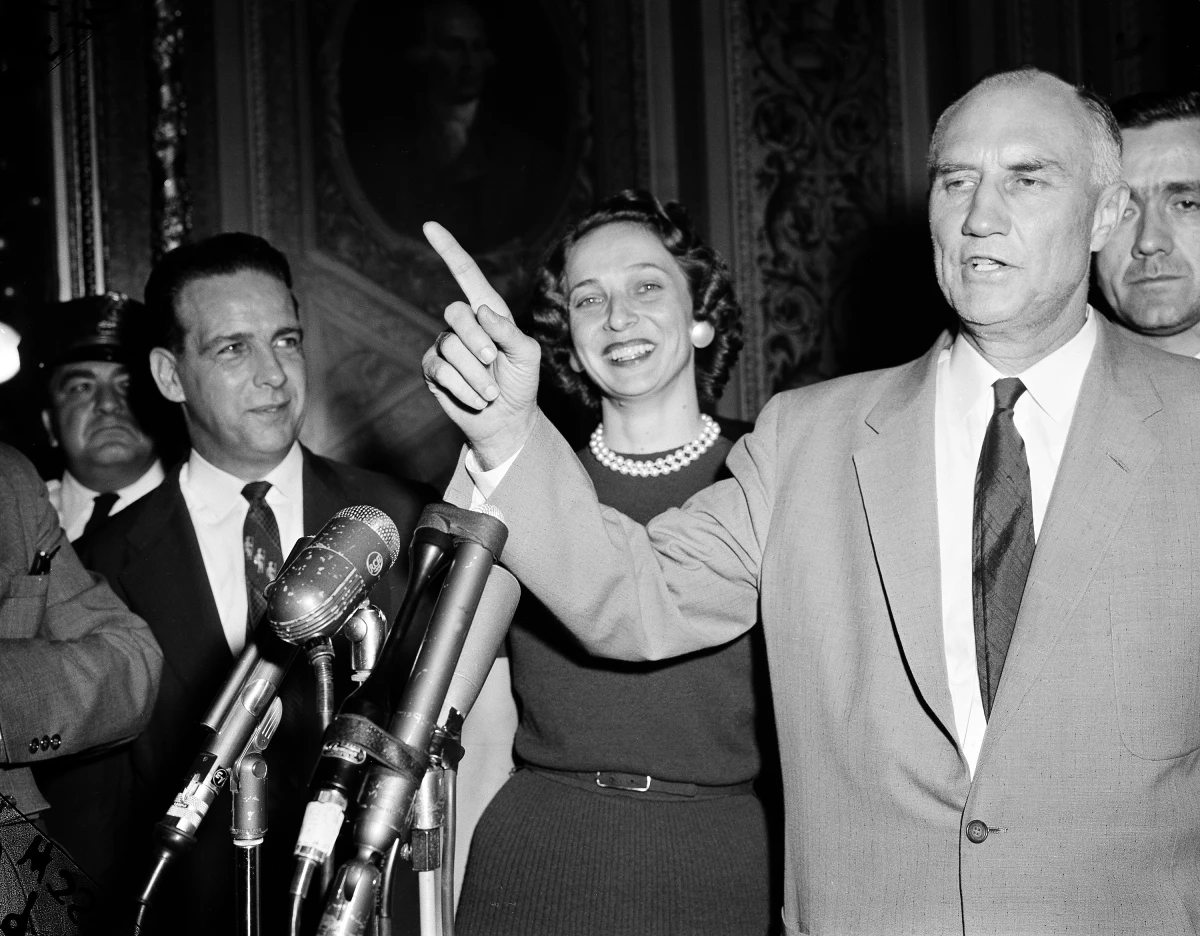
Gréta Bedekovics, the head of the Democracy team at the progressive Center for American Progress, notes that the filibuster has long been used as a tool to block civil rights legislation — segregationist Sen. Strom Thurmond of South Carolina spoke for more than 24 hours in an effort to block the Civil Rights Act of 1957 — and sees it as a way for minority viewpoints to block policies supported by a majority of Americans.
In an April 2024 report, Bedekovics wrote that because senators from less populous states represent the views of fewer Americans — Wyoming residents, for example, have more than 65 times the Senate voting power of Californians — senators from “the 21 least populous states — representing only 11 percent of the country’s population and only 7 percent of the country’s Black population — can abuse the filibuster to prevent almost any legislation from being passed by Congress.”
Sen. Mike Lee, R-Utah, has been the chamber’s most vocal proponent of a return to the so-called talking filibuster, which would require senators who want to halt legislation to actually stand up on the floor of the chamber and speak for hours to block debate. It fell out of fashion in the 1970s. Lee and others have argued that it would be harder for the minority party to block legislation if they are forced to literally speak for hours in opposition on the Senate floor.
The talking filibuster, “if fully utilized and given the time it needs to work, could help us pass the SAVE America Act,” Lee wrote on X last month. “But the benefits wouldn’t end there, as they could help us avoid not only the kind of shutdown hell we’re now experiencing, but also rein in our debt and deficit—at least while Republicans are in charge.”
A return to the talking filibuster would be the latest change to a measure that has evolved considerably over time — until the 1970s, two-thirds of Senators were needed to overcome a filibuster instead of three-fifths.
![]Senate Majority Leader John Thune, R-S.D., speaks to reporters at the U.S. Capitol on April 2, 2026. Thune is facing pressure from President Trump to do away with the filibuster.](https://npr.brightspotcdn.com/dims3/default/strip/false/crop/5616x3744+0+0/resize/1200/quality/90/format/webp/?url=http%3A%2F%2Fnpr-brightspot.s3.amazonaws.com%2F7b%2F5b%2F1c4a000444e799bae691b0b0c169%2Fgettyimages-2268865753.jpg)
In the 2010s, then-Senate Majority Leader Harry Reid, D-Nev., led a change to allow a simple majority of Senators to advance presidential nominees to the executive branch or federal court judges. Later that decade, Senate Majority Leader Mitch McConnell, R-Ky. changed the rules again to include the confirmation of Supreme Court Justices at the lower threshold.
Thune has so far resisted the pressure — in part because he says he doesn’t have the votes to scrap the filibuster.
“We don’t have the votes for it. And that’s, again, it’s a simple function of the math in the Senate. It would take even a talking filibuster. It would take 51 votes. We don’t have 51 votes for that in the United States Senate,” Thune told Fox News’ Brett Baier last month.
So far, the institutionalists have prevailed
The use of the filibuster on almost all legislation is a distinctly modern development. But the origin of the tool goes back a very long way, to the first ever Senate session.
Sen. William Maclay of Pennsylvania wrote in his diary on September 22, 1789 that the “design of the Virginians . . . was to talk away the time, so that we could not get the bill passed.” The term filibuster came later, in the mid-nineteenth century.
Flexing minority power and consensus building has long been a defining feature of the Senate. Here’s then-Minority Leader Sen. McConnell in 2010:
“I believe it was Washington, it certainly was one of our founders, who was quoted as saying at the Constitutional Convention, the Senate was going to be like the saucer under the teacup, and the tea was going to slosh out and cool off. And the Senate, he anticipated, would be a place where passions would be reined in, and presumably, progress would be made in the political center. And it seems to me, if you look back over the 200-year history of our country, the Senate has certainly forced solutions to the middle. And most observers would argue that that’s been good for the country.”
And Schumer in 2005:
“Bottom line is very simple: the ideologues in the Senate want to turn what the Founding Fathers called ‘the cooling saucer of democracy’ into the rubber stamp of dictatorship. We will not let them. They want, because they can’t get their way on every judge, to change the rules in mid-stream, to wash away 200 years of history. They want to make this country into a banana republic, where if you don’t get your way, you change the rules. Are we going to let them? It’ll be a doomsday for democracy if we do.”
Both men went on to play a role in weakening the filibuster when it suited their needs — and political scientists have cast doubt on the idea that the tool was really part of the framers’ vision for the Senate. But it has defined the chamber’s process for more than 200 years — and the sense of the Senate has remained in favor of the tool throughout its occasional moments of crisis.
Time will tell if that support lasts the year.
Transcript:
AILSA CHANG, HOST:
The Senate filibuster. At first, it meant a long speech that a lawmaker could use to obstruct a vote. But today, senators can filibuster a bill without even needing to speak. President Trump wants to end the practice in order to pass his proof of citizenship voting bill. Here he is stumping for it in Memphis last month.
(SOUNDBITE OF ARCHIVED RECORDING)
PRESIDENT DONALD TRUMP: If you could get rid of the filibuster, it would be great. It would be great. Get rid of the filibuster and get it all done.
CHANG: Is his pressure campaign enough? Here’s NPR congressional reporter Eric McDaniel.
ERIC MCDANIEL, BYLINE: You’d think there’s nothing more perilous in politics than the flip-flop. But it seems like every modern Senate leader has been on all sides of the filibuster. When you’re in the minority, it’s a vital tool to preserve your rights and build consensus.
(SOUNDBITE OF ARCHIVED RECORDING)
CHUCK SCHUMER: Without the 60-vote threshold for legislation, the Senate becomes a majoritarian institution like the House, much more subject to the winds of short-term electoral change.
MCDANIEL: That was Democratic Minority Leader Chuck Schumer in 2017, when Republicans killed the filibuster for Supreme Court nominees. And here’s Schumer in 2022, a majority leader trying to sidestep the tool in order to pass his party’s own voting rights bill.
(SOUNDBITE OF ARCHIVED RECORDING)
SCHUMER: But the Senate was never envisioned to allow an absolute minority party veto. Never. In fact, the founders expressly rejected the inclusion of a supermajority requirement for the Senate.
MCDANIEL: Mitch McConnell championed the filibuster as a tool that forces compromise when Democrats weakened it in 2013. Then McConnell weakened it himself a few years later after he became the Senate’s majority leader. Now Republicans are contending with Democratic opposition to the SAVE America Act, which would require folks to show proof of citizenship before voting. Some of them want to do away with the silent filibuster and go back to making legislators talk until they can’t anymore in order to force a bill to clear the filibuster’s 60-vote threshold. Here’s Utah’s Mike Lee on “The Charlie Kirk Show” last year.
(SOUNDBITE OF PODCAST, “THE CHARLIE KIRK SHOW”)
MIKE LEE: You enforce the rules by requiring them to debate. And then the minute they stop debating – if they’ve exhausted either themselves physically or their right to speak – that moment, you can call the vote.
MCDANIEL: It’s, well, a lot harder in practice. Republican senators would have to stay in the Senate chamber to prevent other parliamentary shenanigans. And regardless, Majority Leader John Thune says that he just can’t make the numbers work to change or end the filibuster. Here he is talking to Fox News in March.
(SOUNDBITE OF ARCHIVED RECORDING)
JOHN THUNE: We don’t have 51 votes for that in the United States Senate.
MCDANIEL: And maybe the math changes under pressure from Trump. Though, depending on how you’re counting, the filibuster’s lasted for nearly 200 years, so it’s got momentum. And the case to keep the filibuster is clear enough. If you want laws to pass with more consensus, requiring more than a simple majority in order to pass them is useful. But in a Congress that already struggles to pass things, where virtually everything now gets filibustered, could lowering the bar add some life back to the Hill?
(SOUNDBITE OF ARCHIVED NPR CONTENT)
SARAH BINDER: We have this notion that the filibuster’s like this principle of unlimited debate to protect minority interests and so forth. But as we discovered, it’s really just politics. It’s brute-force politics.
MCDANIEL: That’s Sarah Binder, a political scientist at George Washington University, talking to NPR’s Throughline podcast in 2022. And the question is, does the Senate need to do more to protect the viewpoint of the minority? Filibuster critics point out that every state already gets two senators, regardless of the size. That means if you live in a less populous place, like Wyoming, you effectively get more than 65 times the Senate representation that someone living in California does. For now, it seems like President Trump’s hopes of adding proof of citizenship requirements to elections nationwide are dashed. But if history is any guide on the filibuster, you never have to wait that long for folks to change their mind. Eric McDaniel, NPR News, Washington.
(SOUNDBITE OF MUSIC)
