


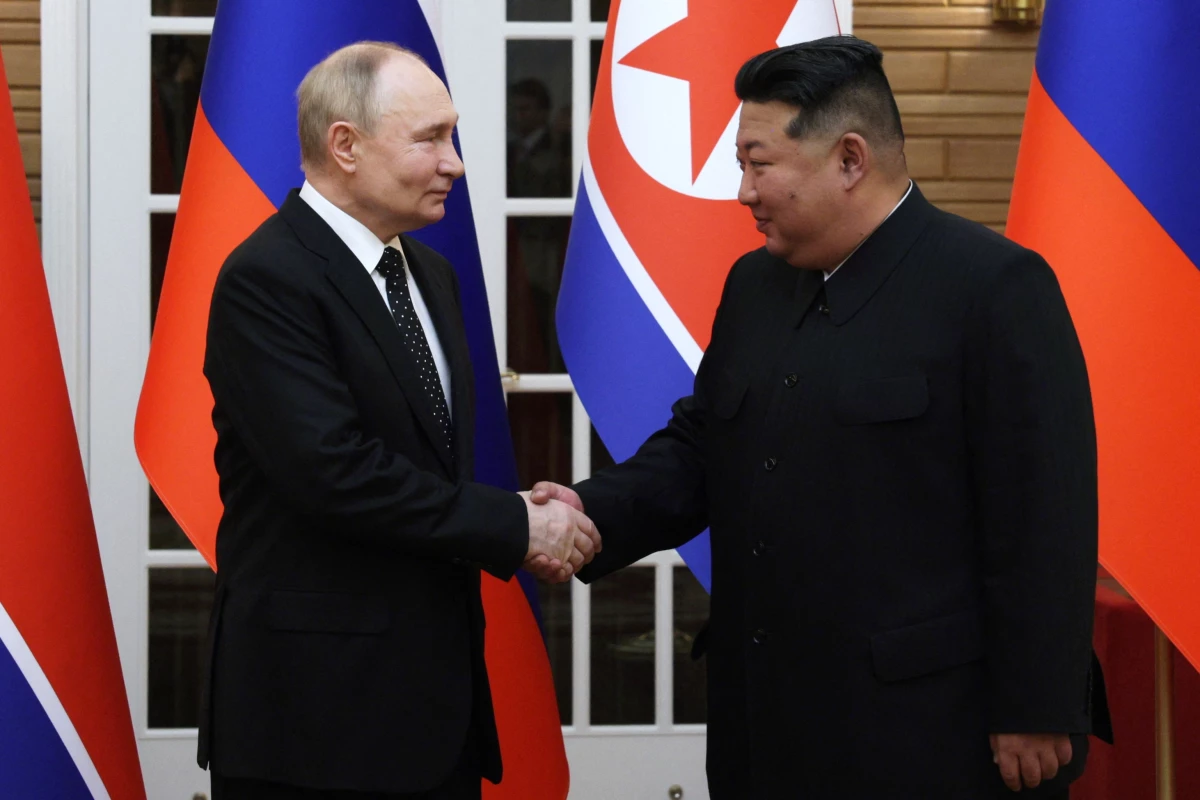
KYIV, Ukraine — The Ukrainian government says its military intelligence has evidence that North Korea isn’t just sending weapons to assist Russia in the war on Ukraine. Pyongyang may also be sending soldiers.
“This is no longer just about transferring weapons,” Ukrainian President Volodymyr Zelenskyy said in a video address over the weekend. “It’s about actually transferring people from North Korea to the occupying military forces.”
Andriy Kovalenko, who leads the center for countering disinformation on Ukraine’s Defense and Security Council, told NPR that he was briefed on the issue and said Russia is training North Korean military personnel on Russian territory.
“The enemy’s plans are to use [the North Korean presence] to reinforce conscripts and border guards in the border regions of Russia,” he said. “But it’s too early to say whether they will be deployed directly on the territory of Ukraine.”
White House National Security Council spokesperson Sean Savett said in a statement that the Biden administration is concerned about reports of North Korean soldiers fighting for Russia. If true, he said, it “would mark a significant increase” in the two countries’ defense relationship and would “indicate a new level of desperation for Russia as it continues to suffer significant casualties on the battlefield in its brutal war against Ukraine.”
The South Korean Defense Ministry says it’s closely monitoring for signs of these troop deployments.
Kremlin spokesman Dmitry Peskov, meanwhile, calls the Ukrainian claim an “information hoax.”
North Korea and Russia have signed a strategic agreement that serves as a military alliance. South Korean Defense Minister Shin Wonsik told Bloomberg this summer that Pyongyang has been sending Russia millions of artillery shells.
There’s also evidence that North Korea is making missiles to order for Russia and that those missiles are being used to attack Ukraine.
Investigators from Conflict Armament Research, a U.K.-based investigative organization tracking the supply of weapons and ammunition in armed conflicts, discovered the remnants of four North Korean-manufactured Hwasong-11 ballistic missiles in Ukraine.
“This illustrates two things,” says Damien Spleeters, who leads CAR’s investigations in Ukraine. “The first thing is that there wasn’t just a one-off transfer of missiles in late 2023. We see that there’s at least been another transfer in 2024. So it’s an ongoing type of relationship. The second thing is that there’s a very tight window between production, transfer and use.”
He said the missile component found was made around March of this year and used a few months later, in August.
Ukraine says North Korean military engineers have been sent to Russia or even occupied territories to check how well these missiles are launching. Spleeters doesn’t rule that out.
“It would make sense for people involved in the production of those missiles to be close to where they are being used and assess how effective they are, in order to make improvements to those missiles,” he said.
Meanwhile, Kovalenko of Ukraine’s Defense and Security Council said the presence of North Korean troops in Russia “is already a complete change of balance” in a war where NATO says it has not put boots on the ground in Ukraine.
“Also,” he added, “autocrats make weapons cheaper and faster.”
Zelenskyy told Ukraine’s Parliament on Wednesday that North Korea is also sending factory workers to Russia to replace those conscripted to fight in Ukraine.
Speaking to lawmakers about his plan to end the war on Ukraine’s terms, the president said he hopes Ukraine’s allies will change their strategy to help the country prevail. One of the conditions in his plan is that Ukraine be invited to join NATO before the war ends, something many Western allies, including the United States, are reluctant to do in order to avoid angering Russia.
NPR producer Polina Lytvynova contributed to this report from Kyiv
Transcript:
LEILA FADEL, HOST:
Ukraine says its military intelligence has evidence that North Korea isn’t just sending weapons to Russia to assist in the war on Ukraine.
A MARTÍNEZ, HOST:
Yeah, that’s right. North Korea may also be sending soldiers. Now, the Kremlin is denying the claim, even as Russia receives large shipments of ammunition from North Korea, some of which has been produced just this year.
FADEL: With me now is NPR’s Joanna Kakissis in Kyiv. Thanks for being here.
JOANNA KAKISSIS, BYLINE: Thanks for having me.
FADEL: So let’s start with Ukraine’s claim that North Korea is sending soldiers to Russia. How credible is this claim?
KAKISSIS: Well, the Ukrainians say it’s credible. Ukraine’s president, Volodymyr Zelenskyy, told Ukrainians all about it in a video address earlier this week. And we spoke to Andriy Kovalenko from Ukraine’s National Security and Defense Council. He was briefed about the developments by military intelligence. He told us Russia, whom he calls the enemy, is training North Korean military personnel on Russian territory but are keeping them inside Russia for now.
ANDRIY KOVALENKO: (Through interpreter) As of now, the enemy’s plans are to reinforce conscripts and border guards in the border regions of Russia. But it’s too early to say whether they will be deployed directly on the territory of Ukraine.
KAKISSIS: Now, the Kremlin denies this is all happening and calls it, quote, “an information hoax.”
FADEL: OK, so Russia saying this isn’t true. But Russia and North Korea do have a military alliance, basically, right? So what does that involve?
KAKISSIS: So Leila, that means that the two countries can coordinate to, quote, “eliminate an immediate threat of armed aggression.” South Korea says North Korea has been sending thousands of shipments of munitions to Russia in violation of sanctions. There’s also evidence that North Korea is making missiles to order for Russia, and those missiles are being used to attack Ukraine.
We spoke about this with Damien Spleeters of Conflict Armament Research, which is a U.K.-based organization that tracks the supply of weapons and ammunition in armed conflicts. And Spleeters says his group discovered the remnants of four North Korean-manufactured ballistic missiles known as the Hwasong-11 in Ukraine. First of all, he says this seems to confirm an ongoing weapons transfer.
DAMIEN SPLEETERS: The second thing that this finding illustrates is that there’s a very tight window between production, transfer and use.
KAKISSIS: He says the missile component found was likely made around March of this year and that the Russians used the missile in August.
FADEL: OK, so what’s the connection between these missiles and the North Korean military personnel that Ukraine says are in Russia?
KAKISSIS: So Kovalenko from Ukraine’s National Defense and Security Council says North Korea is likely sending military engineers to monitor these missiles. There’s evidence that some of these engineers may have been killed in a Ukrainian strike in occupied eastern Ukraine. Spleeters says these engineers could be assessing how these missiles are launching.
SPLEETERS: It would make sense for people involved in the production of those missiles to be close to where they are being used and assess how effective they are in order to make improvements to those missiles.
KAKISSIS: Now, Ukrainian officials fear that troops could follow these military engineers, who are likely officers. And if that happens, they say it could lead to a Russian breakthrough on the front line.
FADEL: So does this change anything for the West’s calculation? Does it now force the West to get more involved in defending Ukraine?
KAKISSIS: Well, Zelenskyy sure hopes so, and so do many Ukrainians who question the West’s commitment to Ukraine as Russia continues its war machine, despite sanctions. President Zelenskyy keeps telling the West, we will lose this war unless there’s a change in strategy. And he, as well as several military analysts, say Western partners give Ukraine just enough support to survive but not to win. And because this is a war of attrition, Russia has the advantage. It has a bigger military arsenal, and it has, like, four times the population of Ukraine. It also has North Korean weapons and maybe even North Korean soldiers at its disposal in the future.
FADEL: NPR’s Joanna Kakissis. Thank you, Joanna.
KAKISSIS: You’re welcome.
