


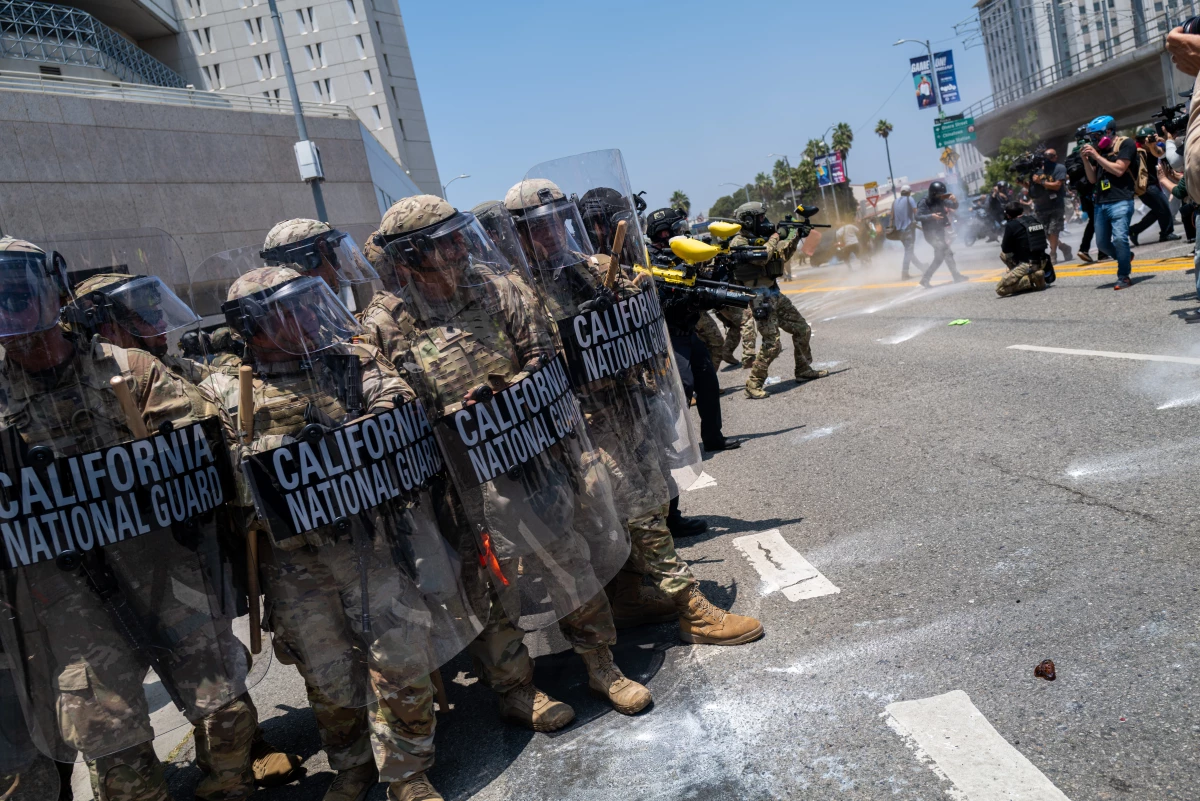
President Trump’s deployment of the National Guard to break up immigration protests in Los Angeles is a dangerous abuse of power that puts Americans in danger, Hina Shamsi, the ACLU’s National Security Project director, told NPR.
“It’s really recklessly undermining our foundational democratic principle that the military should not be policing civilians,” Shamsi said in an interview with Morning Edition after a weekend of clashes between protestors, LA police, federal agents and troops.
Immigration and Customs Enforcement announced on social media Saturday it had arrested 118 immigrants during operations in Los Angeles last week. Demonstrators protested the raids and clashed with police in the city and surrounding areas, including Paramount and neighboring Compton, through the weekend.
In response to the protests, Trump signed a memorandum deploying 2,000 National Guardsmen into the city on Saturday to address the protests without California Gov. Gavin Newsom’s consent. About 300 were deployed by Sunday morning. The administration argues that the deployment was to ensure the safety of ICE and other federal immigration agents, who have been under attack by “violent mobs” since the protests broke out.
Newsom said the president’s action was unnecessary and that it would only inflame tensions.
“Federal troops themselves – this is not what they’re trained for,” Shamsi said. “And the concern is that this escalatory response creates not just legal and ethical jeopardy for troops, but exacerbates and creates real likelihood that harm and risk to civilians will occur.”
In response to NPR’s request for comment about Shamsi’s analysis, White House spokeswoman Abigail Jackson issued the following statement: “Violent rioters in Los Angeles, enabled by Democrat Governor Gavin Newsom, have attacked American law enforcement, set cars on fire, and fueled lawless chaos. President Trump rightfully stepped in to protect federal law enforcement officers. It’s a shame the AMERICAN Civil Liberties Union is more concerned with defending violent riots in defense of illegal immigration than they are about defending American citizens.”
Shamsi spoke to NPR’s Leila Fadel about why she says Trump is abusing his presidential power by deploying the military onto demonstrators in LA.
The following interview has been lightly edited for length and clarity.
Interview highlights
Leila Fadel: So what gives the president the authority to go against the governor’s wishes and deploy the National Guard?
Hina Shamsi: Well, that’s just the problem. The president may have rare and extraordinary authority [to] domestically deploy the military, but that’s reserved for genuine emergencies like an extreme situation of an actual war or an armed rebellion, or to enforce federal laws if civil agencies and courts aren’t functioning. But that’s not what we have here in this situation. What President Trump did in invoking statute in a very novel way without geographic limitations is a dangerous abuse of power. It’s putting Americans in danger. It’s creating legal and ethical jeopardy for troops. And very importantly, also, it’s really recklessly undermining our foundational democratic principle that the military should not be policing civilians.
Fadel: You said without geographical locations. Do you expect this to happen in other parts of the country or worry about that?
Shamsi: It is a real concern, because I’m worried that this isn’t just about the protests in Los Angeles. The terms of the presidential memo issued on Saturday night don’t place a geographic limit and the time limit of deployment up to the discretion of the Secretary of Defense. So, the concern is that the president is attempting to write himself a blank check to use the military not only in Los Angeles, but in other places where people are exercising their constitutionally protected rights to speak out against dangerous ICE raids that are snatching their neighbors from their communities.
Fadel: What changes having the National Guard on the ground when it comes to the rights of protesters?
Shamsi: Nothing. And I really want to emphasize that. It doesn’t matter what uniform they wear. The Constitution, and in particular the First Amendment, applies and troops conduct is governed by strict constitutional limits. But here’s the problem: federalized troops, federal troops themselves – this is not what they’re trained for. And the concern is that this escalatory response creates not just legal and ethical jeopardy for troops, like I said, but exacerbates and creates real likelihood that harm and risk to civilians will occur. Military personnel are not generally trained police civilians. So, it escalates the foreseeable risks to protesters’ constitutional rights. And we’re really worried it could have deadly consequences.
Fadel: Gov. Newsom plans to sue the Trump administration. You mention that this is a very rarely used authority, but it sounds like it is legal, even if it’s rare. So does he have any grounds to sue?
Shamsi: Well, I think the legality is almost certain to be tested in the courts. And on its face, the statute that the president invoked does not give him the authority that he is claiming in his Saturday night memorandum. It is unsurprising that the state would sue because the Constitution preserves, to the states, the ability to address unrest through the exercise of their police powers. And it generally prohibits the federal government from unilaterally deploying military personnel when no federal interest is genuinely threatened. And certainly President Trump would claim federal interest to justify it. But I think there’s a really strong argument that the president’s claims are pretextual or false and not consistent with what the Constitution and laws permit.
Fadel: The defense secretary, Pete Hegseth, has said he’s ready to mobilize the Marines if needed. Has that ever happened before? Are there situations where that would be legal, Marines on U.S. streets as enforcement against Americans?
Shamsi: I think that threat should send a chill down our spines. There is absolutely no need for federal Marines who are not trained to police civilians. And what this does is really fray our democratic principles.
Destinee Adams produced this piece for web, and Obed Manuel edited it.
Transcript:
LEILA FADEL, HOST:
California congresswoman Maxine Waters, a Democrat, told NPR she worries President Trump’s deployment of National Guard troops was aimed at scaring people, not quelling unrest.
MAXINE WATERS: I don’t see any reason for it other than Donald Trump trying to intimidate and frighten and live up to his promise to MAGA people that he was going to deport millions of immigrants. We know that he doesn’t like Los Angeles. We know that because it’s a sanctuary city, that he’s going to continue to try to target us.
FADEL: So what does the Constitution have to say about all this? Hina Shamsi directs the ACLU’s National Security Project and is on the line now to give us her perspective. Good morning, and thank you for being on the program.
HINA SHAMSI: Good morning, good to be with you.
FADEL: So what gives the president the authority to go against the governor’s wishes and deploy the National Guard?
SHAMSI: Well, that’s just the problem. The president may have rare and extraordinary authority to domestically deploy the military, but that’s reserved for genuine emergencies like an extreme situation of an actual war or an armed rebellion or to enforce federal laws of civil agencies and courts aren’t functioning. But that’s not what we have here in this situation. What President Trump did in invoking a statute in a very novel way, without geographic limitations, is a dangerous abuse of power. It’s putting Americans in danger. It’s creating legal and ethical jeopardy for troops. And very importantly, also, it’s really recklessly undermining our foundational democratic principle that the military should not be policing civilians.
FADEL: You said without geographical locations, do you expect this to happen in other parts of the country or worry about that?
SHAMSI: Well, it is a real concern because – and we’re worried that this isn’t just about the protests in Los Angeles. The terms of the presidential memo issued on Saturday night, don’t place a geographic limit and leave the time limit of deployment up to the discretion of the Secretary of Defense. So the concern is that the president is attempting to write himself a blank check to use the military not only in Los Angeles but in other places where people are exercising their constitutionally-protected rights to speak out against dangerous ICE raids that are snatching their neighbors from their communities.
FADEL: Now, the administration is saying they’re just implementing their immigration policy. Now, this hasn’t happened since the 1960s, and at that time, President Johnson federalized the Guard in Alabama to protect civil rights demonstrators. Is this moment in Los Angeles comparable at all?
SHAMSI: Absolutely not. So in the modern era, we leave sort of law enforcement and constitutional approaches to protest for state and local law enforcement. Now, when we’re talking about the Civil Rights era – well, let me give you one clear example, for example from say, 1958. There, President Eisenhower invoked the Insurrection Act, which hasn’t happened yet in this circumstance. But anyway, the president invoked the Insurrection Act and deployed federal troops in Arkansas to enforce the Supreme Court’s Brown v. Board decision and guard the Little Rock Nine against a racist and violent mob. And there, the president acted after the governor had himself deployed the National Guard to support segregationists in defiance of the Supreme Court’s decision.
Here it’s very different. Here, officials at all levels of California – all California officials have said that they were capably handling the protests. The LAPD even reported the protests had remained peaceful and commended those who were exercising their First Amendment rights responsibly, and the president deployed the National Guard over the objection of the governor without clear congressional authority – and that is a very dangerous move.
FADEL: Now, what changes having the National Guard on the ground when it comes to the rights of protesters?
SHAMSI: Nothing. And I really want to emphasize that. It doesn’t matter what uniform they wear. The Constitution and in particular, the First Amendment applies, and troops conduct is governed by strict constitutional limits. But here’s the problem. Federalized troops, federal troops themselves, this is not what they’re trained for, and the concern is that this escalatory response creates not just legal and ethical jeopardy for troops, like I said, but exacerbates and creates real likelihood that harm and risk to civilians will occur. Military personnel are not trained – generally trained to police civilians. So just – it escalates the foreseeable risks to protesters’ constitutional rights, and they’re really worried it could have deadly consequences.
FADEL: We heard our correspondent say the governor plans to sue. You mentioned that this is a very rarely used authority, but it sounds like it is legal, even if it’s rare. So does he have any grounds to sue?
SHAMSI: Well, I think the legality is almost certain to be tested in the courts and on its face, the statute that the president invoked does not give him the authority that he is claiming in his Saturday night memorandum. It is unsurprising that the state would sue because the Constitution preserves to the state the state’s ability to address unrest through the exercise of their police powers, and it generally prohibits the federal government from unilaterally deploying military personnel where no federal interest is genuinely threatened. And, you know, certainly, President Trump would claim federal interest to justify it. But I think there’s a really strong argument that the president’s claims are pretextual or false and not consistent with what the Constitution and laws permit.
FADEL: And really quickly, the Defense Secretary Pete Hegseth has said he’s ready to mobilize the Marines, if needed. Has that ever happened before? Are there situations where that would be legal – Marines on U.S. streets as enforcement against Americans? We only have a few seconds.
SHAMSI: I think that threat should send a chill down our spines. There is absolutely no need for federal Marines who are not trained to police civilians. And what this does is really fray our democratic principles. Again, the military should not be playing this role.
FADEL: Hina Shamsi is the Director of the ACLU’s National Security Project. Thank you.
