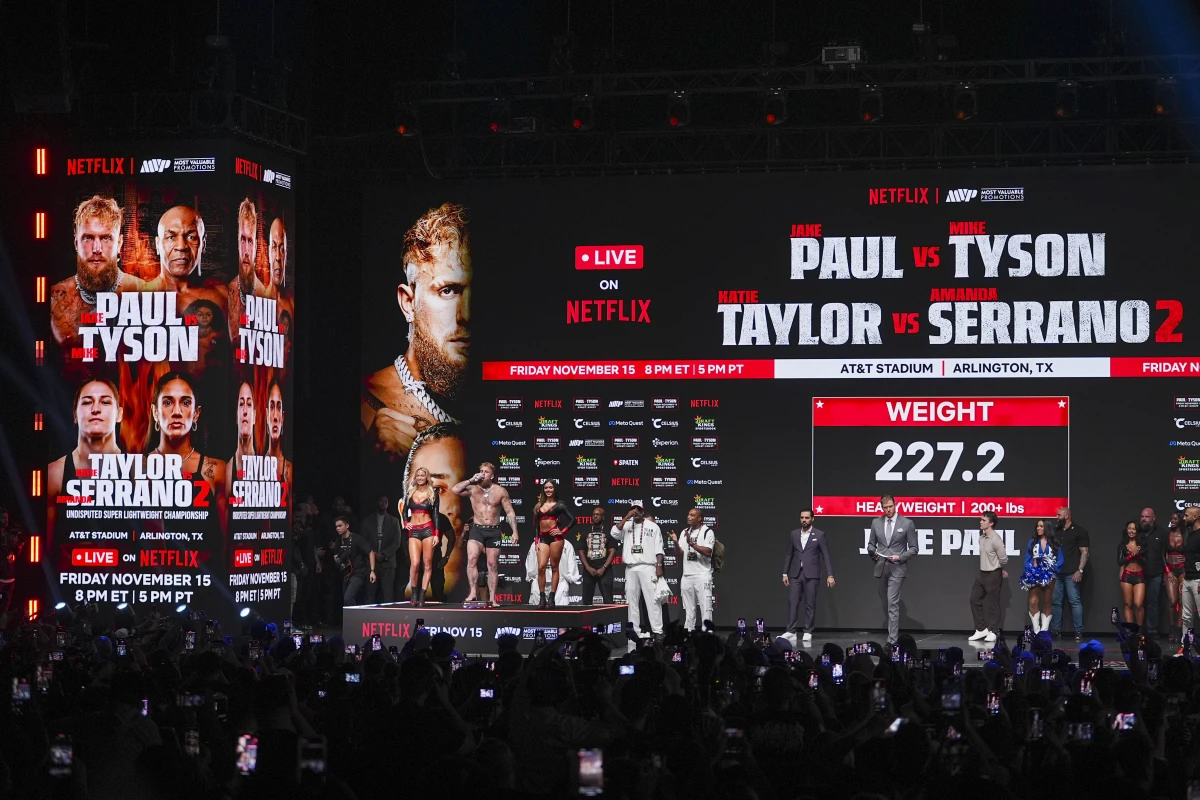
More than 100 million people tuned in last week to watch internet celebrity-turned-boxer Jake Paul take on boxing legend Mike Tyson.
The bout generated major buzz and had some hoping for a nostalgic dose of a Tyson knockout.
But when it came time to actually watch the ultimately underwhelming fight, many fans were booted from the stream or experienced long buffering times. The disappointment over the tech issues was evident from screenshots shared on social media. One Florida man has even gone as far as filing a class action lawsuit against the streaming service.
With Netflix scheduled to stream two live Christmas Day NFL games and more and more live events headed to other streaming services, it raised a question: Is the internet ready to handle them?
Morning Edition‘s A Martínez spoke to Michael Smith, a professor of information technology and policy at Carnegie Mellon University, who believes we should be optimistic about streaming’s long-term foray into live events.
Why is it difficult to stream events like the Tyson-Paul fight to hundreds of millions of people?
Smith said the internet was designed for point-to-point communication, while broadcast channels were designed for multipoint communication.
TV broadcasters, for example, transmit one signal via one shared channel to all TVs in their coverage area. Streaming services, in contrast, require a dedicated channel every time someone connects online to play an episode of a show, movie or live sports event.
“So we’re trying to get the internet to do something it wasn’t really designed to do,” Smith said.
On the night of the fight, some 85,000 viewers reported on the website Down Detector that they were having Netflix streaming problems, the Associated Press reports. Down Detector tracks website outages and user issues. When NPR reached out to Netflix for comment, the company emailed a response saying its team worked to stabilize streaming issues for most customers and that it supported 65 million concurrent streams at peak viewing.
“This unprecedented scale created many technical challenges, which the launch team tackled brilliantly by prioritizing stability of the stream for the majority of viewers,” Netflix’s Chief Technology Officer Elizabeth Stone said in a message to employees reported by Bloomberg. “We don’t want to dismiss the poor experience of some members, and know we have room for improvement, but still consider this event a huge success.”
Would it be possible to stream the Super Bowl online for everyone instead of on cable or satellite?
Probably not today, Smith says, but technology is progressing.
He pointed to issues HBO faced in 2014, when Game of Thrones was nearing peak popularity. Fans trying to stream the season four premiere on HBO Go overwhelmed the app, causing it to crash.
He’s not concerned, though, that streams will crash for Thursday’s Pittsburgh Steelers-Cleveland Browns NFL game, which is set to stream on Amazon Prime. That’s because streaming technology overall has simply gotten better in the past decade.
“So we’ve moved from 10 million being the problem to 100 million being the problem in 10 years,” Smith said. “I think we’re going to get even better over the next 10 years.”
What can a service like Netflix do to improve streaming for future live events that might get hundreds of millions of views?
NPR also asked Netflix how it was preparing for the two upcoming NFL Christmas Day games. A spokesperson said via email that the company feels it has the infrastructure it needs to prepare for the two games and that it is working to optimize its systems and add more capacity to make improvements using what it learned from the Tyson-Paul fight issues.
The company said it is also working with internet service provider partners to grow its interconnection capabilities.
“Netflix right now has got to be working on their server capacity and their intermediate buffering nodes to make them ready for these two NFL games,” Smith said. “I think it’s going to turn out just fine.”
Suzanne Nuyen edited.
The radio version of this story was scripted by Adam Bearne and produced by Nia Dumas.
Transcript:
A MARTÍNEZ, HOST:
More than a hundred million people around the world streamed last Friday’s boxing match between Mike Tyson and Jake Paul.
(SOUNDBITE OF TV SHOW, “PAUL VS. TYSON”)
UNIDENTIFIED ANNOUNCER: Declaring your winner by unanimous decision, Jake El Gallo Paul.
MARTÍNEZ: Now, not all of them had a smooth experience, including me. I had a little trouble with the feed. It froze once. I had to exit Netflix and then restart it. And the picture from time to time would pixelate – you know, blur with those little squares. Social media was flooded with complaints about poor picture quality, and some users could not connect at all. So that got us wondering, is the internet ready to stream big live events? I’m going to ask Michael Smith, professor of information technology and policy at Carnegie Mellon University. So professor, what makes it so difficult to stream something live over the internet to millions of people?
MICHAEL SMITH: Well, the internet was designed for point-to-point communication. Broadcast channels were designed for, you know, multi-point communication. That’s why it’s called broadcast. So we’re trying to get the internet to do something it wasn’t really designed to do.
MARTÍNEZ: Now, would it even be possible today to have everyone who wants to watch the Super Bowl, for example, do so online instead of on cable or satellite?
SMITH: Probably not today.
MARTÍNEZ: (Laughter).
SMITH: And here’s the analogy I would think of – right? – in 2014, HBO online would crash every time they launched a new episode of “Game Of Thrones,” right? So 10 million people watching “Game Of Thrones” would crash it. Tonight, we’re going to watch the Browns play the Steelers – go Steelers – on “Thursday Night Football.” Ten million people are going to watch it. It’s going to be just fine. So we’ve moved from 10 million being the problem and – to a hundred million being the problem in 10 years. I think we’re going to get even better over the next 10 years.
MARTÍNEZ: Well, so you mentioned tonight’s game. I know Netflix is just about – what? – a month away from another big day of sports. It’s going to stream two NFL games on Christmas, and one of them is going to have a halftime show by Beyonce. So, I mean, what do companies need to do to make it possible to stream hundreds of millions – or to stream for hundreds of millions of people at the same time?
SMITH: Yeah. So Netflix right now has got to be working on their server capacity and their intermediate buffering nodes to make them ready for these two NFL games. I think it’s going to turn out just fine.
MARTÍNEZ: You know, I used to say when I was a sports radio host a long time ago that eventually, we’re all going to be watching things like the Super Bowl pay-per-view. In some ways, I think we’re getting close to it. I mean, is that what’s going to happen with pretty much every single big sporting event – eventually, one day, we’re going to just stream all of them?
SMITH: I think we’re going to stream all of them. And I think you’re right. We’re getting closer to pay-per-view or pay-per-view in a big bundle like ESPN+ or Amazon Prime.
MARTÍNEZ: Callers used to say I was crazy, Michael…
(LAUGHTER)
MARTÍNEZ: …That it’s never going to happen. No way. You’re nuts, A. But…
SMITH: Feel free to call them back and tell him you were right.
MARTÍNEZ: I guess I’ll have to pull the tapes. So Michael Smith is a professor of IT and policy at Carnegie Mellon University. Professor Smith, thanks.
SMITH: My pleasure.
(SOUNDBITE OF JUICE CUICE’S “DON’T LET GO”)