


Zohran Mamdani picked a decommissioned subway station beneath City Hall as the venue for his private swearing-in ceremony as New York City’s new mayor — a symbolic choice for a candidate who rode to victory on pledges such as free public transit.
The Democratic socialist opted to take the oath of office past midnight on New Year’s Eve in the old City Hall subway station in Lower Manhattan, as an act meant to capture the spirit of the city’s history of serving working people as he signals his incoming administration’s civic priorities.
The subterranean site, which closed 80 years ago, is noted for its architectural grandeur with chandeliers, glass skylights and tiled vaulted tunnels.
Mamdani told Streetsblog NYC, which first reported the news, that when the station first opened in 1904, “it was a physical monument to a city that dared to be both beautiful and build great things that would transform working peoples’ lives.”
“That ambition need not be a memory confined only to our past, nor must it be isolated only to the tunnels beneath City Hall: It will be the purpose of the administration fortunate enough to serve New Yorkers from the building above,” Mamdani said in the statement to Streetsblog.
The small, underground ceremony’s invitees included Mamdani’s family and political ally New York Attorney General Letitia James, tapped to deliver the oath of office. A public inauguration in the afternoon has been planned to take place near City Hall, followed by a block party.
James said on social media that she was honored to swear in Mamdani at the historic subway station: “Our subways connect us all, and they represent exactly what our next mayor is fighting for: a city every New Yorker can thrive in,” she wrote.
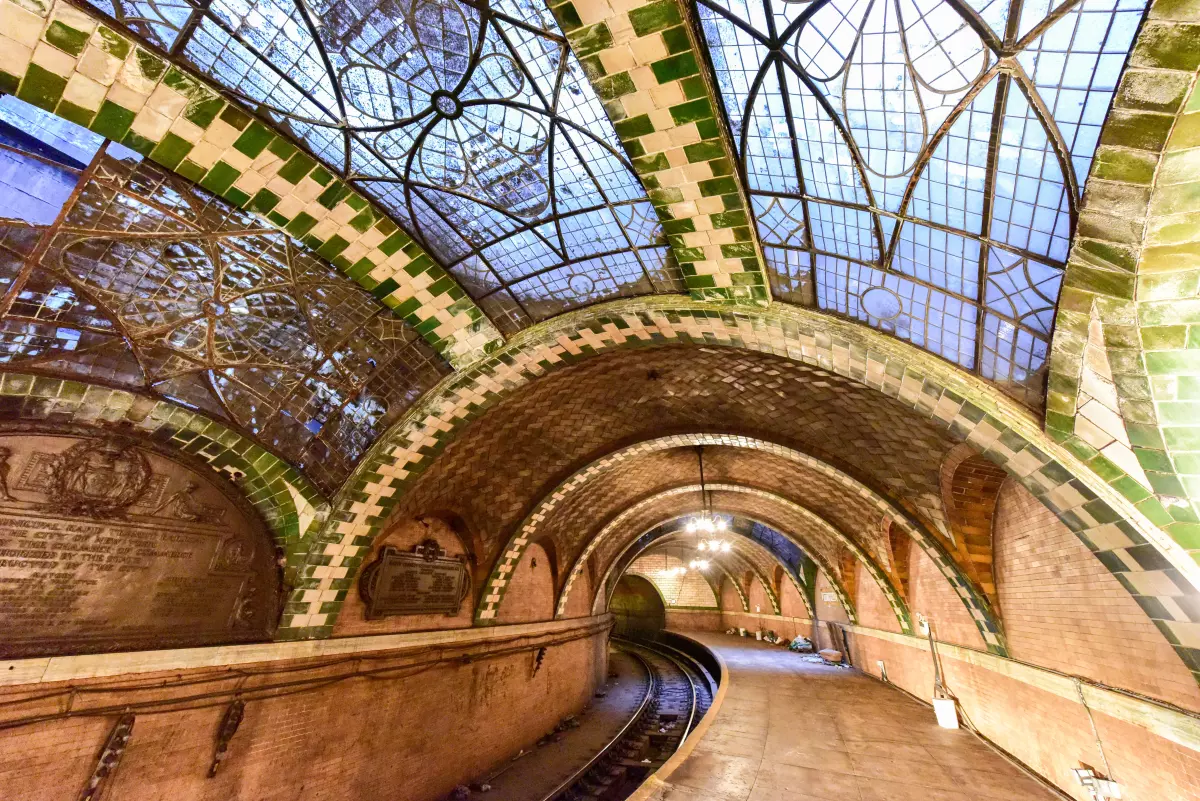
A relic of civic innovation
Trains first departed the City Hall station on Oct. 27, 1904, as the first stop on the city’s first subway line. It took passengers as far as the Bronx, the borough where Mamdani attended high school.
When train cars got longer to make room for the city’s growing ridership, they became incompatible with the platform’s curved design, according to The New York Times. The city shut down the station in 1945 with service stopping for good that New Year’s Eve.
What’s now regarded as a relic of transit innovation was once hailed as “an underground cathedral” and “the Mona Lisa of subway stations.”
The station, designed by George Heins and Christopher LaFarge with Guastavino vaulted ceilings, features large brass light fixtures, glass skylights that look out to the park above, and green- and cream-colored tilework.
The public can still see the historic tunnels from a train car on Manhattan’s 6 line, which has a turnaround point looping through the terminal, or on a guided tour with the New York Transit Museum.
