


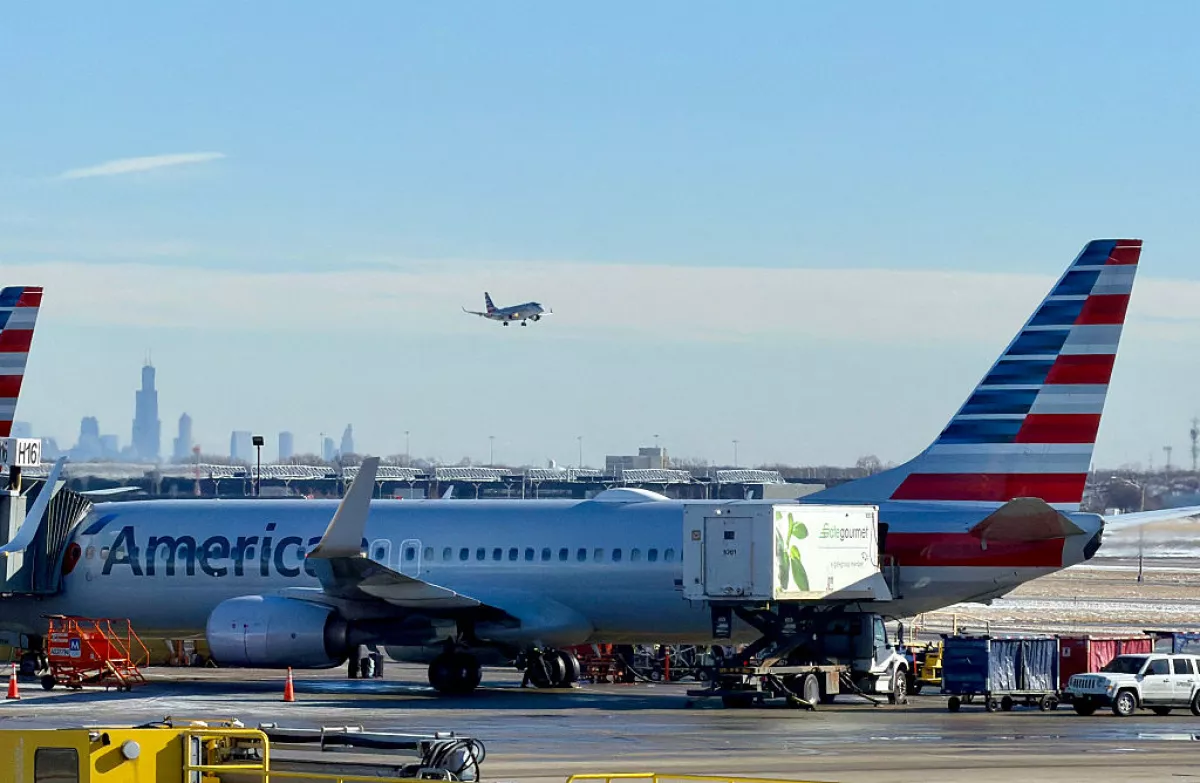
CHICAGO — How the turf war at O’Hare International Airport started is a matter of debate. American Airlines CEO Robert Isom blames his rival, United Airlines.
“Where we were headed in Chicago, due to the reckless scheduling of our competitor, okay, was going to be gridlock,” Isom said at an investors conference in Washington, D.C. last month.
United CEO Scott Kirby laughed off that criticism when he got the same question a few hours later. Kirby pointed the finger at American, where he used to work, and said he’s glad the Department of Transportation is stepping in.
“The DOT is going to come in and play dad and force us to share,” Kirby said. “And it’s going to all be fine.”
Aviation regulators are working to head off a traffic jam this summer at one of the country’s biggest airports. The Federal Aviation Administration wants to cut flights at O’Hare International Airport in Chicago, where United and American have added hundreds of flights in a battle for market share.
This is not business as usual for the airlines, or for federal regulators. In part, that reflects O’Hare’s unusual position in the aviation industry. It’s now the busiest airport in the U.S. in terms of takeoffs and landings, and it’s a critical hub for two major airlines.
“No other airport in the world is like this,” said Joe Schwieterman, a professor of transportation at DePaul University in Chicago. “We’ve got two global hubs side by side at the same airport, you know, within view of each other.”
The city is an important market and hub for both American and United, he said, which is why they’ve been fighting over gates at O’Hare for years. That has led both airlines to add flights at a pace faster than Schwieterman has ever seen, drawing the attention of regulators at the FAA.
“It’s anticipating what could be a long, hot summer if things go as badly as they fear,” Schwieterman said.
Daily takeoffs and landings at O’Hare were set to jump from almost 2,700 last summer to more than 3,000 per day this year. Regulators at the FAA worried that would “stress the runway, terminal, and air traffic control systems at the airport,” they wrote in a public notice in February.
In that filing, the FAA said it wants to cap the number of takeoffs and landings at 2,800 per day in order “to prevent large-scale operational disruption” at O’Hare. In another filing in March, the FAA proposed limiting operations further, to about 2,600 takeoffs and landings and per day.
It’s an unusually aggressive move — one that some aviation industry veterans did not expect.
“I was happily surprised that they’re taking action in advance,” said William McGee, a senior fellow at the American Economic Liberties Project, a left-leaning think tank in Washington, D.C.
The FAA typically waits for delays and cancellations to mount before forcing airlines to cut flights, said McGee, who used to work in airline operations.
The agency sharply limited flights last year at Newark Liberty International Airport in N.J., after a combination of air traffic control problems and runway construction led to chaos.
“Their modus operandi has been to just let these things play out until they become a mess. And they’re being a little proactive here,” McGee said. “It’s like, here’s the pill. Now swallow it.”
The FAA convened a series of meetings last month to talk about the planned cuts with the airlines and the Chicago Department of Aviation, which operates O’Hare. Regulators have not yet released their final plan.
So far, American and United both sound supportive of the flight reductions at O’Hare, at least in public. The airlines may be open to cutting some of their less popular routes this summer because of rising fuel costs, Schwieterman says, and they might welcome a chance to do it in a way that doesn’t advantage their competitor.
“They’re kind of frozen into their plans unless they both do something in unison,” Schwieterman said. “That’s where the FAA can come along and maybe bring some, you might say, rationality to this.”
But the Chicago Department of Aviation, which operates O’Hare, is trying to fight the proposed cuts, which it calls “unwarranted” and “regressive” in public comments filed last month.
The CDA says O’Hare’s expansion in recent years has reduced delays and increased its operating capacity, arguing that the airport can accommodate 2,800 takeoffs and landings per day.
The CDA contends that the FAA is pushing to cut even more flights at O’Hare than it has said publicly. FAA officials floated caps as low as 2,400 takeoffs and landings per day in meetings last month, according to the CDA’s filing.
Passengers at O’Hare have their own concerns about the proposed cuts.
“That would be really unfortunate because this is my favorite airport,” said Ferrari Benton of Chicago. Benton, who describes herself as a loyal United customer, does not want to see the airline cut nonstop flights at O’Hare.
“This is our biggest airport and it’s really busy. So I feel like they probably should not limit. If anything, I feel like they should probably add more staff and more flights,” she said.
But other passengers see some possible benefits. Gary Smith of Naperville, Ill., was in the American Airlines terminal at O’Hare.
“As somebody who’s lived here my entire life, I guess it’s a two-edged sword,” Smith said. “It would be nice because maybe it would reduce some of the congestion here. But at the same time, it is going to impact people. And it’s going to cause inconvenience to people.”
NPR’s Joel Rose reported from Washington, D.C., and Jessica Pupovac contributed from Chicago.
