


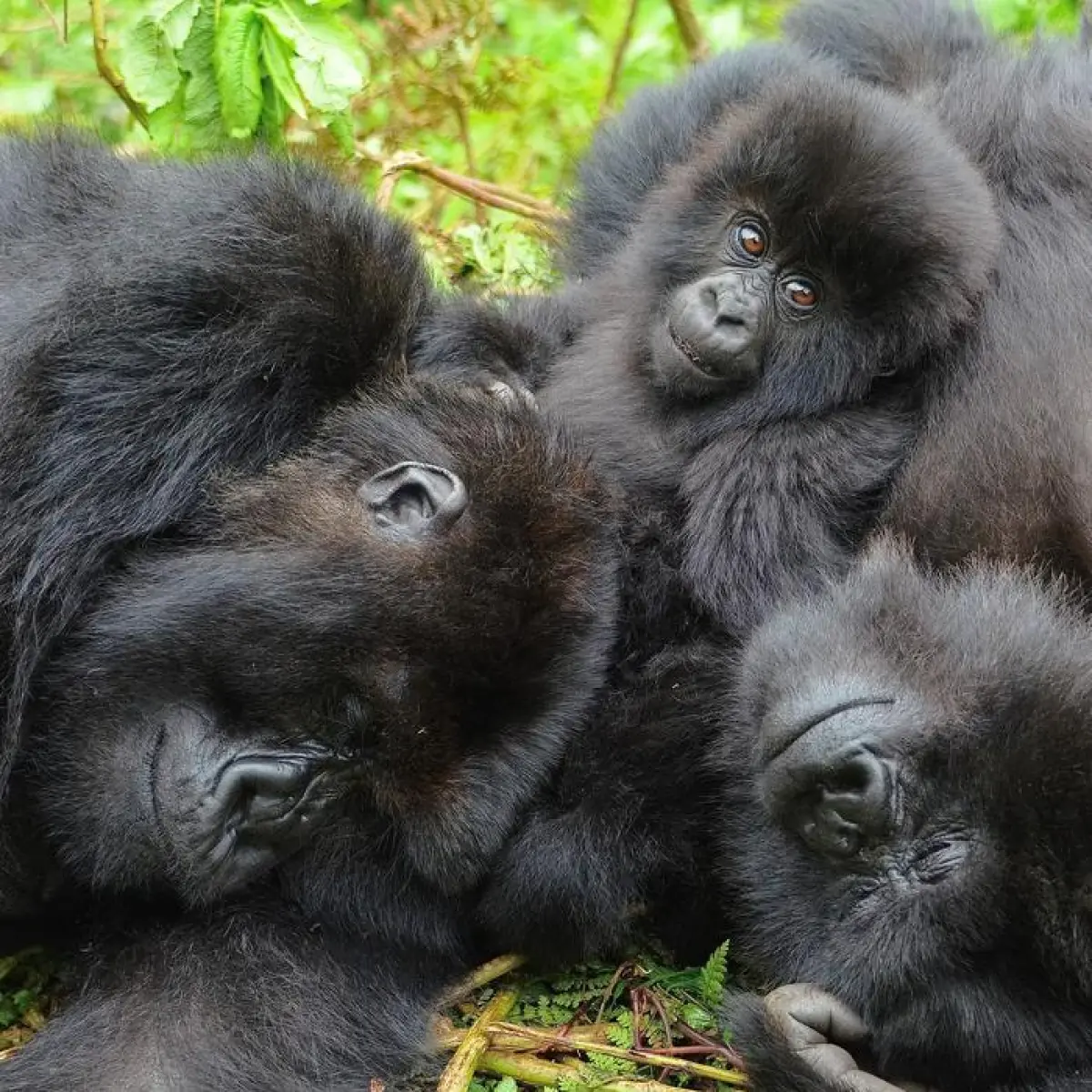
If you’re taking a new job, or moving to a new town, it can often help if you have at least one friend who’s already there — someone to introduce you around and show you the ropes. This is true for people, and it also seems to be true for female mountain gorillas.
That’s because female gorillas seek out familiar female faces when they’re deciding whether to move from one social group to another, according to a new study published in the Proceedings of the Royal Society B.
Both male and female gorillas are known to disperse from the group that they originally grew up in, and females can change groups multiple times throughout their lives.
When making that kind of move, female gorillas strongly prefer to join a group that had females they’d lived with at some point in the past for at least 5 years, or had seen in the last two years, the study shows.
That’s surprising, because previously some scientists thought that all this moving around would mean that female gorillas wouldn’t form close bonds, says Victoire Martignac, a Ph.D. student from the University of Zurich.
“It’s often assumed that they will not invest so much time and energy in those social relationships, because why invest in a relationship if you know that you or the other individual might disperse at any time?” she says. “And yet we are seeing that those relationships can matter even after years apart.”
Seeking out old friends
This new study was only possible because of the decades of close observations made by trackers affiliated with an organization called the Dian Fossey Gorilla Fund.
Thanks to those observations, researchers know which gorillas belong to each social group, and where they go when they leave that group.
“Males, when they disperse, they usually become solitary and will try to attract females and try to establish their own group,” explains Martignac.
Females, in contrast, use a different approach. They wait until their group encounters another group in the forest. This lets them watch the interactions and check out who’s in that other group, before deciding whether or not to join it.
“What we found is that females will consistently avoid groups that contain males that they grew up with,” she says.
This makes sense, because a male that they grew up with might share the same father, so avoiding those males helps avoid inbreeding. Females didn’t seem so concerned about males that were known to them but hadn’t been part of their original group when they were young.
It turned out, though, that female gorillas did really care if a group had female gorillas that they recognized from the past, either because they’d grown up together or had lived together at some point.
“They were really attracted to groups that contained females that they knew,” says Martignac.
Basically, female gorillas seem to be seeking out their friends when deciding whether or not to make a change, says Robert Seyfarth, an emeritus professor of psychology at the University of Pennsylvania who has studied relationships in animals but wasn’t part of this research team.
“They’re making, as it were, decisions about where to disperse,” he says, and those decisions seem to be based on relationships that they’ve had before. “While that seems obvious in humans, we really haven’t been able to document it in non-human primates up until now.”
He says the big question is whether female gorillas derive some benefit from sticking with their buddies: “Does this preference make a difference in terms of survival and reproduction?”
Dispersal and humans
One of the goals of this particular study was to better understand the evolutionary roots of movement and dispersal in humans, says Martignac. Gorillas are similar to humans in that both males and females move around and are flexible in how often they move.
Humans are constantly moving across cities, countries, and social groups. “We are also creating new relationships while maintaining old relationships,” she says. “The fact that we can also see this in gorillas is very interesting. This ability goes far back into the evolutionary past.”
“I think it really shows that dispersal does not result in the loss of relationships, but can actually enable individuals to maintain old relationships,” she says, “and actually those old relationships can help them to navigate through this complex social network.”
What’s more, it means that all of these gorilla groups are not independent, but part of a larger social world that may reflect how human society began to develop way back when.
Human social organization is characterized by groups that have linkages between them that form larger communities, notes Seyfarth.
The fact that female gorillas pay attention to the composition of groups and prefer to join groups that have former female associates, he says, “raises the possibility that groups have relations with each other that are interesting. Some groups are sort of more closely bonded than others, and it makes a kind of community.”
Transcript:
STEVE INSKEEP, HOST:
If you’re taking a new job, moving to a new town, it often helps if you have a friend – somebody who’s already there, somebody to introduce you to other people and show you the ropes. This is true for humans, and it also seems to be true for female mountain gorillas. Goodness, this network covers everything. NPR’s Nell Greenfieldboyce reports that the gorillas can form social bonds with other females that influence their choices when making a move.
NELL GREENFIELDBOYCE, BYLINE: In Rwanda, an organization called the Dian Fossey Gorilla Fund has spent decades using teams of trackers to closely watch groups of mountain gorillas. Researchers know which gorillas belong to each social group and where they go when they leave that group – because gorillas do tend to leave.
Victoire Martignac is with the University of Zurich. She says male gorillas will strike out alone.
VICTOIRE MARTIGNAC: Males – when they disperse, they usually become solitary. And then they will try to attract females in order to establish their own group.
GREENFIELDBOYCE: Females, in contrast, use a different approach. They wait until their group encounters another group in the forest. Then they seem to check out who’s in that other group before deciding whether or not to join it.
MARTIGNAC: What we found is that female consistently will avoid groups that contain males that they grew up with.
GREENFIELDBOYCE: This makes sense. A male that they grew up with might be related to them, so avoiding those males helps to avoid inbreeding. But it turns out that female gorillas also really care about the female members of a group. They seem drawn to familiar faces.
MARTIGNAC: They were really attracted to groups that contained females that they knew.
GREENFIELDBOYCE: They knew them because they grew up together or they’d lived together previously, because female gorillas can actually change groups multiple times over the course of their lives. Martignac says that scientists used to think all of this moving around would lead to weak bonds between females.
MARTIGNAC: It’s often assumed that they will not invest so much time and energy in the social relationship.
GREENFIELDBOYCE: Since one or the other female might just move away.
MARTIGNAC: And yet we are seeing that those relationships – they can matter even after years apart.
GREENFIELDBOYCE: She and her colleagues found that when deciding when to join a social group, female gorillas strongly prefer to join females they’d seen in the last two years or that they’d lived with for at least five years at some point in the past. A report on the findings is published in the science journal called the Proceedings of the Royal Society B.
Robert Seyfarth is an emeritus professor of psychology at the University of Pennsylvania. He’s studied social relationships and animals but wasn’t part of this research team. He says this is a novel finding – that female gorillas will essentially seek out their friends when deciding where to go.
ROBERT SEYFARTH: You know, while that seems obvious in humans, we really haven’t been able to document it in nonhuman primates up until now.
GREENFIELDBOYCE: He says this kind of long-term study of multiple groups is really unusual, and what he wonders now is whether female gorillas get any benefit from sticking with their old pals.
SEYFARTH: Does this preference make a difference in terms of survival and reproduction?
GREENFIELDBOYCE: He also wonders if these relationships eventually lead to groups forming close ties with each other, much like small groups of people can come together to form a larger community.
Nell Greenfieldboyce, NPR News.
(SOUNDBITE OF VAIKO EPLIK’S “INDI IME”)
