


Daily electrical stimulation of certain nerves in the spinal cord appeared to help three people with spinal muscular atrophy (SMA), an inherited disorder that causes muscles to waste away.
The treatment increased leg muscle strength in all three participants and allowed them to walk farther, researchers report in the journal Nature Medicine.
“After some days, my legs just felt supercharged,” says Doug McCullough, 57, one of the participants in the month-long study at the University of Pittsburgh School of Medicine.
If the benefits of spinal stimulation are confirmed in larger trials, the approach could augment the latest drug treatments for SMA. The drugs can slow or stop the disease, but don’t actually reverse its disabling symptoms.
Spinal stimulation also appears to help people with muscle weakness from a stroke. And it might eventually improve the lives of people with ALS (amyotrophic lateral sclerosis) and Parkinson’s disease, researchers say.
Low expectation, surprising result
McCullough was 11 when he was diagnosed with a form of SMA that progresses very slowly.
SMA weakens muscles by killing off motor neurons in the spine. The first motor neurons to go are typically those controlling muscles in the shoulders, back, hips and thighs.
The most severe form of SMA causes severe symptoms in newborns. Until the first drug for SMA arrived in 2016, children typically died before age 2.
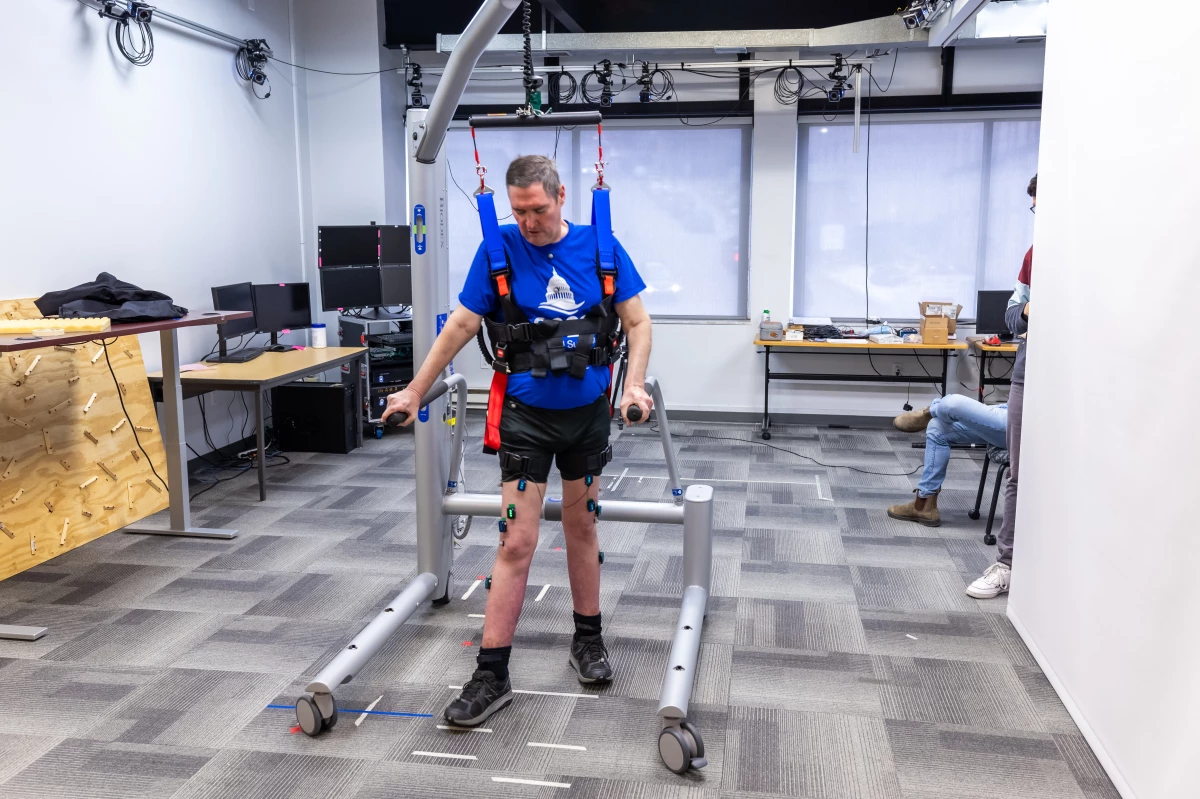
By the time McCullough entered the Pittsburgh study, he was relying on two canes to walk, and had begun using a motorized wheelchair.
“As a person with a progressive disease, you never get any better,” McCullough explains. “You’re either maintaining, or you’re getting worse.”
So McCullough had low expectations when he arrived in Pittsburgh to have wires temporarily implanted in the part of his spine that controls leg muscles that are critical for walking.
After recovering from surgery, he went to the lab, where scientists began delivering pulses of electricity to certain nerves in his spinal cord.
At first, he felt nothing. Then “they’d start turning it up a little bit and you would feel this faint pulse inside your body,” he says.
Specifically, in his legs.
And over the course of the experiment, McCullough’s legs regained some function. He could walk a few steps farther. His gait was a bit better. His legs felt stronger — even when the spinal stimulator wasn’t connected.
“I was like, ‘Whoa, this is surreal!’ ” McCullough says. “This was really the first time that I had seen an improvement.”
A much more dramatic change occurred in another participant, who was 20 and less disabled when he entered the study, says Marco Capogrosso, an assistant professor at the University of Pittsburgh and one of the study’s authors.
“He improved so much that he could walk from the family housing where they were staying for the trial, to our lab,” Capogrosso says. “He couldn’t do that before.”
Stimulation that lasts
Before the SMA study, researchers at the University of Pittsburgh had been using spinal stimulation to boost arm strength in people who’d had a stroke.
The treatment appeared to work by strengthening the connections among the nerve cells involved in controlling and monitoring specific arm muscles. Capogrosso and his team thought a similar approach might work on the leg muscles in people with SMA.
In both cases, the idea was to get more out of the relatively small number of nerve cells that remained intact.
But the results with SMA patients proved far greater than the researchers had anticipated, Capogrosso says.
“Friday they would come in the lab, do their tests, and then they would go home,” he says. “Then on Monday they would come back and suddenly they are 20% [stronger.]”
Much of the improvement was maintained even when the stimulator wasn’t turned on. Capogrosso thinks that’s because stimulation had helped re-establish communication between the remaining motor neurons and other neurons involved in the circuit that allows walking.
“They had much less motor neurons left because some of those died,” he says. “But their cells were better at controlling their muscles.”
The result supports an idea proposed in 2011 by George Mentis, a professor at Columbia University whose research focuses on spinal motor neurons.
“What people thought until that time is that if you fix the motor neurons, you will be fixing the disease,” he says.
But Mentis showed that in mice with SMA, muscle weakness appeared before motor neurons started dying.
The reason, he argued, was that SMA was also disrupting critical connections between motor neurons, which tell a muscle when to contract, and sensory neurons, which monitor what that muscle is doing.
The results in Pittsburgh suggest that spinal stimulation can restore these connections, even when the number of motor neurons has been greatly reduced, Mentis says.
If that’s true, Mentis says, spinal stimulation could greatly improve the lives of people with SMA.
“During that month of electrical stimulation, we never reached a plateau,” he says. “They were still improving.”
So permanent spinal implants might work even better.
Spinal stimulation also might help people with other diseases that affect movement, including ALS and Parkinson’s, Mentis says.
Transcript:
JUANA SUMMERS, HOST:
An experimental treatment that stimulates the spinal cord may help people with a paralyzing genetic disorder. NPR’s Jon Hamilton reports on a study of three people with a rare inherited condition that causes muscles to waste away.
JON HAMILTON, BYLINE: Doug McCullough was 11 when he was diagnosed with spinal muscular atrophy, or SMA, a disorder that kills off motor neurons in the spinal cord. McCullough is in his 50s now and relies on two canes or a wheelchair to get around.
DOUG MCCULLOUGH: As a person with a progressive disease, you never get any better. You’re either maintaining or you’re getting worse.
HAMILTON: So McCullough had low expectations when he signed up for a four-week experiment at the University of Pittsburgh School of Medicine. Scientists there temporarily implanted wires in his spine. Then in the lab, they began delivering pulses of electricity to certain nerves.
MCCULLOUGH: That first afternoon, they were like, do you feel anything? You’re like, no. And then they’d start turning it up a little bit, and then you’d start feeling this faint pulse inside your body.
HAMILTON: Specifically in his legs. And over the course of the experiment, McCullough’s legs regained some function. He could walk farther. His gait was better. His legs felt stronger, even when the spinal stimulator wasn’t connected.
MCCULLOUGH: And after some days, my legs just felt supercharged. It’s like, man, I feel like I can walk a mile.
HAMILTON: Two other volunteers with SMA also improved. The youngest was 20, says Marco Capogrosso, one of the scientists in charge of the experiment.
MARCO CAPOGROSSO: He improved so much that he could walk from the family house in where they were staying for the trial to our lab, and he couldn’t do that before.
HAMILTON: There are now drugs that can slow or stop the loss of motor neurons in people with SMA. But the treatment doesn’t restore the muscle function they’ve lost. Capogrosso’s team had been using spinal stimulation to boost arm strength in stroke patients and thought the approach might work on the leg muscles in people with SMA. In both cases, the idea was to get more out of the relatively small number of nerve cells that remain intact. Capogrosso says the results with SMA patients were remarkable.
CAPOGROSSO: Friday, they would come to the lab, do their tests, and then they would go home. Then on Monday, they would be back. We would reassess their strength ’cause they were doing it on a daily basis. And suddenly, they had 20% more strength for the knee extension.
HAMILTON: Much of the improvement was maintained even when the stimulator wasn’t turned on. Capogrosso thinks that’s because stimulation had helped reestablish communication between the remaining motor neurons and other neurons involved in the circuit that allows walking.
CAPOGROSSO: They had much less motor neurons left because some of those died. But now they were starting working as normal motor neurons. So this increasing strength that we observed was because their cells were better able at controlling their muscle.
HAMILTON: The result, which appears in the journal Nature Medicine, supports an idea proposed in 2011 by George Mentis at Columbia University.
GEORGE MENTIS: What people thought until that time is that this is really a motor neuron disease, and if you fix the motor neurons, you will be fixing the disease.
HAMILTON: But Mentis showed that in mice with SMA, the disease also disrupts connections between motor neurons, which tell a muscle when to contract, and sensory neurons, which monitor what that muscle is doing. Mentis says the results in Pittsburgh suggest that spinal stimulation improves these connections and could make a big difference to people with SMA.
MENTIS: During that month of electrical stimulation, we never reached a plateau. They were still improving. So obviously, you will say to me, oh, my God, can they improve anymore? The preliminary data says yes.
HAMILTON: Mentis says spinal stimulation also might help people with other diseases that affect movement, including ALS and Parkinson’s. Jon Hamilton, NPR News.
(SOUNDBITE OF CHANCE THE RAPPER SONG, “CHILD OF GOD”)
