


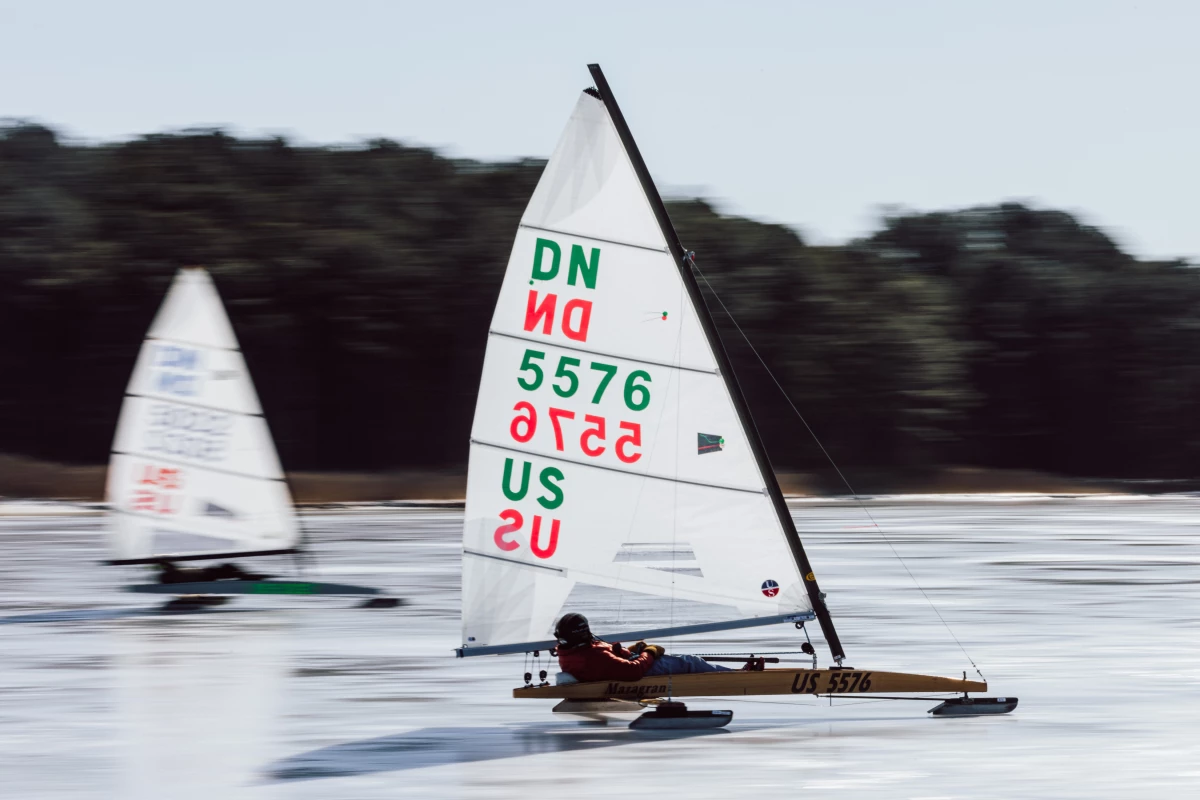
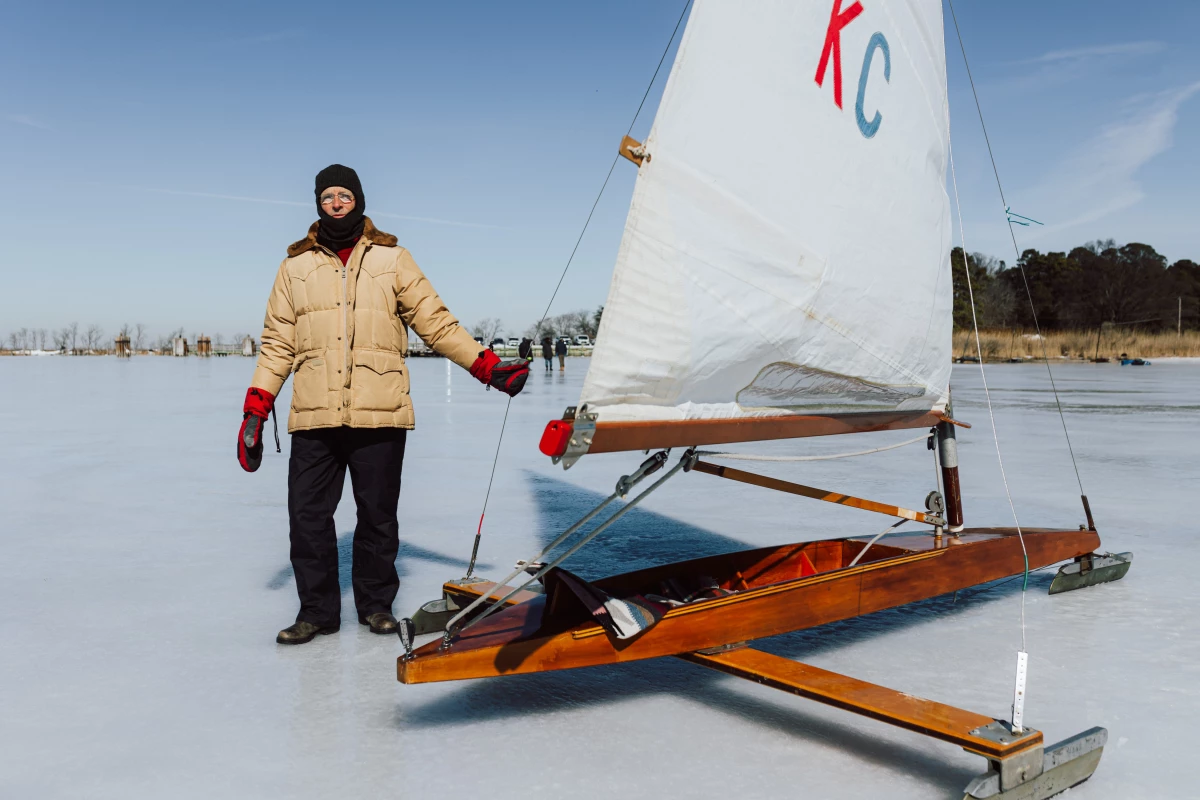
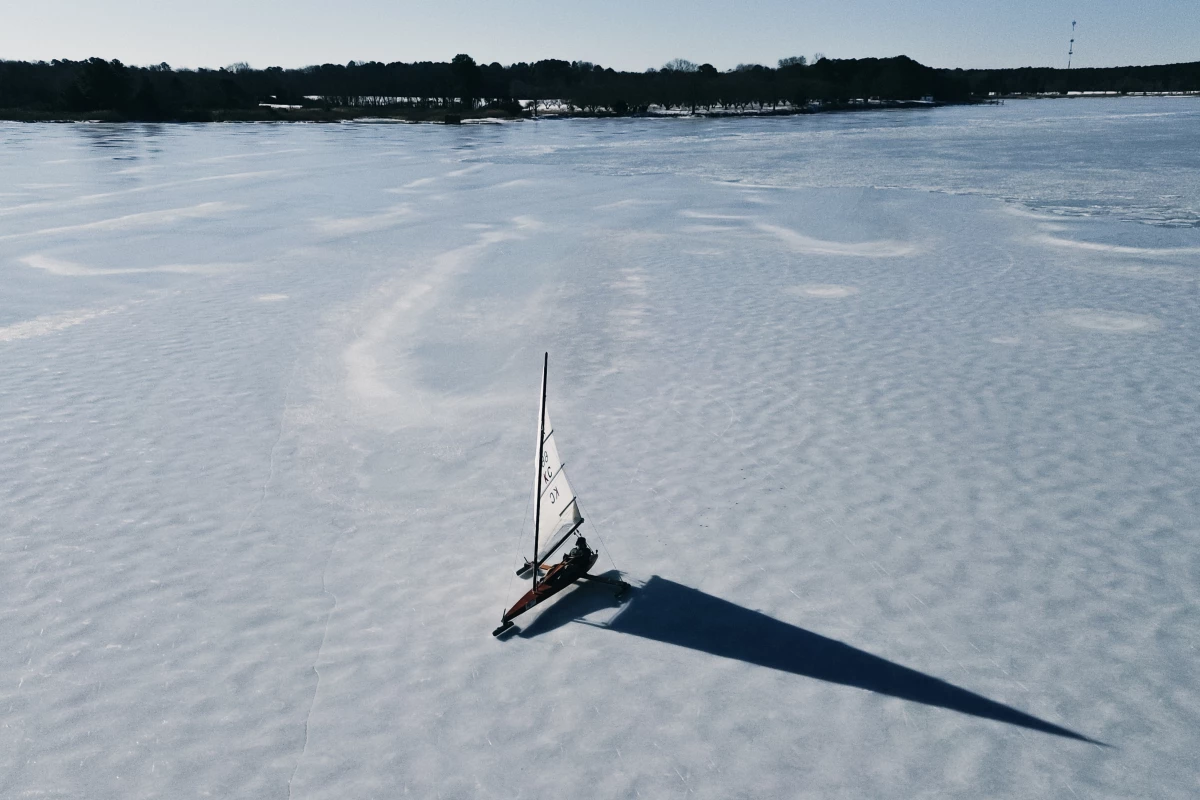
CLAIBORNE COVE, Maryland – Michael Keene grabs the wooden tiller of his ice boat, begins to push it across the ice and then leaps in as if he’s launching a bobsled. Wind fills the white sail and his 12-foot polished wooden vessel accelerates towards the Chesapeake Bay.
The winds are light today, but the ice boat runs on narrow blades creating a near-frictionless ride. Keene, 61, is lying down in the cockpit as if piloting a luge. Soon, the boat is nearing 30 mph – three times the speed of a conventional sailboat on the water under this kind of wind.
“These conditions are really good,” said Keene, referring to the stretch of subfreezing temperatures. “This is our 13th day on the ice, which is fantastic. Usually, we get two or three days and we’re happy.”
(Wesley Lapointe for NPR)
The deep freeze that recently gripped much of the country created some of the best conditions in decades for ice boating, an obscure and often thrilling sport.
This month, the North Shrewsbury Ice Boat & Yacht Club in Red Bank, New Jersey, held a regatta for 30-foot-plus ice yachts for the first time since 2003. Last month, Green Lake in Wisconsin, hosted the North American Championship for popular “DN” ice boats, which came out of a design contest by the Detroit News in the 1930s.
The winner in Wisconsin: an ice boater from Poland.
When the temperatures plunged below freezing last month, sailors here on Maryland’s Eastern Shore literally dusted off their ice boats and pulled them out of sheds and garages. They set up a dozen boats along this cove off the Chesapeake Bay, where the brackish waters don’t often freeze. Some days as many as 100 people came to watch the sleek crafts glide across the mirror-like surface.
“I’ve never seen this in my life,” said Rahul Wankhede, who is in his forties, from central India and now works as a bartender at a hotel south of here. “I FaceTimed my parents and showed them and they were quite amazed.”

Sailors here were out on the ice as often as possible, trading tips and offering rides to anyone interested. Xingqin Feng, who is from southwest China and studying for her CPA test here, jumped at the chance.
The cockpit only seats one, so Feng kicked her feet up on the boat’s fuselage. She sat on a wooden plank and gripped one of the wires that holds up the mast. If she’d let go, Feng would’ve fallen off and gone sliding across the ice.
Before she arrived at the cove, Feng said she was a little scared.
“I thought, ‘What if the ice broke and what if it’s too fast?'” said Feng, 50. Afterwards, she said the ride was fun and exciting.

Ice boaters like Claiborne Cove because the ice is smooth and thick, at least 8 inches, and the water shallow. At low tide, it is just a foot deep.
Ice boating dates to the 1600s or 1700s, depending on the historian. The North Shrewsbury Club says it originated in the Netherlands in the eighteenth century as a form of transporting goods over ice.
People have been sailing iceboats on the Chesapeake Bay for more than a century. A black and white photo at the Chesapeake Bay Maritime Museum in St. Michaels, Maryland, shows men in jackets, ties and wool caps during the 1910s, skating as an iceboat glides past.
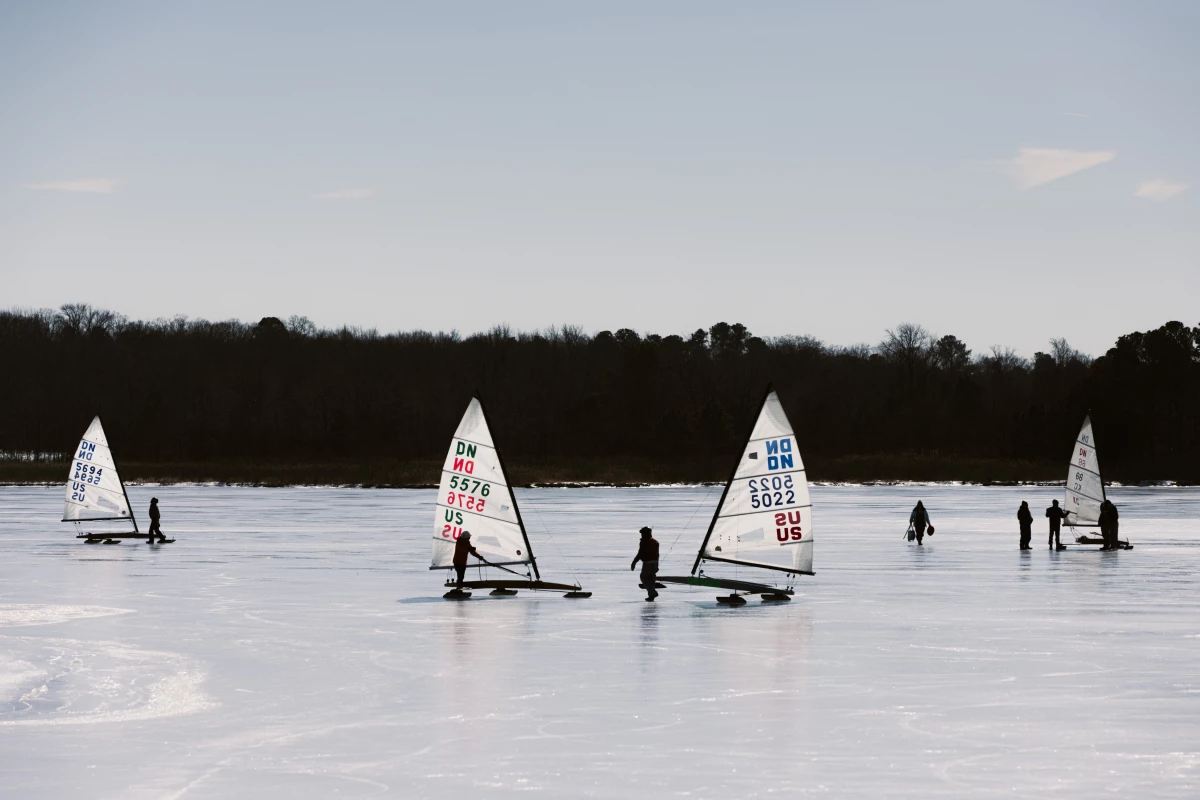
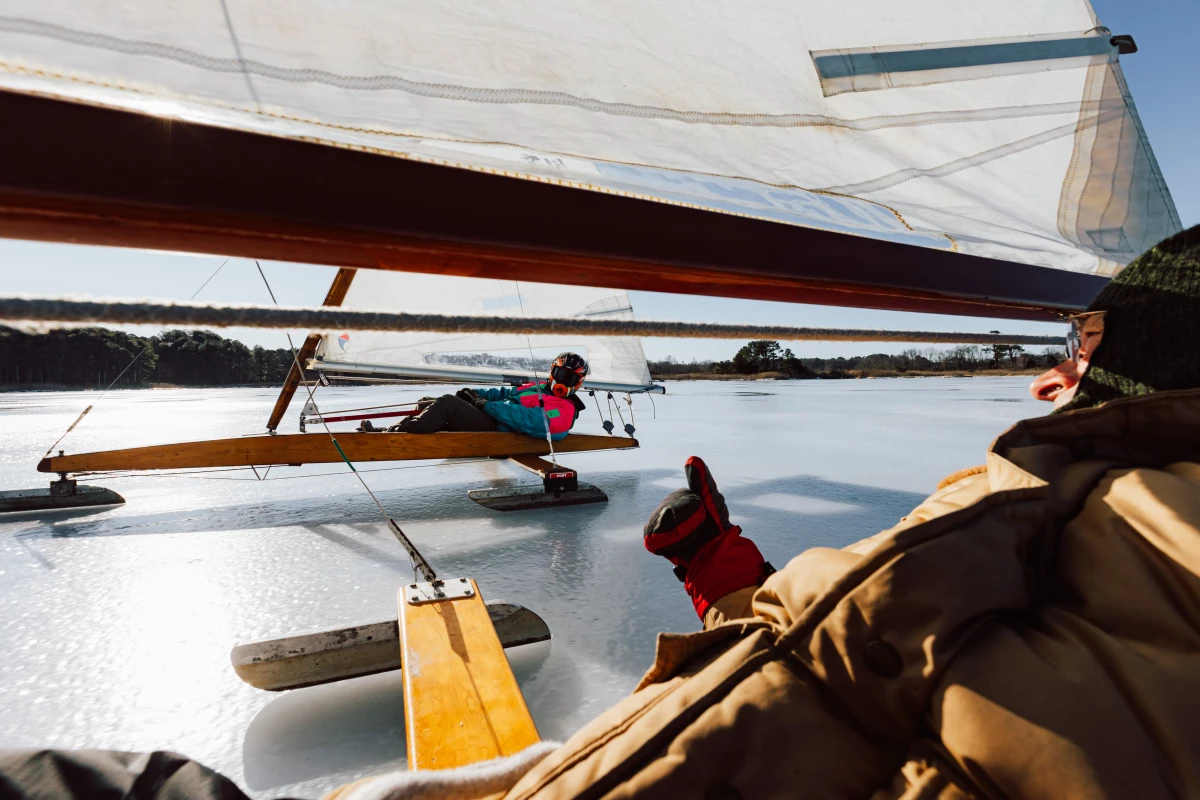
These days ice boaters wear puffy down coats, face coverings for the wind, and sometimes ski helmets for safety. Among the ice boaters on the cove was Dr. David Tuel, 72, a retired orthopedic surgeon from western Maryland.
Last year, Tuel and a friend were sailing on a lake there when they crashed head-on at 40 miles an hour. Tuel says the other boat disintegrated, but neither sailor was injured.
Watching ice boats is entertaining, even when they crash.
“My wife was filming my first crash, she saw me go over, saw me roll out, and I asked her, ‘Why didn’t you come and help me?'” said Tuel. “She says, ‘It was almost too much fun filming you.'”

The last day of this year’s ice boating season on Claiborne Cove was Monday, just before the temperatures were set to rise and turn the smooth surface to slush. Jim Richardson, 78, lives in a house overlooking the cove, but was stuck inside.
Earlier this ice boating season, he was sailing between 35 and 40 miles an hour when he realized he was speeding towards the rocks on shore. Richardson put his foot out to slow down and broke his ankle. He’s now on a walker.
How was the ride going before the crash?
“Absolutely wonderful,” said Richardson, grinning. “That’s why we do this. Once you get your first taste of it, it’s hard to forget.”
NPR National Desk Intern Anusha Mathur contributed to this story.
Transcript:
MARY LOUISE KELLY, HOST:
The deep freeze that recently gripped much of the country created some of the best conditions in decades for a sport you will not see at the Winter Olympics – iceboating. Thanks to the frigid temperatures, a club in Red Bank, New Jersey, was able to hold a regatta for 30-foot-plus ice yachts for the first time since 2003. Well, meanwhile, on Maryland’s eastern shore, iceboaters offered free rides to spectators. NPR’s Frank Langfitt jumped aboard.
(SOUNDBITE OF WIND BLOWING)
FRANK LANGFITT, BYLINE: I’m standing on a cove just off the Chesapeake Bay. It’s about eight inches thick of ice, and there are these boats. They look like little wooden drag racers with sails, and they run on metal blades, and they are just zipping across the ice.
(SOUNDBITE OF BOATS SAILING ON ICE)
MICHAEL KEENE: My name is Michael Keene, and we’re here on what we call Claiborne Cove.
LANGFITT: Keene restores wooden boats. He’s been iceboating for more than two decades. These are the best conditions he’s ever seen.
KEENE: We’ve had a good, large area of smooth ice. The longest stretch of time we’ve had, actually. This is our 13th day on the ice, which is fantastic. Usually, we get two, three days, and we’re happy (laughter).
LANGFITT: Keene invites me for a ride, but the boat’s cockpit – it’s only big enough for one. So I perch outside on a wooden plank that helps support the mast.
KEENE: With your right hand, you’re going to grab hold of the side of the fuselage.
LANGFITT: Mike is now pushing us along almost like a toboggan, bearing down, trying to get the boat going, getting a little bit of speed.
(SOUNDBITE OF BOAT SAILING ON ICE)
LANGFITT: You hear him pulling in the sail.
(SOUNDBITE OF SAIL SQUEAKING)
LANGFITT: Keene jumps on.
KEENE: You’re hearing the blades of the ice boat digging into the ice.
(SOUNDBITE OF BOAT SAILING ON ICE)
LANGFITT: I’m basically hanging out on a piece of wood. If I let go, I would just go sliding across the ice very fast.
(SOUNDBITE OF BOAT SAILING ON ICE)
LANGFITT: The boat’s 12 feet long. Blades are so narrow, the ice so flat, there’s almost no friction. It’s such a smooth ride.
KEENE: It really is.
(SOUNDBITE OF BOAT SAILING ON ICE)
KEENE: Even at 50 miles an hour, which these things can go with just a little bit of wind, they can really get going.
LANGFITT: Today, there’s just a modest breeze. Still, we’re going 25, maybe 30 miles an hour, more than three times faster than a traditional sailboat in these conditions. As we approach the shore, Keene uses a wooden tiller to turn the front blade and whips us through a hairpin turn.
KEENE: …Really fast now. I can really feel the wind against my face.
LANGFITT: Wow.
(SOUNDBITE OF BOAT SAILING ON ICE)
LANGFITT: It’s like an incredible turn.
(SOUNDBITE OF BOAT SAILING ON ICE)
LANGFITT: I’m hanging on for dear life.
KEENE: Frank now is very cold.
LANGFITT: People have iceboated on the bay for more than a century, but the brackish water rarely freezes. So polished wooden vessels with white triangular sails gliding across this glass-like surface are a spectacle. Hundreds have come here to watch over the past two weeks.
RAHUL WANKHEDE: I go by Rahul So Cool.
LANGFITT: Rahul Wankhede is from central India. He works as a bartender at a hotel south of here.
WANKHEDE: I’ve never seen this in my life. So I FaceTime my parents and showed them, and they were, like, quite amazed. And I was telling them, these are the sailboats, and they were on the water without any paddle. And they were astonished.
LANGFITT: Iceboating can be dangerous. Jim Richardson lives in a house overlooking the cove. His final run last week ended badly.
JIM RICHARDSON: I probably was going 35, 40 miles per hour and came around. I had to make a turn. I didn’t have enough ice in front of me. All I could see were the rocks on shore.
LANGFITT: He put his foot out to slow down. Richardson is now on a walker with a broken ankle. He says he still has some teenager in him. Richardson is 78. I asked how his last run was going before the crash.
RICHARDSON: It was absolutely wonderful. I mean, that’s why we do this. Once you get your first taste of it, it’s hard to forget.
LANGFITT: Richardson’s right. I’ve sailed on water since I was a kid, but iceboating was a thrilling new way to ride the wind.
Frank Langfitt, NPR News, Claiborne Cove, Maryland.
(SOUNDBITE OF LUPE FIASCO SONG, “I’M BEAMIN”)
