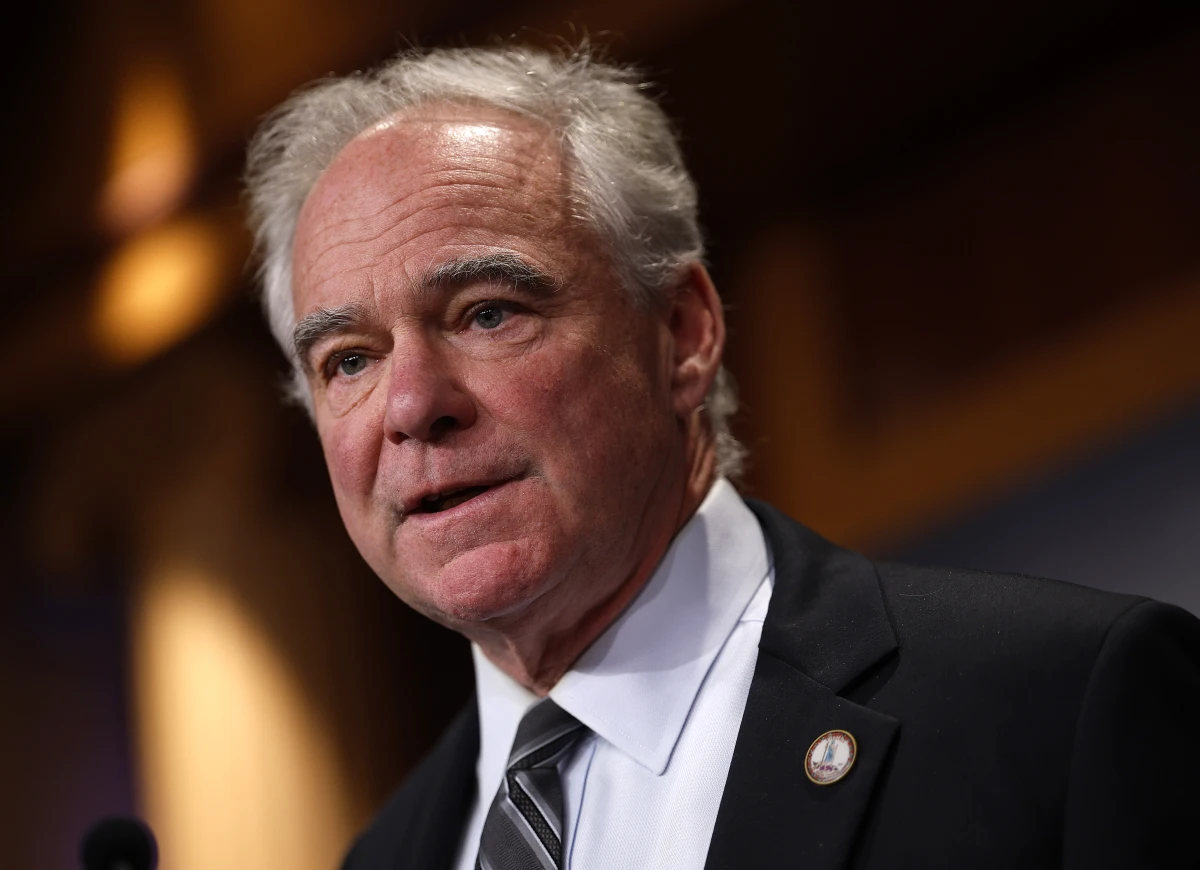
Democratic Senator Tim Kaine of Virginia said President Trump had “in all likelihood” exaggerated the impact that U.S. strikes had on Iran’s nuclear program.
“If the president on Saturday night had said, ‘We have taken this action and we’ve caused severe and significant damage to the Iranian nuclear program,’ you wouldn’t have seen all this damage control,” Kaine told Morning Edition. “The president overstated it, in all likelihood.”
“They’re scrambling because the president has kind of dislocated his own shoulder by patting himself on the back in some ways that are unrealistic,” he continued.
Defense Secretary Pete Hegseth, CIA Director John Ratcliffe and Secretary of State Marco Rubio on Thursday briefed senators on Capitol Hill. Afterward, several senators emerged and said it was too early to tell the full extent of the damage U.S. bombs had on Iran’s nuclear enrichment program.
U.S. airstrikes hit three separate nuclear sites south of Iran’s capital, Tehran on June 21.
A leaked preliminary report from the Defense Intelligence Agency issued not long after the strikes described the damage as “limited” and said the strikes may have only set back Iran’s nuclear program by a matter of months. Trump has responded to media stories citing that report, claiming that Iran’s nuclear program was “totally obliterated” by the U.S. Despite a lack of evidence, Hegseth and other top administration officials have stepped in to back the president.
“President Trump directed the most complex and secretive military operation in history,” Hegseth declared at a Pentagon news conference. “It was a resounding success resulting in a ceasefire agreement.”
Iran’s foreign minister, Abbas Araghchi, has said Iran’s nuclear facilities suffered serious damage, but he didn’t provide details. And Rafael Grossi, head of the International Atomic Energy Agency, the UN’s nuclear watchdog agency, also said there was significant damage, but he doesn’t believe the entire nuclear program was destroyed.
NPR’s Steve Inskeep spoke with Kaine further about the Thursday night briefing on Capitol Hill and what Trump could have done, in his opinion, to better and more accurately inform the public about the U.S. attack on Iran.
The following excerpt has been edited for length and clarity.
Interview highlights
Steve Inskeep: There is a Defense Intelligence Agency report that said, with low confidence, as they put it, that the military hit Fordo, that they did some damage, but that the Iranians might have moved uranium elsewhere just in time. Is that report that the White House has criticized, in fact, a decent bottom line for what the government knows at this point?
Sen. Tim Kaine: That report is classified. I read it in a classified setting, and I don’t really want to talk about it. But let me just put it in this kind of a context: If the president on Saturday night had said, ‘We have taken this action and we’ve caused severe and significant damage to the Iranian nuclear program,’ you wouldn’t have seen all this damage control for the last few days.
The president overstated it, in all likelihood. He compared it to Hiroshima and Nagasaki. He put up an insulting and juvenile musical video on his Truth Social account with a ‘bomb, bomb, bomb, bomb, bomb, Iran’ song. And now you’ve had the Pentagon try to scramble to assuage his ego — yelling at reporters. They had to postpone the briefing that they gave the senators from Tuesday to Thursday. They had to disinvite Tulsi Gabbard from coming because apparently they didn’t like what she might have said. They’re scrambling because the president has kind of dislocated his own shoulder by patting himself on the back in some ways that are unrealistic.
Inskeep: You’re criticizing the way the president committed this act of war, but it is a situation where Iran had a nuclear program. It was of grave concern to multiple U.S. administrations and both political parties. And then this situation comes up where Israel had started a war. What would you have done differently if you were the president? Iran does have this nuclear program, and the U.S. did have the available bomb for Fordo, which seems to have been developed just for that purpose.
Kaine: There’s two things I would have done differently. First, this war really is sort of on Trump’s shoulders because he tore up a nuclear deal that was working, that was limiting Iran’s nuclear program even more than these bombs have limited it. This was a program that was working not only in the eyes of our allies and the [International Atomic Energy Agency] but also working in the eyes of Trump’s Term One Cabinet — national security team — that said, ‘Don’t tear up this deal.’ It’s limiting Iranian centrifuges, limiting enrichment and limiting nuclear research. We had deep inspections into what Iran was doing. But when President Trump tore that up, Iran raced forward. So number one, prefer diplomacy over bombs. And number two, if Israel wants to start a war with Iran, we will help defend Israel. But we didn’t need to join this war.
Inskeep: The White House claims it’s going to limit classified information given to Congress from now on because somebody disclosed CIA findings, Defense Intelligence Agency findings, that the president didn’t like. Did this subject come up in your meeting?
Kaine: A member of the Senate asked, ‘Are you going to curtail information to us?’ And the administration briefers said, ‘No, we are not.’ But we’re still worried about it because the president chose to notify Republican leaders of the strike, but not Democratic leaders. And that is something that no president has done during the time that I’ve been here.
Transcript:
STEVE INSKEEP, HOST:
OK. Greg mentioned a briefing for senators. Democratic Senator Tim Kaine of Virginia was in it. He is on the Senate committees that oversee the military and foreign relations, and he’s with us once again. Senator, good morning.
TIM KAINE: Good morning, Steve.
INSKEEP: What impression did you come away with about the level of damage to Iran’s nuclear program?
KAINE: Steve, it was entirely a classified hearing. And so, obviously, I’m not going to talk about classified information, but I think if you look at the combined public statements that these officials have made, that the Iranian foreign minister has made, that the IAEA has made and that Israel has made, the bottom-line conclusion is severe and significant damage to Iranians’ nuclear program, with details still coming out. But severe and significant damage would be the fair way to characterize this.
INSKEEP: I appreciate that, and that doesn’t seem inconsistent with the Defense Intelligence Agency report – that NPR has reported on and others have reported on – that said with low confidence, as they put it, that the military hit Fordo, that they did some damage, but that the Iranians might have moved uranium elsewhere just in time. Is that report that the White House has criticized, in fact, a decent bottom line for what the government knows at this point?
KAINE: Steve, again, that report is classified. I read it in a classified setting, and I don’t really want to talk about it.
INSKEEP: Got it.
KAINE: But let me just put it in this kind of a context. If the president, on Saturday night, had said we have taken this action and we’ve caused severe and significant damage to the Iranian nuclear program, you wouldn’t have seen all this damage control over the damage for the last few days. The president overstated it, in all likelihood. He compared it to Hiroshima and Nagasaki. He put up an insulting and juvenile musical video on his Truth Social account with a “Bomb, Bomb, Bomb, Bomb, Bomb Iran” song. And now you’ve had the Pentagon try to scramble to – you know, to assuage his ego, yelling at reporters. They had to postpone the briefing that they gave the senators from Tuesday to Thursday. They had to disinvite Tulsi Gabbard from coming because, apparently, they didn’t like what she might have said. They’re scrambling because the president has kind of dislocated his own shoulder by patting himself on the back in some ways that are unrealistic.
And that segues into the concern that I have. We shouldn’t be going to war on the say-so of one person. That’s not how the nation goes to war. General Caine talks about we will do this at the time and place of the nation’s choosing. The nation didn’t choose that. President Trump made a unilateral decision without notifying, consulting or getting approval from Congress. In my view, that is just flat wrong, and that’s why I filed a War Powers Resolution to get senators to weigh in on the question of should the nation be at war with Iran without a vote of Congress? I don’t think we should. Some might think we should. We will have that vote later today.
INSKEEP: Is the point moot because the president says the operation’s over anyway?
KAINE: Well, if you completely believe that when he says that, there is no chance of any more military action against Iran, then yes. But I don’t think anybody believes that. The president used military action to strike Iran in his first term. He’s just expended tremendous, you know, U.S. assets. These Massive Ordnance Penetrators and the Tomahawk missiles are expensive. They take a long time to reconstitute. I don’t think anyone should have confidence that the president will not use military action in the future.
INSKEEP: You’re raising an important point here, senator, about who in our republic gets to decide if we go to war, commit an act of war. There’s a lot we could discuss about that. I want to ask first, though, about the substance. You’re criticizing the way the president committed this act of war.
KAINE: Yep.
INSKEEP: But it is a situation where Iran had a nuclear program. It was of grave concern to multiple U.S. administrations and both political parties, and then this situation comes up where Israel had started a war. What would you have done differently – if you were the president, what would you have done differently, given that Israel had started the war against Iran? Iran does have this nuclear program, and the U.S. did have the available bomb for Fordo, which seems to have been developed just for that purpose.
KAINE: Steve, there’s two things I would’ve done differently. First, this war really is sort of on Trump’s shoulders because he tore up a nuclear deal that was working, that was limiting Iran’s nuclear program even more than these bombs have limited it. This was a program that was working not only in the eyes of our allies and the IAEA, but also working in the eyes of Trump’s Term 1 Cabinet, national security team, that said don’t tear up this deal. It’s limiting Iranian centrifuges, limiting enrichment, limiting nuclear research. We had deep inspections into what Iran was doing. But when President Trump tore that up, Iran raced forward. So No. 1 – preferred diplomacy over bombs.
And No. 2, if Israel wants to start a war with Iran, we will help defend Israel, but we didn’t need to join this war. And the Israelis had achieved significant goals against the nuclear program. In fact, the day before President Trump launched these missiles and these bombs, Israel said it had already set the Iranian program back two or three years. There was no urgency to this. There was nothing that meant the president needed to act without consulting Congress. So I think we shouldn’t be at war without Congress, but I also know deeply, Virginians, my troops – I’m on the Armed Services Committee – they think being involved in a third war in the Middle East since 2001 is absolutely ridiculous and would suggest that the U.S. hadn’t learned the lessons of the past 20 years.
INSKEEP: Another quick question about the president and Congress. The White House claims it’s going to limit classified information given to Congress from now on because somebody disclosed DIA findings – Defense Intelligence Agency findings that we mentioned earlier – that the president didn’t like. Did this subject come up in your meeting?
KAINE: The subject came up only in this way. A member of the Senate asked, are you going to, you know, curtail information to us? And the administration briefer said, no, we are not. But we’re still worried about it because the president chose to notify Republican leaders of the strike, but not Democratic leaders. And that is something that no president has done during the time that I’ve been here. I’ve been with Democratic and Republican presidents. There’s a protocol…
INSKEEP: Yeah.
KAINE: …About who gets noticed. And it’s both the Democratic and Republican leaders of the key committees – armed services, foreign relations, intelligence, appropriations.
INSKEEP: Are your Republican colleagues sticking up for you and saying national security needs to be bipartisan; it really matters?
KAINE: I’ve not heard them. I hope they will. And I think they believe that it should, but I’ve not heard anybody raise – on the Republican side, raise concerns about Democrats not getting information.
INSKEEP: Senator Tim Kaine of Virginia, it’s always a pleasure talking with you. Thank you, sir.
KAINE: Steve, great to be with you. Thanks.
(SOUNDBITE OF MUSIC)