


The arrest of Salvadoran journalist Mario Guevara in Georgia earlier this month highlights the risks journalists who are not citizens face under a Trump administration aggressively pursuing mass deportations.
Guevara is currently in Immigration and Customs Enforcement custody after he live streamed his own arrest by local law enforcement for alleged unlawful assembly and obstruction of officers on June 14 while covering a “No Kings” protest in DeKalb County.
In a statement to NPR, the Department of Homeland Security said Guevara was not detained because he is a journalist. DHS said Guevara entered the country illegally in 2004 and urged him to “self deport.”
His attorney, Giovanni Diaz, disputes that and told NPR that Guevara entered the U.S. legally on a tourist visa and has valid work authorization. Guevara also has a pending application for adjustment of status, which could result in him obtaining permanent residency.
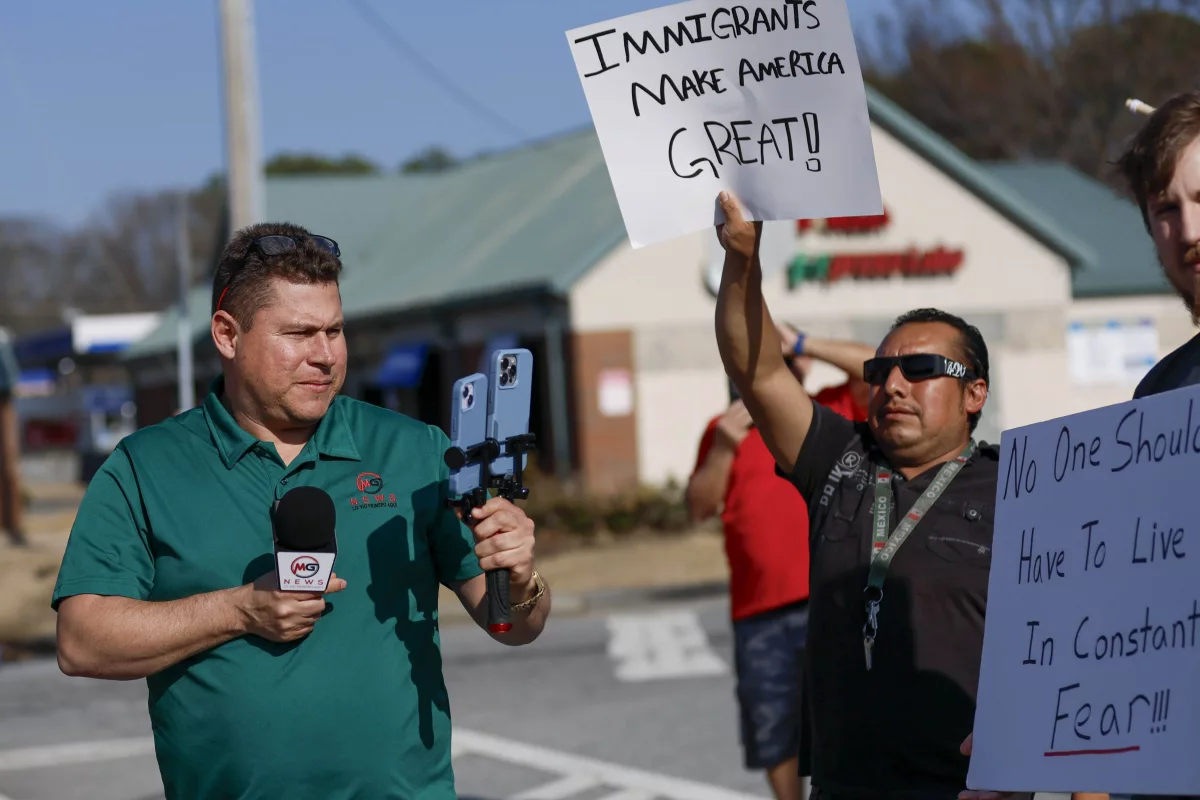
Originally from El Salvador, Guevara has lived in the U.S. for about 20 years and built a large following covering immigrant communities in Georgia for Spanish-language media outlets and his independent outlet, MG News. On the day of his arrest, photos and video of the arrest clearly show Guevara wearing a vest with the words “PRESS” across the back and chest.
“I’m a member of the media, officer,” Guevara can be heard saying in his live stream moments before his arrest as a row of law enforcement officers approach a sidewalk where he stood. As officers detain him, his phone falls to the ground and an officer picks it up at Guevara’s request. The livestream partially shows Guevara being led away in handcuffs and then placed in a law enforcement vehicle.
Katherine Jacobsen, the U.S., Canada and Caribbean program coordinator for the Committee to Protect Journalists, told Morning Edition that Guevara’s arrest sets an “alarming precedent” for noncitizen journalists working in the U.S.
In a letter sent to DHS this week, CPJ wrote that Guevara’s case represents “a grim erosion of both freedom of the press and the rule of law.”
This interview has been edited for length and clarity.
Interview highlights
Leila Fadel: So what is the Committee to Protect Journalists’ concern here? Was he detained over his legal status or was he detained because of his work?
Katherine Jacobsen: Guevara was initially detained because he was recording a protest. There are misdemeanor charges against him. It’s highly irregular that any of those charges would actually be held up. We’ve seen this in many other cases. And simply put, Guevarra was doing his job and reporting the news. To use that as a pretext to hold him – a journalist – for a very long period of time in law enforcement detention, and then to transfer him to ICE detention after, that is something that we haven’t seen before and is an incredibly alarming precedent to set.
Fadel: What protections exist for immigrant journalists like Guevara and others who are doing their jobs in the United States?
Jacobsen: In theory, they enjoy the same First Amendment rights that a U.S. citizen who is a reporter enjoy while they’re out covering things. In the U.S., there are hundreds of foreign reporters. Many of them have a specific type of journalist visa, but some have other types of work authorization. And when a journalist who, again, is here legally is picked up by law enforcement and then his immigration status is called into question in the course of these legal proceedings, it’s alarming.
Fadel: So you sent a letter to the Department of Homeland Security. What did you say in that letter? What were you asking for and what did they say back?
Jacobsen: We sent a letter to the Department of Homeland Security asking that Guevara be released immediately and pointed out that the whole reason why he was detained in the first place was because of charges relating to First Amendment activity. And we find that very problematic. We have not received a response. The Department of Homeland Security has also tweeted that the narrative about Guevara is false, though they have not specified further as to what the falsehoods are.
Fadel: What would you say to other non-citizen journalists in the United States right now who have work authorization or visas to do their jobs, who may be afraid to cover sensitive issues or protests because of what they’re seeing?
Jacobsen: I think there is a great deal of reason for concern at this time, and it’s important to make sure that those journalists have contact with a good immigration lawyer, as well as First Amendment lawyers, and have a clear understanding of their rights.
The digital version of this story was edited by Treye Green. The radio story was edited by Mohamad ElBardicy and produced by Milton Guevara.
Transcript:
LEILA FADEL, HOST:
Mario Guevara, a journalist from El Salvador, has lived in the U.S. for 20 years. He reports on immigrant communities in Georgia for Spanish-language media outlets. He was even the subject of a 2019 New York Times documentary.
(SOUNDBITE OF ARCHIVED RECORDING)
UNIDENTIFIED OFFICER: Turn off the camera.
MARIO GUEVARA: Officer – you can’t do that, officer.
UNIDENTIFIED OFFICER: So you’re not here for any lawful purposes.
UNIDENTIFIED PERSON: You’re impeding our investigation. You do…
FADEL: Earlier this month, Guevara was arrested while reporting on an anti-Trump protest in Atlanta. He was then transferred to immigration authorities and remains in detention. The Committee to Protect Journalists is expressing alarm. I asked Katherine Jacobsen – CPJ’s U.S., Canada and Caribbean program coordinator – why.
KATHERINE JACOBSEN: Guevara was covering the No Kings protests against the Trump administration. He was wearing a press vest that clearly stated press on it and was livestreaming the event. At the time of his detention, he was trying to record the proceedings, and officers walked up to him and arrested him. I should also say, this is all available on body cam footage, which has since been released. So there’s a very clear documentation about what happened.
FADEL: So what is the Committee to Protect Journalists’ concern here? I mean, was he detained over his legal status, or was he detained because of his work?
JACOBSEN: Guevara was initially detained because he was recording a protest. There are misdemeanor charges against him. It’s highly irregular that any of those charges would actually be held up, right? We’ve seen this in many other cases. And simply put, Guevara was doing his job and reporting the news. And to use that as a pretext to hold him – a journalist – for a very long period of time in law enforcement detention and then to transfer him to ICE detention after that is something that we haven’t seen before and is an incredibly alarming precedent to set.
FADEL: What protections exist for immigrant journalists like Guevara and others who are doing their jobs in the United States?
JACOBSEN: Well, in theory, they enjoy the same First Amendment rights that a U.S. citizen, who is a reporter, enjoy while they’re out covering things. In the U.S., there are hundreds of foreign reporters. Many of them have a specific type of journalist visa, but some have other types of work authorization. And when a journalist who, again, is here legally is picked up by law enforcement and then his immigration status is called into question in the course of these legal proceedings, it’s alarming.
FADEL: So you sent a letter to the Department of Homeland Security. What did you say in that letter? What were you asking for, and what did they say back?
JACOBSEN: We sent a letter to the Department of Homeland Security asking that Guevara be released immediately and pointed out that the whole reason why he was detained in the first place was because of charges relating to First Amendment activity, and we find that very problematic. We have not received a response. The Department of Homeland Security has also tweeted that the narrative about Guevara is false. So they have not specified further as to what the falsehoods are.
FADEL: What would you say to other noncitizen journalists in the United States right now who have work authorization or visas to do their jobs, who may be afraid to cover sensitive issues or protests because of what they’re seeing?
JACOBSEN: I think there is a great deal of reason for concern at this time, and it’s important to make sure that those journalists have contact with a good immigration lawyer, as well as First Amendment lawyers, and have a clear understanding of their rights.
FADEL: Katherine Jacobsen is the U.S., Canada and Caribbean program coordinator for the Committee to Protect Journalists. Thank you so much.
JACOBSEN: Thanks for having me.
FADEL: We reached out to the Department of Homeland Security. They also told us this narrative is false. In a statement, a department spokesperson said Guevara is in removal proceedings and urged him to, quote, “self-deport.” They also said Guevara was arrested by local police and transferred to ICE custody because he entered the U.S. illegally in 2004. Guevara’s lawyer says that’s not true. He entered the country legally on a visa and that he has work authorization. The lawyer says his immigration status had been pending.
