


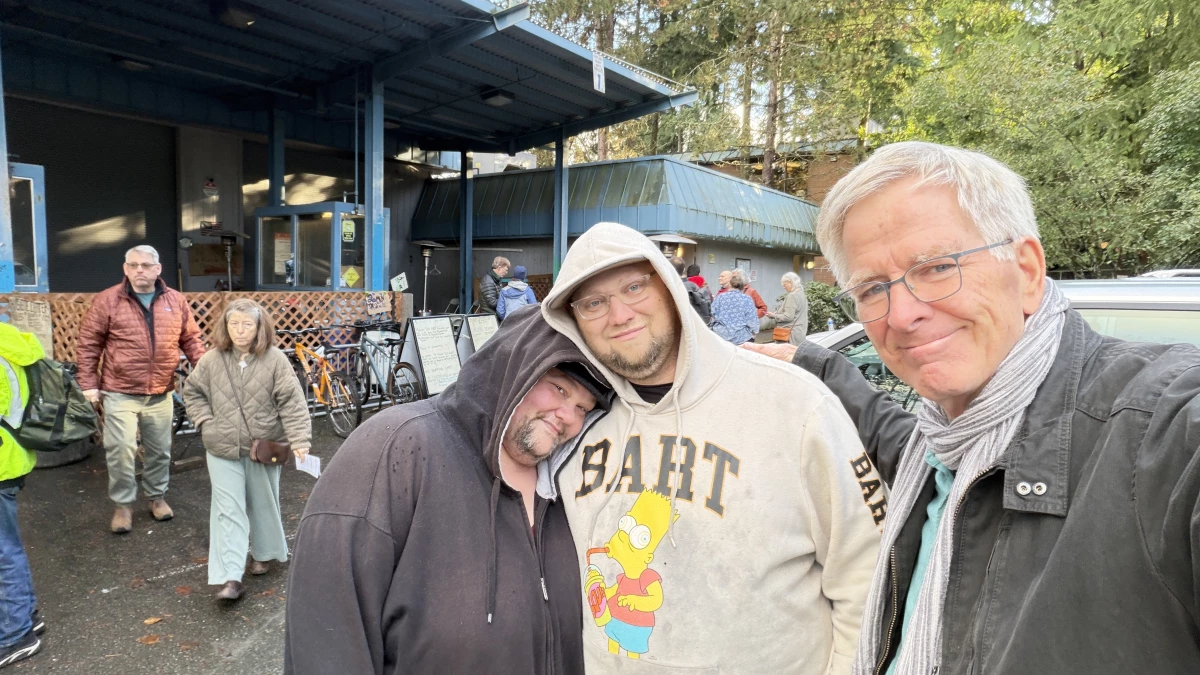
An anonymous donor stepped in last month to save a Seattle-area community center that was slated to close.
Last week, community members learned that the new owner was travel writer and TV host Rick Steves, who pledged to keep it open and free for people needing hot showers and hot meals.
“I vividly remember what it’s like as a kid backpacking around the world to need a shower, to need a place to wash your clothes,” Steves told a crowd who gathered on Wednesday to celebrate the purchase over cake and with words fait accompli written in red icing.
Many homeless people had come to depend on the Lynnwood Hygiene Center, which had operated rent-free on the property since 2020.
But the center said in November that it would close after the property was sold to a developer.
Steves said he learned about the hygiene center’s impending closure by reading about it in a local online newspaper — just weeks before it was set to shut down.
Despite living nearby, he said he hadn’t even known the center existed.
In fact, Steves told NPR he didn’t even know what a hygiene center was until he read about the closure — a place where people can shower, wash clothes, grab a hot meal and spend a few hours indoors.
“I realized, oh my goodness, there’s an invisible community with an invisible center helping invisible people. And it’s not right. It needs to be kept alive,” Steves said.
In a series of posts on Bluesky, Steves said was struck by how difficult it would be to replace.
Steves said he bought the property for $2.25 million.
Members of the community pitched in another $400,000 in donations, which the center says will go toward renovations and expanding services.
“It’s huge,” said Sandra Mears, executive director of the Jean Kim Foundation, which runs the hygiene center.
Mears says before Steves came in, she had been told to plan a goodbye party.
“I didn’t want a goodbye party,” she said.
Thanks to the donations, Mears says the Lynnwood Hygiene Center will continue serving around 700 people in the community, providing upwards of 16,000 hot meals and 10,000 showers a year.
Steves called the purchase the best $2.25 million he could imagine spending.
But he says private donations are also not a substitute for public investment — and shouldn’t determine whether essential services survive.
He describes his decision as a response to what he sees as a failure of public priorities, not a model to be relied upon.
“If we don’t have [$2.25 million] for a whole county to give homeless people a shower and a place to get out of the rain and a place to wash their clothes, what kind of society are we?” Steves said.
Transcript:
STEVE INSKEEP, HOST:
A Seattle-area community center is getting a second life, and that’s a big deal for more than 700 people who go there for a hot meal or a shower. The center said in November it would have to close, and then a very well-traveled TV host stepped in. NPR’s Rebecca Rosman has more.
REBECCA ROSMAN, BYLINE: In November, Sandra Mears was told it was time to hang up her hat. The building that housed the Lynnwood Hygiene Center, where she served as director, was going to be sold. Why not throw a goodbye party, the board suggested, but Mears didn’t like goodbyes or ultimatums. If a place like this just disappeared, where were people in need going to go?
SANDRA MEARS: So I started hustling, trying to find another place.
ROSMAN: But no deal was going to be as good as the one she already had. For five years, the center had operated out of a former emissions testing site rent-free. How do you replace that? A piece was published in the local paper about what was happening and about what the community stood to lose. One reader reached out.
MEARS: I was checking my email. And it came through the website, and it was from Rick Steves.
(SOUNDBITE OF ARCHIVED RECORDING)
RICK STEVES: Hi. I’m Rick Steves, and it’s Christmastime in Europe.
ROSMAN: Yes, that Rick Steves – the guidebook author and public TV host who has taken viewers across Europe, from the boulevards of Paris to the piazzas of Italy. But there’s another side of Rick Steves, who has lived just north of Seattle for nearly 60 years. He’s deeply invested in his local community.
STEVES: You know, when I first learned about this, I didn’t even know what a hygiene center was.
ROSMAN: He quickly learned that they’re an essential resource for people experiencing homelessness – a place to shower, wash clothes and just get out of the rain for a few hours. This is Seattle, after all. Even bigger, it was a place for community.
STEVES: It’s community among homeless people, and it’s also community among people that care enough to get out there and volunteer.
ROSMAN: So Steves bought the building and the land beneath it for $2 million. An additional $400,000 came in from community donors, money that will go toward renovations and expanded services. After initially keeping the purchase anonymous, Steves went public last week. He says this isn’t about charity. It was about keeping communities alive. But he also says private donations are not a catch-all solution and that meeting basic needs should be a public responsibility.
STEVES: And a smart national budget should reflect my love-thy-neighbor ethic.
ROSMAN: For now, Steves says he’s happy he could step in. But he hopes the takeaway goes beyond this one building and towards what a community can do collectively.
Rebecca Rosman, NPR News.
(SOUNDBITE OF GET THE BLESSING’S “QUIET”)
INSKEEP: Rick Steves might appreciate a story we have later today. NPR staff traveled a lot this year, sometimes on assignment, sometimes for fun. This afternoon on All Things Considered, we hear their recommendations for your next trip, from pristine wilderness to roadside attractions. Listen in the NPR app or on this public radio station.
(SOUNDBITE OF GET THE BLESSING’S “QUIET”)
