


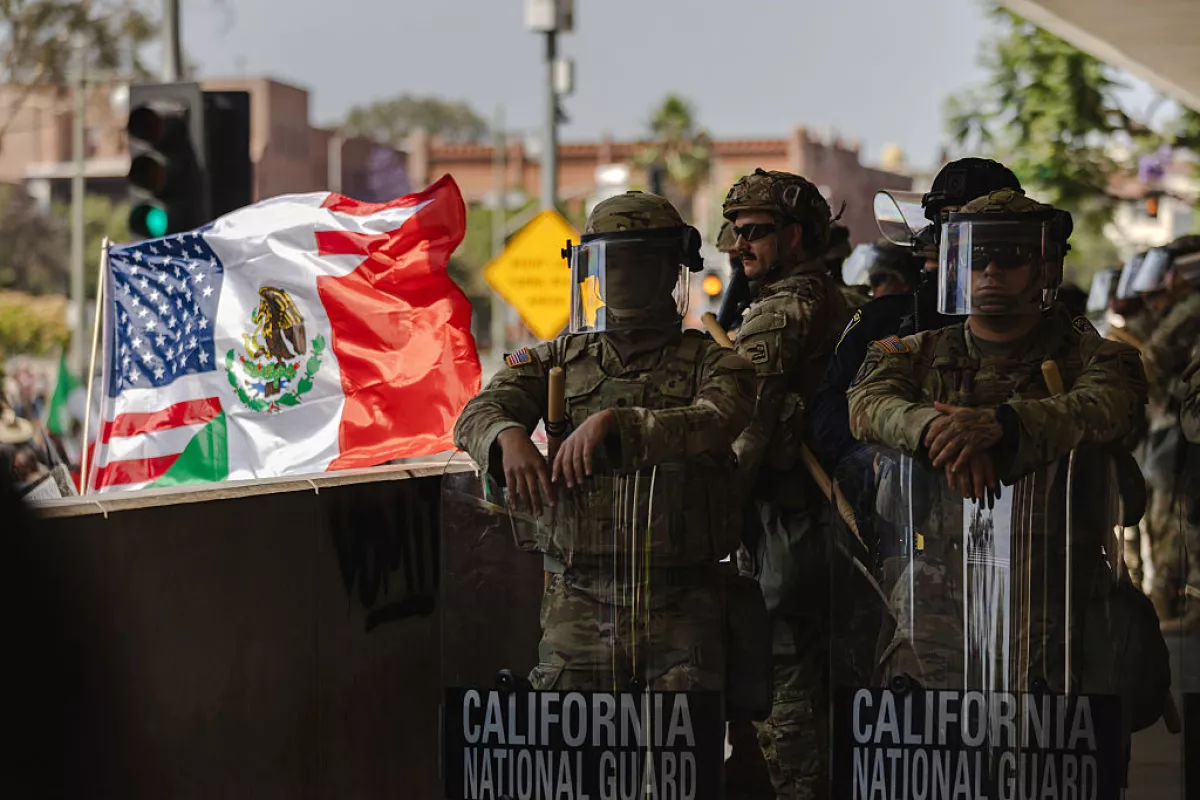
Hundreds of active-duty Marines have arrived in the Los Angeles area, under the order of President Trump, to protect federal personnel and property amid anti-immigration enforcement protests in the city.
The activation of 700 Marines came the same day California sued the Trump administration over the deployment of National Guard troops in Los Angeles.
In their lawsuit, California Gov. Gavin Newsom and state Attorney General Rob Bonta accused Trump of violating a federal statute by deploying the National Guard over the governor’s objections and violating the Tenth Amendment of the U.S. Constitution.
In a budget hearing on Capitol Hill Tuesday, Marine Corps Gen. Eric Smith said that the Marines deployed to the area had not yet been called to respond to the protests, adding they are trained for crowd control and have no arrest authority.
Retired U.S. Marine Corps Lt. Gen. Walter Gaskin told All Things Considered host Mary Louise Kelly on Tuesday that Marines will follow orders but deploying them on American soil is “a misuse of talent and forces.”
“A mission to restore peace and protect property may require the use of deadly force. That use of deadly force against American citizens is very problematic,” Gaskin, who once led the North Carolina Department of Military and Veterans Affairs, said. “What if the crowd pushes you? What if the crowd starts throwing bricks, Molotov cocktails? It becomes a deadly situation in that defense.”
This interview has been lightly edited for length and clarity.
Interview highlights
Mary Louise Kelly: We’re looking at 4,000 National Guard, 700 Marines for a situation that California and LA officials say local law enforcement can handle. Is that overkill?
Walter Gaskin: Well, it is extreme overkill. For example, if you look at the size of the police force in Los Angeles, plus the sheriff’s department, plus the National Guard, for what was originally about 400 disturbants — I have never seen an environment where you didn’t have agitators.
And so if the de-escalation has not happened, it won’t until there are there casualties. And we’ve got too many examples of that type of thing in our history just by using National Guard and the police force, let alone adding active duty Title 10 soldiers and Marines to do that.
Kelly: Do you see issues with chain of command in this situation?
Gaskin: Yes, I do. I would not want to be in the common opposition or that division commander or that regimental commander or that battalion commander who has to prepare these folks for combat.
Because, like I said, there is no half way in between. When ordered to do, they have to execute. That’s why we train and we put restraint on the rules of engagement so that they understand if ordered to do this, this is because this is a requirement, not some political whim or something that someone wants to do politically to prove a point.
Kelly: What guidance would you give a Marine who came to you with questions about this mission?
Gaskin: Same thing that we always do. Ours is not to reason why, but to do or die. And that’s what we are trained to do. And so they have to they have to follow orders. That’s why the pressure becomes on the leadership. And as I started out by saying, the misuse of a capability.
This interview was adapted for the web by Manuela Lopez Restrepo and edited by Karen Zamora.
Transcript:
AILSA CHANG, HOST:
Hundreds of active duty U.S. Marines have now arrived right here in the Greater Los Angeles area. President Trump ordered them to mobilize in a, quote, “support role” to protect federal property and personnel amid protests over ICE immigration raids.
MARY LOUISE KELLY, HOST:
Now, this is controversial. It is raising legal questions to do with the deployment of active duty military on U.S. soil and over the objections of state and local leaders. But we wanted to take a moment to consider what this looks like through the eyes of the 700 or so Marines tasked with the mission. That is something we’re going to talk through now with retired Marine Lt. Gen. Walter Gaskin. He served decades in the Marine Corps, working as acting chairman of the NATO Military Committee, deploying to Iraq and serving as commanding general 2nd Marine Division at Camp Lejeune in North Carolina. General Gaskin, welcome to ALL THINGS CONSIDERED.
WALTER GASKIN: Thank you. Glad to be here.
KELLY: Your first thought when you heard Marines were being deployed to LA.
GASKIN: A misuse of the talent and forces – even though I hear a lot about the lack of training, the training isn’t the issue. They are trained to do that. But what comes into is they’re trained killers and separation of a very hostile rules of engagement. So to actually turn that toward American citizens is problematic.
KELLY: Let me jump in. OK, so you just said this, in your view, is a misuse of talent and forces. And say more about the issue of trained killers. They have not been ordered, I will say. They are in LA. They have not been deployed to specific places. We don’t know exactly what they’re going to be doing. But the idea, as they say, is that they will be protecting federal buildings, federal property, federal personnel. Why is that so problematic?
GASKIN: Because you can’t turn it off – a mission to restore peace and protect property may require the use of deadly force. That use of deadly force against American citizens is very problematic. In addition to that, they do not have Posse Comitatus, the ability to arrest and detain, especially under the Title 10 provision, which is train and equip forces to engage, close with and destroy the enemy.
KELLY: I just want to push you on this when you say you can’t turn it off. The commandant of the Marine Corps – this is General Eric Smith – he was just asked some of the questions I’m asking you. And he’s saying, look, they’re not going to have arrest authority. They’re only there to protect federal property, federal personnel. They are trained for crowd control.
GASKIN: That’s exactly right. But remember the follow-up on that statement. And as I know General Smith very well, he was once one of my company commanders and has been placed in that type of situation when we were defending the embassy in Liberia. When – I mean, when I say you can’t turn it off, if you’re there to protect something, what if the crowd pushes you? What if the crowd starts throwing bricks, Molotov cocktails? It becomes a deadly situation in that defense. That’s what I mean, and you can’t turn it off once you have engaged it.
KELLY: I did want to ask about the troop numbers that are in play here. We’re looking at 4,000 National Guard, 700 Marines for a situation that California and LA officials say local law enforcement can handle. Is that overkill?
GASKIN: Well, it is extreme overkill. For example, if you look at the size of the police force there in Los Angeles, plus the sheriff’s department, plus the National Guard, you know, for a – what was originally about 400 disturbance. And you will always – I have never seen a environment where you didn’t have agitators. And so if the de-escalation has not happened, it won’t until there are casualties. And we’ve got too many examples of that type of thing in our history, just by using National Guard and the police force, let alone adding active duty Title 10 soldiers and Marines to do that.
KELLY: Do you see issues with chain of command in this situation?
GASKIN: I see – yes, I do. I see – I would not want to be in the commandant position or that division commander or that regimental commander or that battalion commander who has to prepare these folks for combat because, like I said, there is no halfway in between. You either are – when ordered to do, they have to execute. That’s why we train and we put restraint and the rules of engagement, so that they understand if ordered to do this, this is because this is requirement, not some political whim or something that someone wants to do politically to prove a point.
KELLY: What guidance would you give a Marine who came to you with questions about this mission?
GASKIN: Same thing that we always do – ours is not to reason why, but to do or die. And that’s what we are trained to do. And so they have to follow orders. That’s why the pressure becomes on the leadership, and as I started out by saying, the misuse of a capability.
KELLY: General Gaskin, thank you.
GASKIN: Thank you.
KELLY: That’s retired Marine Corps Lt. Gen. Walter Gaskin.
