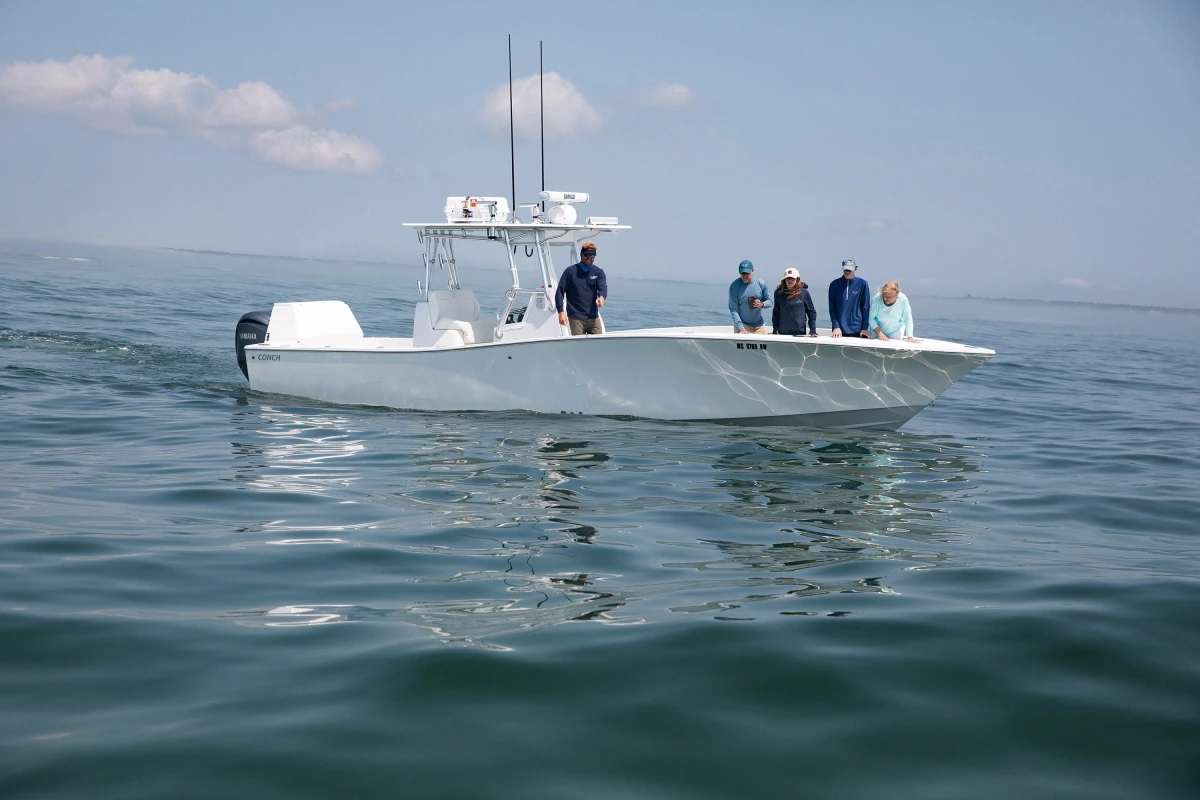
Great white shark tours have become popular around Cape Cod as more of the largest predator fish are showing up here. Captain Cullen Lundholm (left) of White Sharks Tours Cape Cod points to a 12-foot female shark as passengers of a private charter try to spot it. Tours like this are pricey as companies use spotter planes to find the great whites.  A private tour on a charter boat can costs $2,000 dollars or more, while group tours are around $300 per person.
Great white shark tours have become popular around Cape Cod as more of the largest predator fish are showing up here. Captain Cullen Lundholm (left) of White Sharks Tours Cape Cod points to a 12-foot female shark as passengers of a private charter try to spot it. Tours like this are pricey as companies use spotter planes to find the great whites. A private tour on a charter boat can costs $2,000 dollars or more, while group tours are around $300 per person. (Kayana Szymczak | for NPR)

White shark tourism is taking off in Cape Cod, where the ocean’s largest predator fish have made a remarkable comeback.

Kris Roszack owns Down Cape Charters in Harwich, near the elbow of Cape Cod. He says white sharks have become more predictable here than the weather.

Roszack is concerned about the low clouds this morning. It’s illegal here to lure sharks to a boat. So these tours rely on spotter planes to find them.

“I mean, success rate is probably in the upper 90% if the conditions are right,” Roszack said.

“We do not want to just take people for expensive boat rides.

”A few decades ago, white shark numbers reached an all-time low in Cape Cod. Experts blame mainly the decimation of seals, their main food source. Fishermen considered seals pests, and the state paid bounties for culling seals. But since the Marine Mammal Protection Act of 1972, seals have come back, at first slowly, then exponentially. Now they’re everywhere, Captain Nick Franco says. Franco leads shark tours in the area.

We take a ride with one tour boat to see what happens.
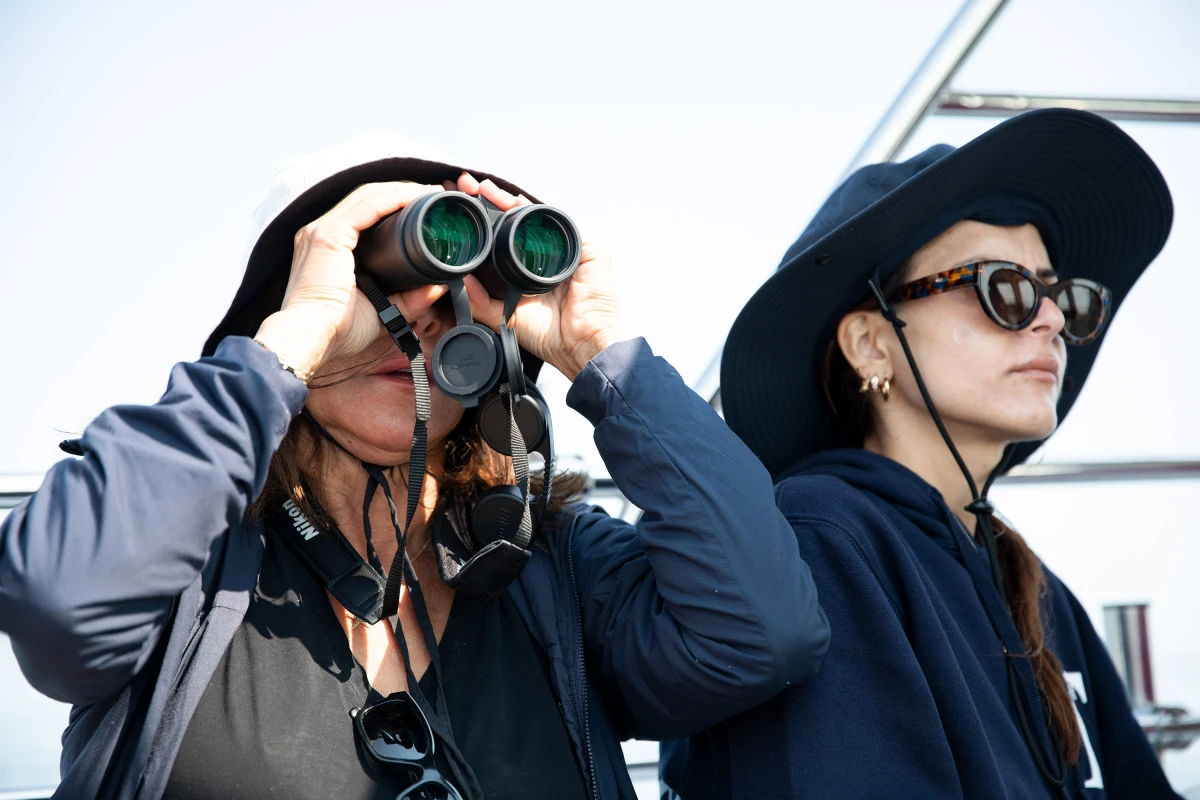
Victoria Germann (left) takes a closer look at the spotter plane, which has appeared on the horizon. She and her daughter Olivia Germann (right), 24, came from Connecticut to but were prepared to travel as far as Guadalupe Island last year to see white sharks, when the Mexican hotspot was closed to shark eco-tourism due to the environmental impacts of the unregulated industry.
Victoria Germann (left) takes a closer look at the spotter plane, which has appeared on the horizon. She and her daughter Olivia Germann (right), 24, came from Connecticut to but were prepared to travel as far as Guadalupe Island last year to see white sharks, when the Mexican hotspot was closed to shark eco-tourism due to the environmental impacts of the unregulated industry. (Kayana Szymczak | for NPR)
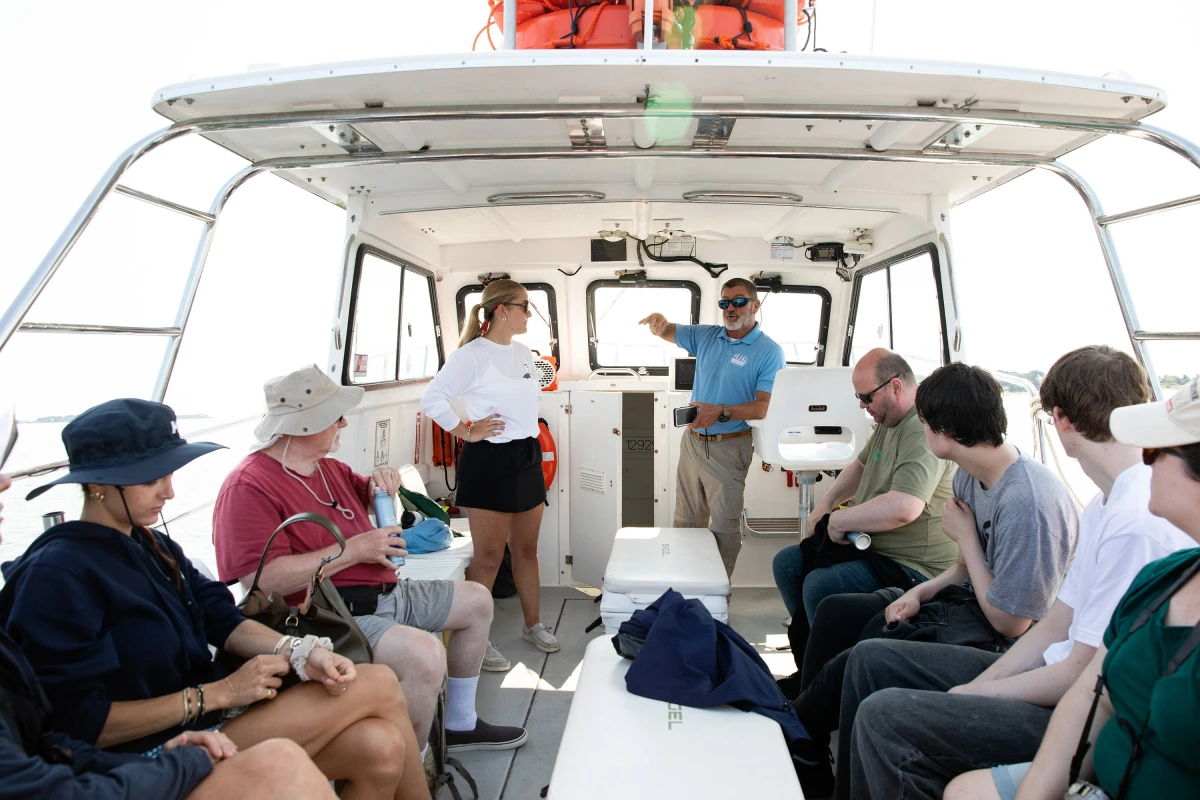
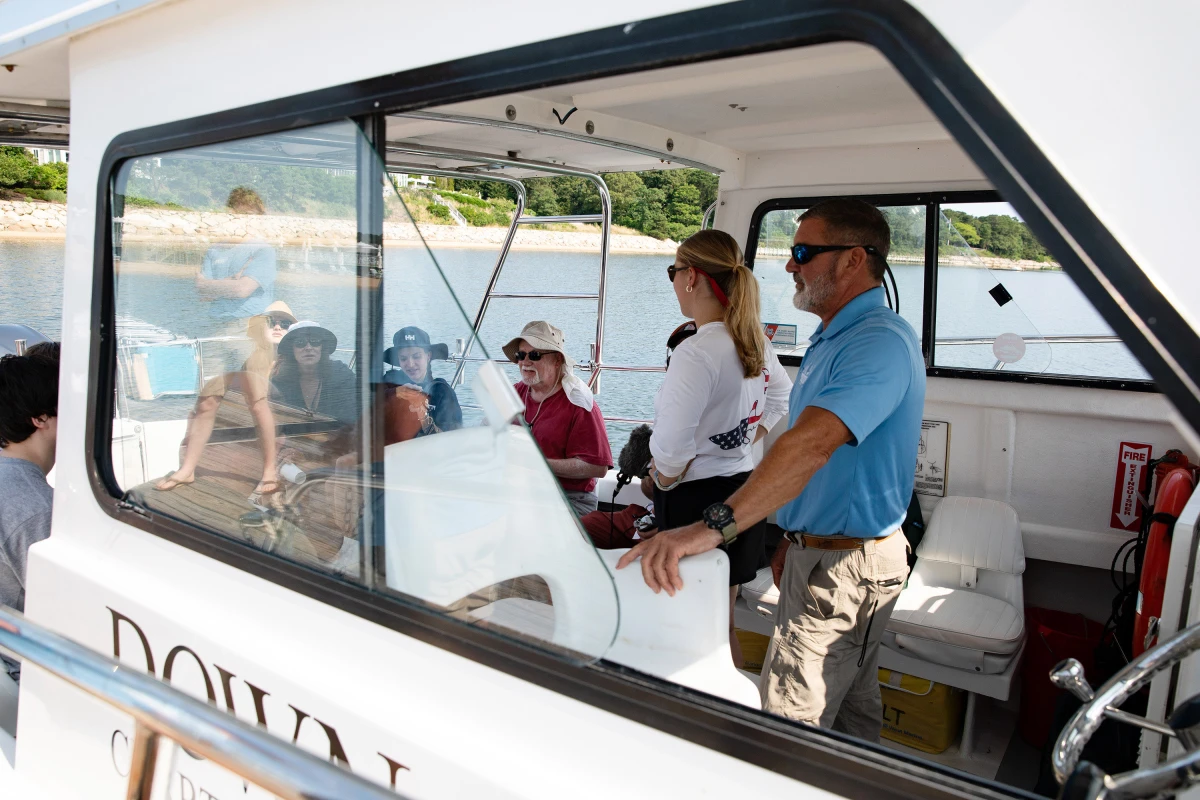
Like any boat tour, Captain Nick Franco, 55, explains where the life jackets, fire extinguishers, and head are onboard. Brigitte “Gigi” Marino, 22 (no relation to the author) has a bachelor’s degree in Marine Biology and is there to answer any questions passengers might have about white sharks biology. Though the 30-foot boat is rated for 20 passengers, Down Cape only allows 10. That way, it’s safe for everyone to gather on the shark-side of the boat, but Franco asks that people rotate to the gunwale cordially so that everyone has a turn being closest. From left to right, Olivia Germann, Walter Pytlak, Gigi Marino, Nick Franco, Paul Dunne, Jacob Dunne, Felix Dunne, and Valerie Bogan.
Like any boat tour, Captain Nick Franco, 55, explains where the life jackets, fire extinguishers, and head are onboard. Brigitte “Gigi” Marino, 22 (no relation to the author) has a bachelor’s degree in Marine Biology and is there to answer any questions passengers might have about white sharks biology. Though the 30-foot boat is rated for 20 passengers, Down Cape only allows 10. That way, it’s safe for everyone to gather on the shark-side of the boat, but Franco asks that people rotate to the gunwale cordially so that everyone has a turn being closest. From left to right, Olivia Germann, Walter Pytlak, Gigi Marino, Nick Franco, Paul Dunne, Jacob Dunne, Felix Dunne, and Valerie Bogan. (Kayana Szymczak | for NPR)
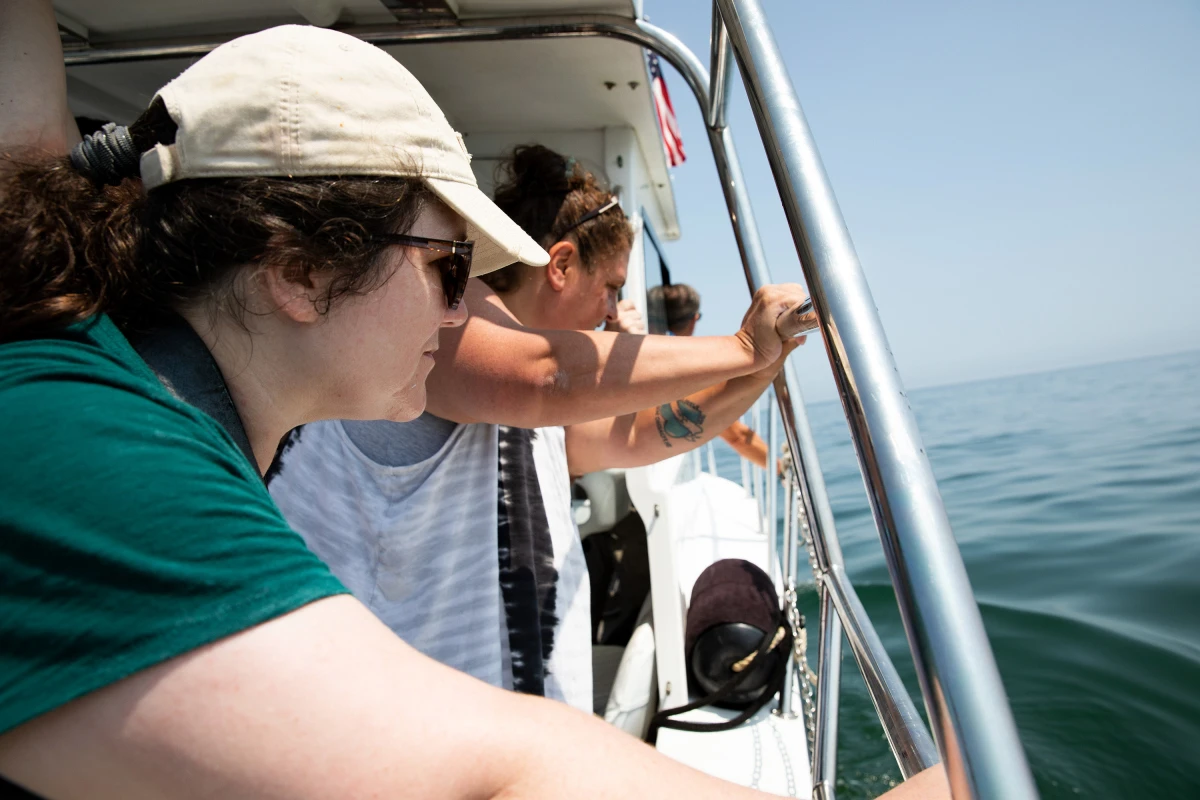
Valerie Bogan (left), 46, from Hagerstown, Indiana, and Lisa Castle, 51, from Shelton, Connecticut, get a good look of a white shark. The shark’s path is not straight but meandering. Captain Franco, watching it from the starboard window, steers the boat at a low throttle to keep us close.
Valerie Bogan (left), 46, from Hagerstown, Indiana, and Lisa Castle, 51, from Shelton, Connecticut, get a good look of a white shark. The shark’s path is not straight but meandering. Captain Franco, watching it from the starboard window, steers the boat at a low throttle to keep us close. (Kayana Szymczak | for NPR)
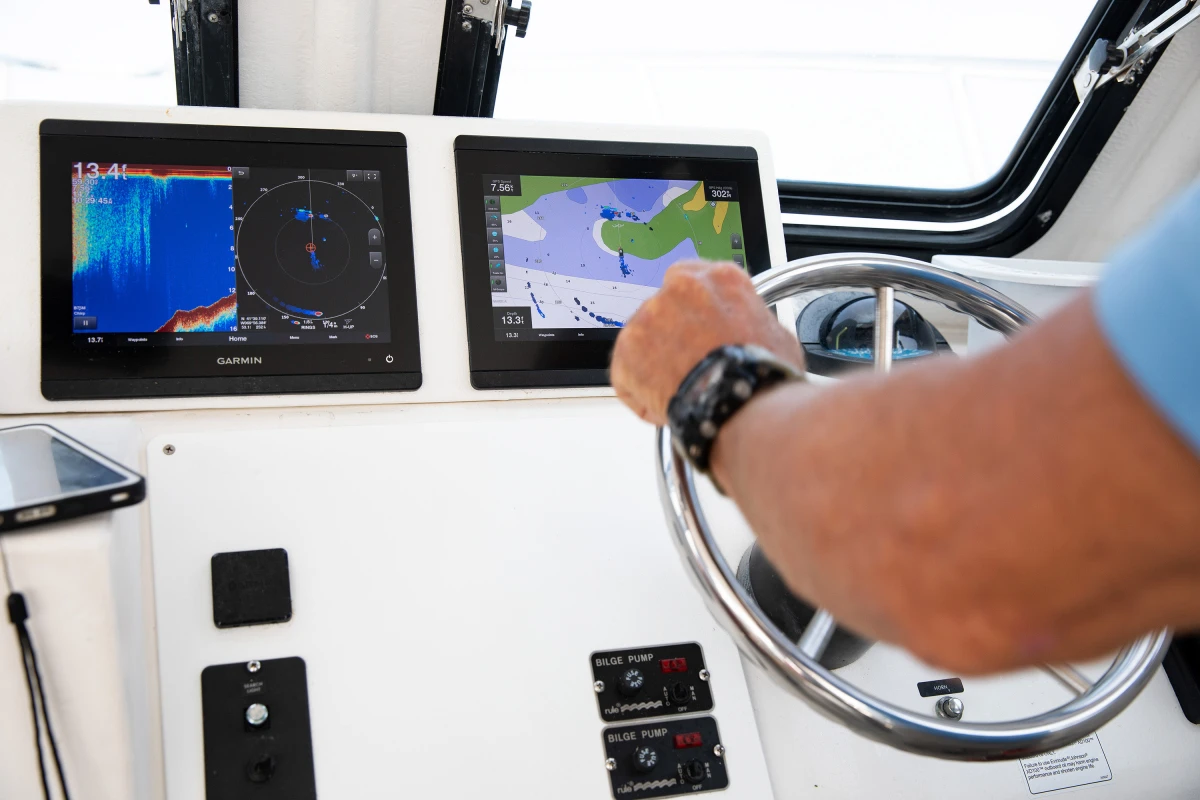
Captain Franco pays close attention to depth. Not only is Chatham Harbor hazardously shallow, but sharks are especially visible in depths of ten feet or less, against the contrast of the sandy bottom.
Captain Franco pays close attention to depth. Not only is Chatham Harbor hazardously shallow, but sharks are especially visible in depths of ten feet or less, against the contrast of the sandy bottom. (Kayana Szymczak | for NPR)
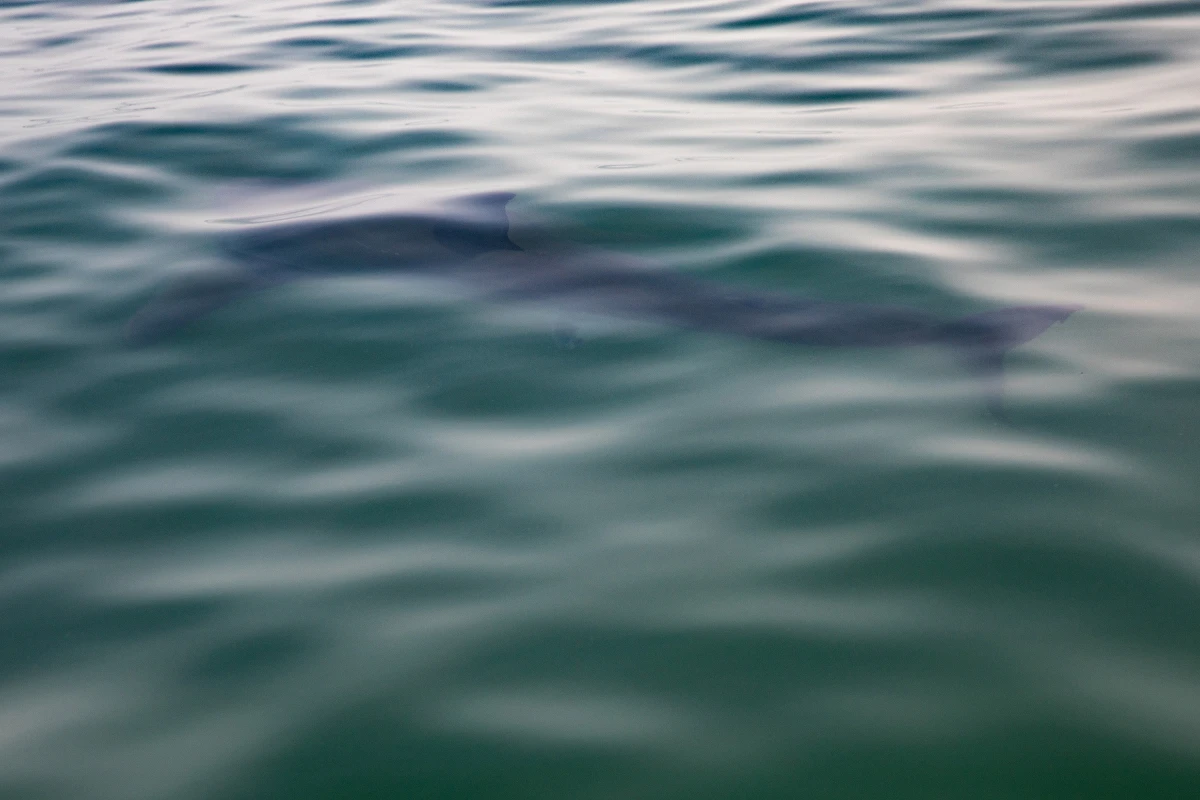
A few yards form the boat, the 12-foot, female, untagged shark is glimpsed here even at a low angle. Water conditions are particularly calm today, which makes a big difference in visibility. In addition to fog or low-lying clouds, wind and waves can cause last-minute cancellations.
A few yards form the boat, the 12-foot, female, untagged shark is glimpsed here even at a low angle. Water conditions are particularly calm today, which makes a big difference in visibility. In addition to fog or low-lying clouds, wind and waves can cause last-minute cancellations. (Kayana Szymczak | for NPR)
Before the tour leaves dock, Captain Nick Franco, right, waits to instructions from the spotter plane pilot on which direction to head first. From left to right, Felix Dunne, Kate Hales, Victoria and Olivia Germann, Walter Pytlak, and Brigitte “Gigi” Marino, the guide.
Before the tour leaves dock, Captain Nick Franco, right, waits to instructions from the spotter plane pilot on which direction to head first. From left to right, Felix Dunne, Kate Hales, Victoria and Olivia Germann, Walter Pytlak, and Brigitte “Gigi” Marino, the guide. (Kayana Szymczak | for NPR)
Katherine “Katie” Hales, 27, a biology major who works in finance, says that seeing a white shark was on her “bucket list.”
Katherine “Katie” Hales, 27, a biology major who works in finance, says that seeing a white shark was on her “bucket list.” (Kayana Szymczak | for NPR)
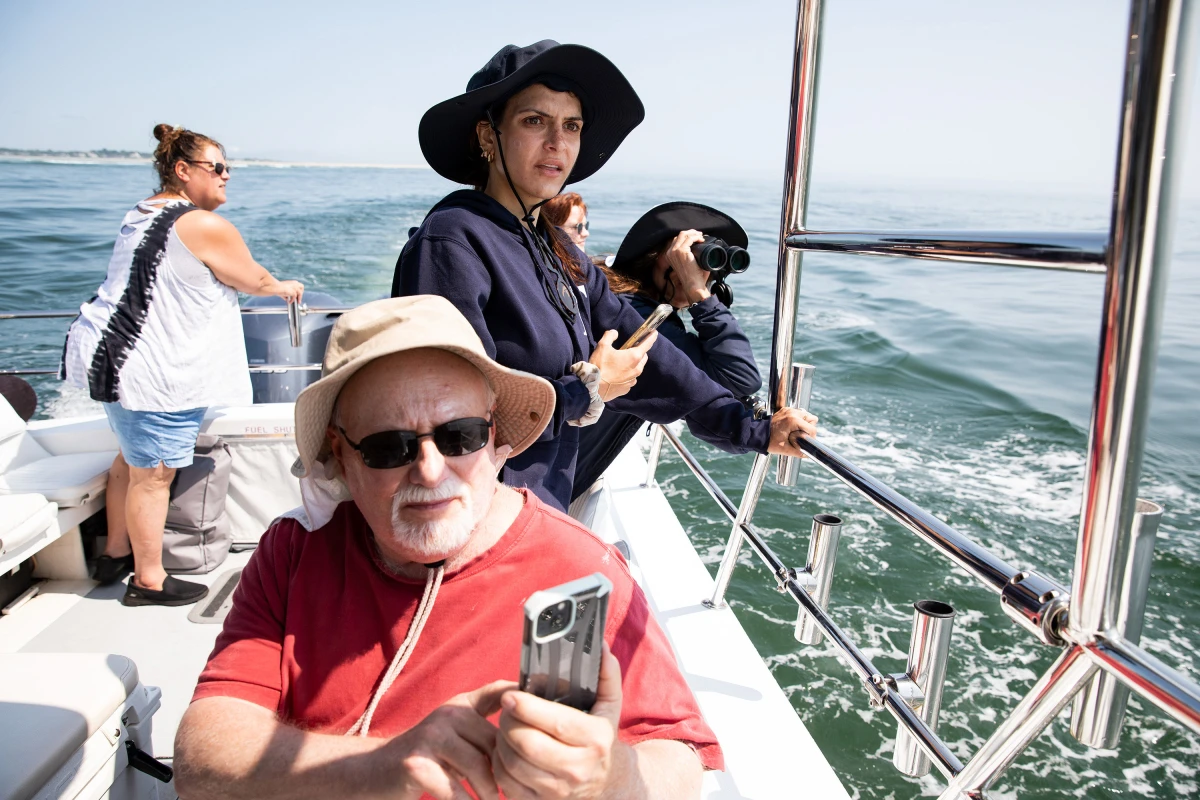
Passengers watch a harbor seal feeding on a school small fish. From left to right, Lisa Castle, her uncle Walter Pytlak, Olivia Germann, Katherine Hales, and Victoria Germann.
Passengers watch a harbor seal feeding on a school small fish. From left to right, Lisa Castle, her uncle Walter Pytlak, Olivia Germann, Katherine Hales, and Victoria Germann. (Kayana Szymczak | for NPR)
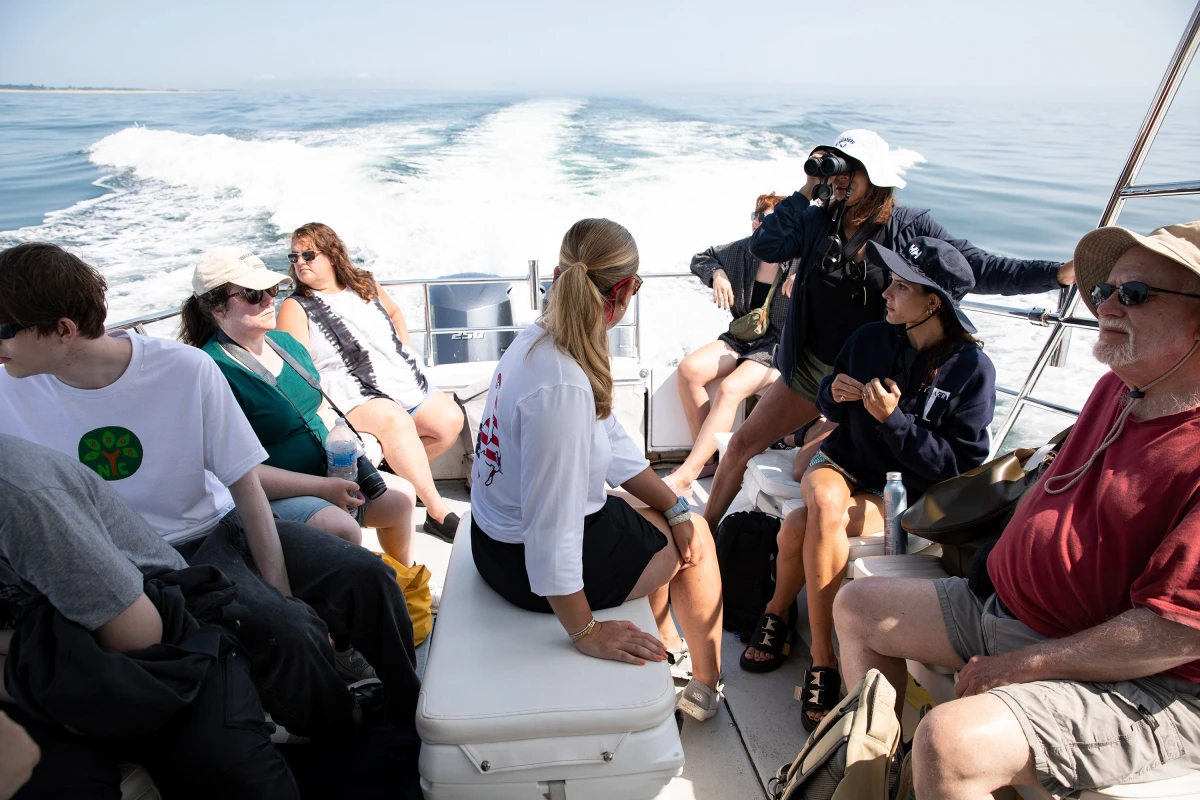
The tour heads back into the harbor with satisfied passengers. From left to right, Jacob Dunne, Valerie Bogan, Lisa Castle, Gigi Marino, Kate Hales, Victoria Germann, Olivia Germann, and Walter Pytlak. 
The tour heads back into the harbor with satisfied passengers. From left to right, Jacob Dunne, Valerie Bogan, Lisa Castle, Gigi Marino, Kate Hales, Victoria Germann, Olivia Germann, and Walter Pytlak.  (Kayana Szymczak | for NPR)

Photos edited by Grace Widyatmadja.

Transcript:

AILSA CHANG, HOST:

White shark tourism is taking off in Cape Cod, where the ocean’s largest predator fish have made a remarkable comeback. You can see them by boat for a price. Reporter Paul Marino joined a search for the elusive giant.

(SOUNDBITE OF WATER SPLASHING)

PAUL MARINO, BYLINE: Kris Roszack owns Down Cape Charters in Harwich, near the elbow of Cape Cod. He says white sharks have become more predictable here than the weather.

KRIS ROSZACK: I mean, success rate is probably in the upper 90% if the conditions are right.

P MARINO: He’s concerned about the low clouds this morning. It’s illegal here to lure sharks to a boat. So these tours rely on spotter planes to find them. Already, two trips this week have been canceled because of fog.

ROSZACK: We do not want to just take people for expensive boat rides.

P MARINO: Three hundred fifteen bucks buys you a chance at seeing a great white this way. Lisa Castle came from Connecticut with her uncle. They’re among eight passengers on board. This is the sixth attempt for this shark lover.

LISA CASTLE: Even as a kid, I used to read the book “Shark Attack Files” – yep, very obsessed.

P MARINO: A few decades ago, white shark numbers reached an all-time low in Cape Cod. Experts blame mainly the decimation of seals, their main food source. Fishermen considered seals pests, and the state paid bounties for culling seals. But since the Marine Mammal Protection Act of 1972, seals have come back, at first slowly, then exponentially. Now they’re everywhere, Franco says.

NICK FRANCO: There are thousands and thousands of seals off of Chatham. That’s why this is the most concentrated place in the world of great whites. So with any luck, we’ll get one next to the boat today.

P MARINO: The clouds have lifted, and our boat heads out.

(SOUNDBITE OF BOAT ENGINE RUMBLING)

P MARINO: Our first destination is an acoustic receiver buoy installed by the Atlantic White Shark Conservancy. They’ve tagged over 300 white sharks off Cape Cod for research. When one swims near a buoy, an alert goes out, which tour boats use as a tip.

FRANCO: And that beacon just went off recently. So she is circling the area right now, trying to find this fish.

P MARINO: Our pilot, Melina Varrichio, spots the shark.

FRANCO: Roger that. We do have a target.

MELINA VARRICHIO: Eleven o’clock, 2.5 boat lengths, 1 o’clock, two boat lengths.

P MARINO: Brigitte Marino, a recent college grad and shark guide, points to an obscure mass.

BRIGITTE MARINO: She’s right here.

P MARINO: Only a few passengers get a glimpse.

UNIDENTIFIED PERSON #1: Boy, I cannot see him.

B MARINO: Toward that boat.

UNIDENTIFIED PERSON #2: It’s just a shadow.

P MARINO: Just as quickly, it’s gone.

B MARINO: He’s swimming away from us.

P MARINO: But the disappointment doesn’t last. A few minutes later, the pilot spots two sharks.

VARRICHIO: I’ll keep circling the two of them, and once you get here, we’ll get you on the one that’s more shallow most likely.

FRANCO: Roger that.

P MARINO: Nine tour companies on Cape Cod have recently started offering these tours. We’re suddenly joined by another boat. Both tours’ spotter planes circle overhead.

(SOUNDBITE OF AIRPLANE ENGINE RUMBLING)

P MARINO: The rule out here is first come, first served, but the captains are courteous.

FRANCO: If you got it, take it.

P MARINO: That boat follows one shark. We follow another and get as close as we can. The dorsal breaks through the surface.

UNIDENTIFIED PERSON #3: Oh, whoa.

UNIDENTIFIED PERSON #4: Yay.

UNIDENTIFIED PERSON #5: Wow.

(CROSSTALK)

P MARINO: The shark swims alongside the boat for maybe a minute.

FRANCO: That’s a 12-foot great white shark.

P MARINO: Castle feels she’s got her money’s worth.

CASTLE: I’ve been obsessed for a long time. Just – I’m happy I finally got to see one.

P MARINO: Researchers are still studying the impacts of ecotourism on shark health and behavior. The Atlantic White Shark Conservancy says where it’s regulated, like here in Cape Cod, it’s good for sharks because of its educational value. For NPR News, I’m Paul Marino off the coast of Cape Cod.

(SOUNDBITE OF JOHN WILLIAMS’ “JAWS”)