


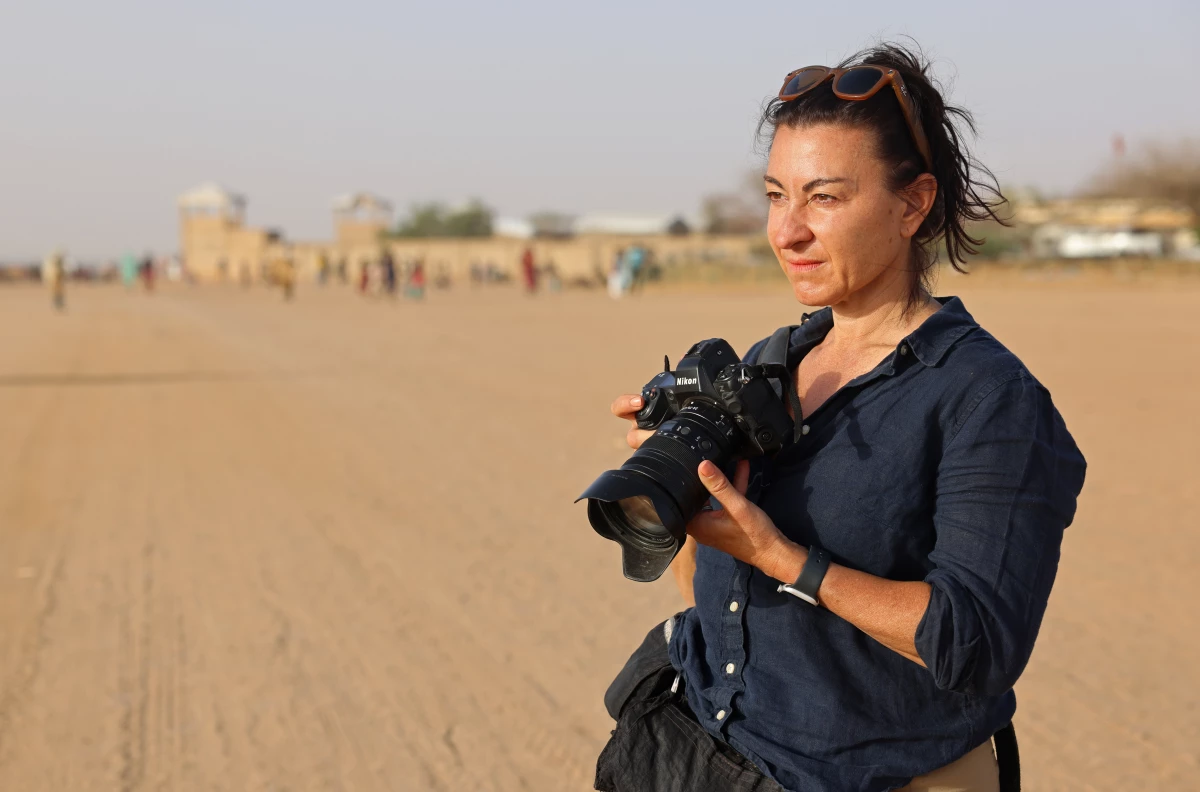
For 25 years, Pulitzer Prize-winning photojournalist Lynsey Addario has covered nearly every major conflict and humanitarian crisis of her generation, from Syria to Sudan to Ukraine. The dangers she encounters on assignment are increasingly serious; the Committee to Protect Journalists estimates that 2024 was the deadliest on record for journalists.
“We’re in an era where journalists are routinely targeted and routinely killed,” she says. “Journalism is equated with death now, in a way that it wasn’t when I first started out.”
Over the years, Addario’s been kidnapped twice, thrown out of a car on a highway in Pakistan, and been ambushed, on two different occasions, by the Taliban and Iraqi insurgents. Still, she says, she sometimes finds parenting two young kids more challenging than reporting from a war zone.
“When I’m in a war zone, that is my focus and that’s all I’m doing. … I go in, I make calculations about the danger, I photograph, I try to tell stories, I go back to the hotel, I file, I try not to get hit in a missile strike,” Addario says. “But with kids it’s like I can’t control when their emotions arise or when their needs arise and it’s a full-time thing and it’s very hard to do to have a full-time job as a parent.”
It was sort of like our prenup. … We realized we love each other, we want a family, but I’m never going to be that person who’s home all the time.
Lynsey Addario
Often, Addario’s work makes it impossible to be physically present in the way other parents can be. “I’ll sign up to be the mystery reader at school and I go and read to Alfred’s class and then I have to cancel because I get stuck in the Darién Gap.”
The new Disney+ documentary Love+War chronicles Addario’s efforts to balance her roles as a mother and a journalist. She calls it a “constant negotiation” with her husband, Paul.
“It was sort of like our prenup. It’s like: ‘I don’t want money. I want my freedom and I want my time to be able to work,'” she says. “We realized we love each other, we want a family, but I’m never going to be that person who’s home all the time.”
Interview highlights
On a close call she experienced in northern Iraq in March 2003
A lot of the civilians were saying, “Get out of here, get out of here. It’s not safe.” And of course, the one lesson I’ve learned in all my many years covering war is you always have to listen to the locals. And so I was standing with this other journalist, and I suddenly got this like feeling in the pit of my stomach, and I ran back to the car and shut the door and a huge mortar came like very close to us and our entire car was thrust forward and our driver just took off and sped like very, very fast and we drove for about 10 minutes to a safer area. …
We stopped at a hospital and they were offloading the injured and there were people being treated and it was chaos … and suddenly a taxi pulled up and this taxi driver said, “Is there a journalist around?” And I said, “Yeah.” And he said, “Can anyone help me? I have the body of a journalist in my trunk.” And I sort of doubled over and I felt like I was gonna throw up and I started sobbing and said, like, “I just want to go home. I don’t want to end up in the back of a trunk one day. Like I don’t want to die doing this job. I don’t think I have it in me to be that brave.”

(Caitlin Kelly | National Geographic)
On saying in the documentary that she’s set up her life so that her husband is the main parent, so her kids have continuity should she be killed in the field
How could I not? I mean, look at what I do for a living. I’m constantly photographing people who are killed in war or people whose lives have been torn apart by war. And so part of being a war correspondent is that we’re always making contingency plans and that is relevant to our own lives, and I think I go into these assignments knowing how dangerous they are. Obviously some are less dangerous than others, but just driving a car in war zones is dangerous. It’s one of the most dangerous things we do. And in fact, ironically, the only time I’ve been injured to date was in a car accident, not on the front line. …
Obviously I don’t want to get killed. I don’t want to die. I don’t want to die in war or anywhere else because I want to be here for my children and for my family. But life is full of surprises and anything can happen, not only in war but anywhere.
On feeling most alive when she’s working
When I’m anywhere but behind the viewfinder of my camera actually taking photographs, I have a million things in my mind. I have a million things I want to be doing. I have a million things I am doing, and I’m very kind of scattered and stressed, whatever. And the place where it all comes together and I just focus and I am totally 100 percent present is when I’m working. …
When I’m home, I’m happy to be home, I’m happy to be with my family, but I have one eye on the television — what is the story I should be covering next? I’m doing research, I’m spread very thin. But it is true that when I start to actually go out to take photos and I’m in a situation where I’m interviewing someone, capturing their story, making pictures, I feel most like myself, like where I need to be. And that’s a hard thing to say out loud because most people will be like, “Well, that makes you a horrible mother … you should never say that out loud.” But that’s just me and that is a reality.
On maintaining hope, despite seeing the worst of humanity and suffering
Images can move people, can educate people, can enlighten people, can flip misconceptions, can bridge people. I still believe in photojournalism and even though I’ve seen so many horrific things and I’ve seen evil and I’ve seen things that I just never thought a human being would be capable of and I’ve heard testimonies, I still see extraordinary beauty and generosity and resilience and love and hope and I think so long as the people I’m photographing have that spirit, I will have that spirit. … I can’t predict how I’ll feel in a year, in five years, and 10 years, I have no idea. But I still have hope and belief in photojournalism.
On her next assignment
I’m looking at Sudan and then I’m also looking at some stories in the United States. … So I haven’t had that conversation yet, primarily because I just came home from a three-week trip and I just hesitant to say, “I’m gonna leave again and I’m going to Sudan.” So I’m waiting for the right time. It never feels like the right time, but they’re hard conversations when I have to say I’m leaving.
Sam Briger and Anna Bauman produced and edited this interview for broadcast. Bridget Bentz, Molly Seavy-Nesper and Beth Novey adapted it for the web.
Transcript:
TERRY GROSS, HOST:
This is FRESH AIR. I’m Terry Gross. Our guest today is the Pulitzer Prize-winning photojournalist Lynsey Addario, who has risked her life and come close to losing it working in war zones, including Ukraine. But before we say more about her, I want to introduce our guest interviewer today, Sam Fragoso. You may know him as the host of the interview podcast Talk Easy. I think he’s a terrific interviewer, and I say that as a listener to the podcast and as one of his recent interviewees. Now that I’ve introduced Sam, here’s Sam to introduce Lynsey Addario.
SAM FRAGOSO: In 2015, Lynsey Addario published an essay in The New York Times Magazine titled “What can a pregnant photojournalist cover? Everything.” Addario, now a mother of two, has since continued her work in the male-dominated world of conflict photography. But the gendered question around the perceived limits of working mothers is at the heart of a new documentary called “Love+War.” It paints a comprehensive picture of Addario’s life both in the field and back at home.
Since September 11, 2001, Addario has covered nearly every major conflict and humanitarian crisis of her generation, including the Ukraine war, where she’s been on assignment from The New York Times since 2022. In the process of creating what she calls a historical record, she’s been kidnapped twice, thrown out of a car on a highway in Pakistan and been ambushed on two different occasions by the Taliban and Iraqi insurgents. People have a tendency to move on, she says in “Love+War.” It’s my job to get people to continue paying attention.
Lynsey Addario, welcome back to FRESH AIR.
LYNSEY ADDARIO: Thank you so much.
FRAGOSO: I want to begin where the film does, on March 6 of 2022 in Irpin, Ukraine, where you’re on assignment for The New York Times. And I believe it’s there that you’re photographing Ukrainian refugees – children, peaceful civilians – attempting to flee the violence that had begun just days earlier. In the distance, we see a family with backpacks, a blue roller suitcase, and they make it safely across the Irpin River and into Kyiv, where they then enter your frame. Can you tell us what you saw next?
ADDARIO: Yeah. So on the morning of March 6, it was a Sunday morning, and we understood that hundreds of people were fleeing the area of Bucha and Irpin, which were the suburbs around Kyiv. And it seemed very tense that morning, and we approached and immediately took cover behind this sort of cement wall. And I was photographing civilians kind of streaming across my viewfinder, getting really angry, actually, kind of upset that I was watching, like, children being dragged by their parents and the elderly on people’s backs and that civilians were once again paying the price of war.
And so as I was photographing, a mortar round came in. And it came in, and it landed a little bit off in the distance. Like, I don’t know, a few hundred meters. And then a second round came in, and my security adviser said, do you want to leave? And I said, no. The Russians know this is a civilian evacuation route. You know, Putin said that he was not deliberately targeting civilians, so I think we’re OK. Then suddenly, another round came in and landed literally about 20 feet from me, and I dove down behind the cement wall.
So immediately, I looked at Andriy – my Ukrainian colleague, Andriy Dubchak – and we checked each other out to make sure we weren’t bleeding. And then it was very dusty because of, of course, the aftermath of this mortar landing very close to us. And I immediately assumed that it was soldiers who had been hit. I don’t know why, because obviously, there were civilians in that position. But I – in my head, I sort of, like, thought it was soldiers. And I ran across the street, and I started trying to process what I was seeing. And I was looking at these four bodies. First, I didn’t know if they were alive or had been killed. And I was looking at their feet, and I saw these little moon boots of a child. And I thought, how can it be? Like, that’s a child. You know, there shouldn’t be a child killed.
And I am a mother, and my son Alfred was about 3 at that time. And my instinct was to run, but then I said to myself, like, no. You know, you need to take photographs. I – like, I knew I had just witnessed, like, the deliberate targeting of a civilian evacuation route. So I started taking photos and very quickly moving my way around the scene and eventually made it back to the hotel and filed the pictures of this family. It was a mother, her two children and a church volunteer who was ushering them to safety that morning.
And then there was a lot of debate as to, you know, whether it was appropriate to run a picture of four dead civilians. The New York Times doesn’t usually publish pictures of dead civilians, and nor would they publish faces. And so eventually, they decided to run with the picture. And I really pushed for it because I was in the attack and I witnessed the run-up, and I knew it was deliberate. It wasn’t just sort of a random attack. And it turned out that the father and husband of the woman and children killed found out about his family’s death from my photograph. And so that was…
FRAGOSO: On the front page of The New York Times.
ADDARIO: Well, he saw it first on Twitter and then eventually, you know, on The New York Times. But it was for him his first – he first learned about his family’s death on Twitter and on social media, and he recognized the luggage and the jackets. And we met with him a few days later with Andrew Kramer, The New York Times’ bureau chief at the time.
FRAGOSO: Speaking of the documentary, one of the reasons you agreed to participate in the film is becalyuse you had seen several other films about war correspondents, and they were always about men. And, quote, “no one ever really got it right.” What did you want to correct in making this movie?
ADDARIO: Well, I mean, look, no one ever got it right – maybe that’s not fair to say because, obviously, a documentary on a man like Jim Nachtwey – “War Photographer” was brilliant, and Jim is brilliant. I mean, he’s an extraordinary war photographer, but we’re very different people. And I think the image that most people have in their heads of war photographers is like Jim – you know, stoic, strong. You know, he puts everything into his work and doesn’t really share his personal life. And I think that is a majority. I think Jim represents a majority of people who do the work that I do. But I guess when I said, no one ever gets it right, it’s more like, we’re not all like that, you know? And I rarely see the picture of a woman depicted in that role as a war photographer, and so I really wanted to show a different version.
FRAGOSO: There’s a moment in the film where we see you in Somalia, Panama and the Darien Gap, where you’re working to tell these urgent stories, to show us in vivid photographic detail the cost of conflict, while also fielding a typical call from your family back home. I want to play a clip from that moment. In it, your husband Paul speaks first.
(SOUNDBITE OF FILM, “LOVE+WAR”)
PAUL DE BENDERN: It’s the length of assignments. That’s always been the challenge in our relationship. If it’s one week, two weeks, it’s not really a big deal. But when it gets longer, over three weeks is always – things tend to unravel at home.
(SOUNDBITE OF CLATTERING)
UNIDENTIFIED CHILD: OK. OK. Snap. Snap.
ADDARIO: In my heart, all I want to be doing is shooting. It’s frustrating. I’m constantly tortured, like I’m not in the right place. But I come back. I’m supposed to be really happy. And I feel like I should be there, and I feel like a bad journalist ’cause I’m not. My head is always where I’m not.
Hi, Lukas.
LUKAS: When are you coming back?
ADDARIO: Oh, like, 10 days.
LUKAS: Oh.
ADDARIO: I know, my love.
DE BENDERN: It’s the compromise, right? She wants to do all of the things and be at home as well, and it’s just not possible.
ADDARIO: Everything has gotten delayed. I may not get home till Saturday. I suck as a parent. I suck as a journalist. I’m always compromising.
I can’t do it. I’ll switch with someone.
DE BENDERN: No, I – no, no, no, no, no. This is Alfred’s thing (ph).
ADDARIO: (Crying).
DE BENDERN: You’ve got to be there. He’s asked for it constantly. This is Alfred’s thing. I mean, are you seriously not going to – why don’t you just be a mother?
ADDARIO: That’s rough.
FRAGOSO: Hearing that clip now, how did it play to you?
ADDARIO: Well, I mean, it plays absolutely like our lives, you know? I mean, the thing is, this is a constant negotiation and a constant give-and-take in our lives. And Paul and I have those conversations routinely because what – you know, I try to line up these stories. What happens in most of the places I cover is that they are extremely hard to access. So it’s not like you can just fly into the heart of a war and, you know, shoot for 10 days and leave. Like, often it takes me days, if not a week to actually get to a story, and then I have to work. And so, you know, a lot of that is I’ll sign up to be the mystery reader at school, and I go and read to Alfred’s class. And then I have to cancel because I get stuck in the Darien Gap or – everyone always says, do you FaceTime with your kids when you’re gone? And actually, I find it almost harder on them because then they’re just reminded of the fact that I’m not there.
And so, you know, it’s just so – there’s so much packed into that clip that you played because it’s stuff I’ve been grappling with since I became a parent. And it kills me that my kids don’t have just a normal mother who can be present all the time. And that’s why I really didn’t think I would ever have children because I just didn’t think this profession would allow me the ability to sort of be able to stop and have kids. And it wasn’t until I met Paul and Paul said, you know, I will be the full-time parent, and you can continue doing your work. So it was sort of like our prenup, you know? It was like, I don’t want money. I want my freedom, and I want my time to be able to work. That’s all I wanted out of, you know, my marriage. And our – you know, when we talked about looking forward, was like, I – we just realized we love each other. We want a family, but I’m never going to be that person who’s home all the time.
FRAGOSO: Did he sign the photojournalist prenup that you presented him with?
ADDARIO: (Laughter) Yeah. Well, he did, and that – he married me. And I think he knew that when he met me, I was exactly the same. So, you know, people don’t change that much. And so I think he got that.
GROSS: That’s Lynsey Addario speaking with our guest interviewer, Sam Fragoso. Addario is a Pulitzer Prize-winning photojournalist. Now she’s the subject of a new documentary called “Love+War” about the tension between her work as a photojournalist in war zones and her life as a wife and mother. It’s streaming on Disney+. More after a break. This is FRESH AIR.
(SOUNDBITE OF MATT ULERY’S “GAVE PROOF”)
GROSS: This is FRESH AIR. Let’s get back to the interview our guest contributor, Sam Fragoso, recorded with Lynsey Addario. Sam hosts his own weekly podcast called “Talk Easy.” Addario is a Pulitzer Prize-winning photojournalist and the subject of a new documentary called “Love+War.” It’s about her career photographing war and humanitarian crises and the impact risking her life to do her work has had on her husband and two children.
FRAGOSO: You say in the film that raising kids is harder than war, which is a great one-line joke.
ADDARIO: (Laughter).
FRAGOSO: But is any of that bit true for you?
ADDARIO: Yeah. It is true for me, actually. I think people are so stunned that I actually said that out loud, but I really mean it. You know, having kids is one of, of course, the greatest gifts in life, but it’s also one of the hardest things I’ve ever done, you know, because I have these two sons who rely on me. You can’t just sort of turn them off when you need some time, you know, you need – it’s a lot of work, and it’s a lot of emotion. I have to be dedicated when I’m home to whatever they need. And that’s what parenting is.
But I think for – you know, for any working parent, we have so much stress and so much on our minds that we bring home. And so it’s very hard. You know, when I’m in a war zone, that is my focus, and that’s all I’m doing. It’s like, I know how (inaudible) make calculations about the danger. I photograph. I go back to the hotel. I file. I try not to get hit in a missile strike, go to the shelter when I have to. It’s very kind of – you know, I know the drill. But with kids, it’s like, I can’t control when their emotions arise or when their needs arise. And it’s a full-time thing. And it’s very hard to do, to have a full-time job as a parent when I’m juggling another job, essentially, or another life.
FRAGOSO: In your memoir, “It’s What I Do,” you write, when I return home and rationally consider the risks, the choices are difficult, but when I’m doing my work, I’m alive.
ADDARIO: Correct.
FRAGOSO: So when you’re back home, how do you grapple with that?
ADDARIO: You know, you’re right. I mean, you’re absolutely right. I think when I’m anywhere but behind my – the viewfinder of my camera actually taking photographs, I have a million things in my mind. I have a million things I want to be doing. I have a million things I am doing. And I’m very kind of scattered and stressed and whatever. And the place where it all comes together and I just focus and I am totally 100% present is when I’m working. And I don’t know how to describe that. When I’m home, I’m happy to be home. I’m happy to be with my family. But I have one eye on the television. What is the story I should be covering next? I’m spread very thin.
But it is true that when I start to actually go out to take photos, and I’m in a situation where I’m interviewing someone, capturing their story, making pictures, I feel most like myself, like, where I need to be. And that’s a hard thing to say out loud because most people would be like, well, that makes you a horrible mother, and that makes you, like, a – you know, you should never say that out loud. But that’s just me. And, you know, that is a reality.
FRAGOSO: Lynsey, I want to talk about how you arrived at doing all this work in the first place, which I believe began back in 1996 working at the Buenos Aires Herald, where you were paid $10 a picture.
ADDARIO: (Laughter) Yes.
FRAGOSO: At that point, did you know what photographer you wanted to be?
ADDARIO: No, I absolutely did not know what kind of photographer I wanted to be. I had been photographing since I was about 12 or 13. My dad gave me a camera that a client of his had given to him. And I started kind of teaching myself how to photograph. I read all these books with Ansel Adams photos on the cover of how to photograph and aperture and f-stop and speed. And so I was kind of teaching myself how to photograph. But by the time I got to Argentina, I had graduated from University of Wisconsin at Madison. I had studied international relations and Italian, and I wanted to learn Spanish.
And so I went to Argentina. And it was in Buenos Aires that I started becoming aware of photographs in the newspaper, and how one could sort of marry photography and international relations. And it was this revelation to me. And it seems crazy, but actually, I wasn’t really aware that photojournalism as a profession existed. And so I went into the English language newspaper. And there were two men in kind of their 40s who would just chain-smoke in the photo department and pull pictures off the AP wire.
And I went in and I just said, like, can I have a job? And they looked at me and they were like, first of all, go learn Spanish and come back. And so I was like, OK. And I already spoke Italian, so I learned Spanish very, very quickly. And I went back like, I don’t know, a month or two later. And I said, OK, like, I learned Spanish. Can I have a job? And they were like no. And I just basically was relentless. I just kept going in. And finally, they said OK.
FRAGOSO: Well, hold on. But, Lynsey, hold on. Why do you think you were so relentless? Why did you keep badgering them?
ADDARIO: Because I think I was, in all that time, I was like, started looking at newspapers and magazines and exhibitions. I went to a Salgado exhibit that kind of blew my mind. And I think I realized, like, I could take photographs and tell stories with photographs. And it was something that I didn’t realize before. To me, photography was like fine art. Or it was, you know, Henri Cartier-Bresson. And it was like, you know, capture the decisive moment or it was – you know? But it never was about telling stories, and specifically about political issues, international relations. And so it just seemed like, OK, this is it. This is for me.
FRAGOSO: But is the dog in this because you’re the youngest of four growing up in Connecticut? Like, where does that come from?
ADDARIO: I mean, I wish I knew where the dogness came from. I mean, I do not give up. And it’s like, yeah, it’s probably because I’m the youngest of four sisters.
FRAGOSO: (Laughter).
ADDARIO: But it’s a trait in me that has cursed me, and it’s blessed me, because I just don’t give up. But anyway, so I kept going into this photo department. And the guys were just so sick of me that they were like, look, Madonna is filming “Evita” at the Casa Rosada. And if you can sneak on set and get a picture of Madonna, we’ll give you a job. So that was my big break. I went to the set. It was, like, early evening. There were all these New York bouncers. There was a perimeter around the set. And of course, I talked my way on. I was like, if you let me in, I’m going to be famous one day. I’m going to be a famous photographer. The guys were like, OK, you’re so pathetic, we’re just going to let you inside and good luck.
And so I went onto the press riser, and I raised my little camera to my eye. And I only had a 50-millimeter lens. And of course, Madonna was, like, miles away. And so I must’ve looked so exasperated because this guy, one of the journalists, one of the photographers on the press riser, had, like, a 600-millimeter lens. You know, it was on a tripod. It looked like a Hubble telescope, essentially. And he looked at me and he goes, hey, kid, put your camera back on my lens, and you could take a photo.
And I was so green, I knew so little about photography that I didn’t even realize I can put my Nikon camera back on the back of his giant lens. And so he helped me (laughter), and I did it. And I took a photo, and it was, like, of the balcony. It wasn’t even, like, Madonna, you know? It was the balcony. And I ran. I was so ignorant that I didn’t even stay all night to get the picture. And I ran back to the newsroom, and I ended up getting the picture on the front page. And it was a horrible picture, but I got a job. And so I stayed like nine months. And that’s where I did my first, like, published works.
GROSS: We’re listening to Pulitzer Prize-winning photojournalist Lynsey Addario speaking with our guest interviewer Sam Fragoso. Addario is the subject of the new documentary on Disney+ called “Love+War.” Sam is the host of the weekly interview podcast “Talk Easy.” We’ll hear more of the interview after a break. I’m Terry Gross, and this is FRESH AIR.
(SOUNDBITE OF RENAUD GARCIA-FONS, KIKO RUIZ, NEGRITO TRASANTE’S “BERIMBASS”)
GROSS: This is FRESH AIR. I’m Terry Gross. Let’s get back to the interview our guest contributor, Sam Fragoso, recorded with Pulitzer Prize-winning photojournalist Lynsey Addario. Addario has covered wars and humanitarian crises around the globe for about 25 years and has been kidnapped twice in the process. There’s a new documentary about Addario’s struggles to balance her dangerous work and her family life. It’s called “Love+War.” It’s streaming on Disney+. Sam is the host and creator of Talk Easy, a weekly interview podcast.
FRAGOSO: Come 2000, in your late 20s, you’re working in Pakistan and Afghanistan under Taliban rule. But it wasn’t until the attacks of 9/11 that the trajectory of your career changed. Can you take me back to the first time you were bombed – in March of 2003 in northern Iraq? What happened?
ADDARIO: Oh, yeah. So this is while U.S. forces were backing Kurdish Peshmerga to fight against Al-Ansar in northern Iraq. And so I was working with a group of journalists, international media based in northern Iraq, so Erbil and Sulaymaniyah. And things were getting very, very tense. It was, like, kind of moving up to when the invasion of Iraq was going to happen. The U.S. forces were with Kurdish Peshmerga, fighting Al-Ansar. Fighting was kind of really picking up, and it was near this area of Halabja in northern Iraq.
And so I was working with a group of journalists, and we heard that a lot of civilians started fleeing from the mountains where Al-Ansar had their stronghold. So we went out there, and we were all kind of parked along this road. It was, like, a T-junction. And people were fleeing from the mountains, coming toward us. And at one point, it started getting pretty tense, and a lot of the civilians were saying, get out of here. Get out of here. It’s not safe. And of course, the one lesson I’ve learned in all my many years covering war is you always have to listen to the locals.
And so I was standing with this other journalist. And I suddenly got this, like, feeling in the pit of my stomach, and I ran back to the car and shut the door. And a huge – a mortar came, like, very close to us, and our entire car was thrust forward. And our driver just took off and sped, like, very, very fast, and we drove for about 10 minutes to a safer area. And we got out, and we stopped at a hospital. And they were offloading the injured, and there were people being treated, and it was chaos. And I had never had such a near-death experience, and I was kind of in shock. I’m just standing there. And all I can think of is, I just – I don’t know if I can do this. Like, that was really scary.
And suddenly a taxi pulled up. And this taxi driver said, is there a journalist around? And I said, yeah. And he said, can anyone help me? I have the body of a journalist in my trunk. And I sort of doubled over, and I felt like I was going to throw up. And I started sobbing and said, like, I just want to go home. I don’t want to end up in the back of a trunk one day. Like, I don’t want to die doing this job. You know, I don’t think I have it in me to be that brave.
FRAGOSO: You know, there’s a passage about this moment in your book “It’s What I Do” at the end of chapter five, and it has stayed with me since I first read it. And I thought, if you’re open to it, would you mind reading it for us?
ADDARIO: OK.
(Reading) How did one transfer the body of a friend out of a country we all snuck into illegally, when there were no functioning embassies, no police, no diplomats and the only open border accessible from northern Iraq was Iran? It seemed so obvious, but I didn’t know that war meant death – that journalists might also get killed in the war. I hid behind the hospital, ashamed of my weakness, my tears and my fear, wondering if I had the strength for this job, and wept inconsolably. The war had begun.
I – you know, it’s so interesting to read that passage now, 20-plus years later, because, of course, war means death. And when war – you know, now we’re in an era where journalists are routinely targeted and routinely killed, and I’ve lost friends and colleagues. And I’ve – you know, we’ve – of – journalists – journalism is equated with death now in a way that it wasn’t when I first started out. You know, when I first started out, yeah, we put press and journalists and TV on our flak jackets and helmets and our cars and on the top of our cars in case there was a – an airstrike to be had. And, you know, it’s ridiculous. Now, of course, I read that passage, and I was so naive.
FRAGOSO: Three weeks into the Libyan uprising in March of 2011, you and three other New York Times journalists are kidnapped and held hostage for six days by the Gaddafi army. And in the book, you write about this moment a month later when you’re back in New York. Despite all that you had witnessed and endured yourself, it was actually the passing of your colleagues Tim Hetherington and Chris Hondros, who were both killed in Libya, that kind of opened the floodgates, so to speak. Like…
ADDARIO: Yeah.
FRAGOSO: Was it the loss of them that tore down what you described in the book as your ever-present guard? Is that what did it?
ADDARIO: Well, it was a combination of things. I think what happens in these situations is, like, you know, we survived. Our driver, Mohammed (ph), did not. We – The New York Times sent a team back to Libya to see if he – they could help find him in one of the prisons, if he was still alive. And essentially, he was never found alive, and so we assume he was executed or killed in crossfire in that moment. And so there’s, like, a survivor’s guilt that happens or that I felt.
And so when Tim and Chris were killed – basically, I had been emailing with Tim and Chris. I spent the New Year’s Eve with them that year, with both of them and a both – and, you know, a bunch of other photographers. And Tim and I were emailing in the lead-up to his arrival in Libya. He was asking me all sorts of questions about what to bring and etc. And then when we survived that horrific experience in Libya, where we should have been killed – I mean, we could have been killed, I don’t know how many different – on how many different occasions.
To be back in New York and to be sitting in a conference room with – surrounded by a bunch of editors, and to see on my Blackberry at the time, to look over and see that they had been killed in Libya as, like, the headline of an email, I couldn’t hold myself together. Everything sort of came crashing down on me. And I think it was because, you know, in those moments, I ask myself those questions of, like, why? Why did we survive and they didn’t, you know, who decides these things in life? And there are no answers, of course. But it just felt like the proximity, my own proximity to death became so clear in that moment. Maybe I just tucked it aside and just thought, OK, you know, like I tell myself every time I’m in a near-death experience, maybe it wasn’t as bad as I thought it was.
FRAGOSO: I’m curious about the risks journalists face at this moment, because since you began 25 years ago, there’s been a rise in kidnapping. There’s a rise in targeted killing of journalists with few being held accountable for those killings. According to the CPJ, the Committee to Protect Journalists, 2024 was the deadliest year for journalists. And this year, 121 journalists and media workers have already been killed. And those are just the ones who were counted.
ADDARIO: We know about, exactly.
FRAGOSO: Do you think the lack of culpability is the result of people believing less and less in the value of our largest media institutions?
ADDARIO: I don’t know. I think they play off one another. I think a few things are happening. I think, yes, journalists are routinely killed and targeted with impunity. I think that no one – very few people are ever held accountable for killing journalists. Although, you know, there have been obviously people like the Committee to Protect Journalists. There are organizations that very – you know, they take incredible, extraordinary measures to document every single death of a journalist and make people aware of the fact that this is a profession that is increasingly dangerous.
But I also think that the rhetoric of, like, fake news and, you know, the rhetoric against the truth and journalism itself also doesn’t help the situation, you know? So I think it comes from both sides. And I think that people take for granted the fact that they have news at their disposal, that there is a free press, that we are allowed to express ourselves. And I think that’s problematic right now because, you know, we live in a world where democracy and journalism and free press is always under attack. And we see it in certain countries where people cannot speak, cannot speak honestly and openly without getting targeted. So, you know, when you see journalists get targeted, the obvious casualty of that is truth.
GROSS: That’s photojournalist Lynsey Addario speaking with our guest contributor Sam Fragoso, who hosts his own podcast called “Talk Easy.” Addario is the subject of a new documentary called “Love+War.” We’ll hear more of the interview after a break. This is FRESH AIR.
(SOUNDBITE OF SLOWBERN’S “WHEN WAR WAS KING”)
GROSS: This is FRESH AIR. Let’s get back to the interview our guest contributor Sam Fragoso recorded with Pulitzer Prize-winning photojournalist Lynsey Addario. She’s the subject of a new documentary called “Love+War.”
FRAGOSO: We’ve spoken extensively about the risks involved with the job. But I’m thinking about the consequences of continuing to do this work, as I know you will because you say in the film, I’ve set it up so if something does happen to me, they have Paul. And that really, I have to say…
ADDARIO: Yeah.
FRAGOSO: It kind of broke my heart because the way you’ve set it up in the film, it plays as if you’ve created conditions almost like a rehearsal for him and the kids of what life could be like should you not be able to make it back.
ADDARIO: Well, I mean, how could I not? I mean, look at what I do for a living. I mean, I’m constantly photographing people who are killed in war or people whose lives have been torn apart by war. And so, part of being a war correspondent is that we’re always making contingency plans. And that is relevant to our own lives, you know? And I think I go into these assignments knowing how dangerous they are. Obviously, some are less dangerous than others. But just driving a car in war zones is dangerous. It’s one of the most dangerous things we do. And in fact, ironically, the only time I’ve been injured to date was in a car accident, not on the front line. And so I think, yes, that line, you know, when I say that, I mean it. And I’m not – it’s painful for me to say. And it’s painful, I’m sure.
You know, I think when I was watching the movie with Lukas, it was that line that was so hard for me to hear myself say next to him because it’s true. And, you know, obviously I don’t want to get killed. I don’t want to die. I don’t want to die in war or anywhere else because I want to be here for my children and for my family. But life is full of surprises. And anything can happen, not only in war, but anywhere. And I think we have to always, you know, have contingency plans in life and think of our children, what happens if? And that’s important.
FRAGOSO: Have you seen the documentary “Salt Of The Earth”?
ADDARIO: No. The Salgado? Yeah, no, not yet. I have it on my…
FRAGOSO: OK.
ADDARIO: Yeah.
FRAGOSO: There’s a part I want to just quote for you. Like, well, around the same time that you walked into that exhibit that you mentioned earlier in the mid-’90s, Sebastiao Salgado said, after years of photographing famine, war and genocide in Africa and Europe, quote, “I did not believe in anything. I did not believe in the salvation of the human race. Our history is a history of war. It is an endless story. We should see these images to see how terrible our species is.” Now, he passed away earlier this year. And I know he’s been a major influence on your work and your career. And the photos you’re trying to produce, work that affects policy, that captures the repercussions of those policies, the fallout. But when you hear that – like, by the time he was at the tail end of his career, he was way down to the point where he didn’t see the point of what he was doing. He did not have any hope left. How does that quote sit with you in 2025?
ADDARIO: You know, I still have hope. I really do. I still think images can move people, can educate people, can enlighten people, can flip misconceptions, can bridge people. You know, I still believe in photojournalism. And I still, even though I’ve seen so many horrific things, and I’ve seen evil, and I’ve seen – you know, seen things that I just never thought a human being would be capable of. And I’ve heard testimonies, and, you know, I still see extraordinary beauty and generosity and resilience and love and hope. And I think so long as the people I’m photographing have that spirit, I will have that spirit. And so I’m not at that point. I hope I don’t get to that point. No one ever knows. I mean, I can’t predict how I’ll feel in a year, in five years, in 10 years. I have no idea. But I still have hope and belief in photojournalism.
FRAGOSO: At the moment, you’re with your family back home in London, right?
ADDARIO: Yes.
FRAGOSO: Do you know where you’re headed next?
ADDARIO: I’m looking at Sudan. And then I’m also looking at some stories in the United States.
FRAGOSO: And have you had that conversation with your family yet about the next assignment?
ADDARIO: No. I have not because I’ve been on the sort of – I’ve been out promoting the documentary and doing interviews for a few months. And I think Alfred, my younger – my 6-year-old, he’s gotten used to having me around, and so has Lukas. And I think it’s harder when I’ve been kind of in and out and home than when I’m just gone for a long time at once. So I haven’t had that conversation yet, primarily because I just came home from a three-week trip. And I’m just hesitant to say, I’m going to leave again, and I’m going to Sudan. So I’m waiting for the right time. It never feels like the right time. But they’re hard conversations when I have to say I’m leaving.
FRAGOSO: How do you do it?
ADDARIO: Oh, I wait for what feels like the right moment. And I just try and be strong and say, I’ll be back really soon, and it’s a quick trip, and, you know, everything will be fine, and you’re with Daddy, and, you know – yeah.
FRAGOSO: When you tell your mother, what do you think she’ll say, and how do you think she’ll say it?
ADDARIO: My mother?
FRAGOSO: Mm-hmm.
ADDARIO: She’ll say, when are you going to stop? Why do you have to go? (Laughter) She’s going to say, do you really have to go? Can’t you just stop already? (Laughter) And then she’ll giggle, and then she’ll say, you know, I understand. She says it, like, you know. (Laughter) Yeah.
FRAGOSO: Lynsey Addario, thank you for joining us.
ADDARIO: Thank you so much for having me.
GROSS: That was photojournalist Lynsey Addario speaking with our guest interviewer, Sam Fragoso. Addario is the subject of a new documentary called “Love+War.” It’s streaming on Disney+. Sam is the creator and host of the weekly interview podcast “Talk Easy.” New episodes drop on Sundays.
Coming up, Maureen Corrigan reviews Ann Packer’s new novel about a marriage in which the husband becomes the wife’s caregiver. That’s after a short break. This is FRESH AIR.
(SOUNDBITE OF CHARLIE HADEN’S “EL CIEGO (THE BLIND)”)
