


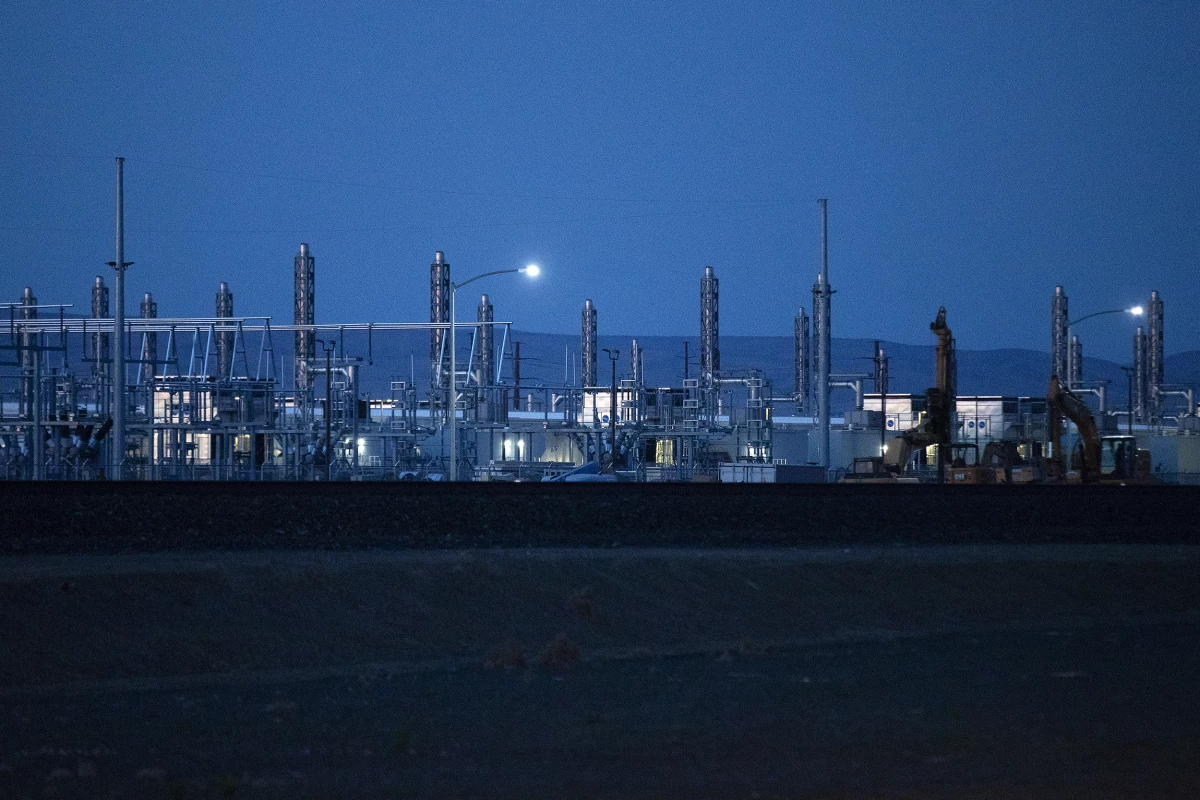
Demand for more artificial intelligence has led to a rapid growth of AI data centers — and lots of concerned citizens. The politicians aren’t far behind.
In recent months, protesters in Virginia, Pennsylvania, North Carolina and other states have shut down proposals for new building sites. A town in Wisconsin is even trying to oust its mayor after approval of a data center there.
The large-scale facilities are necessary to match the electricity demand required for AI, but high energy costs come with them, angering residents.
Virginia Gov. Abigail Spanberger, a Democrat, won her election last year in part by talking about higher energy bills in the state. And the issue is growing in importance for this year’s midterm elections, even getting on the White House’s radar.
“I do think this is going to be a big issue in our politics throughout this year and probably for the foreseeable future,” said Brendan Steinhauser, the CEO of the Alliance for Secure AI, a group pushing for more AI safeguards.
But the issue isn’t exactly divided by party lines.
While President Trump and his AI czar David Sacks have been outspoken about the need for more data center construction and looser regulations on artificial intelligence, other elected officials on both sides of the aisle are taking a different approach.
Sen. Bernie Sanders of Vermont, an independent who caucuses with Democrats, recently proposed a nationwide moratorium on data center construction. On the other side, Republican Sen. Josh Hawley of Missouri has pushed for more regulation of AI, and Florida Gov. Ron DeSantis, a Republican, has urged more caution when it comes to the technology and the companies that create it.
“There are some people that say, you know, the right policy is to just give Big Tech whatever they want, subsidize it and all this stuff, and somehow that’s going to lead us to some happy place. I reject that,” DeSantis said last month.
How lawmakers talk about data centers in elections this year will be critical, according to Steinhauser, who also used to work for Republican campaigns. He says showing a “healthy skepticism” toward tech companies is helpful, especially for Republicans who are looking to take a different approach on AI than the president.
“On this issue, for whatever reason, people are so concerned about it and so worried about it that they’re cheering anyone who is saying the right things or expressing skepticism,” he added.
“When you talk to Republican voters and activists around the country, they’re more closely aligned with Governor DeSantis on this than they are with, say, David Sacks. And I think Republicans in Congress just sort of need to be reminded of that and need to see that more and more,” Steinhauser said.
Top issue
When it comes to higher costs, a topic that remains a top-of-mind issue for voters, according to polling from NPR/PBS News/Marist, the White House has started to weigh in.
This month, Trump and a bipartisan group of governors announced an effort to try to urge PJM, one of the United States’ largest electricity grid operators, to facilitate lower energy costs for consumers. The administration, though, has no authority over how a private company can operate. PJM has also released its own plan.
Technology companies are also starting to respond to public outcry on their own. OpenAI and Microsoft recently announced efforts to curb energy costs for consumers.
“The industry is committed to being a responsible partner in the communities and where they locate but also a responsive partner,” Dan Diorio, the vice president of state policy for the Data Center Coalition, a group that represents AI companies including Meta and Amazon.
Backlash grows
Backlash against the rapid growth of AI data centers has been prevalent in Virginia, which has the world’s highest concentration of data centers. A 2024 independent study commissioned by the state government showed that by 2040, residents could be paying up to $37 more per month on energy. And at a time when voters are putting cost of living at the top of their list of concerns, every increased cost matters.
The high concentration of data centers mostly exists in the northern part of the state, in the suburbs of Washington, D.C. But near Richmond, Va., residents in more rural Hanover County are showing up by the hundreds to protest. And unlike with most other issues, they’re not divided by politics.
“It’s actually been a unifying issue that we haven’t really seen before in a long time, because regardless of whether you’re a Republican or a Democrat, you just don’t want it,” said Jennifer Corpus, who is organizing protests in the area.
Transcript:
MICHEL MARTIN, HOST:
Voters around the country are pushing back against the building of data centers for artificial intelligence. The large-scale facilities are necessary to match the demand for AI, but there are high energy costs that come with them. It’s an issue that was critical in key state elections last year. Now it’s becoming a midterm issue and is drawing White House attention. NPR White House correspondent Deepa Shivaram traveled to Hanover, Virginia, and brings us this report.
DEEPA SHIVARAM, BYLINE: The most popular sign for anti-data-center protesters in Hanover County reads, grow tomatoes, not data centers. They’re everywhere, says Jennifer Corpus, a Hanover resident.
JENNIFER CORPUS: And I think it’s, like, that emotional tie to being, like, this is our county, and this is something that our county’s known for. Like, why do we want to be known for data centers? We don’t.
SHIVARAM: Corpus has been leading protests to convince local leaders to vote against plans for four new data centers in the area.
(SOUNDBITE OF ARCHIVED RECORDING)
UNIDENTIFIED PROTESTERS: (Chanting) The data center’s bound to fail.
UNIDENTIFIED PROTESTER: Hanover is not for sale.
SHIVARAM: She’s concerned about everything from how data centers will impact rural land to higher energy costs.
(SOUNDBITE OF ARCHIVED RECORDING)
CORPUS: Hanover residents do not want data centers.
(CHEERING)
SHIVARAM: The rise of data centers has become a particular issue in Virginia, which has the highest number of data centers than anywhere in the world. An independent review commissioned by the state government showed that by 2040, Virginians could be paying up to $37 more per month in energy costs. In other states, like Wisconsin, North Carolina and Pennsylvania, similar fights are popping up. Brendan Steinhauser leads The Alliance for Secure AI, a group pushing for more AI safeguards. He says the pushback against data centres reflects people’s larger fears.
BRENDAN STEINHAUSER: There’s a fear that’s out there that is real and that is palpable that is informing the way they think about these huge facilities that they see in their neighborhood. And they’re like, what is happening? Why is this happening so fast? Why didn’t I get a say in this?
SHIVARAM: Proponents say they’re crucial for everyday technology use and bring jobs to the area. But the debate has started to become seeped in politics, and it’s not exactly divided by party. Senator Bernie Sanders of Vermont, who caucuses with Democrats, has pushed for a nationwide moratorium. Republicans like Missouri Senator Josh Hawley and Florida Governor Ron DeSantis are both pushing for more regulations. Here’s the governor last month.
(SOUNDBITE OF ARCHIVED RECORDING)
RON DESANTIS: There are some people that say, you know, the right policy is to just give Big Tech whatever they want, subsidize it and all this stuff, and somehow that’s going to lead us to some happy place. You know, I reject that.
SHIVARAM: And while President Trump and his AI czar, David Sacks, have been advocating for more data centers and working closely with tech companies, the White House is starting to respond to voters’ cost concerns, though they have no authority over how private companies can operate. Tech companies, though, are starting to act amid the public backlash. OpenAI and Microsoft both announced initiatives to lower energy and water usage around their data centers. Here’s Dan Diorio from the Data Center Coalition, a group that represents companies like Meta and Amazon.
DAN DIORIO: The industry is committed to being a responsible partner in the communities and where they locate, but also a responsive partner.
SHIVARAM: As both parties gear up for elections later this year, how they talk about data centers could be critical, especially because it hasn’t been defined by party lines, says Steinhauser.
STEINHAUSER: On this issue, for whatever reason, people are just so concerned about it. And they’re so worried about it that I think they’re just cheering anyone who is saying the right things or is expressing skepticism.
SHIVARAM: That’s certainly true for Hanover residents, including Corpus. She says the issue will be a big part of how she votes in local elections.
CORPUS: If someone told me they were anti-data center, they’d have my vote.
SHIVARAM: All the other disagreements, Corpus says, can wait.
Deepa Shivaram, NPR News, Hanover, Virginia.
(SOUNDBITE OF MUSIC)
