


Editor’s note: Some of the video descriptions in this story depict violent arrests.
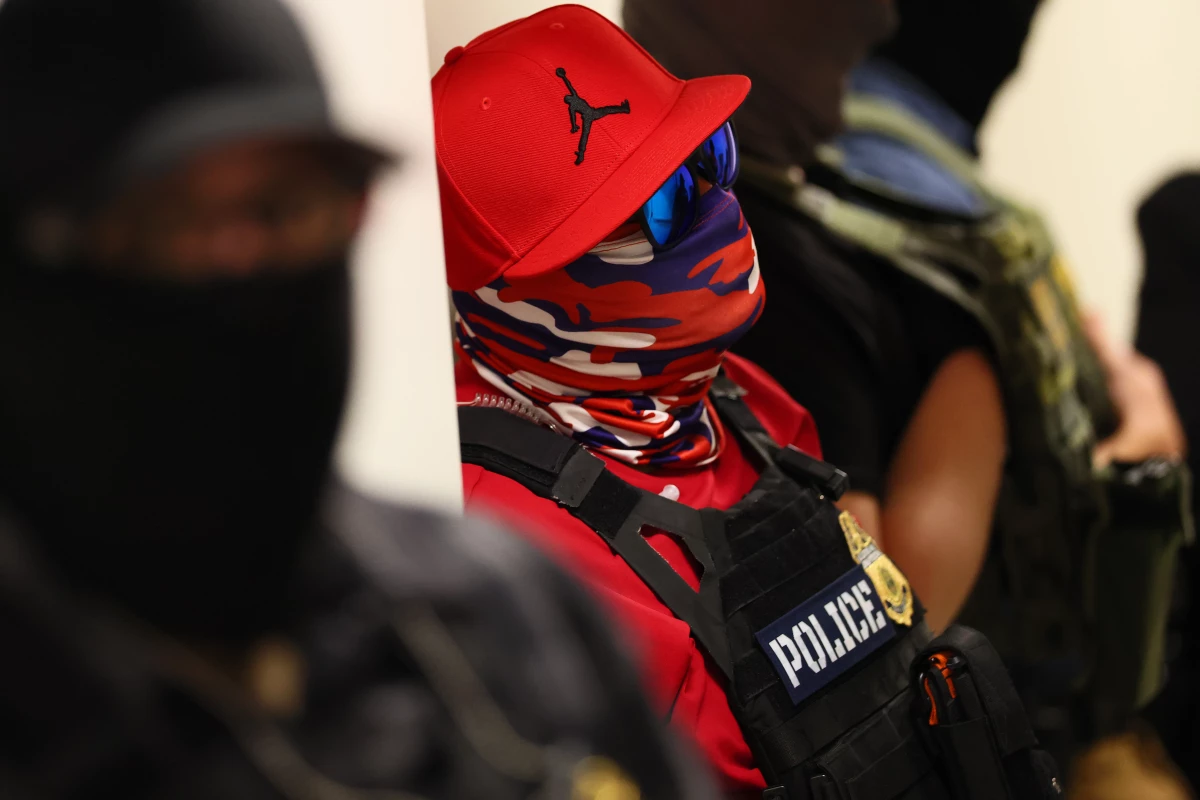
A man lies pinned in the middle of the road, groaning in pain. He’s surrounded by men in tactical gear marked “Police,” their faces covered by masks and dark sunglasses. One officer punches him repeatedly in the head.
Outside a courthouse in San Antonio, a woman and her 3-year-old son are led away by men in plainclothes with their faces obscured. Her husband calls out, “My wife, my son,” in Spanish.
These scenes have been captured in various videos posted online by firsthand witnesses of the Trump administration’s aggressive crackdown on illegal immigration across several U.S. cities.
The arrests follow a pattern: masked agents, including Immigration and Customs Enforcement and other federal officers assigned to work with ICE, wearing plainclothes and sometimes arriving in unmarked vehicles. Department of Homeland Security (DHS) Assistant Secretary for Public Affairs Tricia McLaughlin told NPR that agents are covering their faces to protect themselves from doxing and increasing threats. But civil rights groups and legal advocates say it’s creating fear and undermining public trust.
“It may well be a reason for masking if you are engaged in a clandestine operation against an organized drug ring or a well-armed gang of some sort,” said Stephen Kass, a member of the New York City Bar Association, which last month criticized agents for obscuring their identities through masking. “But that’s not what’s happening here.”
Kass is referring to arrests like the one that Job Garcia witnessed at a Home Depot in Hollywood, Calif.
Garcia, a 37-year-old photographer and Ph.D. student at Claremont Graduate University, had just left the store when he saw men surround a box truck with a Latino man in the driver’s seat. Some wore vests that read “POLICE — U.S. BORDER PATROL,” and their faces were covered.
Then, one smashed the truck’s window.
“Hey, no les abra! Yo, are you f***ing serious, bro?” Garcia is heard yelling in the video he recorded, in which he warns the driver in Spanish to not open his door.
When he stepped closer to film, Garcia says, agents shoved him to the ground.
“Get down! Get him down!” one shouted.
Garcia was detained for more than 24 hours. He said he was never told why, despite repeatedly stating he was born and raised in Los Angeles.
“They never said what I was being detained for,” he said.
Garcia said he recorded agents because he “knew what these supposed ICE agents were doing was wrong, was unlawful,” adding that he wanted them held accountable for how they were going about their arrests.
“When you have masks on, you will look a little bit more terrifying. And I think what they were trying to do is inflict terror in the community,” he said.
Garcia believes the agents appeared to single him out because he’s Latino.
“They saw my appearance as a threat because there were also other white bystanders who were yelling at them. And they didn’t go after them.”
He’s now suing DHS and seeking $1 million in recompense, alleging he was targeted for speaking up.
“What they’re doing is actual terror, and the pain they’re inflicting on the community is huge. Stripping people from their families — this is beyond politics. This is harming actual human beings.”
Garcia is being represented by the Mexican American Legal Defense and Educational Fund (MALDEF).
“There weren’t warrants presented by these Border Patrol or ICE agents to the individuals in the parking lot,” said MALDEF’s Ernest Herrera. “A place where predominantly Latino workers or workers of Latin American origin were seeking work. And they were, we believe, profiled because of that.”
Herrera believes Garcia was also being profiled.
McLaughlin of DHS pushed back on those claims.
“It’s disgusting that he’s going to charge these men and women as if there is some sort of profiling going on,” McLaughlin said.
She said Garcia was arrested because “he assaulted a Border Patrol officer and was actively, verbally harassing them. So it had nothing to do with his citizenship. It’s the fact that he’s actually going forth and assaulting [a] law enforcement officer.”
When asked why Garcia says he was not given an explanation for his arrest or release, McLaughlin said, “He was arrested — I’m happy to share this specific information with you.”
She added, “We have evidence that he did” allegedly assault agents. DHS did not provide NPR with evidence upon request.
McLaughlin also denied reports that ICE agents who wear masks are failing to identify themselves.
“I’ve been on a number of these operations,” she said. “They are wearing vests that say ICE or ERO, which is the enforcement arm of ICE or Homeland Security Investigations. They clearly verbally identify themselves. And they also are flanked by vehicles that also say ‘Homeland Security.'”
When asked about federal regulations that require officers to identify themselves, McLaughlin said masking is about safety.
“These are men and women who [are] being doxed online. We know that people take video of the operations as they’re ongoing. Law enforcement. Their families have been targeted. Their personal addresses and information have been put on sites like Reddit and other online chat forums for people to target them,” McLaughlin said.
Democratic Sens. Alex Padilla of California and Cory Booker of New Jersey have introduced legislation that would ban federal immigration agents from wearing masks during arrests. In June, Padilla was forcefully removed by federal agents from a news conference in Los Angeles while attempting to question DHS Secretary Kristi Noem about the Trump administration’s decision to send in the National Guard to the city.
Kass, of the New York City Bar Association, said his group has other safety concerns.
“It also encourages violence,” he said. “In many states, people are allowed to carry guns. They’re also allowed to stand their ground when they’re accosted by threatening strangers. This is an invitation for somebody to shoot back.”
And, he added, it risks abuse.
“Once they are masked, they do not feel accountable because they do not feel they will be identified.”
There have been scattered reports of people impersonating immigration agents. In Philadelphia, police said a man with a gun and a fake badge robbed an auto shop while claiming to be with ICE. In North Carolina, another man allegedly posed as an agent and forced a woman to have sex under threat of deportation. DHS says it is investigating those reports.
As for Garcia, he says life hasn’t been the same since the arrest. He worries most about his mother, a U.S. citizen who has lived in the United States for four decades and doesn’t speak English well.
“We don’t allow her to go out anymore by herself. Not without one of us with her.” He says fear has taken hold in his community, especially among the most vulnerable. “People are just staying home altogether and not coming out.” He describes feeling othered in his own country.
Speaking out and suing, he says, is his way of taking back some power.
The radio version was produced by Barry Gordemer and edited by HJ Mai and Adam Bearne. The digital version was adapted and produced by Majd Al-Waheidi, and edited by Obed Manuel.
Transcript:
LEILA FADEL, BYLINE: Before we get into this next story, I want to warn you that some of the sounds you’ll hear are of violent arrests. We start with a man pinned down in the middle of a road in Santa Ana, California.
(SCREAMING)
FADEL: He’s surrounded by men in masks, dark sunglasses and green tactical vests that say police on the back. One of them punches the man repeatedly in the head.
(SCREAMING)
FADEL: Outside a court in San Antonio, Texas, a mother and her 3-year-old son are led away by masked men in plain clothes.
(SOUNDBITE OF ARCHIVED RECORDING)
UNIDENTIFIED PERSON #1: (Non-English language spoken).
UNIDENTIFIED PERSON #2: (Non-English language spoken).
FADEL: Her husband cries out, my wife, my son.
(SOUNDBITE OF ARCHIVED RECORDING)
UNIDENTIFIED PERSON #1: (Crying).
UNIDENTIFIED PERSON #3: (Non-English language spoken).
UNIDENTIFIED PERSON #1: (Non-English language spoken, crying).
FADEL: These arrests by immigration agents captured on camera by witnesses in cities across the country have a common thread. In a lot of the videos, the agents are wearing masks, and in some cases, witnesses say they’re not identifying themselves and showing up in unmarked cars. The Department of Homeland Security says it’s for the agents’ safety as they face an increase in assaults. But civil rights groups, immigration advocates and lawyers don’t buy that. That includes the New York City Bar Association that issued a statement on masking. Stephen Kass is a member.
STEPHEN KASS: It may well be a reason for masking if you are engaged in a clandestine operation against an organized drug ring or a well-armed gang. But that’s not what’s happening here.
FADEL: He’s referring to raids like the one Job Garcia happened upon as he left the Home Depot in Hollywood, California.
JOB GARCIA: It was just supposed to be a normal day for me, and that ended up happening.
FADEL: In the parking lot, he saw men surrounding a box truck with a Latino man in the driver’s seat. Garcia says he wasn’t sure if these were really immigration agents that he was seeing. Their faces were covered, although some of them did have on tactical vests that said Police – U.S. Border Patrol. Then they smashed the truck’s window to get to the driver.
(SOUNDBITE OF ARCHIVED RECORDING)
GARCIA: (Non-English language spoken).
(SOUNDBITE OF VEHICLE WINDOW SMASHING)
GARCIA: You are [expletive] serious, bro?
FADEL: Garcia moved closer, yelled, but he never touched the officers in the video. And then he’s being pushed to the ground by some of those masked men.
(SOUNDBITE OF ARCHIVED RECORDING)
UNIDENTIFIED OFFICER: Get him down. Get him down.
FADEL: He was locked up for more than 24 hours, even after telling agents that he was born and raised in Los Angeles, that he’s an American. And then he was let go with no explanation.
GARCIA: They never said what I was being detained for.
FADEL: I asked Garcia why he started filming when he saw the raid.
GARCIA: Because I knew what these supposed ICE agents were doing was wrong, and I wanted to make sure that they would be held accountable.
FADEL: Why do you think they were wearing masks, these agents?
GARCIA: When you have masks on, you will look a little bit more terrifying. And I think what they were trying to do is inflict terror in the community.
FADEL: You’re filming them. You’re saying, what the F is going on? You’re very upset. Do you think that they saw you as threatening?
GARCIA: They saw my appearance as a threat ’cause there was also other white bystanders who are yelling, and they didn’t go after them.
FADEL: It’s why he’s suing DHS. Garcia says he was targeted for speaking up and because he’s Latino.
GARCIA: What they’re doing is actual terror, and the pain they’re inflicting on the community is huge. Stripping people from their families. I guess I would just want people to know that this is beyond politics. This is harming actual human beings.
FADEL: Department of Homeland Security Assistant Secretary for Public Affairs Tricia McLaughlin says that the accusation of profiling and trying to inflict terror…
TRICIA MCLAUGHLIN: It’s disgusting, and it’s wrong.
FADEL: She tells a different story.
MCLAUGHLIN: He was arrested because he assaulted a Border Patrol officer and was actively verbally harassing them. So had nothing to do with his citizenship. It’s the fact that he’s actually going forth and assaulting law enforcement officers who are trying to (ph)…
FADEL: But he wasn’t charged with assault, and he was told that he did – he was never told why.
MCLAUGHLIN: He was arrested, yes.
FADEL: OK.
MCLAUGHLIN: I’m happy to share this specific information with you.
FADEL: Sure.
MCLAUGHLIN: This is something I feel we can indeed (ph)…
FADEL: What he said to us was he was released without explanation, and he was never charged with anything and that other…
MCLAUGHLIN: Yeah, but we have evidence that he did.
FADEL: After the interview, we asked for that evidence. It was not provided. McLaughlin also denied accusations by witnesses in multiple cases that ICE officers who wear masks do not always properly identify themselves during raids and sometimes wear plain clothes and drive unmarked vehicles.
MCLAUGHLIN: I’ve been on a number of these operations, and they are wearing vests that say ICE or ERO, which is the enforcement arm of ICE or Homeland Security Investigations. They clearly verbally identify themselves as well, and they also are flanked by vehicles that also say Homeland Security.
FADEL: How does it protect them to cover their faces? I mean, how do you comply with the code of federal regulations that require agents to identify themselves?
MCLAUGHLIN: These are men and women who they’re being doxxed online. We know that people take video of the operations as they’re ongoing. Law enforcement, their families have been targeted, their personal addresses and information have been put on sites like Reddit and other online chat forums for people to target them and go after them.
FADEL: Because of the growing concern, Democratic Senators Alex Padilla and Cory Booker just introduced legislation that would ban immigration officers from wearing masks. And the New York lawyer, Stephen Kass, who you heard from earlier, says he and the New York City Bar Association have another major concern.
KASS: It also encourages violence. In many states, people are allowed to carry guns. They’re also allowed to stand their ground when they’re accosted by threatening strangers. This is an invitation for somebody to shoot back or to respond with pepper spray or even Mace.
FADEL: Or violence from the officers.
KASS: Once they are masked, they do not feel accountable because they do not feel they will be identified.
FADEL: And now there are scattered reports across the country of criminals impersonating immigration officers. Police in Philadelphia say a man with a gun, a badge and who identified as ICE robbed an auto repair shop. In North Carolina, a man’s accused of telling his victim he was an ICE agent before forcing her to have sex with him under the threat of deportation. Homeland Security says they take these reports seriously and are looking into them. In the meantime, since his arrest, Job Garcia says his life has forever changed.
GARCIA: I feel nervous, and more so the people who are actually most vulnerable. They’re scared. And I’ve just heard stories of people just staying home altogether and not coming out.
FADEL: And he’s most afraid for his mother. She’s a citizen, but she doesn’t speak English well.
GARCIA: We don’t allow her to go out anymore by herself, not without one of us with her. I mean, she’s been here for about 40 years.
FADEL: He says he feels othered in his own country, hopeless. But speaking up and suing, it’s his way of taking power back.
(SOUNDBITE OF MUSIC)
