


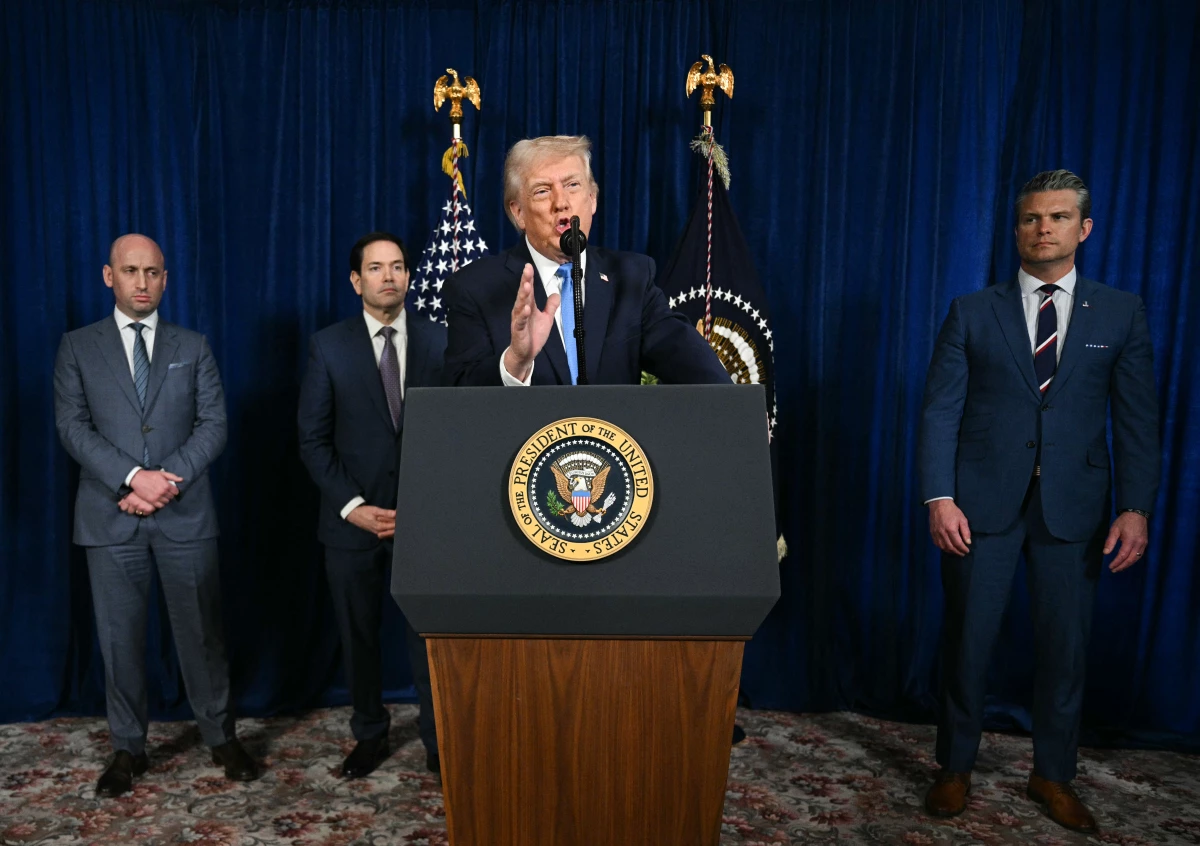
President Trump escalated the U.S. drug war in dramatic fashion early Saturday, ordering the invasion of Venezuela and removing that country’s president Nicolás Maduro and his wife, Cilia Flores, who were quickly charged with narcotics trafficking by the U.S. Justice Department.
But the stunning military action comes at a time when Trump has also freed or pardoned other convicted drug dealers and people accused of ties to drug gangs and cartels – notably the former president of Honduras.
Targeting a ‘campaign of deadly narco-terrorism’
Venezuela’s Maduro and Flores face charges of “drug trafficking and narco-terrorism conspiracies,” according to an indictment made public by U.S. Attorney General Pam Bondi. “They will soon face the full wrath of American justice on American soil in American courts,” Bondi said in a post on social media.
The Justice Department charged Maduro in March 2020, during Trump’s first administration, in connection with alleged narcoterrorism and drug smuggling into the United States.
That indictment alleged Maduro was the leader of the Cartel de los Soles, and that he and other defendants took part in a narco-terrorism conspiracy with the Colombian guerrilla group known as the Revolutionary Armed Forces of Colombia (FARC).
During a Saturday news conference, Trump acknowledged other motives that led him to order the attack, including his desire to seize control of Venezuela’s oil fields. But he pointed to drug trafficking as a key factor, accusing Maduro of a “campaign of deadly narco-terrorism against the United States and its citizens.”
Since taking office, Trump has rapidly shifted the fight against drug overdose deaths in the U.S. from a public health response to aggressive interdiction efforts led in unprecedented ways by the U.S. military.
Trump has designated a growing number of drug cartels as terrorist organizations, ordered the U.S. Navy to target alleged drug boats in a series of deadly strikes, and designated the street opioid fentanyl as a weapon of mass destruction.
The shift, and Saturday’s military action, has drawn praise from conservative supporters.
“[Maduro’s capture] is a massive improvement over what we’ve had, which is a narco-dictatorship, which has been weaponizing drugs and mass migration against the United States,” said Andrés Martínez-Fernández, an expert on Latin America at the Heritage Foundation, in a statement posted on social media.
But despite Trump’s tough rhetoric and actions, he also has sparked controversy by some of his recent pardons.
‘Using the drug war as an excuse’
Last month, Trump freed former Honduran President Juan Orlando Hernandez, who had been convicted in the U.S. of helping smuggle more than 400 tons of cocaine into the U.S.
Jeffrey Singer, a drug policy analyst at the libertarian Cato Institute, said given Trump’s pattern of leniency for some alleged drug criminals, he’s skeptical that narcotics interdiction was a serious goal of Saturday’s operation in Venezuela.
“If this is what’s motivating [Trump], if it’s stopping drug trafficking, why is he pardoning the Honduran president who was convicted of cocaine trafficking? It’s never been about that,” he said.
According to Singer, it’s dangerous for the U.S. government to use criminal drug charges as justification for the military invasion of another country, and seizure of a foreign leader, without first getting authorization from Congress. “They’re basically using the drug war as an excuse,” he added.
During his news conference on Saturday, Trump said his decision to pardon Honduras’s former president reflected his belief that Hernandez was prosecuted unfairly by the Biden administration.
“This was a man who was persecuted very unfairly,” he said, without offering evidence. “That man was treated very badly and unfairly, that’s why I gave him a pardon.”
Tough talk, yet some drug criminals go free
But Hernandez isn’t an isolated case. During his second term, Trump has pardoned and released a significant number of other figures involved in drug trafficking, including Ross Ulbricht who was serving a life sentence for creating a “dark web” site known as Silk Road, used by drug traffickers.
“Ulbricht deliberately operated Silk Road as an online criminal marketplace intended to enable its users to buy and sell drugs and other illegal goods,” said the DOJ in a 2015 statement.
Trump also granted clemency to Larry Hoover, 74, who was serving multiple life sentences in federal prison for crimes, including drug trafficking, linked to his role leading the Chicago-based Gangster Disciples.
In August, Democratic Rep. Robert Garcia raised “serious concern” after the Trump administration freed and deported to El Salvador a man named Cesar Humberto Lopez-Lario, accused by the DOJ of being “a high-ranking leader” of the drug gang MS-13. “Such a decision not only undercuts ongoing federal investigations but also threatens U.S. national security,” Garcia wrote.
Previously, during his first term in the White House, Trump’s administration also freed Gen. Salvador Cienfuegos Zepeda, Mexico’s former Secretary of National Defense in 2020. Cienfuegos faced accusations in the U.S. of partnering closely with drug cartels that funneled vast amounts of drugs into the U.S.
“There’s a lot of mixed messages and mixed signals [from the White House] which creates sort of chaos and uncertainty,” said Singer at the Cato Institute, in a May interview with NPR. “On the one hand you’re threatening even tougher penalties on people who deal in drugs, while on the other hand you’re releasing drug dealers from prisons.”
–Portions of this developing story were published in a previous NPR news report on May 31, 2025.
