


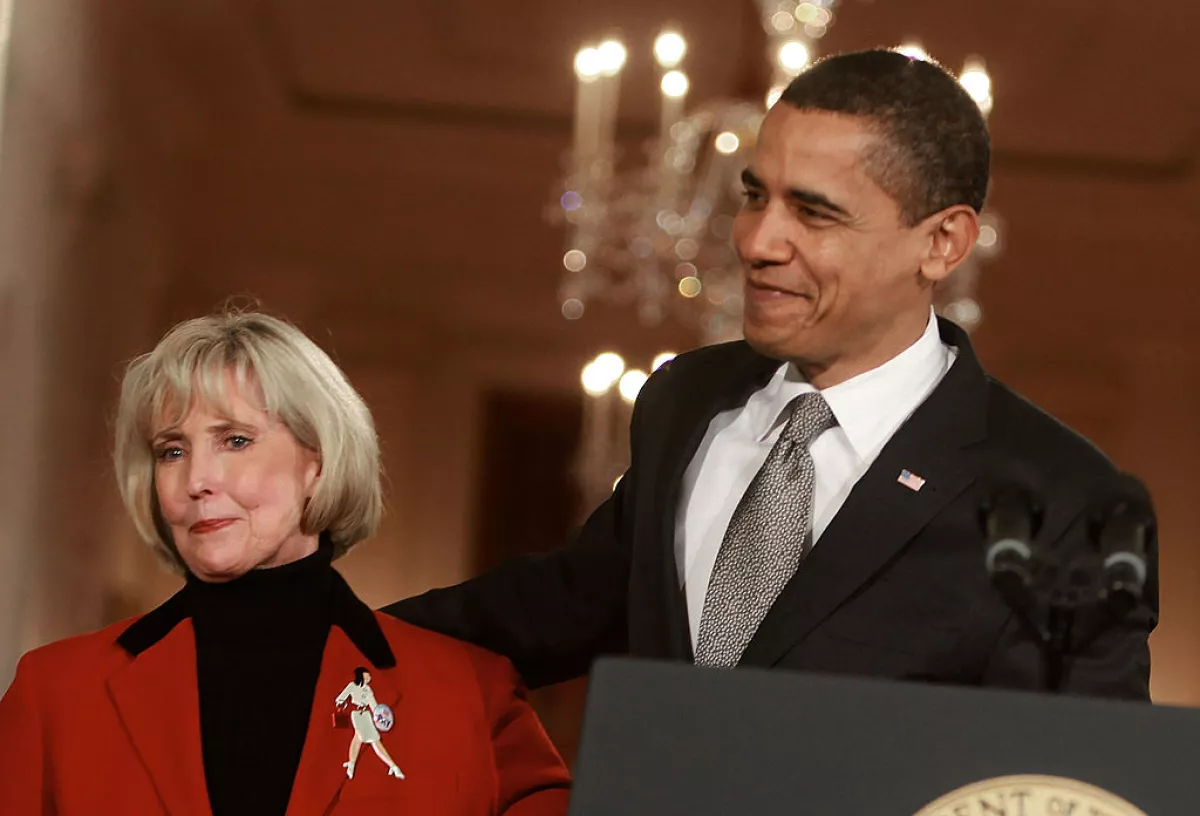
Lilly Ledbetter, a women’s equality activist whose fight for pay equity led to passage of the monumental Lilly Ledbetter Fair Pay Act of 2009, died Saturday. She was 86.
Ledbetter’s death was confirmed on Monday by Jodi Solomon, her speaking manager.
“She was fierce, she was a crusader and just a really good friend. She will be missed a lot,” Solomon told NPR.
Born in Jacksonville, Ala., Ledbetter was hired as a supervisor at a Goodyear tire plant in Gadsden, Ala., in 1979. Years later, she discovered through an anonymous note left in her mailbox that she was receiving less pay than her male co-workers who worked the same position.
“When I saw that, it took my breath away. I felt humiliated. I felt degraded,” Ledbetter recalled in an interview with NPR in 2009. “I had to sort of get my composure back to go ahead to perform my job and then, the first day off, I went to Birmingham, Ala., and filed a charge with the EEOC.”
That action in 1998 was the beginning of a 10-year legal fight for Ledbetter toward equity.
She retired from Goodyear 11 months after she found out about the pay disparity and filed a gender discrimination lawsuit against the company in 1999. She won the suit in 2003 and was awarded more than $3 million, but the amount was reduced to $300,000 because of a statutory cap and $60,000 in back pay. Goodyear appealed the decision to the Supreme Court, arguing that Ledbetter could only win damages or back pay for the 180 days prior to the filing of her claim. In 2007, the high court agreed in a 5-4 ruling.
In her dissent, Justice Ruth Bader Ginsburg said Ledbetter’s case is “not time barred” and wrote the issue “is in Congress’ court.”
Less than two years later, Congress passed the Lilly Ledbetter Fair Pay Act of 2009, which amended the Civil Rights Act of 1964 and allows workers to “obtain relief, including recovery of back pay, for up to two years preceding the filing of the charge.” Then-President Barack Obama signed the measure into law on Jan. 29, 2009, the first bill he signed as president.
Obama paid a tribute to Ledbetter in a statement on Sunday.
“Lilly Ledbetter never set out to be a trailblazer or a household name. She just wanted to be paid the same as a man for her hard work,” he wrote. “Lilly did what so many Americans before her have done: setting her sights high for herself and even higher for her children and grandchildren. Michelle and I are grateful for her advocacy and her friendship, and we send our love and prayers to her family and everyone who is continuing the fight that she began.”
Ledbetter has been recognized for her advocacy on pay equity and her story continues to resonate.
Last week, Ledbetter was honored with a Lifetime Achievement Award from Advertising Week for her activism on Equal Pay. Lilly, a movie based on Ledbetter’s life, is being shown at screenings across the country.
NPR’s Nina Totenberg contributed to this report.
Transcript:
JUANA SUMMERS, HOST:
Lilly Ledbetter, an activist whose fight for pay equity led to passage of the landmark Lilly Ledbetter Fair Pay Act of 2009, died on Saturday. She was 86 years old. NPR’s Chandelis Duster is here to help us remember Ledbetter and her legacy. Hi there.
CHANDELIS DUSTER, BYLINE: Hi.
SUMMERS: So Chandelis, just start by telling us a bit about Lilly Ledbetter and her life.
DUSTER: When I spoke with her long-time speaking manager, Jodi Solomon, she called her fierce, a crusader and a really good friend. She was born in Jacksonville, Alabama, and worked as a supervisor at a Goodyear tire plant in Gadsden, Alabama, when she found out she was being paid less than her male co-workers for the same job. She ultimately filed a complaint with the Equal Opportunity Employment Commission and a lawsuit. She won, but the Supreme Court ultimately ruled that her claim was filed too late. Still, Justice Ruth Bader Ginsburg challenged Congress to take up the issue of fair pay, and that culminated in the Fair Pay Act of 2009.
In the decades since her case, her story still resonates. Just last week, Ledbetter was honored with a Lifetime Achievement Award from Advertising Week for her activism on equal pay. A movie called “Lilly” that is based on her life, is being shown at screenings across the country. And former President Barack Obama, who signed the bill named after her into law, also paid tribute to Ledbetter. He said in a statement that she did what so many Americans before her have done – setting her sights high for herself and even higher for her children and grandchildren.
SUMMERS: I mean, this case was quite monumental. Let’s take a listen to some of what former President Obama had to say back in 2009.
(SOUNDBITE OF ARCHIVED RECORDING)
BARACK OBAMA: This is the only the beginning. I know that if we stay focused, as Lilly did, and keep standing for what’s right, as Lilly did, we will close that pay gap, and we will make sure that our daughters have the same rights, the same chances and the same freedoms to pursue their dreams as our sons.
SUMMERS: How have her activism and the legislation affected the pay gap between men and women?
DUSTER: Her activism has led to changes, especially when it comes to pay in the workplace, including allowing workers to have more time to present a pay discrimination case. And while there is more work to be done on pay equity, there has been some progress. The Pew Research Center released a report last year that shows the gender pay gap has narrowed. Forty years ago, women earned 65 cents for every dollar that men earned. Fast forward to 2022, women earned 82 cents for every dollar that men did.
SUMMERS: As you’ve just been describing, this was a fight that was incredibly meaningful to Ledbetter. I know that back in 2009, she shared some advice for working women with NPR’s Michel Martin. Let’s take a listen.
(SOUNDBITE OF ARCHIVED NPR BROADCAST)
LILLY LEDBETTER: I would like to tell the young women who are out there working to be aware of what’s happening to them in their job and to keep their goals set high and to strive to achieve them and step up – don’t step back – to get what they’re entitled to because we do live in a great country.
SUMMERS: And, Chandelis, how would you characterize her legacy when it comes to young women in the workplace?
DUSTER: Her case has inspired some women to become bolder about advocating for themselves and their pay in the workplace. Fatima Goss Graves, who is president and CEO of the National Women’s Law Center, remembered Ledbetter in a statement, saying, even into her 80s, Lilly never hesitated to hop on planes to speak to women across the country about why they must actively fight for wage equality. Former House Speaker Nancy Pelosi praised Ledbetter for her work and said her name is synonymous with courage, opportunity and progress.
SUMMERS: That’s NPR’s Chandelis Duster. Thank you.
DUSTER: Thank you so much.
