


In 1934, the Washington Post called Elder Lightfoot Solomon Michaux the “best known” Black man in America. They weren’t wrong. By that year, Michaux, preacher and founder of the Gospel Spreading Church of God, had been delivering his religious message to more than 25 million radio listeners each week, according to Suzanne Smith, a historian at George Mason University.
Michaux was known as the “Happy Am I” preacher because of his cheerful demeanor, gospel-filled services and his jaunty theme song of the same name.
He started preaching in 1917 in Hopewell and Newport News, Va., according to a biography about his life, Elder Lightfoot Solomon Michaux: His Social and Political Interests and Influence by Lillian Ashcraft-Eason. He preached a message of positivity and racial harmony. In 1926, he was arrested for performing integrated baptisms in Virginia.
This was also during the Great Migration when more than six million Black Americans left the South and headed North — subsequently, his church in Virginia grew.
“When I was a little boy and my father took me to the church, there were so many people in there, there were no seats,” Joseph Sturdivant, a longtime member of the Church of God congregation, told Radio Diaries.
In 1928, Michaux established a permanent Church of God location on Washington D.C.’s Georgia Avenue. He began broadcasting his services for an hour a week on an independent station, WJSV. When WJSV was sold to CBS in 1932, Michaux’s radio program went national.
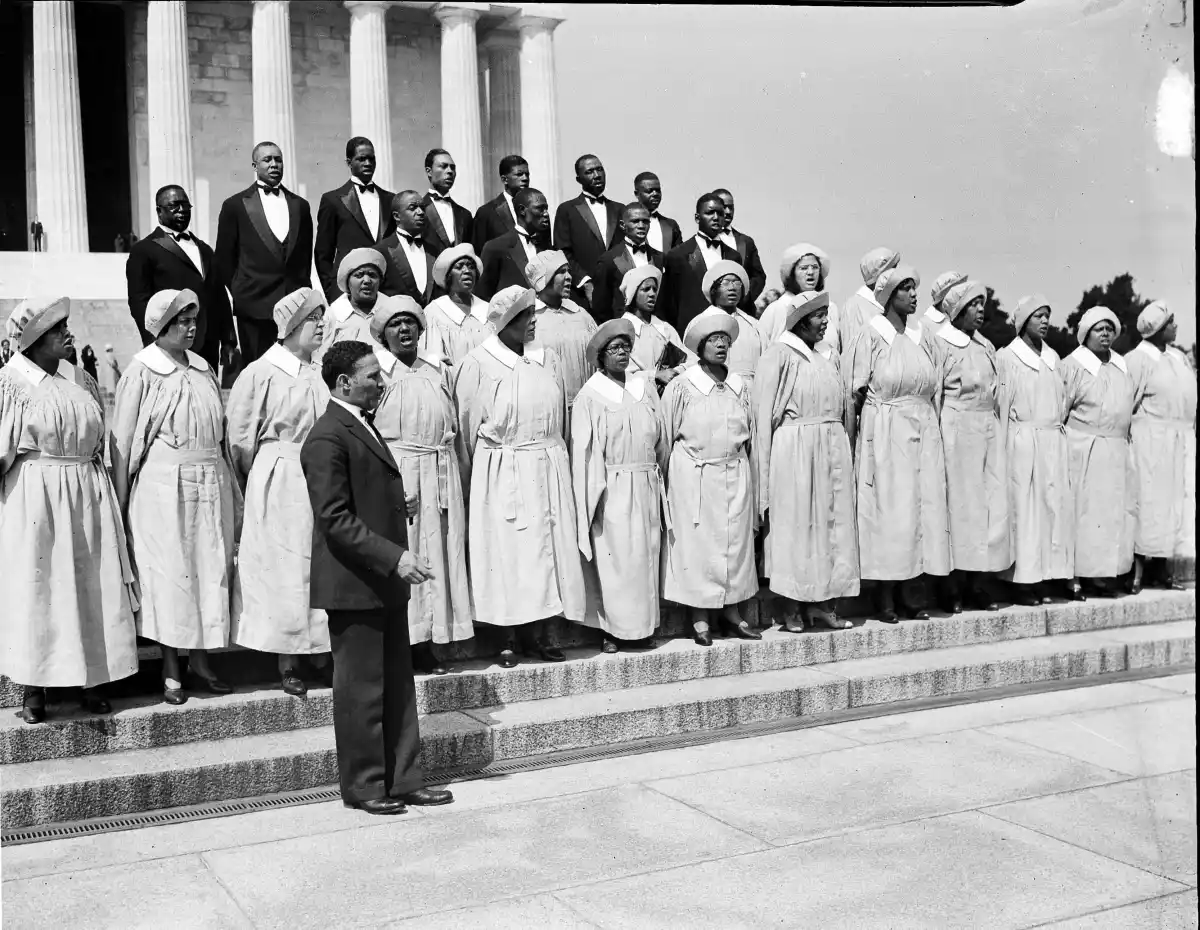
Sturdivant, who was part of the backing band for the Church of God choir, recalled visitors from other cities traveling to Washington to see Michaux’s broadcast church services.
“Sometimes you would have busloads of people, white people, that would come from different cities just for that broadcast,” Sturdivant said.
Ashcraft-Eason, a Newport News native, was a member of the church in the 1940s and often traveled to Washington to view the broadcast services.
“There were other good preachers, but the Church of God made you feel special,” Ashcraft-Eason told Radio Diaries.
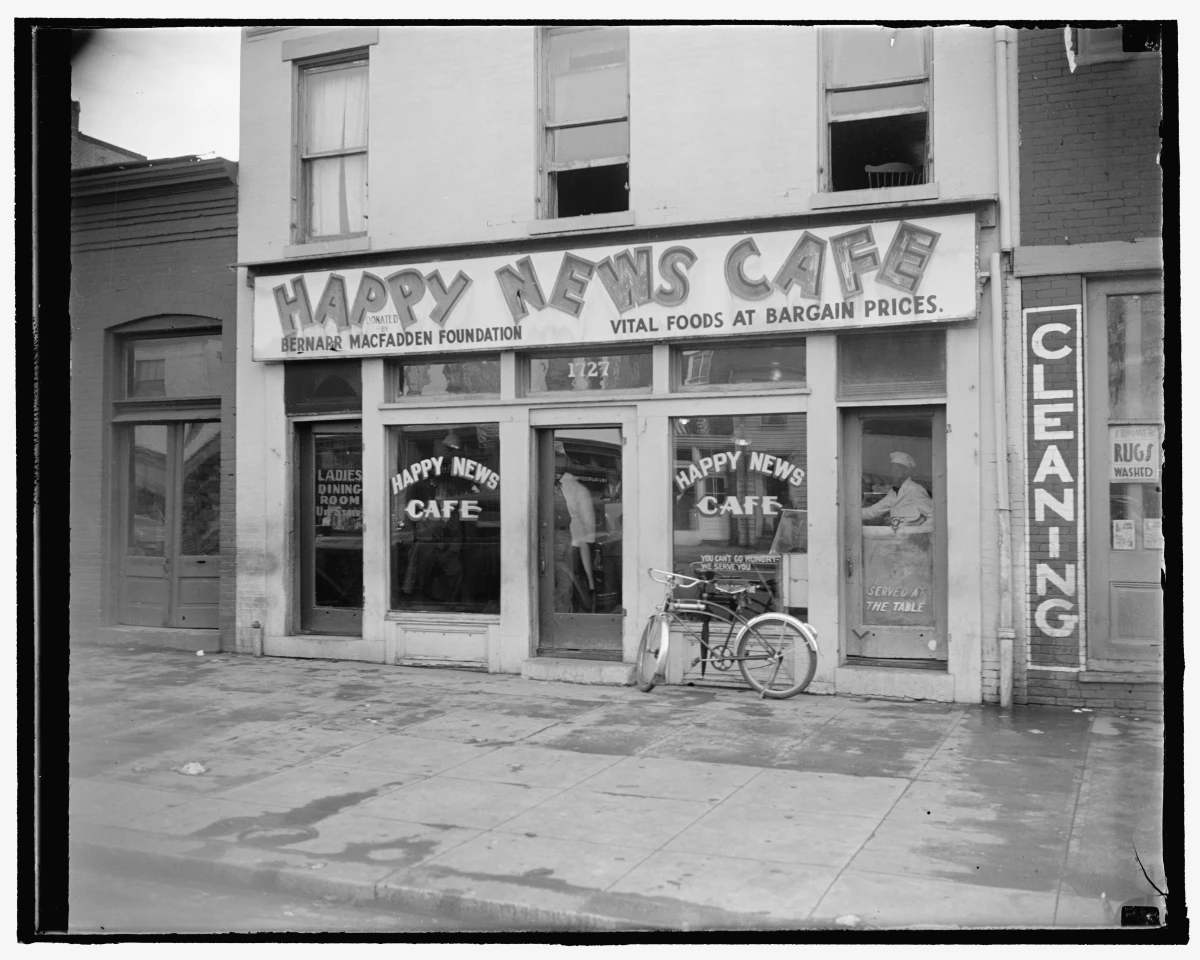
In 1933, Michaux started a philanthropic program called the Good Neighbor League, which provided food and housing for evicted persons in the Washington, D.C. area. The church also started the Happy News Café, a restaurant with cheap or free meals.
“Your friends, your associates, were all members of the Church of God,” Ashcraft-Eason said. “That was your family. Elder Michaux was like your father.”
As a prominent preacher in the nation’s capital, it wasn’t long before Michaux’s influence reached the political sphere. In 1940, Ashcraft-Eason wrote in her book that Michaux spoke in support of Franklin D. Roosevelt at the Democratic National Convention. He was later seen at the White House with Presidents Harry S. Truman and Dwight D. Eisenhower.
“The presidents [saw] him as someone who is a national voice that African Americans listen to, that if he endorses them in any way in his broadcasts, it will get African Americans to vote for them,” Smith, who’s working on a biography about the preacher, told Radio Diaries.
“He knew how to find favor with white people,” Smith says. “That was his strategy throughout his life for trying to uplift his race.”
The rift between King and Michaux
It was his proximity to politics that placed Michaux on the radar of FBI Director J. Edgar Hoover in the 1940s.
“Hoover is trying to cultivate his relationships with religious leaders to shore up support for his own investigative missions and just his general power in the government,” Smith says.
Lerone A. Martin, director of the Martin Luther King Jr. Research and Education Institute at Stanford University, explored declassified documents detailing communication between Michaux and the FBI for a scholarly article. Memos detail outreach from Michaux to the FBI as early as the 1930s.
“Michaux says that I’m a Christian, I know that the FBI is a Christian organization, and together, we can make sure that communism doesn’t get a foothold in this country,” Martin told Radio Diaries.
But according to Martin, Michaux’s communication with the FBI “heat[ed] up” once another preacher began rising to prominence: Martin Luther King, Jr.
King’s leadership during the Montgomery Bus Boycott in the mid-1950s launched him onto the national scene. However, King’s activism also sounded alarms at the FBI.
“[Hoover] believes that there is a communist conspiracy at root within the Civil Rights Movement, and particularly with Martin Luther King Jr.,” Martin says.
Just a year after the Montgomery Bus Boycott, the FBI began its Counterintelligence Program, or COINTELPRO, to disrupt the Communist Party in the United States. By the 1960s, this program was targeting Civil Rights leaders like King.
“That’s the moment where the FBI is plotting and thinking that Michaux may be useful,” Martin told Radio Diaries. “They will call Michaux into service. Anytime they need someone to launder information for them, they’ll call in Michaux and he’ll do so on his radio broadcast.”
As King became more public with his grievances against Hoover, Michaux went more public with his grievances against King. Michaux made headlines in 1964 for writing a letter to King, calling on him to apologize to Hoover for creating a “feud that now threatens America.” The following year, Michaux and his followers picketed one of King’s Southern Christian Leadership Conference meetings. Speaking to the New York Times, Michaux argued that King’s demands, such as an economic boycott of the state of Alabama, could “destroy the progress the Negro has made.”
“Don’t worry about ’em in Alabama or anywhere else, all of us are going to die,” Michaux preached in a 1963 broadcast. “But what we have to do is make sure when we do die, we got a home in the sky. And don’t let malice, or envy, don’t let the newspapers, nor the radios stir you up. Just get on your knees and pray for ’em.”
“Michaux is saying, all this protest, all this nonsense, all this jostling for rights is absurd,” Martin says. “He goes about saying that racial equality is a worthy thing to pursue but it’s never going to materialize until God establishes his rule in people’s hearts. Martin Luther King’s dream is just silly.”

The rift between King and Michaux left some church members torn.
“I remember feeling a conflict,” says Ashcraft-Eason. “There was the Civil Rights Movement, that was good. There was the Church of God, that was good. So, how do you live with those two forces?”
Black newspapers criticized Michaux’s antagonism towards King. Responding to the Church of God’s picket of King’s meetings, the Baltimore Afro-American wrote that given Michaux has been a “vigorous campaigner for equal rights,” they “regret to see him on the side of the oddballs.”
“You had entertainers of the day, popular entertainers of the day who were coming out in support of Civil Rights,” says Martin. “He didn’t adjust. He stayed with the ‘Happy Am I’ formula. And I think many Americans at this time, especially Black Americans, began to not really enjoy the form.”
Michaux died of a heart attack in October of 1968, just months after King’s assassination.
“People often don’t want to acknowledge that [Michaux] had such a popular following because his politics now, in retrospect, were on the wrong side of history,” Martin says.
Michaux’s church, the Gospel Spreading Church of God, still stands on Georgia Avenue, across from Howard University Hospital. The congregation is smaller now, but they still meet for services on the first and third Sunday of each month. Now in his 90s, Sturdivant is still a member. He helps publish the church’s paper, The Happy News. Michaux’s sermons are still often printed in that paper.
“There was only one Elder Michaux,” Sturdivant says. “We just try to live according to the gospel that he preached. What he taught us is still true. He’s not here, but the gospel is still here.”
This story was produced by Mycah Hazel and the team at Radio Diaries. It was edited by Deborah George, Joe Richman and Ben Shapiro. You can find more stories on the Radio Diaries Podcast.
Transcript:
ROB SCHMITZ, HOST:
Today, we’re bringing you another installment of radio diary series Making Waves, about influential and controversial broadcasters. In 1934, the Washington Post called Elder Lightfoot Solomon Michaux, the best-known Black man in America. Known as the Happy Am I preacher, Michaux’s Sunday services were broadcast to more than 25 million listeners on CBS radio. But when the Civil Rights Movement came around, Michaux’s popularity took a turn.
(SOUNDBITE OF ARCHIVED RECORDING)
UNIDENTIFIED GROUP: (Singing) Happy am I with my redeemer, singing along the homeward way.
UNIDENTIFIED ANNOUNCER: Good morning from the nation’s capital. From the Church of God in Washington, D.C., we bring you now its regular Sunday morning service conducted by Elder Lightfoot Solomon Michaux.
JOSEPH STURDIVANT: When I was a little boy and my father took me to the church, there were so many people in there, there was no seats.
LILLIAN ASHCRAFT-EASON: You see the band, the choir. And then you see him waltz into the church and jump up on the pulpit. And then the choir starts singing “Happy Am I.”
(SOUNDBITE OF SONG, “HAPPY AM I”)
UNIDENTIFIED GROUP: (Singing) Happy am I with my redeemer, singing along the homeward way, and telling the lost of His great love, the lost of His great mercy. Happy am I…
ASHCRAFT-EASON: Then he would begin his sermon. And even as a child, you knew to be still and to listen.
(SOUNDBITE OF ARCHIVED RECORDING)
LIGHTFOOT SOLOMON MICHAUX: Good morning, is everybody happy? This is Elder Lightfoot Solomon Michaux, the Happy Am I preacher, come this morning to tell you Jesus loves you.
STURDIVANT: My name is Joseph Sturdivant, and I’ve been a member of the Church of God since birth, 1933, and I’m still there.
ASHCRAFT-EASON: My name is Lillian Ashcraft-Eason. I was born into the Church of God in 1940.
(SOUNDBITE OF MUSIC)
ASHCRAFT-EASON: There were other good preachers. But the Church of God made you feel special. People in the church thought that they could go to him with any problem that were bothering them within their lives. There was the Great Depression, for example, and a lot of peoples came to the church because they were hungry.
STURDIVANT: The Happy-Am-I cafe was down on 7th Street. You could get a meal for 1 cent. And the interesting thing about that cafe was that we fed a lot of white people. He was always looking to do things that other preachers wouldn’t do (laughter).
ASHCRAFT-EASON: Your friends, your associates, were all members of the Church of God. That was your family. Elder Michaux was like your father.
(SOUNDBITE OF ARCHIVED RECORDING)
MICHAUX: I’m not much of a singer, but I thank God for my song. I’m on my way rejoicing. I’m happy all day long.
LERONE MARTIN: He’s known as the Happy Am I preacher, so he has this kind of charisma, smiling, very happy. My name is Dr. Lerone Martin, and I am the director of the Martin Luther King Jr. Research and Education Institute at Stanford University. He knows how to put people at ease, how to make people laugh.
(SOUNDBITE OF ARCHIVED RECORDING)
MICHAUX: When the load get heavy and the way seems dreary, I just keep on singing my song, “Happy Am I.” There were many who ridiculed him. One detractor called it a religious version of “Amos ‘n’ Andy,” but he also had a great deal of supporters.
STURDIVANT: Sometimes, you would have busloads of people, white people, that would come from different cities just for that broadcast. It was unusual to have something like that going on.
(SOUNDBITE OF ARCHIVED RECORDING)
MICHAUX: Ain’t no white, nor black, brown, nor yellow, nor red with God.
(CROSSTALK)
MICHAUX: I said, I’d die for a white man as quick as I would for a Black man. God’s grace is for every human race.
MARTIN: Michaux is someone I think that we can point to as a radio genius in the sense that he’s able to do something that most of us could not imagine by having a nationwide broadcast that is extremely popular with both Black and white listeners. And this is an African American man in the early ’30s.
(SOUNDBITE OF MUSIC)
SUZANNE SMITH: He decides to support Franklin Delano Roosevelt in his first election to the White House and go on the radio and encourage African Americans to vote and really brings in a lot of votes for him. I am Suzanne Smith. I’m a professor of history at George Mason University, and I’m currently working on my book project on Elder Lightfoot Solomon Michaux.
Once he develops that relationship with Roosevelt, Truman and Eisenhower also see him in a similar vein. The presidents see him as someone who is a national voice that African Americans listen to that, if he endorses them in any way in his broadcasts, it will get African Americans to vote for them.
(SOUNDBITE OF MUSIC)
MARTIN: He ingratiates himself with these presidents, in many ways by flattery. He writes to Truman, and he says, You’re God’s man, and in fact, look at your name. Your name says, true man ’cause you are a true man. He is a constant figure in the White House, even if he’s being brought to the White House under the cover of darkness.
STURDIVANT: Generally, Black people didn’t go in the White House. My father-in-law was his chauffeur at one time, and he said, he would take him to the White House, but they would usually go there about 2 o’clock in the morning when nobody could see him going in there (laughter). Whoever heard anybody do anything like that?
SMITH: He’s very much a wheeler dealer.
MARTIN: He sincerely believes that having insider status is what’s going to help people of color the most – not protesting power, but trying to work with power.
(SOUNDBITE OF ARCHIVED RECORDING)
UNIDENTIFIED NARRATOR: Upon the shoulders of John Edgar Hoover, director of the FBI since 1924, rests heavy responsibilities. Not only must he direct the Bureau’s offensive against subversive agents…
SMITH: He knew how to find favor with white people. That was his strategy throughout his life for trying to uplift his race. In the 1940s, he starts communicating with J. Edgar Hoover, and J. Edgar Hoover was tremendously revered by most Americans. They felt he was somebody who was fighting crime in America and fighting communism in America and doing a good job.
MARTIN: Michaux says that I am a Christian. I know that the FBI is a Christian organization. And together, we can make sure that communism doesn’t get a foothold in this country.
SMITH: Hoover is trying to cultivate his relationships with religious leaders to shore up support for his own investigative missions and his general power in the government.
MARTIN: Their relationship heats up after King’s I Have A Dream address at the March on Washington in August of 1963.
(SOUNDBITE OF ARCHIVED RECORDING)
MARTIN LUTHER KING JR: Even the state of Mississippi, a state sweltering with the heat of injustice, sweltering with the heat of oppression, will be transformed into an oasis of freedom and justice. I have a dream.
MARTIN: Hoover is concerned about this. He believes that there is a communist conspiracy at root within the Civil Rights Movement and particularly with Martin Luther King Jr. That’s the moment where the FBI is plotting and thinking that Michaux may be useful. They will call Michaux into service. Any time they need someone to launder information for them, they’ll call in Michaux, and he’ll do so on his radio broadcast.
(SOUNDBITE OF ARCHIVED RECORDING)
MICHAUX: Don’t worry about them in Alabama or anywhere else. All of us are going to die. But what we want to do is we show, when we do die, we’ve got a home in the sky.
MARTIN: Michaux is saying, all this protest, all this nonsense, all this jostling for rights, is absurd.
(SOUNDBITE OF ARCHIVED RECORDING)
MICHAUX: And don’t let malice or envy – don’t let the newspapers nor the radios stir you up. Just get on your knees and pray for them. Amen.
MARTIN: He goes about saying that racial equality is a worthy thing to pursue, but it’s never going to materialize until God establishes his rule in people’s hearts. Martin Luther King’s dream is just silly. I do think Michaux sees King’s rise in some ways as a threat. Not only is King rising to power, but he’s getting recognition. At the end of 1963, he’s informed by TIME magazine that he’s the man of the year.
ASHCRAFT-EASON: He was trying to hold on to his members, and he didn’t want them over there in the Civil Rights Movement. That was going to take them away from the church and maybe away from their membership. I remember feeling a conflict. There was the Civil Rights Movement. That was good. There was the Church of God. That was good. So how do you live with those two forces?
STURDIVANT: When Martin Luther King made the speech, Elder Michaux told us that that dream was not going to come true in this world. Now, he wasn’t against Martin Luther King. He didn’t say that. But the Lord is going to have to work that out. It’s more than a man could do. And Elder Michaux told us that that was the way it was going to be.
(SOUNDBITE OF MUSIC)
SMITH: He becomes increasingly marginalized because he stood up against King.
MARTIN: He was still on CBS, but the popularity did decline.
SMITH: Everything he had known in his life was being questioned when he was seeing a man like Martin Luther King, who was far more eloquent in many ways and far more confrontational.
MARTIN: You had entertainers of the day, popular entertainers of the day, who were coming out in support of civil rights. He didn’t adjust. He stayed with the Happy-Am-I formula. And I think many of Americans at this time, especially Black Americans, began to not really enjoy the form. There are a number of letters to the editor in Black newspapers where people will criticize him and say, what is he doing? I’ve enjoyed his preaching, but you do not publicly attack Martin Luther King, Jr.
(SOUNDBITE OF ARCHIVED RECORDING)
MICHAUX: H.
UNIDENTIFIED GROUP #2: H.
MICHAUX: A.
UNIDENTIFIED GROUP #2: A.
MICHAUX: P.
UNIDENTIFIED GROUP #2: P.
MICHAUX: P.
UNIDENTIFIED GROUP #2: P.
MICHAUX: Y.
UNIDENTIFIED GROUP #2: Y.
MICHAUX: A.
UNIDENTIFIED GROUP #2: A.
MICHAUX: M.
UNIDENTIFIED GROUP #2: M.
MICHAUX: I.
LIGHTFOOT SOLOMON MICHAUX AND UNIDENTIFIED GROUP #2: I.
SMITH: Up until the last few weeks of his life, he maintains his radio broadcasts, and you can hear it in his voice that he’s really physically not well.
(SOUNDBITE OF ARCHIVED RECORDING)
MICHAUX: This morning, the world is standing in the need of prayer.
UNIDENTIFIED GROUP #3: Amen.
MICHAUX: Every man, every woman, that knows that his hands are clean, heart pure.
SMITH: He eventually suffers from a stroke and is hospitalized. He passed away quietly in the hospital in October of 1968.
(SOUNDBITE OF ARCHIVED RECORDING)
MICHAUX: If I go away, I am coming back to receive you. All you’ve got to do is to keep on believing.
UNIDENTIFIED GROUP #4: (Singing) Keep on believing.
MARTIN: People often don’t want to acknowledge that he had such a popular following because his politics now, in retrospect, were on the wrong side of history.
ASHCRAFT-EASON: I think he’s sort of forgotten. I wanted him to become more of an associate of Dr. King’s. But I think that I understand that there are no perfect people.
(SOUNDBITE OF ARCHIVED RECORDING)
UNIDENTIFIED GROUP #4: (Singing) Keep on…
STURDIVANT: There was only one Elder Michaux. We just try to live according to the gospel that he preached. What he told us is still true. He’s not here, but the gospel is still here.
(SOUNDBITE OF MUSIC)
SCHMITZ: The Church of God still stands on Georgia Avenue in Washington, D.C. The congregation is much smaller now, and many of the worshippers are elderly, but Elder Michaux’s sermons are still published monthly in the church bulletin. The story you heard is produced by Mycah Hazel and edited by Deborah George. You can hear more stories from Making Waves on the Radio Diaries Podcast.
(SOUNDBITE OF MUSIC)
