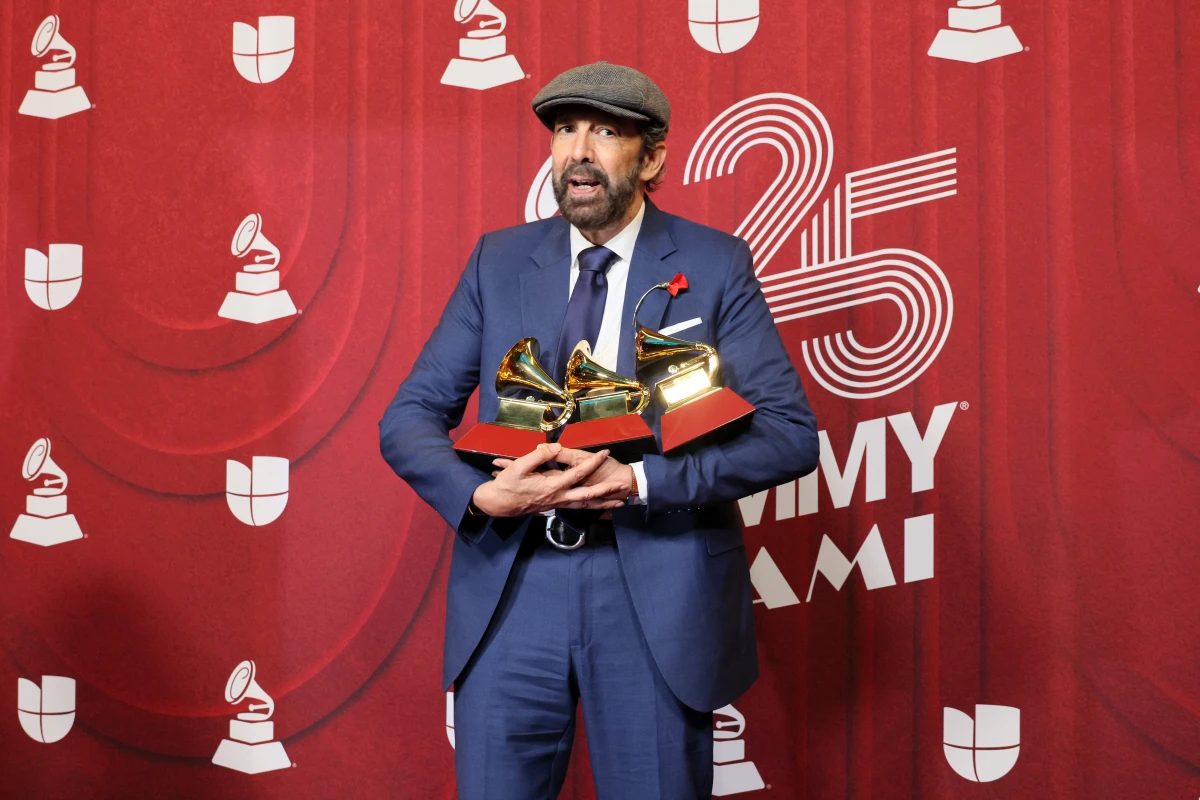
The 25th annual Latin Grammy awards were presented in Miami Thursday night and the occasion was a look at the past, present and future of Latin music.
Veteran Dominican merengue star Juan Luis Guerra and his group 4.40, an artist who won two Latin Grammys during the very first ceremony presented in 2000, collected a total of four trophies, including the top honors of both record of the year and album of the year for his release Radio Güira.
While his competition in the record of the year category featured a Who’s Who of much younger musicians including Puerto Rico’s Bad Bunny, Brazilian pop sensation Anitta, Colombian Karol G and break out Mexican star Peso Pluma, Guerra’s win seemed to reflect his peer’s admiration not just for the longevity of his career but also the legacy of the last 25 years of Latin music.
The future of Latin music was also reflected in three wins by Mexican American songwriter and producer Edgar Barrera.
He has already collected not only over 20 Latin Grammys, as well as a Grammy for songwriter of the year, also billions of streams for writing or producing songs by Bad Bunny, Karol G, Peso Pluma, Shakira, Maluma and for crossover acts like Camilo Cabello and Ariana Grande.
At 34 years old, just slightly older than the Latin Grammys themselves, Barrera reflects the vitality of talent in Latin music not just in the moment but for at least a few more decades to come.
Other highlights included Puerto Rican vocalist Kany García winning best traditional pop vocal album for García, as well as Venezuelan upstarts Rawayana besting favorites Kali Uchis and Peso Pluma for best pop song.
Bad Bunny won the best reggaeton performance category, which was crowded with top names including J Balvin, Álvaro Díaz and Rauw Alejandro. And OG reggaeton pioneer Daddy Yankee beat out younger artists for best urban song.
Carin León edged out a crowded best contemporary Mexican music album category that included Peso Pluma, Natanael Cano, Grupo Frontera and DannyLux. While former boy band member turned deep thinker Draco Rosa won best pop/rock album for another of his highly conceptualized albums, Reflejos de lo Eterno.

And the best new artist category is always a glimpse at the changing sound of Latin music. This year’s winner, Colombian vocalist Ela Taubert, was recognized for her deeply personal song writing, a glimpse of the highly personal turn songwriting has taken in recent years.
A lot has changed in Latin music since the first awards were handed out. For one, the market has grown exponentially as the Latino population here in the United States has grown substantially.
According to the U.S. Census, the number of people who self-identify as Latino has grown from just over 12% in 2000 to almost 19% of the U.S. population. In the first half of 2024, Latin music revenue grew 7% to a record $685 million, according to the Recording Industry Association of America.
Changes in technology have fueled not only the growth of sales, from CDs to streaming, but have also catapulted Latin musicians to a global level. Today, songs by nominees like Bad Bunny, Carin León, Camilo and Karol G stream in the billions with name recognition well beyond Latin America, Spain and the U.S.
Transcript:
MICHEL MARTIN, HOST:
Miami was the center of the Latin music world last night, hosting the Latin Grammy Awards on Univision. NPR’s Felix Contreras says the show had more than the usual trophies to celebrate.
FELIX CONTRERAS, BYLINE: Sure, the night’s first order of business was recognizing the best Latin music made in the last year. That included best new artist, Colombian vocalist Ela Taubert.
(SOUNDBITE OF SONG, “COMO PASO?”)
ELA TAUBERT: (Singing in Spanish).
CONTRERAS: But it was also a celebration of Latin Grammy history itself in honor of the award’s 25th anniversary. In speeches and video flashbacks, the show reflected on how much the music business has changed. The first year of the Latin Grammys, the CD was king – no streaming services – and there were only 40 categories. Now there are 58 categories, including a completely new award – best Latin electronic music performance, won by Argentine producer Bizarrap and Colombian vocalist Shakira.
(SOUNDBITE OF SONG, “SHAKIRA: BZRP MUSIC SESSIONS, VOL. 53”)
SHAKIRA: (Singing in Spanish).
CONTRERAS: The telecast also featured a tribute to Brazilian pioneer Sergio Mendes by fellow Brazilians Anitta and Tiago Iorc.
(SOUNDBITE OF ARCHIVED RECORDING)
ANITTA AND TIAGO IORC: (Singing in Spanish).
CONTRERAS: Many of the Latin Grammy categories celebrate specific regional and cultural styles. Best instrumental album went to Brazilian mandolin player Hamilton de Holanda and the Venezuelan group C4.
(SOUNDBITE OF HAMILTON DE HOLANDA AND C4 TRIO’S “LA FIESTA”)
CONTRERAS: Dominican merengue star Juan Luis Guerra and his group 440 won this year’s top awards of record of the year and album of the year. Guerra is among the most awarded musicians in Latin Grammy history.
(SOUNDBITE OF SONG, “MAMBO 23”)
JUAN LUIS GUERRA: (Singing in Spanish).
CONTRERAS: The first time Guerra won a Latin Grammy? At the very first ceremony back in the year 2000.
Felix Contreras, NPR News.
(SOUNDBITE OF SONG, “MAMBO 23”)
GUERRA: (Singing in Spanish).