


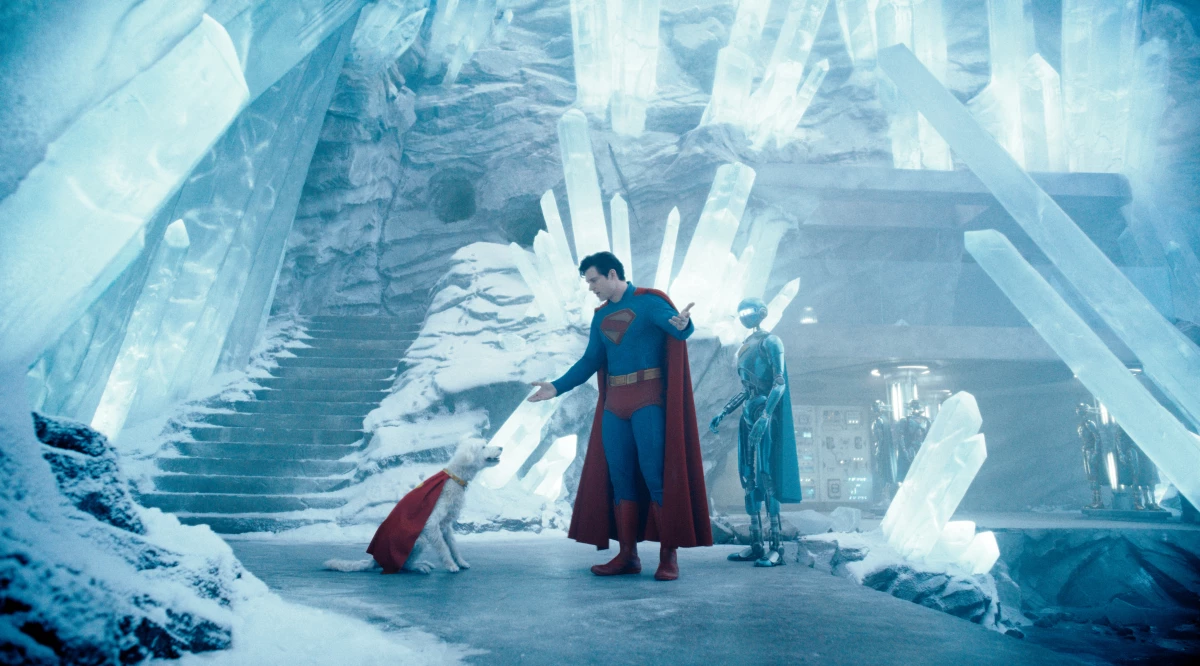
Before I saw James Gunn’s new Superman movie, which sets out to lay the cornerstone of a new era for DC superhero characters, I was pessimistic.
Over my years as a critic, I’ve loved a few Gunn projects for their humor and cleverness (Slither, Guardians of the Galaxy) but more recently hated others for their adolescent glibness (Peacemaker) and cheap sentimentality (Guardians of the Galaxy Vol. 3), respectively.
But I’ve spent far more years — decades, in fact — as a Superman fan. A few years back I channelled that fandom into an egregiously nerdy form of scholarship, when I wrote Superman: The Unauthorized Biography, a cultural history of the character that tracks which aspects of him have changed over the years (and why) and which have remained constant (and why).
Here’s the TL;DR for that book: The two central, definitive attributes to any Superman story are selflessness and resolve. He must always: 1. Put the needs of others before those of himself and 2. Refuse to give up. If either of those factors are missing, our minds rebel — it’s simply not Superman.
But having now seen Gunn’s Superman, I’m prepared to add a third essential attribute to the idiomatic fuel mixture that makes Superman Superman, which this film illustrates with a bracing clarity and humor:
He’s corny.
The red trunks diaries
The first word we see Superman (David Corenswet) say on-screen — he mutters it to himself, having just had his big red butt entirely handed to him in a fight — is, “Golly.” (Throughout the film, he peppers his dialogue with the occasional “gosh.”)
Later, Lois Lane (Rachel Brosnahan) makes fun of his taste in music (bland, radio-friendly pop-punk).
When questioned about his reasons for performing a certain super-deed that saved thousands of lives, his response is incredulity: “Why? I mean … to do good! For, you know … good!”
At one point, instead of gloating over a fallen foe, he launches into an impassioned speech about his abject love of humanity and his own, all-too-human fallibility.
In terms of visual iconography, Gunn not only returns the classic red trunks to the Superman costume, he doubles down on them. He makes sure they evoke an old-school circus strongman, as the character’s original illustrator Joe Shuster intended. (Which means, in the 2025 of sleek, sweat-wicking athleisure, they resolutely, even defiantly, resemble nothing so much as granny panties. Deal with it.)
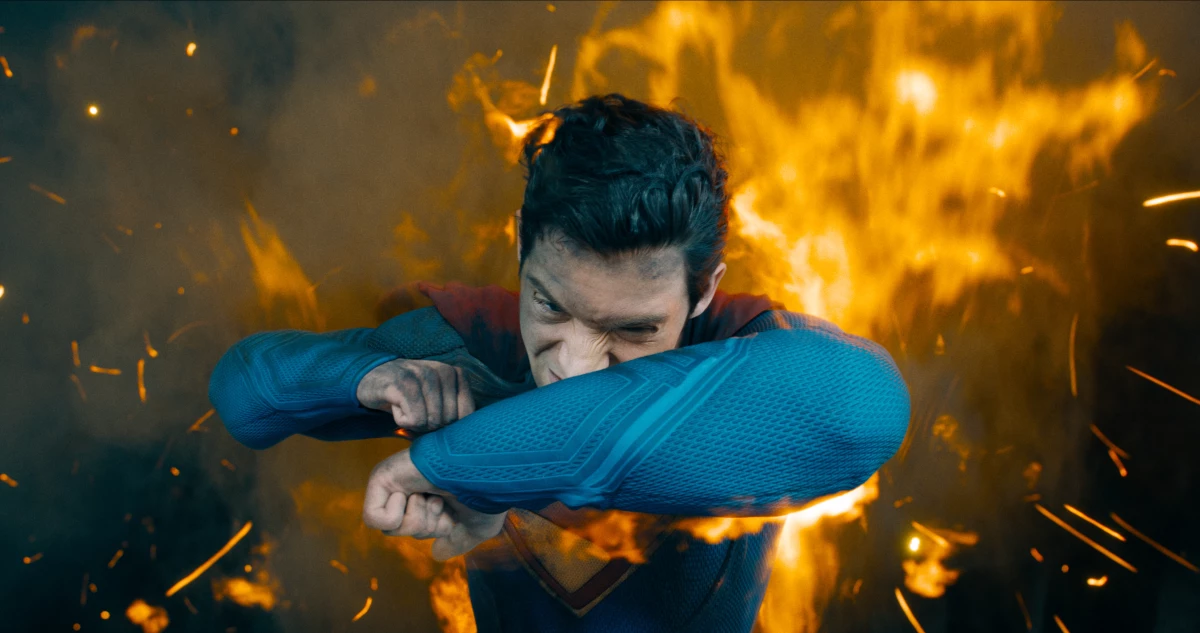
And as for resolve: He’s got that in spades. This Superman starts the film bruised, bloody, battered but unbowed, and will spend much of its running time getting further hammered and lasered and imprisoned and kryptonite-poisoned by evil billionaire Lex Luthor (Nicholas Hoult).
Luthor’s goal is the annihilation of Superman, and he’s using everything in his considerable power to get it, from nanite-enhanced goons to international conflicts to social media smear campaigns. (This is another one of those films in which incessant television broadcasts act as a kind of electronic Greek chorus, helpfully informing us of major, albeit seemingly instantaneous, shifts in public opinion.)
But every time he’s brought low, this Superman rallies, and returns to the fray.
All of this, of course, is corny. Hokey. Cheesy. Achingly sincere. Cringe, even.
Which is to say: It’s Superman.
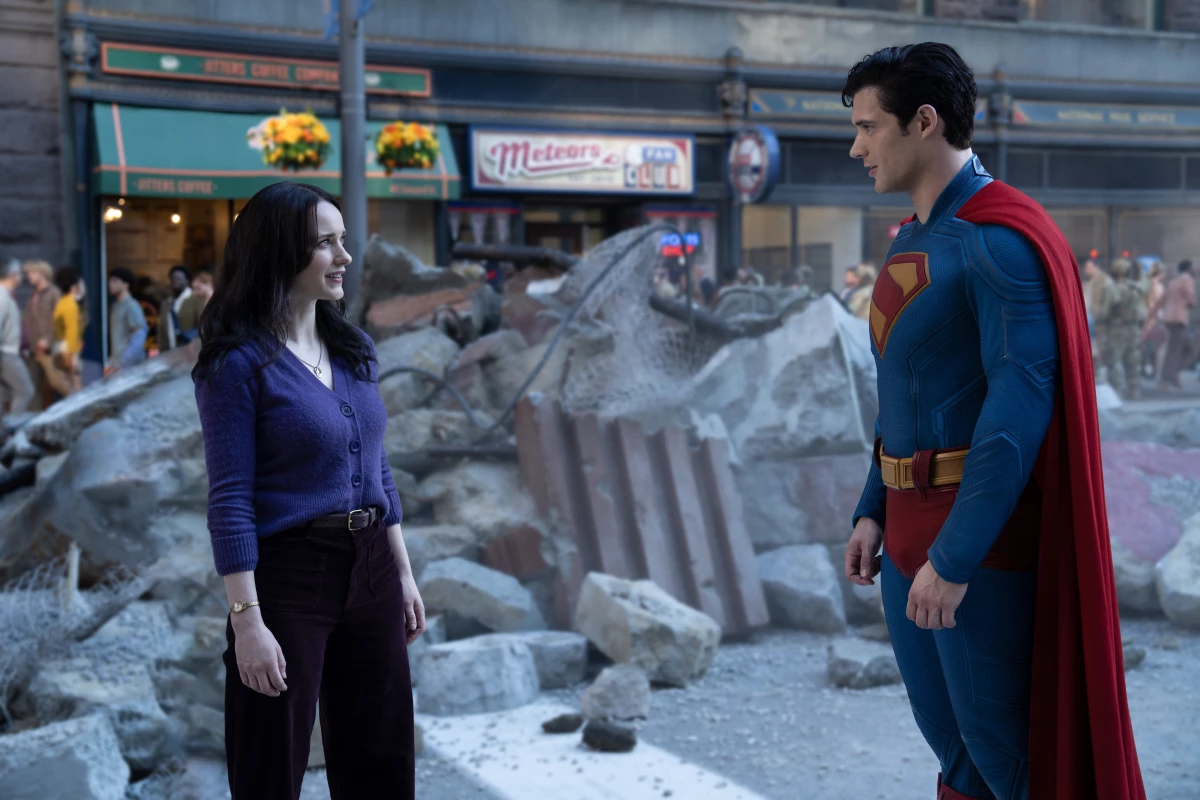
Recent attempts to tell live-action Superman stories have shied away from his bright, hopeful, altruistic nature in favor of making him more cool and relatable (read: dark and brooding). That’s not who he is; it never has been.
Superman is an ideal. He represents the best we can aspire to be. He’s not the hero you relate to, à la Peter Parker/Spider-Man’s ongoing struggle to pay his rent and buy Aunt May her damn medicine. He’s the hero who inspires you, who shows you the way.
The way we Superman now
Every era gets the Superman it needs. Richard Donner’s grand, mythic, unapologetically hopeful Superman: The Movie (1978) arrived in the wake of Vietnam and Watergate, when America had sunk into a defensive cynicism.
Gunn’s Superman arrives at yet another time in American history when everything that we ostensibly stand for — bedrock American principles like justice for all, defending the defenseless, helping those in need — feel out of reach.
It’s inspiring to be reminded what those ideals look like, even if Superman (and Superman) shows them to us through a bright, aspirational lens.
If that seems at all radical, chalk it up to the fact that our early-aughts cultural fascination with antiheroes like Walter White and Don Draper sloshed over into our superheroes at some point. It’s not just the old-schoolers like Batman and Iron Man; now, every jabroni in tights has a dark outlook and a troubled past. This year alone, the Thunderbolts* battled a super-powered personification of regret itself. And over on Disney+’s Ironheart, our ostensible hero was so mired in guilt that she slid into a life of crime and drew the attention of the MCU’s literal devil.
But there’s always been another way. It doesn’t have to be about slogging through trauma and shame and shadow-selves and endlessly tedious redemption arcs. Sometimes, it’s simpler, cleaner, brighter. And also? Not for nothing?
More fun.
Cheer elegance
Again and again, in Gunn’s film, we watch Superman placing himself between innocent civilians and mortal danger, saving individual lives. Which brings me to the very simple reason why Gunn’s movie works as well as it does.
It makes you want to cheer.
That’s it, that’s the secret ingredient that’s been missing from so many superhero stories for so long.
You come to a Superman movie to feel that surge of elation, that vicarious joy that moves you to cheer and applaud the events on screen. If you’ve ever found yourself in a crowded theater and got swept up in such a moment (Avengers: Endgame‘s iconic “On your left” scene, for example), you remember it for the rest of your life.
I felt that surge of joy several times, watching Superman, and the crowd around me felt it, too. Admittedly, we weren’t always cheering for Superman himself.
At one point Edi Gathegi’s Mr. Terrific, one of several C-list DC heroes appearing in the film, gets a moment of his own that elicited cries of appreciation from my crowd. (This is notable, because in the comics he’s famously the third-smartest man in the world, but just comes off as a dour stiff. Gathegi’s take is much more fun, and more in keeping with how anyone possessed of such world-class intelligence would act in real life — namely, perpetually and performatively annoyed at having to be surrounded by stupid people.)
Mostly, though, we were cheering for the dog.
Krypto is a super-powered (and super-poorly trained) dog in a cape, and he’s resolutely awesome. He gets several cheerable moments, bless his foofy little ears. (I should perhaps mention here that the original draft of my book about Superman included 5,000 words on the fascinating history and abiding importance of Krypto, in all his awesomeness, which were cruelly cut down to a single paragraph by my editor, because, in his words, “Nobody cares about the damn dog.” When Gunn’s Krypto emerges as the breakout character find of 2025, history will have proven me right.)
You already believe a man can fly
Caveats? Well, Hoult’s Luthor is fun, though he doesn’t get a chance to do much more than preen and explain his motivations to absolutely anyone and everyone within earshot. At any given moment you can’t help thinking you’re getting maybe 60% of what Hoult could bring.
At one point in the movie, a citizen of Metropolis — a person of color — is used as a prop to establish just how villainous our villain is. It’s shocking, because the sudden act of violence seems so out of keeping with the bright tone of the film, but also because it seems like a kind of vestigial tail, a wildly unnecessary holdover from action films of the ’70s and ’80s.
But on a broader level, Gunn’s film is very good at what it sets out to do: It delivers a Superman deeply in touch with his humanity, and perfectly representative of the essence of the character.
What it doesn’t do, particularly, is break much in the way of new ground.
Recent attempts to tell live-action Superman stories have shied away from his bright, hopeful, altruistic nature in favor of making him more cool and relatable (read: dark and brooding). That’s not who he is; it never has been.
It lacks the grand sweep and scope of Donner’s 1978 film, which had a much heavier lift — it had to establish the mythic quality necessary for audiences to “believe a man can fly.”
But Gunn doesn’t need to establish that — he can draft off of the decades of Superman film and television projects that have landed since 1978 to do the world-building work. So he doesn’t waste our time with any of it: As the film opens, Superman is a known presence. Clark and Lois are dating. Luthor hates Superman.
While it hits a lot of narrative beats that have been hit before in previous films, television series and comics (we get another Pa Kent “Clark, it’s your actions that make you who you are,” speech, for example) at least it hits them cleanly, and it doesn’t apologize for them.
But as a result, the film can’t help but feel smaller and more circumspect than the grander, statelier Superman movies of Donner, Bryan Singer and Zack Snyder. (I’m not bringing Superman III and Superman IV into this discussion and you’ll thank me for it.)
The feeling of watching it is similar to that of perusing an individual comic book — it’s bright, colorful, it’s crammed with characters who don’t get quite enough to do (too-brief scenes with the Daily Planet staff can only feint toward establishing them as individual characters) but it’s inviting you into a universe that you may want to spend more time in.
And staring up at you from the page is Corenswet’s iconic, goofy, inspiring, cheesy Superman, preparing yet again to hurl himself in harm’s way, because that’s what he was made to do.
Transcript:
SCOTT DETROW, HOST:
There is a new “Superman” in theaters this weekend, and though you might be thinking – more Superman? – this latest version feels a little different. Among other things, it features a very cute dog.
(SOUNDBITE OF FILM, “SUPERMAN”)
DAVID CORENSWET: (As Superman) Krypto.
(SOUNDBITE OF DOG BARKING)
CORENSWET: (As Superman) Home – take me home.
DETROW: We here at NPR are lucky to have a veritable “Superman” expert on staff. He even wrote a book on the guy. It’s Glen Weldon, host of NPR’s Pop Culture Happy Hour podcast. Hey, Glen.
GLEN WELDON, BYLINE: Hey, Scott. What’s this veritable nonsense? I’ve spent years researching that book.
DETROW: (Laughter) Listen, I cannot stress to you how anxious I am to ask this first question because I feel like for nearly 20 years now, I have eagerly anticipated new “Superman” movies. I have gone to the theater. It’s been like Charlie Brown and Lucy and the football…
WELDON: (Laughter).
DETROW: …And I’ve been horribly disappointed. So OK, Glen, how is the new “Superman” movie?
WELDON: All right, I’m going to put it this way. All I want out of a “Superman” movie is, you know, make me cheer. That’s it.
DETROW: Yes.
WELDON: Make me feel that kind of a welling up of joy and excitement at something I see on screen because when you’re in a crowded theater – you know this – and everyone goes nuts around you, that’s a great feeling. And that is exactly what’s been missing from superhero movies for a very long time because Hollywood tried to make them, I don’t know, more adult and nuanced, which always translates to dark and gloomy.
DETROW: Which is not “Superman.”
WELDON: It’s not “Superman.” And I’m here to tell you, Scott, you’re going to cheer. You’re going to find yourself swept up in excitement several times in this movie. Now, to be fair, you’re not always going to be cheering “Superman.” Sometimes you’re going to be cheering other characters. Mostly, though, you’re going to be cheering for the dog.
DETROW: OK, so this is Krypto, the Superdog we’re talking about. Krypto with a K.
WELDON: Yeah (laughter).
DETROW: He is a super-powered dog in a red cape. You know, he’s been in the comic books for a while, but I think, like, he’s not really movie-level pop culture known.
WELDON: Right.
DETROW: Tell us about Krypto and why he is in this movie.
WELDON: Well, I mean, when I was writing my book about Superman over the years, I came to love Krypto. This is a dog that debuted in the comics back in the ’50s, during what we call the Silver Age of comics, which is when things got goofy because that was a time when comics creators realized that the comic book page doesn’t have a special effects budget. You can do anything. I never thought I’d see Krypto, of all things, on screen, but here we are, and he’s fantastic.
DETROW: That is great. You wrote in a review that we published on npr.org this morning that the new “Superman” movie is, in your words – I’m going to read them to you – (reading) corny, hokey, cheesy, achingly sincere, cringe even.
I don’t know – like, maybe that’s not an insult when we’re talking about the Man of Steel, right?
WELDON: Yeah, you get it. I mean, Superman is corny. He has to be to work. And I was very worried when they tapped writer-director James Gunn for this. He did the “Guardians Of The Galaxy” movies for Marvel. I didn’t think he was the right guy for this character because his trademark in the past has been kind of glib and snarky. And snarky is kryptonite. You get snarky anywhere near Superman and he dies. But you can tell right away that Gunn gets it because – you know, so David Corenswet plays Superman in this movie. The film opens. He’s just had his big, red butt handed to him in a fight. The very first word we see him say on screen is, golly.
DETROW: (Laughter).
WELDON: And Scott, when that happened, I let out a sigh of relief. My shoulders dropped. I’m like, we’re in good hands, because Superman isn’t cool. He’s an ideal. He represents the best we can aspire to be. And that’s why this movie could not have come at a better time.
DETROW: You say in your review that every era gets the “Superman” it needs. Why did you say that?
WELDON: Well, when I was a kid, the ’78 Christopher Reeve “Superman” movie came out just as Vietnam and Watergate had us all feeling, you know, justifiably cynical, I would say. And that movie gave us something, someone to believe in again. Gunn’s “Superman” arrives at another time in American history when everything that we stand for – right? – bedrock American principles like justice for all and defending the defenseless and helping those in need – those feel farther away than they should right now. And you watch this movie, and you’re reminded what those ideals look like, even if they’re packaged in, you know, bold primary colors and little red boots.
But at the end of the day, what is Superman for? He is there to represent the idea that if you’re gifted with power, and privileged, an indestructible body, in his case – right? – you could choose to do anything. What he chooses to do – the only thing he chooses to do – is to be of service to others, to take action, to place that indestructible body in harm’s way between innocent people and anyone who wants to hurt them. That is goofy. That is corny. That is hokey, but it is also something that superhero movies haven’t been for a very long time – it is legitimately inspiring.
DETROW: That is Glen Weldon, host of NPR’s Pop Culture Happy Hour podcast. Thank you for the news you brought me, and thank you…
(LAUGHTER)
DETROW: …For doing this conversation.
WELDON: Take me home, Krypto.
(SOUNDBITE OF JOHN WILLIAMS’ “MAIN TITLE (FROM SUPERMAN)”)
