


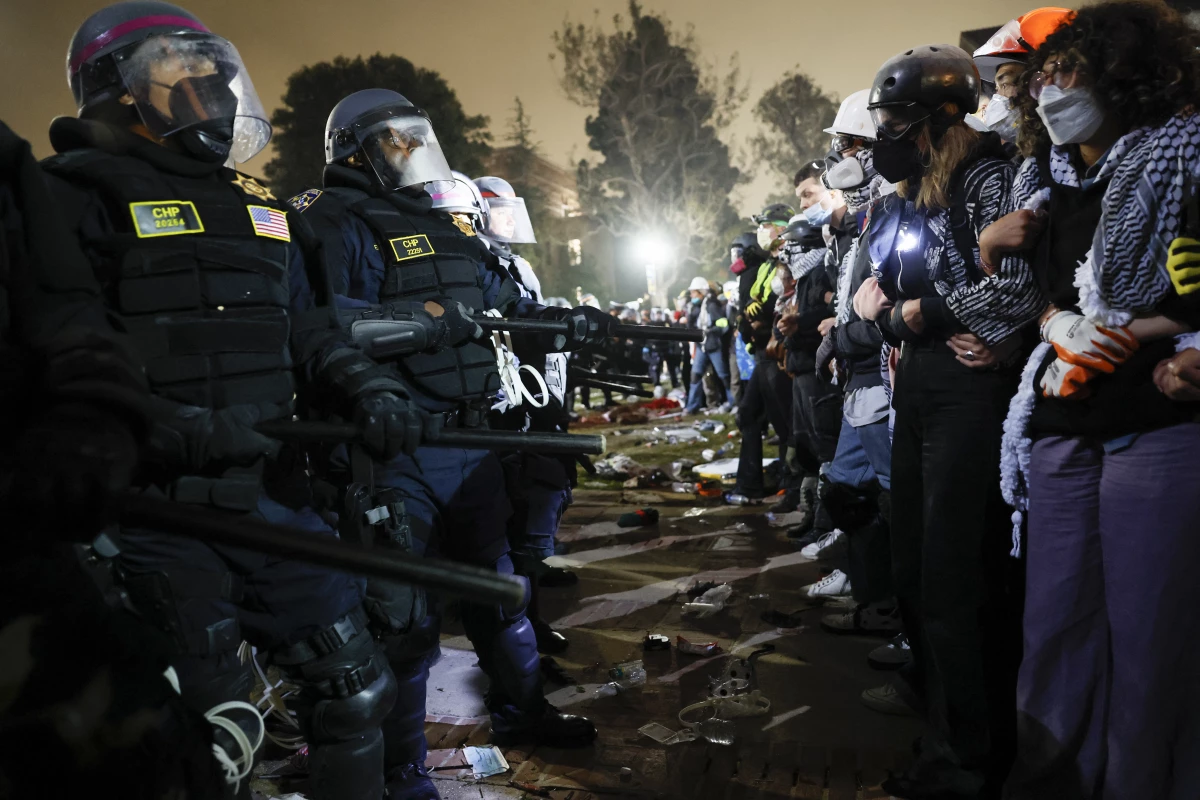
College students are trickling back onto campuses for the fall semester just months after protests exploded across the U.S. over Israel’s war in Gaza.
University leaders are bracing for more protests and counterprotests this semester, and on some campuses, new rules have already taken effect, including:
- At Columbia University — where President Minouche Shafik resigned this month — a color-coded system is now in place to restrict guest access to campus at various times.
- At the University of South Florida, all planned activities that involve signs, tents or amplified sound now require prior approval.
- Across the University of California system, it is now prohibited to use a mask to hide your identity, or block walkways and university buildings.
- And at several campuses around the country, including across the UC system, encampments have been banned.
To some, these new guidelines are a welcome change.
“I appreciate the clarity provided by the administration … regarding how they will support all students to ensure they can be on campus and express their whole selves without fear of intimidation and threats, including Jewish students,” Rabbi Adam Naftalin-Kelman told NPR member station KQED last week. He is the executive director of Berkeley Hillel, a Jewish organization on the UC Berkeley campus.
Meanwhile, others in the UC system are concerned about how these rules will be enforced and whether they will impede free speech, including Benjamin Lynch, a researcher at the University of California, Los Angeles and a pro-Palestinian activist.
“This is going to be like trying to enforce jaywalking or something,” he said. “It’s only ever going to be used against specific people to politically target, you know, anyone critical of the administration.”
One university doubles down
School is back in session, and the line between providing campus security and allowing for free speech is still extremely thin.
NPR spoke to Vanderbilt University Chancellor Daniel Diermeier to better understand how university leaders are thinking through this tension.
Last spring, three Vanderbilt students were expelled for their role in a pro-Palestinian demonstration on campus, which was one of the most severe consequences a university took during the protests. Diermeier says that was the right thing to do.
“We have a clear commitment at Vanderbilt for free speech and civil discourse, and for most of the time during last year, our students did a great job,” he said. “But we had one incident when our main building was closed. Students forced entrance into the building — they injured one of our security guards. And we told them throughout this process when they were occupying that they would be subject to student discipline.”
Diermeier said rather than make him think differently about the approach, the events of last spring reaffirmed his commitment to Vanderbilt’s rules. He broke them down into three categories:
- A strong commitment to open forums.
- A commitment to civil discourse: “Which means that we treat each other with respect.”
- “Institutional neutrality”: “Which means that the university will not take a position on contested political and social issues.”
On the last point, NPR asked Diermeier whether neutrality meant silence when it came to the war in Gaza. He said neutrality means university leadership refrains from taking positions, but it doesn’t restrict students or faculty from engaging in debates.
“As a matter of fact, we believe that by exercising such restraints, we’re creating an environment that further encourages discussion and debate so that people are not worried about a party line,” he said. “Another way to say this is the job of a university is to encourage debates, not to settle them.”
Diermeier began his tenure as Vanderbilt chancellor on July 1, 2020, and Vanderbilt’s Board of Trust just extended his contract through 2035.
He said when it comes to charged issues, it is important for a university to define the environment and the values that support free speech — something Vanderbilt has been doing with first-year students coming onto campus in the last week.
“We had a long discussion about that. They get it. What we cannot have is lawlessness on campus when students break the rules intentionally,” he said. “They may disagree with the specifics of it and whether that should be the consequence or this should be the consequence, but that’s why you have a disciplinary process that’s applied in a consistent fashion.”
Transcript:
AILSA CHANG, HOST:
College students are trickling back onto campuses for the fall semester, just months after protests exploded across the U.S. over the war in Gaza.
(SOUNDBITE OF ARCHIVED RECORDING)
UNIDENTIFIED GROUP: (Chanting) Disclose. Divest. We will not stop. We will not rest. Disclose.
CHANG: University leaders are bracing for more protests and counterprotests as the Israel-Hamas war continues. And after the high-profile resignations of several university presidents, including Columbia University President Minouche Shafik earlier this month, we’re left wondering, how does a university president walk the very fine line between providing security on campus and allowing for free speech? Well, to help us answer that question, we’re joined now by Daniel Diermeier, the chancellor of Vanderbilt University. Welcome.
DANIEL DIERMEIER: Thank you very much. Thanks for having me.
CHANG: Well, thank you for being with us. So I know that today is the first day of classes for Vanderbilt students. But before we talk about the upcoming year, I just want to start with events from last spring on your campus because three students were expelled for their role in a pro-Palestinian demonstration in March, which was one of the most severe consequences that we saw a university take during those protests. And, you know, I want to ask you because four months later, I’m wondering, do you still stand by that approach that expelling those three students was the right thing to do?
DIERMEIER: Yeah, absolutely. We think that this was the right decision. We have a clear commitment at Vanderbilt for free speech and civil discourse. And for most of the time during last year, our students did a great job. But we had one incident when our main building was closed. Students forced entrance into the building. They injured one of our security guards. And we told them throughout this process when they were occupying that they would be subject to student discipline. And as part of this process, the three students were expelled. We then had an appeals process. So I think it’s very important that we’re always clear about what the values and the rules on campus are, but then we’re also willing to enforce them.
CHANG: Did the events of last spring make you think any differently about what the rules around free expression should be?
DIERMEIER: No. Just on the contrary, we have a very clear understanding at Vanderbilt what the rules are. We have a strong commitment to open forums, the commitment to civil discourse, which means that we treat each other with respect. And the third one is for institutional neutrality, which means that the university will not take position on contested political and social issues.
CHANG: On the idea of neutrality – I mean, you just spoke about the importance of neutrality. What is neutrality to you when it comes to an issue like Israel’s war in Gaza? Is neutrality silence?
DIERMEIER: So institutional neutrality is a restraint exercised by the leadership of the university to refrain from taking positions on controversial political and social issues. It does not restrict, in any way, shape or form, the rights of the members of our community, students or faculty to engage in such debate. As a matter of fact, we believe that by exercising such restraints, we’re creating an environment that further encourages discussion and debate so that people are not worried about a party line. Another way to say this is the job of a university is to encourage debates, not to settle them.
CHANG: Well, then to students out there – both new students and returning students – what is your message to them who are concerned that Vanderbilt is not a hospitable place for free expression?
DIERMEIER: One has to really distinguish the environment and the values that support free speech, which we have been very supportive of. Just two days ago, when the new first years arrived on campus, we had a long discussion about that. They get it. What we cannot have is lawlessness on campus. When students break the rules intentionally, that’s where we have to step in. Our students and our faculty understand that. They may disagree with the specifics of it and whether you should – that should be the consequence or this should be the consequence, but that’s why you have a disciplinary process that’s applied in a consistent fashion.
CHANG: I am wondering, you know, all this pressure from students, from donors, from what’s happening across your state, the country, the world – do you think it’s just harder to be a university president these days?
DIERMEIER: There’s no doubt that this is a particularly challenging environment. But my sense is that this is such a privilege, to be able to lead a great university. In difficult times, the stakes are higher, but that doesn’t bother me. One should do it with pride, and one should do it based on the values and purpose of the institution.
CHANG: Daniel Diermeier is the chancellor of Vanderbilt University. Thank you very much for taking the time to speak with us.
DIERMEIER: Thank you very much. My pleasure.
