


LOOMIS, CA — This town of 7,000 people mostly in single family homes sits along a freeway outside of Sacramento. People here are concerned about suburban issues like traffic, rapid development and gas prices.
It’s a red area represented by a Republican in Congress. But an election Tuesday will determine whether the state redraws congressional lines and divides people here into districts likely to elect Democrats to the U.S. House.
“We want to keep our communities that are alike together, right? And so if we get sucked into Sacramento or, you know, somewhere, we don’t share the same needs, right?” says Amanda Cortez, a Republican who serves on the Loomis Town Council.

The result of the election in California on Tuesday could determine not only who represents Cortez and her neighbors in Loomis, but who controls the U.S. House after the midterm elections next year.
California’s ballot question was a reaction to Trump’s redistricting push
This summer President Trump set off a national redistricting race, starting in Texas, to boost chances for GOP candidates in 2026. Missouri and North Carolina Republicans also redistricted and Trump is urging leaders in Indiana, Kansas and other states to follow. Democrats say the GOP is gerrymandering in ways that dilute the votes of Black and Latino communities.
California’s redistricting proposal, Proposition 50, would redraw the state’s congressional map to help yield up to five new seats for Democrats. California’s Democratic Gov. Gavin Newsom set it in motion after Texas Republicans moved to get the edge in five seats in their state.
Republicans in California could pay the price. Mike Murray, another Republican voter in the third Congressional district that Loomis is in, says the ballot proposal will dilute his community’s voice by splitting the county into three separate districts.
“If we wanted to live in an urban community with the problems and the benefits of an urban community, we would. But we choose to live here. And when we choose to live here, we hope that somebody will represent us in our way of life,” Murray said.
Eric Schickler, co-director of the Institute of Governmental Studies at the University of California, Berkeley, says opponents of California’s redistricting plan are concerned it will sideline the state’s independent citizens redistricting commission, which has helped give their communities a voice.
“The basic argument made by opponents of Prop 50 is that the non-partisan process that was set up in 2008 for the legislature and 2010 for Congress has worked well for the state. It’s giving rise to more competitive elections,” Schickler said.
Democrats see a chance to counter Trump’s national agenda
But for proponents, mainly Democrats, California’s special election is all about Congress and the Trump administration.
“To the extent that voters care about having a check on President Trump, well, you need a Democratic House to do that, is the argument that Democrats are making,” Schickler added.
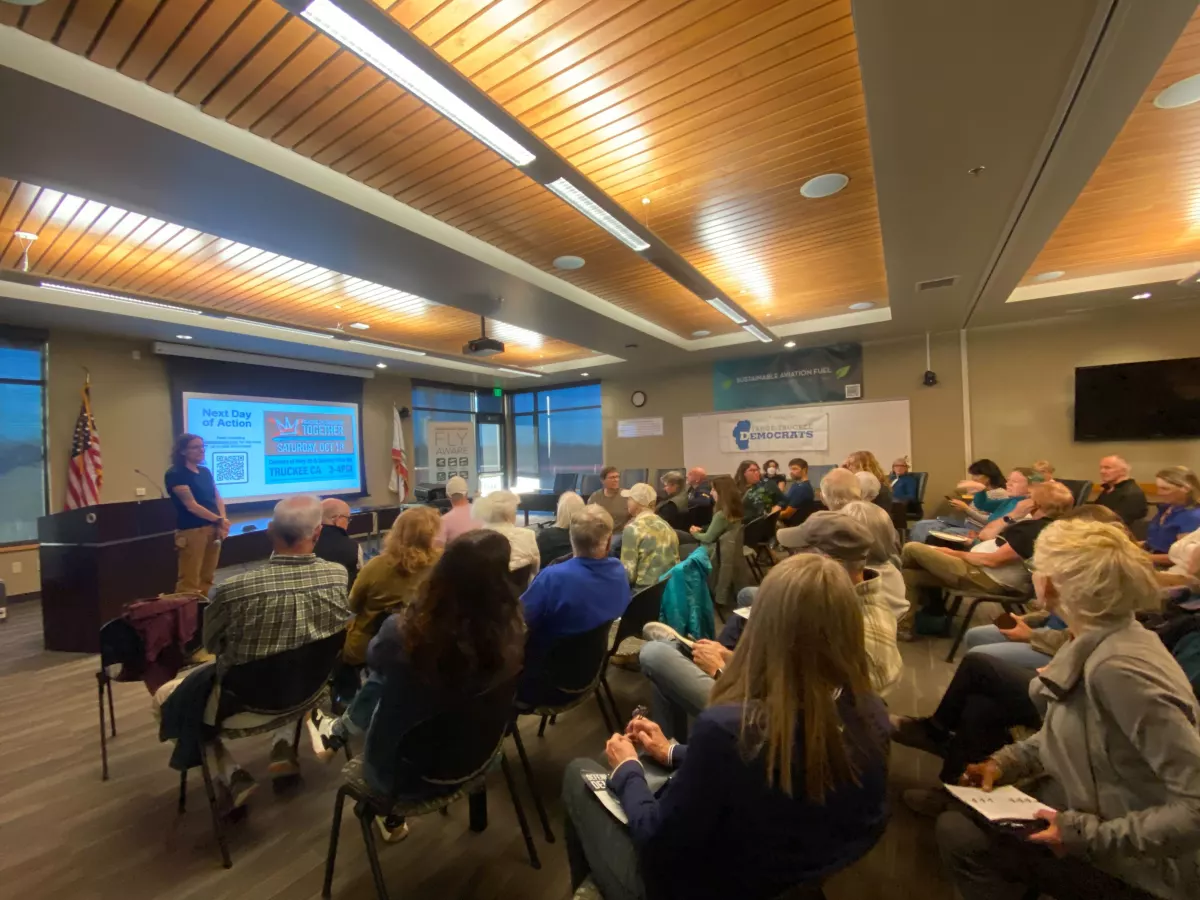
Cyan Samone lives in Truckee, California near Lake Tahoe, a blue dot in the same Republican congressional district as the town of Loomis.
At a recent gathering of local Democrats organizing to support Prop 50, Samone said the redistricting is a chance to push back on the Trump administration’s immigration crackdown.
“I have a lot of friends who are immigrants from different countries who have left authoritarian regimes,” said Samone. “You see the patterns and you just don’t want to see that happen here and I don’t want to have to see people who fled terrible situations having to run again.”
Samone’s husband, Ben Woodard, says redistricting could mean Democrats here are able to elect a representative that’ll pay more attention to what his community needs.
“The Democratic Party representative would do that,” Woodard said. “Look over our interests like, you know, the cuts to Medicare definitely impact rural health care.”
Supporters of California’s redistricting measure appear to have the upper hand heading into election week. It’s a state with a deep blue electorate and many voters see this as a national struggle.
Laura Fitzgerald covers California state politics for CapRadio.
Transcript:
SCOTT SIMON, HOST:
In just over a week, voters in California face a question that could determine who controls Congress after the 2026 midterm elections. They’re deciding if the state should redistrict, giving Democrats an edge to win five more seats in the narrowly divided U.S. House. Now, this vote comes in response to President Trump encouraging Texas to redraw lines to favor Republicans. CapRadio’s Laura Fitzgerald reports from a part of California where Republicans could lose out.
LAURA FITZGERALD, BYLINE: Loomis, California, is a suburban town of about 7,000 people outside of Sacramento. It’s a red area, represented by a Republican in Congress. But under the redistricting map on the ballot in the November 4 election, voters there would be divided and drawn into districts likely to elect Democrats. Amanda Cortez is a Republican on the town council organizing opposition.
AMANDA CORTEZ: We want to keep our communities that are like together, right? And so if we get sucked into Sacramento or, you know, somewhere, we don’t share the same needs, right?
CORTEZ: This area has lots of single-family homes on either side of a major freeway and faces suburban issues, like traffic getting in and out, rapid development and high gas prices. Mike Murray (ph) also lives in the area, and he’s involved in his county’s Republican club. He’s voting no on the measure, called Prop 50, because he says his future votes for Congress will be swamped by the Democratic votes in nearby Sacramento.
MIKE MURRAY: If we wanted to live in an urban community with the problems and the benefits of an urban community, we would. But we choose to live here. And when we choose to live here, we hope that somebody will represent us and our way of life.
FITZGERALD: Usually, states redistrict at the start of the decade, when the census comes out, but California Republicans could end up paying the price for the redistricting battle that President Trump has set off around the country now. Murray says, for him, this isn’t about national politics or redistricting in other states.
MURRAY: My concern has always been on our community and our representation. When things are wrong in other places, doing things wrong here, it’s not the way to go. Hey, this is something you teach your kids. Two wrongs don’t make it right.
FITZGERALD: But Trump did get Texas to write a new map that could flip five more seats to Republican candidates. So California’s Democratic leaders say they drew their map to flip five seats for Democrats and counter Texas. Eric Schickler is a co-director at the Institute of Governmental Studies at the University of California Berkeley. He says opponents to California’s redistricting are concerned it’ll sideline the state’s Independent Redistricting Commission that’s helped give their communities a voice.
ERIC SCHICKLER: The basic argument made by opponents of Prop 50 is that the nonpartisan process, you know, has worked well for the state. It’s given rise to more competitive elections.
FITZGERALD: But for proponents, mainly Democrats, it’s about Congress and the Trump administration.
SCHICKLER: To the extent that voters care about having a check on President Trump – well, you need a Democratic house to do that, is the argument that Democrats are making.
FITZGERALD: In the town of Truckee, a blue dot in the same red congressional district as Loomis, Democrats were wrapping up a meeting to organize for Prop 50. Cyan Samone sees redistricting as a chance to counteract Trump’s immigration crackdown.
(CROSSTALK)
CYAN SAMONE: I have a lot of friends who are immigrants from different countries who have left authoritarian regimes. And you see the patterns, and you just don’t want to see that happen here. And I don’t want to have to see people who fled terrible situations having to run again.
FITZGERALD: Her husband, Ben Woodard (ph), says redistricting could mean Democrats are able to elect a representative that’ll pay more attention to what his community needs.
BEN WOODARD: I think that the Democratic Party representative would do that and would look over our interests, like, you know, the cuts to Medicare definitely impacted rural health care.
FITZGERALD: The proponents appear to have the upper hand heading into the November 4 election. It’s a state where most voters are Democrats, and they see this election as part of a national struggle.
For NPR News, I’m Laura Fitzgerald in Sacramento.
