


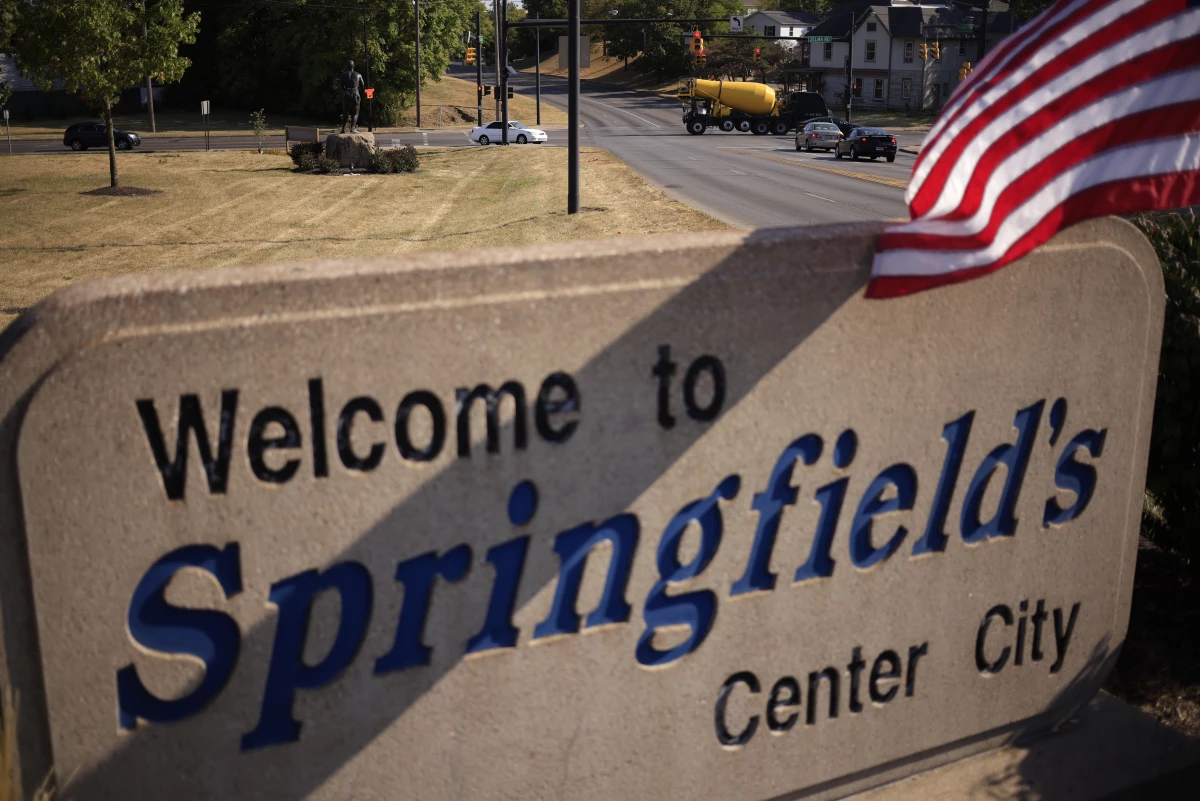
When former President Donald Trump made a false claim in this month’s debate with Vice President Harris that Haitian migrants were eating pets in Springfield, Ohio, it stunned many who heard it. But perhaps among the most stunned were neo-Nazis, who, for weeks, had been trying to launch that racist lie into the mainstream.
“Whether they’re neo-Nazi or white nationalist, all of them [were] thrilled,” said Jeff Tischauser, senior research analyst at the Southern Poverty Law Center. “All of them [were] in almost disbelief that they had a presidential candidate recycle and reuse the rhetoric that has been popular in these movements for decades.”
One group, especially, was celebrating. The Blood Tribe, a neo-Nazi hate group that Tischauser estimates to have between 50 and 80 members nationally, posted to the group’s Telegram channel. The group claimed that it had “pushed Springfield into the public consciousness.”
“When Trump mentioned the pet-eating narrative, Blood Tribe was crowing about it,” said Cass Troy, an extremism researcher who runs an online publication called the Cassandra Report. NPR is using a pseudonym for Troy, because of Blood Tribe’s history of doxing its critics.
“They were delighted,” Troy said. “They take all responsibility for it, even though they don’t deserve it.”
Reaching a more mainstream audience
The narrative about pet-eating has been decisively debunked. Even so, it has taken on momentum. Republican Vice Presidential candidate JD Vance has continued to repeat the lie, even after his campaign staff reportedly heard directly from Springfield officials that there was no evidence to support it. Since the debate, the city has fielded dozens of bomb threats against schools and other municipal facilities.
“This fear that’s being created in Springfield is something that Blood Tribe is very proud of at this moment,” said Tischauser.
While the exact origin of the false claim is not clear, the Blood Tribe was early in featuring it on its alternative-tech Gab social media account. On August 11, a day after the group marched with swastika flags through Springfield, a commenter on the group’s page suggested that the city’s Haitian residents might eat pets. But on its alternative tech platform pages, the group’s reach has been limited. It wasn’t until EndWokeness, a right-wing account on X, posted about the topic on September 6 that the lie reached a significant audience.
“The concerning thing that’s happening is we’re seeing a convergence of far right mainstream people having the same talking points as out and proud neo-Nazis,” said Troy.
“I think that one of the things that people need to be cognizant of is anybody who perpetuates this narrative, do they want to be aligned with people like that?” she said. “You know, if you can’t separate out your feelings about basic decency when it comes to immigration, maybe you can separate out basic decency when it comes to not being in league with a Nazi.”
Extremists are activated
After Trump amplified the falsehood during the nationally televised event, extremists have stepped up their in-person activities in Springfield. That Saturday, Proud Boys members from several chapters gathered in the city, KKK leaflets were distributed and a white power organization called the Aryan Freedom Network posted flyers on utility poles.
“They’re just so much more energized now than I’ve seen them in a long time,” said Tischauser. “Leaders of the Blood Tribe [and] leaders of other white supremacist groups are excited about the possibility that this is a recruitment boon because of the size of the audience that got this message.”
Tischauser said in some ways that moment in the debate echoed a moment from four years earlier, when Trump told the Proud Boys to “stand back and stand by” during the 2020 election season. Then, leaders from that group responded jubilantly on social media, and the group was launched onto the public radar.
But Tischauser noted that it’s not an exact comparison. Trump’s statement did not directly point to an extremist group. And even though it has energized these groups, Troy said this energy is not about promoting Trump’s candidacy. Instead, she said it’s about capitalizing on a moment where many Americans may be ready to consider their agenda of racial hate.
“They’re not playing at politics,” explained Troy. “They’re playing at messaging and what’s getting traction. They want the idea to move forward. They don’t actually care who does it.”
Transcript:
STEVE INSKEEP, HOST:
When you say something to a mass audience, you’re really addressing mass audiences. Millions of people hear this program, for example, people across the political spectrum. And some may hear different messages from the very same words, because people bring themselves to that exchange. At this month’s presidential debate, tens of millions of people listened and watched. And some of that audience had their own special take on former President Donald Trump’s false debate claim about Haitians in Springfield, Ohio. Here’s NPR’s Odette Yousef.
ODETTE YOUSEF, BYLINE: Trump stunned many Americans when he said this during the debate.
(SOUNDBITE OF ARCHIVED RECORDING)
DONALD TRUMP: In Springfield, they’re eating the dogs, the people that came in. They’re eating the cats. They’re eating the pets of the people that live there.
YOUSEF: And Jeff Tischauser of the Southern Poverty Law Center says among the most stunned were neo-Nazis.
JEFF TISCHAUSER: The groups that I monitor, whether they’re neo-Nazi or white nationalist – all of them thrilled, all of them in almost disbelief that they had a presidential candidate recycle and reuse the rhetoric that has been popular in these movements for decades.
YOUSEF: One group in particular was celebrating. It was the Blood Tribe, headed by two former Marines. The Blood Tribe is an explicitly neo-Nazi hate group. Its members march in colors, waving swastika flags. It’s relatively small. Tischauser estimates between 50 and 80 members across the country. When Trump said what he said during that debate, the Blood Tribe’s reaction on social media was immediate. It posted that the group, quote, “pushed Springfield into the public consciousness.” But extremism researcher Cass Troy says that’s not quite true.
CASS TROY: They take all responsibility for it, even though they don’t deserve it.
YOUSEF: Troy, as Greek mythology fans might guess, is a pseudonym. NPR is not using her real name, because of the Blood Tribe’s history of doxxing its critics. Troy says that before neo-Nazis jumped on the Springfield bandwagon, a couple of far-right social media accounts were stoking racial division in Springfield. When one of them, End Wokeness, posted the false pet-eating claim, it had nearly 5 million views. That’s a much wider reach than any neo-Nazi group gets. Still, Troy says it’s alarming to see this convergence in language between neo-Nazis and influencers on the right.
TROY: You know, if you can’t separate out your feelings about basic decency when it comes to immigration, maybe you can separate out basic decency when it comes to not being in league with a Nazi.
YOUSEF: Many may not have known that the anti-Haitian claim echoed neo-Nazi propaganda. But Troy says at some point, these neo-Nazis started showing up in person, and that’s when it should have been clear.
(SOUNDBITE OF ARCHIVED RECORDING)
UNIDENTIFIED BLOOD TRIBE LEADER: I’ve come to bring a word of warning – stop what you’re doing before it’s too late.
YOUSEF: In late August, one leader of the Blood Tribe even spoke during public comment at a Springfield City Commission meeting before he was removed.
(SOUNDBITE OF ARCHIVED RECORDING)
ROB RUE: If I could ask the police to go ahead and…
UNIDENTIFIED BLOOD TRIBE LEADER: I’m sure I don’t need to tell you that.
RUE: You just sound threatening. If you go ahead and just peacefully be removed…
UNIDENTIFIED BLOOD TRIBE LEADER: These people…
YOUSEF: Springfield’s rapid repopulation by a non-native group has filled jobs, but also brought challenges. City leaders have said they need more federal support. But for extremist groups like the Blood Tribe, the flattening of these complex issues into a divisive anti-immigrant campaign has been too good to pass up. Patriot Front and Proud Boys have joined in, too. Cass Troy says that none of the Blood Tribe or any neo-Nazi group’s involvement, though, is about helping Trump.
TROY: They’re not playing at politics.
YOUSEF: Troy says what they’re doing is trying to change the culture, to get their ideas out to a wider audience that may be receptive right now.
TROY: They’re playing at messaging and what’s getting traction. They want the idea to move forward. They don’t actually care who does it.
YOUSEF: That idea being an authoritarian white ethnostate. Odette Yousef, NPR News.
(SOUNDBITE OF MUSIC)
