


Wicked costume designer Paul Tazewell has been enchanted by Oz and Munchkinland for most of his life. Growing up, it was an Easter tradition for his family to watch the annual TV broadcast of The Wizard of Oz. Tazewell remembers being struck by the visuals of the 1939 film.
“Going from sepia tone in Dorothy’s house to technicolor when she enters into Munchkinland — that’s one of the most magical transitions that I can remember,” he says.
Tazewell worked to capture the same magic in Wicked: For Good. When Glinda descends from her bubble in iridescent blue and lavender, or when Elphaba sweeps through the sky for the first time in a weathered trench coat and trousers, their clothes are an integral part of the story, telling us who these women have become.
“I see my work as a costume designer to be one of a storyteller, and I’m telling a silent story,” Tazewell says. “It reveals itself adjacent to the performances of the characters.”
For more than 30 years, Tazewell’s designs for Broadway, TV and film have shaped how we see stories, from the worn revolutionary textures of Hamilton to the saturated palette of West Side Story. Earlier this year, he made history as the first Black man to win the Academy Award for costume design for his work on the first Wicked film. But for Tazewell, his work with textiles began decades earlier, when his mom taught him to sew when he was 9.
“My mother had a Singer sewing machine and she would set it up and she would make costumes and clothing for us, my brothers and myself,” he says. “It was just a skill that I wanted to have, so that I could start to create things for myself.”
In college, Tazewell considered a path in the performing arts, but chose design instead. “Where I might not be cast in certain roles because of how I looked, as a designer, I could be anyone,” he says. “I made the decision that I would devote myself to costume design and live vicariously through other characters.”

Interview highlights
On the decision to dress Elphaba in trousers
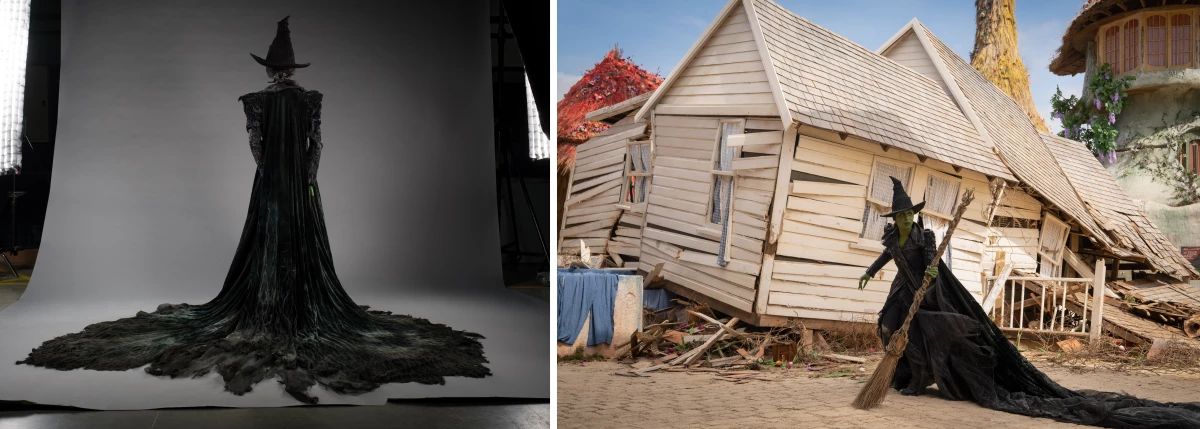
Something happened to my design brain when John M. Chu said that he was casting Cynthia Erivo [in the role of Elphaba]. … I had already worked with Cynthia in Harriet, and I knew her range. I fully understood her connection to clothing, how she develops a character, what that conversation is as she’s developing a character, as you know, because we went through that process on Harriet, but I knew that she would be able to go to a place that would use the agility of wearing trousers as a means of athletic expression and power. That the ability to move allowed for her to navigate the world in a way that was more expansive than being in a skirt and jacket all the time.
On why Elphaba is often in all black
She lost her mother very early in life. She was in mourning, so she wore that color, the black color, signifying mourning. And then to adopt that as a way to pull herself apart from the rest of the community, which we see presented when she’s a little girl the other children in the neighborhood make fun of her. And holding on to that armoring that’s created by wearing black, it felt real in a way because you think about high school students or young students who dress in black or in a very goth way to make themselves feel special or to create a separation from the rest of the bullies that might be hurting them, just to create some significance in their personality.
I was talking about how Cynthia was cast. It was the first time that a Black woman had ever been cast in that role, which was surprising because the whole point of the story is that she is being ostracized or vilified, or that she’s othered because of the color of her skin. Now there’s a direct connection to the racial structure of our country. There are so many similarities in the emotional story for a person of color and how that relates to Elphaba.
On the gray, chunky wool sweater Elphaba wears in her love scene with Fiyero — aka the “sex cardigan”
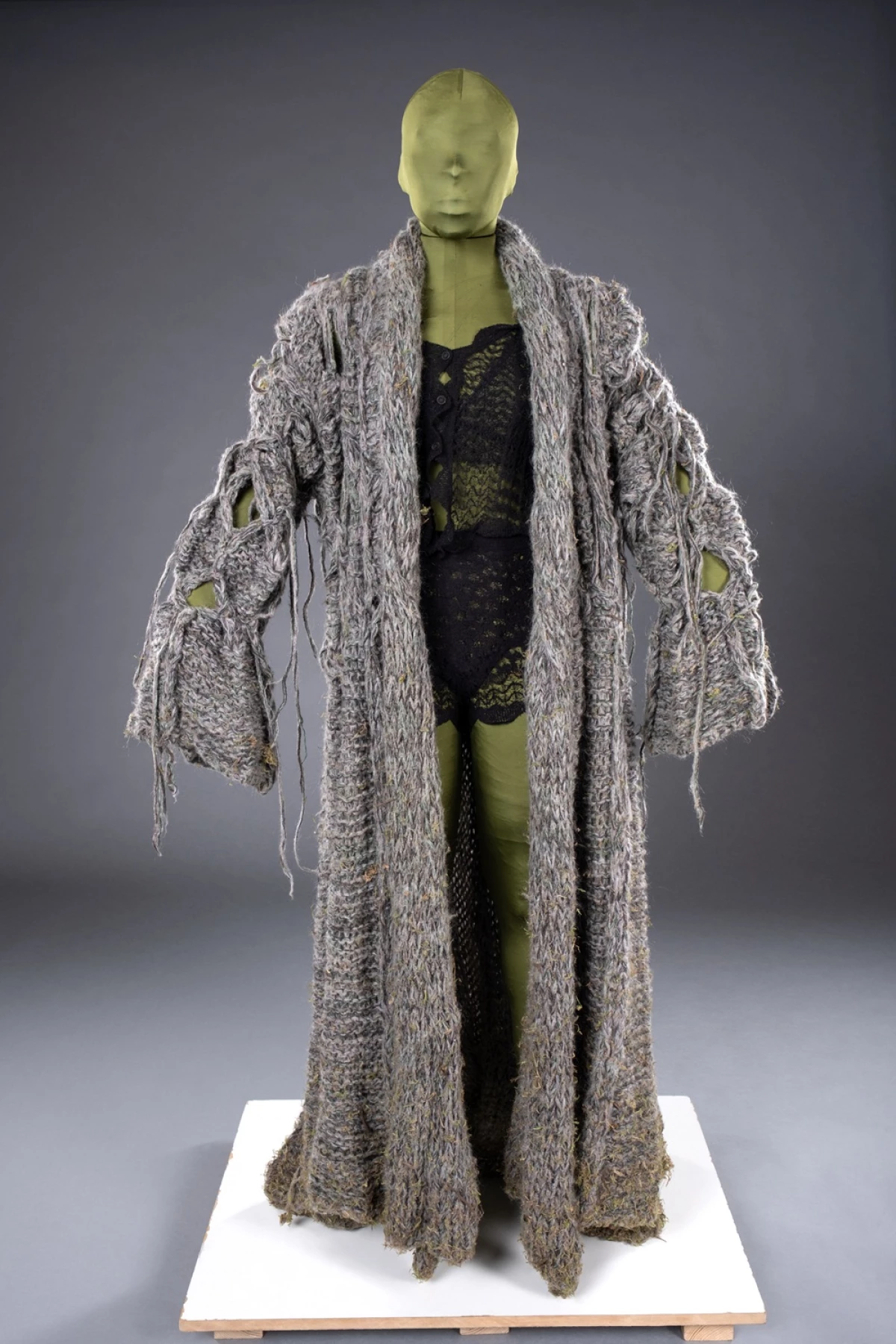
It came out of very literally an organic decision of what does Elphaba have access to? And living alone, what choice would she make when she’s looking for a robe, some way to be protective and warm? … It’s operating as her robe for that moment. She’s got a loom in her treehouse, where she’s weaving her own clothing. She’s manifesting all these things from the elements that are around her, and the sweater is just in keeping with that. Now indeed, you could say, Well, why wasn’t it a black, slinky peignoir? But where would she get … that? Well why would she even have it? … I think that it just follows through with reasonable choices that define who a character is and what is important for them, where their priorities are.
On growing up in a creative family
My grandmother was a painter. My dad loved model trains. So I remember for a period of time he had this huge model train table … [with] model houses [and] you’d create a little town and then the train would ride around it. And then there was the element of live production. They would take us to productions of musicals that were in the Akron and Cleveland area. They encouraged us to join the drama club and my brothers and myself, we were all Suzuki violin or cello student. So culture was was really big. And my grandmother had studied at Oberlin, [studied] music, and she was a piano teacher and piano player and so it was just a part of our family culture that we were expressive.

Ann Marie Baldonado and Thea Chaloner produced and edited this interview for broadcast. Bridget Bentz, Molly Seavy-Nesper and Beth Novey adapted it for the web.
Transcript:
TONYA MOSLEY, HOST:
This is FRESH AIR. I’m Tonya Mosley.
(SOUNDBITE OF WICKED MOVIE CAST SONG, “EVERY DAY MORE WICKED”)
MOSLEY: In “Wicked: For Good,” when Glinda descends from her bubble in iridescent blue and lavender or when Elphaba sweeps through the sky for the first time in a weathered trenchcoat and trousers, their looks aren’t just dazzling us – they’re an integral part of the story, telling us who these women have become and the choices they’ve made. My guest today, costume designer Paul Tazewell, is one of the visual architects of that world. For more than 30 years, his designs across Broadway, television and film have shaped how we see stories, from the worn revolutionary textures of “Hamilton” to the saturated palette of “West Side Story.” Tazewell won the Academy Award last year for his work on “Wicked.” And during his acceptance speech, he paused to acknowledge the significance of that moment.
(SOUNDBITE OF THE 97TH ACADEMY AWARDS)
PAUL TAZEWELL: I am the first Black man…
(APPLAUSE)
TAZEWELL: …To receive the costume design award for my work on “Wicked.”
(APPLAUSE)
TAZEWELL: I’m so proud of this. Thank you, Mom and Emma (ph) so much. Thank you, everyone in the U.K. for all of your beautiful work. I could not have done this without you. My Ozian muses, Cynthia and Ariana, I love you so much. All the other cast, thank you, thank you, thank you for trusting me with bringing your characters to life. This is everything.
MOSLEY: Tazewell’s work now continues in the next chapter of the “Wicked” universe with “Wicked: For Good,” which picks up where the first film left off. Elphaba, played by Cynthia Erivo, is now on the run, branded as the wicked witch, while Glinda, played by Ariana Grande, rises as the face of a new Oz. The film also stars Jonathan Bailey, Bowen Yang, Michelle Yeoh and Jeff Goldblum as the Wizard of Oz, and Colman Domingo joins the cast as the voice of the Cowardly Lion. Paul Tazewell grew up in Ohio, a kid who loved to perform and gradually found his way into costume design. Since then, he’s won two Tony Awards for “Hamilton” and “Death Becomes Her.” And in addition to his Oscar win for “Wicked,” he’s also earned an Emmy in 2016 for “The Wiz Live!” And Paul Tazewell, welcome to Fresh Air.
TAZEWELL: Thank you. It’s so good to be here, Tonya.
MOSLEY: We’re going to get into “Wicked: For Good,” but I could hear you sort of chuckling when you were listening to your acceptance speech. It’s still, like, a surprise for you when you listen to it.
TAZEWELL: Oh, my God, completely. It’s just so out of body. And that whole experience was so out of body. I mean, although I – you know, I trained to be a performer, that’s not what I do. So it’s not what I, you know, kind of carry forward. You know, so it’s always a surprise when I have to get up in front of millions of people and say something that’s coherent. And -because I was so moved. I mean, that’s one of the things that I was chuckling about. I was like, oh, I forgot to say thank you to all the other cast. I mean, it wasn’t that I forgot. I just – you know, just, like, listing all of them off, and, you know, it minimizes the impact that it’s had on me creatively to say that it was – you know, just to say that it was life-changing. I think that it really has affected my life in great ways.
MOSLEY: Well, one of the ways that it’s affected your life is that you’re now a name. That’s very few times, I mean, where we’ve been able to name people who set the worlds behind the movies. We’re often talking to the performers, or we’re talking to the directors or the producers. But as a costume designer, especially for “Wicked” – I mean, it’s such an integral part of the storyline. And from – right from the start of this second film, we’re watching your work. We’re watching these two women step into their new personas, Glinda as the good witch, Elphaba as the wicked witch. And the costumes are really working to tell that story. Elphaba’s elaborate dress. From the first film at the end, it’s now shredded into a tunic, and Glinda is wearing this blue and lavender instead of that signature pink. Walk me through what you were trying to communicate with those opening looks.
TAZEWELL: I see my work as a costume designer to be one of a storyteller, you know, and I’m telling a silent story that reveals itself adjacent to the performances of the characters. Throughout these two beautiful films, you know, I was giving context to what their backstory was – I mean, you know, for each of our principal characters, Elphaba and Glinda, where they came from. With Elphaba, we have been left at the very end of the first film, “Wicked” part one, with “Defying Gravity.” And she’s in her very best dress, dressed to meet the Wizard for the first time. She’s also paired that with her pointed hat. And when she jumps out of the window with the velvet cape that she’s added on and her broom, we realize that she’s completely self-empowered. I mean, she has arrived and has taken ahold of her own power.
So to enter into the beginning of “Wicked: For Good,” we get this sense that she has never really gone back to society. She’s stayed in exile. And a way of expressing that was to keep her in the same dress. But because she has been out there – you know, she’s advocating for animals, saving animals, really, and taking down lines of guards that, you know, we see at the very beginning where they’re all laying the yellow brick road, she has become a huge force and, you know, kind of a superhero. So I wanted to relay that with her silhouette, but also to show the weathering of her garment. So it’s the same cape that we saw at the end of “Wicked” part one in “Defying Gravity.” You know, the lining has come out of it. It’s starting to fray, and it just adds to the texture of who she is – the same with her coat, the sweeping coat that she’s upcycled from a raincoat, but the idea that she has taken just a few things into the forest, and then she’s recreating herself as this heroic image – paired with the pants that we have and also her knee-high boots.
So, you know, in setting that up, I’m making choices about what is the silhouette going to be? How does it potentially align or become nostalgic of the 1939 film and that Wicked Witch of the West, so that we’re always threading, you know, all of these ideas of the Wizard of Oz and Oz, you know, just the Ozian and sensibility all together and wrapping it up in a way that makes sense and says something more – as I was saying, says something more about the characters as well.
MOSLEY: You know, one of the things I’m so interested to know is – I mean, both of these films, one and two, were shot simultaneously. And Cynthia Erivo was on the show a few weeks ago, and she told us that she created scents. So she created perfume, smells that she could help differentiate the days that she was shooting…
TAZEWELL: Right, right.
MOSLEY: …For the film since it was happening.
TAZEWELL: Right.
MOSLEY: For your role, you had to know Elphaba’s entire journey before you started shooting. When you’re designing across two films like that, knowing where a character ends up, how does that change the way you approach, I mean, really, the very first costume?
TAZEWELL: Well, it’s the way that I approach any production. You know, if I was doing a musical, I would be figuring out my characters from the beginning to the end because that’s how the audiences are going to experience them. And then I need to make choices that are consistent as I’m telling that story. The same for “Wicked.” It was about clothing and style and how the different groups, like the Munchkinlanders versus the Uplanders, which is where Glinda’s family is from versus the Winkies or Kiamo Ko, which is where Fiyero is from. Each of those very specific sensibilities. But together, they help to define each other. I mean, they’re consistent by, you know, silhouette. It’s by, you know, the shapes of sleeves and the shapes of skirts and the kinds of textures that I use. I needed to make a world that would be plausible within itself so that you believe in it as an audience member. You’re able to, you know, it doesn’t – you know, I’m not going to throw, you know, a bunch of scenes with sneakers in it unless it’s a very specific Ozian sneaker. You know, and that’s why, you know, everything in this world needed to be bespoke. I mean, it was all created specifically for this world.
MOSLEY: How did you come to the decision to have Elphaba wear trousers?
TAZEWELL: Something happened just to my design brain when Jon M. Chu said that he was casting Cynthia Erivo. And this is after looking at a number of different Elphabas. And I was actually privy to some of those audition tapes just to see where his mind was. But to then see that he was thinking of putting Cynthia in that role, one, I had already worked with Cynthia in “Harriet.” And I knew her range. I mean, you know, I fully understood her connection to clothing, how she develops a character. But I knew that she would be able to go to a place that would use the agility of wearing trousers as a means of athletic expression and power.
The ability to move allowed for her to navigate the world in a way that was more expansive than being in a skirt and jacket all the time, which is how I set her up. I mean, she enters into the world of Shiz dressed in black. You know, and that was another part of the equation was, why does she wear black? And there are many conversations that Jon M. Chu and I had, the director, you know, around, how do we define why she is wearing black? And I made the decision that, well, she lost her mother very early in life. She was in mourning. So she wore that color, you know, signifying mourning.
And then to adopt that as a way to pull herself apart from the rest of the community, which we see, you know, presented, you know, when she’s a little girl and, you know, how the other children in the neighborhood make fun of her. And that holding onto that armoring that’s created by wearing black, it felt real in a way because, you know, you think about high school students or young students who dress in black or in a very goth way to make themselves feel special or to, you know, create a separation from the rest of, you know, those bullies that might be hurting them, you know, just to create some significance in their personality.
MOSLEY: This is so fascinating what you’re saying, because in that way the black stands out. Because I would guess that black is one of the hardest colors to make visually interesting. But up against this colorful world, I mean, it feels like that texture and that detail and her costumes also show up in the black.
TAZEWELL: Thank you for mentioning that. I mean, that was, again, another element is that she’s side by side with Galinda/Glinda, who is always dressed in pink or in light tones. And they are often very feminine, in feminine fabrics. Light, airy, elegant, beautiful, those things that are desirable. I made the decision that there had to be balance, and then it just continues to expand.
You know, I was talking about how Cynthia was cast. You know, it was the first time that a Black woman had ever been cast in that role, which was surprising because the whole point of the story is that she is, you know, being ostracized or vilified or, you know, that she’s othered because of the color of her skin. Now it’s a direct connection to, you know, the racial structure of, you know, even our country. There are so many similarities in the emotional story for a person of color and how that relates to Elphaba.
MOSLEY: Let’s take a short break. If you’re just joining us, I’m talking with Oscar- and Tony-winning costume designer Paul Tazewell, whose work spans theater, television and film. He designed the costumes for the new “Wicked: For Good.” And we’ll continue our conversation after a short break. This is FRESH AIR.
(SOUNDBITE OF RAY CHARLES’ “UNDECIDED”)
MOSLEY: This is FRESH AIR. And today, I’m talking to Paul Tazewell, an Academy Award-winning costume designer whose career includes “Hamilton,” “West Side Story,” “The Color Purple” and now “Wicked: For Good.”
I want to ask you about something that fans have also noted, that there is one steamy, very intimate scene in the film between Elphaba – you know where I’m going.
TAZEWELL: (Laughter).
MOSLEY: And Fiyero, played by Jonathan Bailey. And Elphaba is wearing this long, gray, chunky wool sweater.
TAZEWELL: (Laughter).
MOSLEY: It is such a specific choice. Why?
TAZEWELL: Just lately, people have talked about it. You know, they call it the sex cardigan.
(LAUGHTER)
TAZEWELL: It came out of, you know, very literally, an organic decision of what does Elphaba have access to? And living alone, what choice would she make when she’s, you know, looking for a robe, some way to be protective and warm? And the sweater is one of comfort. When you put someone in a cardigan or in a sweater, what you’re doing is you’re creating – you know, there are many different, you know, connections that we have.
Sometimes it’s a hand-knit sweater. So, you know, you’re connecting it to the person who actually made it, you know, which might be a mother or a grandmother or an aunt. So that gives you comfort. You know, you think about a boyfriend sweater. And that again is, there’s the idea of an oversized, comfortable, something that you could wrap in, how it makes you feel. You know…
MOSLEY: I get that. But, like, intimate time with the man that you’ve been secretly loving forever (laughter), to put on a sweater, what does it signify?
TAZEWELL: It’s operating as her robe for that moment and for, you know, her in exile. And she is making a softer choice, alone in her surroundings of roots and vines and, you know, all the elements that are around her. And you can imagine that, you know, because she’s crafting all of that. You know, she’s got a loom in her live space, in her treehouse, where she’s weaving her own clothing. She’s manifesting all these things from the elements that are around her. And the sweater is just in keeping with that. Now, indeed, you could say, well, you know, why wasn’t it a black, slinky peignoir? But where would she – why would she have that?
MOSLEY: Where would she get that? Right. Right.
TAZEWELL: Well, why would she even have it? Because it’s not like she’s – at that moment, she’s not thinking about Fiyero. She’s thinking about saving – I mean, she angsts some about the love that she has, but she’s not expecting that he’s going to arrive, and therefore, she’s got her special sexy peignoir that she’ll pull out. I mean, that’s very much in line with Glinda. But why would she have that? I think that it just follows through with reasonable choices that define who a character is and what is important for them, where their priorities are. And I felt like the underwear that we have her in, which is very sexy underwear, it’s all knitted, as well, and it’s revealing of her skin. It’s – you know, it’s short. You see your legs and her arms, her stomach, even, to use both. And then they’re together, and they’re actually using the rope as a blanket. So, again, it’s – you know, it’s a much more organic connection to clothing and how the characters relate to it.
MOSLEY: It wouldn’t be realistic that she’d have a little black lingerie in this…
TAZEWELL: Right.
MOSLEY: …Forest, yes. I get it.
TAZEWELL: As much as everyone wants her to have it. Yes.
MOSLEY: OK, Paul, I want to go back to your childhood because the 1939 version of “The Wizard Of Oz” with Judy Garland, it’s a tradition for many families to watch it. And growing up, your family would watch it on Easter.
TAZEWELL: Absolutely.
MOSLEY: So you know why your family made it an Easter tradition to watch?
TAZEWELL: I think that that was when it actually played, you know, because, you know, this was before there was VHS tapes. As I have it in my memory, it was annually that, you know, my three brothers, myself and my two parents would sit, and we would experience, you know, “The Wizard Of Oz.” And it became very, you know, informative. I mean, it was, you know, for me, as a designer, you know, the idea of visual magic, you know, when you think about most specifically, going from sepia tone in Dorothy’s house to technicolor when she enters into Munchkinland. I mean, that’s one of the most magical transitions that I, you know, that I can remember. So, you know, I have that in my bank of imagery as I think about, you know, other projects that I’m designing. There are other films, as well. I mean, if you think about “Willie Wonka And The Chocolate Factory,” or you think about “Mary Poppins” or “Cinderella” Disney, I mean, so at that time, all of those magical stories, all those movies were folded into our, you know, just our family culture, you know, and what we would watch for entertainment.
MOSLEY: Were there things about the costuming in “The Wizard Of Oz,” even back then when you were a young boy, that you noticed? For instance, I’ll just say, you know, with Glinda The Good, it would be part of my daydreams to think about me dressed as her, you know, holding a little wand. I just wonder for little Paul, what – were there any moments that you would think about?
TAZEWELL: Well, I dressed as Glinda. I mean…
MOSLEY: Yeah.
(LAUGHTER)
TAZEWELL: No. But I think that I was transfixed by that costume, just to understand what’s going on in that – you know, that fairy princess dress. And, you know, it’s very classic. You know, it is an archetype of who Glinda is, but then who, you know, when you think of the Good Witch of the North, that’s the image that comes up. It’s this bell-shaped skirt, tight waist, full sleeves, sheer – lots of sheer layers, and then sparkle. And, you know, so just understanding – so what are those qualities that allow for us to think this about this character and then to adopt that and transform it into the Glinda that I created, the pink bubble dress, that is actually Glinda’s moment of coming to power.
MOSLEY: Our guest today is Oscar-winning costume designer Paul Tazewell. We’ll be right back after a short break. I’m Tonya Mosley, and this is FRESH AIR.
(SOUNDBITE OF SONG, “WHAT IS THIS FEELING? “)
ARIANA GRANDE: (As Glinda, singing) What is this feeling, so sudden and new?
CYNTHIA ERIVO: (As Elphaba, singing) I felt the moment I laid eyes on you.
GRANDE: (As Glinda, singing) My pulse is rushing.
ERIVO: (As Elphaba, singing) My head is reeling.
GRANDE: (As Glinda, singing) Yeah, well, my face is flushing.
ARIANA GRANDE AND CYNTHIA ERIVO: (As Glinda and Elphaba, singing) What is this feeling? Fervid as a flame, does it have a name? Yes. Loathing, unadulterated loathing.
GRANDE: (As Glinda, singing) For your face.
ERIVO: (As Elphaba, singing) Your voice.
GRANDE: (As Glinda, singing) Your clothing.
GRANDE AND ERIVO: (As Glinda and Elphaba, singing) Let’s just say I loathe it all. Every little trait, however small, makes my very flesh begin to crawl with simple, utter loathing. There’s a strange exhilaration in such total detestation. It’s so pure, so strong. Though I do admit, it came on fast, still, I do believe that it can last. And I will be…
MOSLEY: This is FRESH AIR. I’m Tonya Mosley. And today, I’m talking with Paul Tazewell, an Oscar-winning costume designer whose three-decade career has helped define the visual language of modern theater and film and who created the costumes for the new movie “Wicked: For Good.” His debut as a costume designer was in 1996 with the Broadway show “Bring In ‘Da Noise, Bring In ‘Da Funk.” He’s won two Tony Awards for costume design for “Hamilton” and “Death Becomes Her.” And he also won an Emmy for his work on “The Wiz Live!” and has worked on many musical productions, including “The Color Purple” and “In The Heights.”
Your mother taught you to sew when you were around 9 years old?
TAZEWELL: That’s right.
MOSLEY: What made you want to learn?
TAZEWELL: You know, I think that I was always transfixed by crafts and working with my hands. And my mother – you know, I was always, you know, right at her side, you know, as she would draw and paint, or early on in my life, she was making puppets and doing puppet shows with her sister and with my older cousins. They would create these puppet shows for libraries in and around Akron for the schools and for the church. And so I was really fully connected and engaged with what they were doing and that kind of crafting. And so in some way, that fed into my desire to create, to work with my hands.
I think that creating clothing was just the next step. You know, my mother had a Singer sewing machine, and she would set it up, and she would make costumes and clothing for us – you know, my brothers and myself. Also, she was making things for herself. And then, you know, it was just a skill that I wanted to have so that I could start to create things for myself. So I would make dashikis and different kinds of clothing, you know, shorts, and, you know, it’s just a way of – you know, it was an activity.
MOSLEY: It really sounds like your family was pretty creative in one way or another. It seems like almost everyone was an artist.
TAZEWELL: We were definitely surrounded within my family. I mean, my grandmother was a painter. My dad, you know, also – he loved model trains. So I remember for a period of time, he had this huge model train table that – you know, where you would have little, you know, model houses. You’d create a little town, and then the train would ride around it. And then, you know, there was the element of live production. I mean, you know, they would take us to productions of musicals, you know, that were in the Akron and Cleveland area. They encouraged us to join the drama club. And my brothers and myself, we were all Suzuki violin or cello students. So culture was really big. My grandmother had studied at Oberlin, music, and she was a piano teacher and piano player. And so, you know, it was just a part of our family culture that, you know, we were expressive in that way.
MOSLEY: Your great-aunt was also the president of Bennett College.
TAZEWELL: That’s right.
MOSLEY: Which is an HBCU in Greensboro.
TAZEWELL: That’s right. Yeah. She was there when the sit-ins happened, you know, so she was very much connected with A&T and, you know, just how the – ’cause Bennett is a girls school, and A&T was a boys school at that time, or largely male. So they would work together. But at that time, you know, there was just a lot of navigating what was going on in the city and, you know, how to be an activist, you know, at that time. It was, you know, a serious time.
MOSLEY: I’m thinking about the aesthetics for the time because, OK, when you were a very young boy, the Civil Rights Movement was so defined by that visual language of respectability, so the suits and the pressed dresses and the carefully composed presentation. But by the time you were a teenager, I mean, there was a whole different aesthetic that was emerging. And where did you fall, for yourself? Where did you see that – where did you sit with your aesthetics and also the way that maybe you were thinking about it?
TAZEWELL: I think that I was engaging with both, really. You know, I remember when my mother cut her hair to become an Afro. So making the decision that she was no longer going to press her hair and grow it long, but she was going to cut it and have it curl up into an Afro and go with a natural style. And my grandmother was, you know, completely against it. I was against it, even – you know, it was like, because of that change. But then, you know, that was a…
MOSLEY: How come? Yeah.
TAZEWELL: I mean, you know, I think that it was just a romantic alignment with, you know, that long, straight hair and just how much white culture had infused itself into how Black people were making choices about how they were going to show up. But wearing jeans to school. I was in grade school at a time where you weren’t allowed to wear jeans to school, and girls weren’t allowed to wear slacks unless they – unless it was snowing outside and they just needed to walk to school, and then they would change out of them.
So I experienced all of that and then that shift into a much more casual style. But I was still brought up by grandparents and parents who – you know, my dad was a research chemist at Firestone, and he dressed in a suit every day, and tie. We all dressed up for church. You know, so there was a formality about what we were taught. But, you know, how I design is very much informed by, you know, the portraits of my family through the ages, you know, from the turn of the century and before, up until that contemporary time, and seeing how my family chose to present themselves, which was usually in a formal way, especially if it was going to be for a photograph.
MOSLEY: Right. Do you have a lot of photographic evidence that you guys have a lot of?
TAZEWELL: I do. I do. Yeah, we’ve kept a lot of it. Yeah. You know, and that has informed, you know, when I remember, you know, a photograph of my great-grandmother and my great-grandfather and my grandmother, as a little girl and grandaunt that you were talking about, who was president at Bennett, it was a beautiful turn-of-the-century family with – you know, my great-grandmother had this large hat, and my great-grandfather had this amazing homburg on. And, you know, so that sparked my interest in period clothing. In my home, and then how it expanded into researching, you know, so what was – you know, she was wearing a corset, obviously, and her clothes were created in a very specific way. And my great-grandfather’s clothes were tailored in a very specific way, according to the period, because they were dressing to armor themselves up for the world.
I mean, you know, they wanted to be seen in a certain light, kind of the Black families who have arrived. You know, they’ve migrated from the South, and they’ve now arrived to the north, and they are respectable people with dignity. And the idea of you know, you’ve got one pair of shoes, and you make sure those shoes are shined when you’re going out into the world just downtown because you want to be seen in a certain light by both, you know, the Black community and the white community. You know, you’re going to put forward your dignity by what you’re wearing on your body. And that became a really powerful message for me. And, you know, I still think about it. You know, that’s how I show up. I show up in a very intentional way.
MOSLEY: You show up in a very simple black way. You love black clothing.
TAZEWELL: I do tend to.
(LAUGHTER)
TAZEWELL: Well, I try to, you know, that energy that it takes to put together clothing I use professionally. You know, so if I can have a uniform and I know that, you know, I know what I’m going to wear when I go out, you know? Lately it’s been a navy blue turtleneck and navy blue trousers. It’s tone-on-tone. I know that I can look good and not have to worry about being fashion forward. I mean, it’s only if I’m doing a red carpet or something like that that I want to make sure that, you know, I show up in, you know, something that makes a mark. Otherwise, I kind of want to recede.
MOSLEY: Well, the thing about it is – and I hope I’m not overstating this or stepping into a territory that I don’t really know. But when you were talking about Elphaba wearing all black and the reasons why and what it signified, in many ways I was just wondering, is that how you think about yourself and your own style?
TAZEWELL: Well, I do have to say that Elphaba is the main character of “Wicked,” the “Wicked” films, that I align myself with. There’s a sensibility about her and how she walks through life, both as an introvert and one that is a listener. Also she’s, with Nessarose, she’s a people pleaser in a way. You know, she’s working to combat the fact that she’s been othered by taking care of other people, making sure that other people are OK.
You know, before “Wicked” was even in my life, that’s a part of my own personality. But then the draw to armor is definitely a part of my personality because I dress according to how I want to be seen, whether it’s an interview with a person that I’ve never met or, you know, it’s going out on a red carpet, you know, I’m dressing in a way very conscious of how I might potentially be seen. And that’s what all of us do, really.
MOSLEY: It is, yeah.
TAZEWELL: We’re just not as intentional or we’re not thinking about it quite as much. We might say, well, you know, I like this, I don’t like that. This is my style, this isn’t my style. But you’re also making choices about how you – or what that is, is making choices about how you want to show up for a specific moment.
MOSLEY: You know, as a Black man, I mean, you’re hypervisible. And I mean that literally because when you’re a Black man in predominantly white spaces, you stand out. You’re seen. It’s just what happens, you know?
TAZEWELL: That’s right, that’s right.
MOSLEY: So that has to factor into how you understand the way people interpret what you wear and how you present yourself and what you say. Do you remember when you became conscious of that?
TAZEWELL: Early, early on, maybe junior high. You know, I wasn’t aware of, you know, growing up in Akron – and, you know, Akron, it has its racist moments, areas. You know, it just had that dynamic, especially when I was coming up. I mean, there were certain areas that you didn’t go into. I mean, it was also the time that, you know, the original “Roots” the novel was created. And then, you know, the television series happened. So that was in our home.
MOSLEY: Oh, for the “Roots.” Yes, yeah.
TAZEWELL: Yeah, for “Roots.” And, you know, all this is folding in. And I’m trying to figure out, who am I? And how can I be true to myself and embrace all that I am drawn to? Because I was operating with two different things. One, that it tended to be more feminine than masculine, you know, because I was drawing and painting and making puppets and creating clothing. So all of those were seen as more feminine.
And then, you know, I couldn’t get around being a Black man or a Black boy. You know, that was how I was seen as well. So, you know, navigating that, you know, when you think about it – when I think about it, you know, just sitting here with you, it’s like, well, that informs why I’m doing what I’m doing because I’m actually trying to control how people see other people before they’ve said anything.
MOSLEY: Let’s take a short break. If you’re just joining us, I’m talking to Oscar-, Tony- and Emmy-winning costume designer Paul Tazewell. We’ll continue our conversation after a short break. This is FRESH AIR.
(SOUNDBITE OF AWREEOH SONG, “CAN’T BRING ME DOWN”)
MOSLEY: This is FRESH AIR. Today I’m talking to Paul Tazewell, an Academy Award-winning costume designer whose career includes designing for “Hamilton,” “West Side Story,” “The Color Purple” and now “Wicked: For Good.”
OK, you have been living in the world of Oz for a really long time in various different ways.
TAZEWELL: (Laughter).
MOSLEY: We talked about “The Wizard Of Oz” as a child. And in high school, you designed costumes for your school’s production of “The Wiz.”
TAZEWELL: That’s right.
MOSLEY: What do you remember about that experience? And what drew you to design rather than to perform?
TAZEWELL: At that time, I had not let go of performance. But, you know, in 1978, “The Wiz” came out as a film.
MOSLEY: Yep, that’s right.
TAZEWELL: The one with Diana Ross and Michael Jackson. Nipsey Russell was in it, and Richard Pryor and Lena Horne. And that was hugely formative for me visually, you know, again, to see Black faces in this epic film, rendered in great style and amazing music by Quincy Jones. He did all the orchestrations for that. It blew my mind, you know, to see that kind of expression of disco iconography represented as the Emerald City world. You know, because I knew “The Wizard Of Oz” from 1939. But then to see it told in, you know, my cultural language was, you know, life-changing. It was like, oh, yeah, well, of course. You know, this all works beautifully. You know, or like the – I think they call them the Winkies in the film. Those people in the factory that are working for Evillene, when they unzip out of their bodies and the skin falls away.
MOSLEY: Right.
TAZEWELL: And then there are these beautiful…
MOSLEY: Yeah.
TAZEWELL: …Dance Theatre of Harlem dancers.
MOSLEY: Yeah. Yep.
TAZEWELL: And you see their brown skin. And, you know, just, you know, that was, again, mind-blowing. It was magical. Then because I went to a magnet school in Akron, part of that was that there was a performing arts program within that school. And at that time, I wanted to be an actor, singer, dancer. That was my hope and drive. And I found theater through a production of “West Side Story” that I was in maybe two years before. So at 16, my teacher, Arnold Thomas, he realized that I was very interested in costume design. And he offered me the project of designing all the costumes for this production of “The Wiz” that they were going to do in the spring. Now, I also auditioned for “The Wiz” as well. And I was given the role of the wizard, or The Wiz…
MOSLEY: Oh.
TAZEWELL: …In that production as well.
MOSLEY: Yeah.
TAZEWELL: So I was designing the costumes and also…
MOSLEY: And performing.
TAZEWELL: …In production at the same time, yeah. But, you know, I was in heaven. You know, I loved creating these fantasy characters through my lens. Now, it was greatly informed, when I think about what I created, I was very much inspired by – or, you know, you could say, you know, copying – the film, you know? But it was, you know, transformed into what we could actually manifest. Thankfully, you know, my mother, my dad, my brothers, we all, you know, they all chipped in, you know…
MOSLEY: Oh, it was a family affair.
TAZEWELL: At the end, yeah, yeah, yeah. But, you know, much of that time, I was creating them on my own.
MOSLEY: Were you creating like designing and then sewing them and putting it all…
TAZEWELL: That’s right.
MOSLEY: Everything?
TAZEWELL: Yeah, the only thing that I didn’t sow was my white suit that my mother made for me as The Wiz.
MOSLEY: (Laughter).
TAZEWELL: So, you know, she made my white suit. It was a double-breasted suit I love, I love. It was a shark skin suit and a white cape with green lining.
MOSLEY: Oh, my God.
TAZEWELL: You know, there was a gold lame pleated cape and dress that was – that I designed for Glinda. That was my continuing evolution of problem-solving and the creation of worlds that I continued to fall in love with. Once I graduated, I ended up going to Pratt Institute to study fashion. And the reason I wanted to be in New York was because I wanted to continue to pursue an acting and dancing career. But I didn’t create a bond with the world of fashion at that time. So I decided that I really wanted to get back into costume design. And for that, I went to North Carolina School of the Arts in Winston-Salem, North Carolina.
And while I was there, I made the conscious decision that I would, you know, put myself whole hog into becoming a costume designer because I was still grappling with, how can I be seen in the way that I want to be seen as a performer? You know, how can I get the roles of a leading man in a musical on Broadway in the way that I want to do that? And will I ever be able to? Because the climate at that time was just, it didn’t feel as inclusive. It wasn’t.
MOSLEY: Well, let’s slow down a little bit, because you left Akron for New York City. This was around ’82. I mean, what a time to be in the city. You’re 18, you’re away from home for the first time, you’re discovering yourself. But you also are kind of coming to grips with maybe you won’t be a performer. Maybe you will go into this other direction. Was there something pivotal that happened during that time period that really solidified that for you?
TAZEWELL: I mean, one of the things was just how difficult it was to – you know, because I was trying to double major. And it seemed like at every turn, I wasn’t able to merge both of them together. And what was really encouraged was my design ability. Meaning, I was getting a lot of encouragement, I was excelling very quickly, it was in the direction of costumes. And I made a decision my junior year that I would devote myself to costume design and live vicariously through other characters. You know, where I might not be cast in certain roles because of how I looked, as a designer, I could be anyone.
MOSLEY: Oh, that’s so…
TAZEWELL: You know, I could live through that process of character development and what they would wear. It just so happens that I wasn’t going to be onstage playing the role.
MOSLEY: Wow. Let’s take a short break. If you’re just joining us, I’m talking to Paul Tazewell, the Oscar-winning costume designer whose work includes “Hamilton,” “West Side Story” and the new film “Wicked: For Good.” We’ll be back after a break. This is FRESH AIR.
(SOUNDBITE OF ORIGINAL BROADWAY CAST OF HAMILTON’S “SATISFIED (INSTRUMENTAL)”)
MOSLEY: This is FRESH AIR. And today, we’re talking to Paul Tazewell, designer, storyteller and the creative mind behind the costumes for “Wicked: For Good.”
Your Broadway debut was in 1996. But “Hamilton,” in 2015, was the moment when the world saw your work. And the costumes, as in all of your productions, do so much storytelling. The way the revolutionaries are Earth tones, and the British are in jewel tones, the way that final dress is both, like, a mourning and a triumph. And how did you and Lin-Manuel Miranda approach the visual language of that show?
TAZEWELL: I mean, I would give it up to – and I love working with Lin. We worked together on “In The Heights” first. But I also want to throw in and acknowledge Thomas Kail, who was the director of both “In The Heights” and of “Hamilton,” because it was Thomas Kail that I was directly engaging with for the overall production. You know, I had a large body of work that I did between “Bring In ‘Da Noise, Bring In ‘Da Funk” and “Hamilton.” And all of that work defines where I was creatively as a designer, to be able to step into “Hamilton” and do what you were suggesting, which is being in control of the imagery that I was using as it relates to these characters that we know or, you know, our forefathers and the world around them, but to show it through the lens of a modern, you know, a modern voice. And making choices about silhouette and very directly research silhouette and where it’s useful…
MOSLEY: And movement.
TAZEWELL: And movement, as well. And that’s where my – you know, my background in dance, that’s, you know, I’m always infusing that into my design because it just becomes part of the performance. You know, the extension of a costume or fabric from the body and how it connects to and is reactive of how the body moves is paramount for me because you get an emotional result from that.
And when you think about “West Side Story,” let’s say, or even in “Hamilton,” where, you know, you have the winter’s ball and the – and because the turn table is turning and the women are moving in a circular manner, the skirts then sweep around in a way that becomes very romantic. And the – you know, the ensemble of ladies in those skirts, you know, so they’ve gone from being soldiers into being these women in this ball. And, you know, when they’re lifted up and they’re swirling around, it creates this really magical, romantic moment that you are swept into. And that’s in support of the three primary women that we’re looking at, which is the Schuyler Sisters, and then experiencing Eliza’s, you know, her transformation. And then we go into Angelica and how she remembers that moment. You know, so all those things are very visceral for me, and I become very emotional about it.
MOSLEY: Are there any funny moments, though, when you thought a garment might work out, and then you practice it and you learn, not so much. This is actually not going to work, you know?
TAZEWELL: I know my life is full of that, but it’s, you know, you have to have trial and error, you know, and so I build into the process a period of R&D to fail, you know, to make bad choices. There are probably seven different versions of the Elphaba hat that I created.
MOSLEY: Wow.
TAZEWELL: One because I wanted to figure it out. I wanted for it to be able to collapse. I wanted for it to live within the design rules that we had created for the film to somehow be a very original version of a hat. Was it going to be straight and pointed up, you know, in a symmetrical way, or was it going to curve? And, you know, just, you know, a little blip is as Jon M. Chu would describe how he was planning on starting the film, it was going to be a close up of the hat that you really couldn’t see what it was. You really didn’t know if it was a mountain or a building or, you know, like, what that structure was. So that…
MOSLEY: Oh, yeah.
TAZEWELL: …Defined why it spirals around. But then the spiral became definitive of everything around, like, it resonates throughout the film, and, you know, you see that usage of spiral defines our world of Oz.
MOSLEY: Paul Tazewell, this has been such a pleasure to talk with you. Thank you so much.
TAZEWELL: Oh, so great to talk to you, as well. Thank you.
MOSLEY: Paul Tazewell is an Oscar, Emmy and Tony Award-winning costume designer, known for his work on “Hamilton,” “West Side Story” and the new film “Wicked: For Good.” Tomorrow on FRESH AIR, Pulitzer Prize-winning photojournalist Lynsey Addario. A new documentary explores the intersection of her all-consuming and dangerous work in conflict zones and her life at home as a wife and a mother. I hope you can join us.
To keep up with what’s on the show and get highlights of our interviews, follow us on Instagram at @nprfreshair. FRESH AIR’s executive producer is Danny Miller. Our technical director and engineer is Audrey Bentham. Our managing producer is Sam Briger. Our interviews and reviews are produced and edited by Phyllis Myers, Ann Marie Baldonado, Lauren Krenzel, Therese Madden, Monique Nazareth, Thea Chaloner, Susan Nyakundi and Anna Bauman. Our digital media producer is Molly Seavy-Nesper. Our consulting visual producer is Hope Wilson. Roberta Shorock directs the show. With Terry Gross, I’m Tonya Mosley.
(SOUNDBITE OF SONG, “FOR GOOD”)
GRANDE: (As Glinda, singing) Like a comet pulled from orbit…
ERIVO: (As Elphaba, singing) Like a ship blown from it’s mooring…
GRANDE: (As Glinda, singing) …As it passes a sun.
ERIVO: (As Elphaba, singing) …By the wind off the sea…
GRANDE: (As Glinda, singing) Like a stream that meets a boulder…
ERIVO: (As Elphaba, singing) Like a seed dropped by a bird in the wood…
GRANDE: (As Glinda, singing) …Halfway through the wood…
GRANDE AND ERIVO: (As Glinda and Elphaba, singing) Who can say if I’ve been changed for the better? I do believe I have been changed for the better.
GRANDE: (As Glinda) And…
