


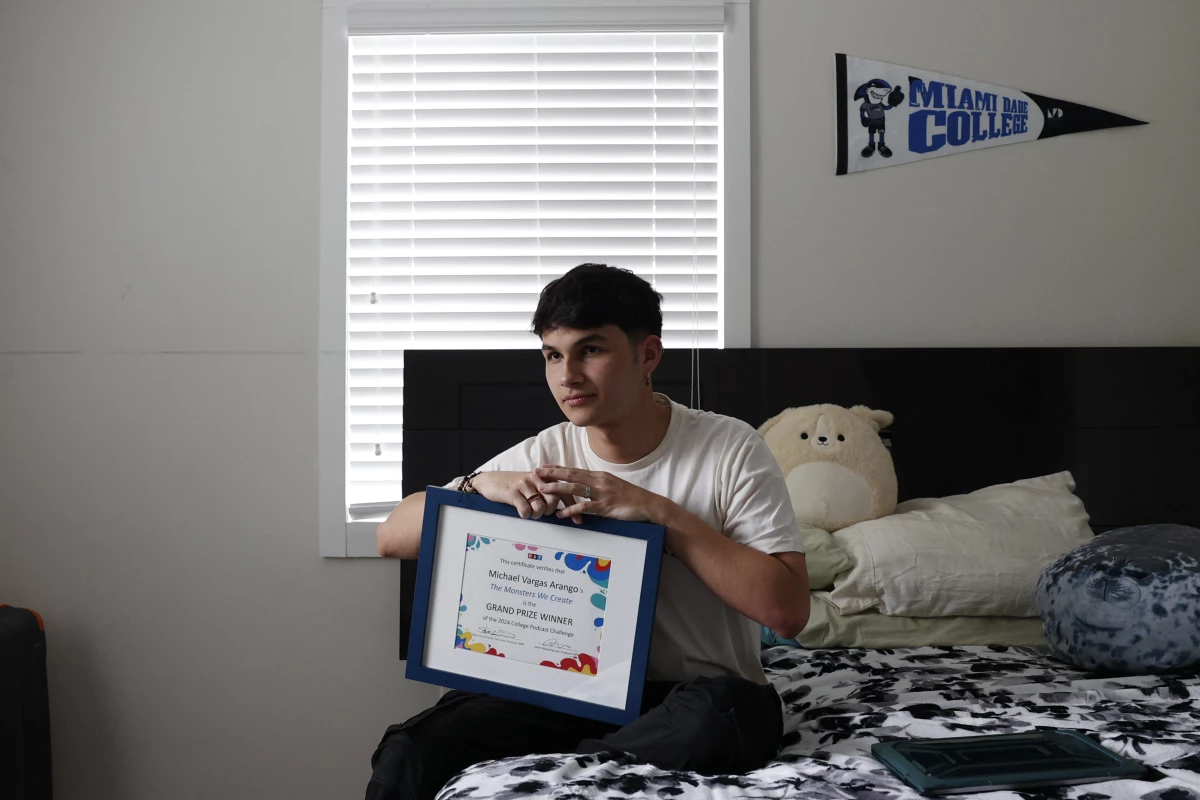
When he sent his story in to NPR’s College Podcast Challenge, Michael Vargas Arango had no idea how his life was about to change.
In it, he talked about growing up in his native Colombia and then moving to the U.S. to study at Miami-Dade College, all while living with a rare mental health condition.
“I am not dangerous. I’m not crazy and I’m not delusional,” he says by way of introducing himself. ” I’m just one more guy with a mental health condition living with it.
He called his podcast The Monsters We Create and he used his own voice, interviews with other students and creative audio effects to convey what it’s like living with schizoaffective disorder. That’s a chronic mental health condition where a person experiences symptoms of schizophrenia, such as hallucinations or delusions, and mood disorders like depression. It’s rare – Vargas Arango is among the 3 in 1,000 people who experience it.
Our judges found his story compelling, deeply emotional and highly moving, and they chose him last summer as our college champion and awarded him the $5,000 grand prize scholarship.
Recently, Vargas Arango sent us a new podcast, The Monsters We Saved, in which he talks about surprising responses he’s received from listeners around the world. Many were from people with their own mental health conditions who talked about how his story made them feel understood, and seen.
Parents wrote to ask him how they could best support their children with schizoaffective disorder. Several listeners asked him to recreate his podcast in different languages, so his message could reach beyond English speakers.
In his new podcast, Vargas Arango tells the story of one listener in particular who came from his own home town: Stefano, a schizoaffective teenager who wrote to him from Medellin, Colombia.
“I felt like I was talking to myself in an earlier stage of my journey,” Vargas Arango says in his podcast. “Having the opportunity to guide someone else on their own journey was just priceless. I felt so happy, so fulfilled and not scared anymore.”
But it took a while before he could fully celebrate his accomplishment. Earlier this year, his grandmother passed away in Colombia. And, he tells us, he wasn’t able to go home for a final visit with her, or attend her funeral.
“I felt lost since I came to this country wondering if sacrificing the time I could spend with my family in Colombia to pursue an uncertain dream in the U.S. was worth it,” he says. “I ask myself every morning, is this what I am supposed to be doing?”
Vargas Arango says telling his story through The Monsters We Create answered that question. He’s found deep satisfaction and a sense of purpose in being able to help and connect with so many people.
He’s graduated now from Miami Dade College, and says he’ll be studying journalism this fall at the University of North Carolina at Chapel Hill.
“I might have not seen my grandma again,” he says. “But I will make her proud no matter what happens.”
Transcript:
SACHA PFEIFFER, HOST:
Last year, we introduced you to a student at Miami-Dade College in Florida who won NPR’s college podcast challenge.
(SOUNDBITE OF PODCAST, “THE MONSTERS WE CREATE”)
MICHAEL VARGAS ARANGO: I’m not dangerous. I’m not crazy, and I’m not delusional.
No, you’re not.
I’m just one more guy with a mental health condition living with it.
PFEIFFER: Michael Vargas Arango shared a very personal story about growing up in his native Colombia and moving to the U.S. to study, all while living with a rare mental health condition. He calls his podcast “The Monsters We Create.” It uses sound effects to convey what his schizoaffective disorder feels like.
(SOUNDBITE OF PODCAST, “THE MONSTERS WE CREATE”)
VARGAS ARANGO: Stop. You’re giving me a headache. Can you shut up for a second?
No, I won’t.
Thank you. This is how I’ve been living my whole life.
Liar.
But you’re probably wondering, what is this guy talking about? Who’s he even talking to? Well, let me explain.
PFEIFFER: He’s learned how to navigate his condition, and he’s become a successful student on campus, but few people knew about his struggles until his winning podcast. Arango has since graduated, and he sent us a new podcast about how his life has changed since the story aired.
(SOUNDBITE OF PODCAST, “THE MONSTERS WE SAVED”)
VARGAS ARANGO: Last year, I opened myself up to the world when I told my story – my life experience dealing with my condition, myself and how society sees and misjudges people like me.
You’re just fine.
The last time you hear of me, I was announced the winner, but what happened next? I was reached out by a lot of national and international media outlets from all around the world.
(Speaking Spanish).
WRLN (ph), Univision, BBC, El Tiempo, Caracol News, Orato World (ph) and many, many others. I have received hundreds of comments from people all around the world. Many connected with my condition, felt understood and seen. There were even parents looking for advices, trying to support their children with some sort of mental health condition. I received many comments asking me to recreate my podcast in different languages so my message could reach beyond English speakers.
Stefano (ph), an schizoaffective teenager from my home country and city, Medellin, Colombia, he, just like other thousands of people, was thanking me for spreading awareness. But there was something different with him. He shared his journey with his schizoaffective disorder, and somehow, I felt like it was talking to myself in an earlier stage of my journey. Having the opportunity to guide someone else on their own journey was just priceless.
(SOUNDBITE OF MUSIC)
VARGAS ARANGO: I felt so happy, so fulfilled and not scared anymore.
There was nothing to be scared of.
But do you know what was the best part of this? The best part of this was seeing how I was helping people. How my message was actually reaching people’s hearts. It was a self-discovery moment that made me understand my place in this world.
My abuela, or well, my grandmother, she was there the night I left Colombia to come to the U.S. She hugged me and whispered crying to my ear, please, don’t leave.
I’ll be there.
And I told her not to worry about it. I promised her that I was going to be back from the U.S. when I was done with school, and we would hang out again. Well, you might be wondering why am I telling you this. I felt lost since I came to this country, wondering if sacrificing the time I could spend with my family in Colombia to pursue an uncertain dream in the U.S. was worth it. I got used to seeing all the people I loved the most through a screen and missing every celebration, birthday and moment with them. I asked myself every morning, is this what am I supposed to be doing? Am I supposed to be here, for a long time.
Why are you telling them this?
My abuela passed away on December 27, and I am devastated. I could not make it to see her again. I could not keep my promise. I could not even attend to her funeral because I was stuck here. She’s actually the reason why I’m giving you this update, guys. My grandma used to say something that I loved but did not understand. There are two days that are the most important in your life. The first one is when you were born, and the second is when you know why. Everything makes sense now, don’t you think? I found my why. The joy I found from helping people is something I cannot even describe. But you know what? This made me understand that the fact that I was born with an schizoaffective disorder was not a burden. It is a purpose.
(SOUNDBITE OF MUSIC)
PFEIFFER: Michael Vargas Arango will be studying journalism this fall at the University of North Carolina at Chapel Hill.
