


CASA GRANDE, Ariz. — By this point in time, you’ve almost certainly heard of former President Donald Trump and have thoughts about if you want him to win in this November’s election.
But as Republican National Committee Chairman Michael Whatley told a crowded room in Casa Grande, Ariz., last week, it takes extra effort to turn those thoughts into ballots for Trump.
“You all know somebody that if they vote, they would vote for him … they would vote for President Trump, but they haven’t voted in four years or six years or eight years,” he said. “Low-propensity voters is what we call them — we need to dynamite those people off of their couch.”
Whatley was at the opening of a Trump Force 47 office in a growing part of Pinal County, about an hour south of Phoenix, touting the party’s plan to marshal a volunteer army of fervent Trump supporters to make neighbor-to-neighbor contacts and mobilize support in key battleground states like Arizona and Georgia.
Trump Force 47 was announced the day after Trump’s guilty verdict was announced in his New York hush money trial. It came at a time when Trump and the RNC were struggling to bring in cash, compared to the fundraising hauls reported by President Biden and the Democratic National Committee.
In all, half a dozen field offices have been opened across Arizona since early June.
The plan is for paid regional field directors to harness the voter volunteers and guide them with RNC data about inactive and infrequent voters in their neighborhoods.
It’s an unconventional approach, but one that Arizona GOP chair Gina Swoboda said will add to Trump’s base of support.
“The focus now is on people you know that are around you, rather than everybody go out and randomly hit doors,” she said. “This is data-driven, focused on the people in the areas that are the voters that we need to turn out in order to land that plane and win that victory.”
It’s also a plan that’s singularly focused on Trump.
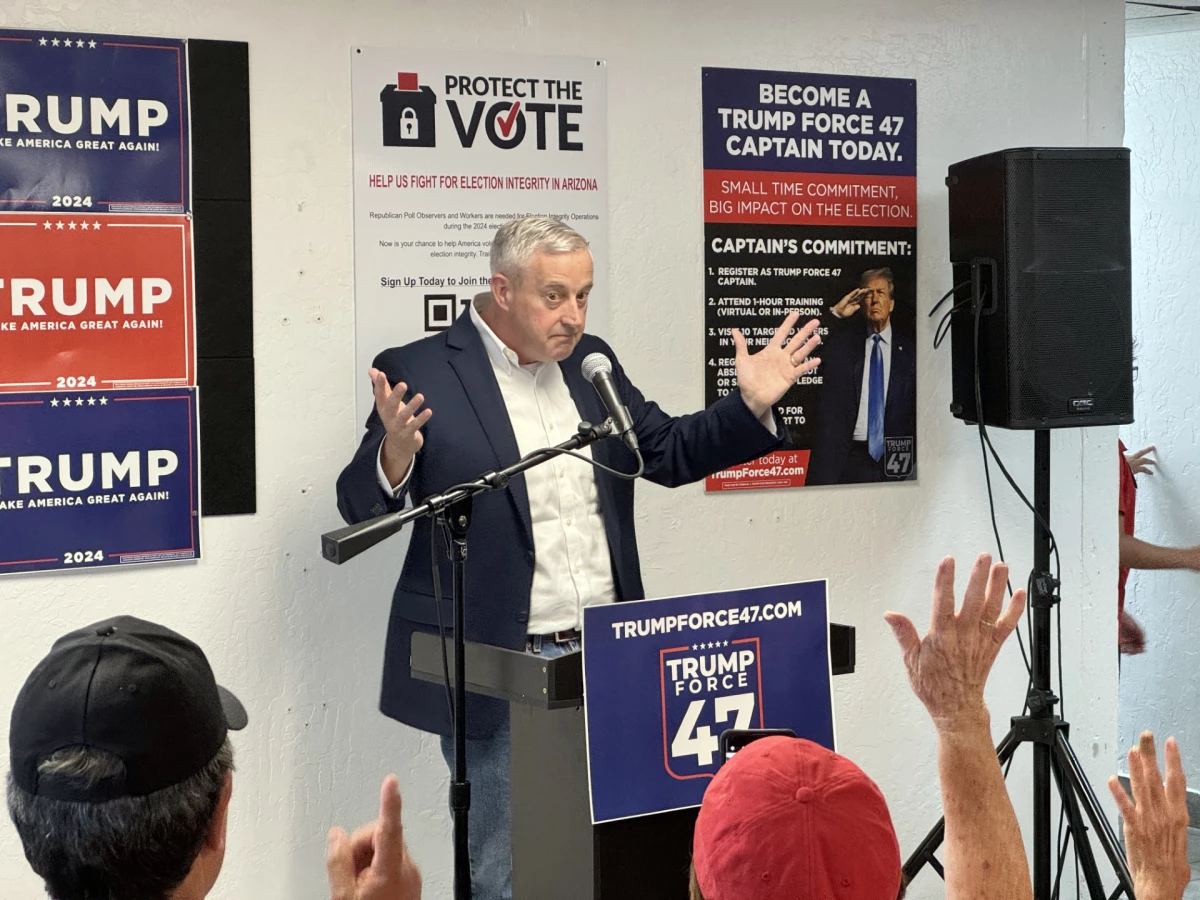
At the Casa Grande office, there are only signs for Trump Force 47 and the RNC’s Protect the Vote campaign.
There are no signs for Kari Lake, the GOP frontrunner for Arizona’s U.S. Senate nomination, even though her race could decide control of that chamber in 2025. In fact, there’s no visual evidence of support for any other GOP candidates.
Trump is the alpha and omega — and that’s by design.
“I think that’s what’s different about the new leadership with the RNC versus 2020,” Arizona RNC spokeswoman Halee Dobbins said. “We really want to focus on the presidential [race] and making sure the president has all he can on the ground to support those efforts.”
It’s not that the RNC doesn’t support candidates down the ballot; Dobbins said they’re just leaving campaigning for those candidates up to others.
“I think we have a great team at the [National Republican Congressional Committee] and the [National Republican Senatorial Committee] who are focused on those candidates, and we are supporting them 100%,” she said. “But we know we do best when we can focus on that top-level ticket.”
On the other side of the aisle, Arizona Democrats are running a more coordinated campaign. Democratic office openings feature wall-to-wall yard signs for an array of candidates up and down the ballot, from Biden to likely U.S. Senate nominee Ruben Gallego to local officials.
Democrats are largely focusing on conveying the stakes of the election for specific groups — partially because of swirling questions around Biden’s fitness to run for a second term, and partially it’s a strategic choice to try to retain their diverse coalition that won in 2020.
In Georgia, recent history raises the stakes
Another Sunbelt state that will be an electoral battleground this year is Georgia, which has seen several high-profile, high-stakes races in the last four years, contributing to fatigue for voters and organizers alike.
Republicans have opened more than a dozen Trump Force 47 offices across the state in the last month, including its first office in Fayetteville, nestled into Atlanta’s southern suburbs.
Fayette County nearly flipped to Democrats in the 2022 U.S. Senate runoff and is home to the type of voters both parties need to show up — and do well with — this November.
That’s one reason Brian Jack, who is the Republican nominee for an open congressional seat that includes the county, was there for the office opening.
“Fayette County is one of those counties that Democrats are targeting this November,” he said. “They want to try to flip our county, and I think that’s reflective of the fact that the president’s campaign decided they wanted to put a regional headquarters here.”

Just like Arizona, this Trump Force 47 office is filled with Trump signs — including walls that spell out “DJT” and “47,” plus dozens of people eager to volunteer their time to tell their neighbors it’s time to show up and vote.
That’s a meaningful shift after Trump’s narrow 2020 loss — and the party losing both Senate seats in 2021 runoffs — in part because of lower Republican turnout and Trump’s false claims of fraud.
This year, though, the message from Trump has been clearer.
“Look, if we win Georgia, we’re going to win the election,” Trump said at a March rally in Rome, Ga. ”Let me put it that way, OK? We have to win Georgia, so get everyone you know and let’s send crooked Joe Biden packing.”
What remains to be seen is how Trump Force 47 will play out come November, especially in an unusual election year where both major candidates have been president.
Right now, Republican Senate candidates are underperforming Trump’s poll numbers, while Democratic Senate candidates are outperforming Biden’s polling. Both parties hope that will change.
Republicans don’t plan to let up on their laser-like focus for Trump, and plan on his voters showing up for other candidates, too.
“We know if voters are going to come out and vote for Trump, they’re going to vote for Republicans down the ballot,” Dobbins, the Arizona RNC spokeswoman, said.
It’s possible the grassroots-led, cost-efficient campaign strategy could lead to a rising tide for Trump that lifts the GOP boat, but it’s not guaranteed.
Transcript:
JUANA SUMMERS, HOST:
Georgia and Arizona, two Sun Belt states former President Trump narrowly lost in 2020, are seen as crucial to deciding the outcome of the presidential election again in November. NPR’s Stephen Fowler and Ben Giles have been on the ground in those states, and what they’ve seen are traditional campaign strategies from Democrats and an unconventional effort by Republicans to turn MAGA enthusiasm into votes in a cost effective manner. To tell us more, Stephen and Ben join us now. Hi there.
STEPHEN FOWLER, BYLINE: Hey there.
BEN GILES, BYLINE: Hello.
SUMMERS: Ben, why don’t you kick us off? Republicans are calling this campaign Trump Force 47. Can you just tell us what exactly that means and what that whole campaign is about?
GILES: So this is the campaign that Trump’s team announced the day after his guilty verdict in the Hush Money trial in New York, 47 being for Trump hopefully becoming the 47th president. At the time this was announced, Trump and the RNC, they were struggling to bring in cash compared to the fundraising halls reported by President Joe Biden and the DNC. With those financial limitations, Trump Force 47 was seen as an attempt to marshal a volunteer army. Rather than an army of paid staffers, the idea is to make neighbor-to-neighbor contact to mobilize Trump voters who maybe haven’t turned out to vote in recent years.
I was in Casa Grande earlier this month, a growing area of Pinal County, Ariz. It’s about an hour south of Phoenix. It’s one of six Trump Force 47 field offices the campaign has opened since early June. Republican National Committee Chairman Michael Whatley was there.
SUMMERS: All right. Let’s take a listen to what he had to say.
MICHAEL WHATLEY: But you all know somebody that if they vote, they would vote for President Trump, but they haven’t voted in four years or six years or eight years. Low propensity voters is what we call them. We need to dynamite those people off of their couch.
GILES: The RNC is relying almost entirely on volunteers to accomplish that goal. The plan is for paid regional field directors to harness those volunteers and feed them with RNC data about inactive voters in their neighborhoods. Gina Swoboda is the new head of the Arizona GOP.
GINA SWOBODA: The focus now is on people you know that are around you rather than, like, everybody just go out and randomly hit doors. So this is data driven, focused on the people in the areas that are the voters that we need to turn out in order to land that plane and win that victory.
GILES: It’s also a plan that’s singularly focused on Trump. At the Casa Grande office, there are only signs for Trump Force 47, and the RNC’s protect the vote campaign. You don’t see signs, for example, Kari Lake, even though Arizona’s Senate race could decide control of that chamber in 2025. Visually, there’s no evidence of support for any other GOP candidates. Trump is the alpha and omega.
HALEE DOBBINS: What’s different about the new leadership with RNC versus 2020, we really want to focus on the presidential and making sure the president has all he can on the ground to support those efforts.
GILES: Halee Dobbins is the RNC’s spokesperson in Arizona. It’s not that the RNC doesn’t support candidates down the ballot, but Dobbins said they’re leaving campaigning for those candidates up to others.
SUMMERS: So the focus here is clearly on the top of the ticket, but Ben, what about Democrats? What do their efforts in Arizona look like?
GILES: Democrats are running a more coordinated campaign. Now by that, I don’t mean that the RNC isn’t coordinating and cooperating with state-level Republicans. But when the DNC and Arizona Democrats open an office, wall to wall, you’ll see yard signs hung up for all sorts of candidates – Biden, of course, but also Ruben Gallego, the likely Democratic nominee for that crucial U.S. Senate race in Arizona. In an office in Tucson, they’re also already campaigning for the presumptive Democratic nominee in a Southern Arizona Congressional district. Democrats in Arizona are running a traditional style campaign focused on all their candidates.
SUMMERS: Stephen Fowler, over to you now and the state of Georgia. You don’t have a big downballot race in that state. Tell us what does campaigning look like there?
FOWLER: Yeah. So Juana, there’s not a big Senate or governor race. So organizing with both parties this year feels a little bit less intense than the last several cycles. There’s more than a dozen Trump Force 47 offices open across the state. And last month, I went to the first one that opened up in Atlanta’s southern suburbs. Fayette County nearly flipped to Democrats in the 2022 U.S. Senate runoff and is home to the type of voters both parties need to do well with this November and need to show up. That’s why Brian Jack, who’s the Republican nominee for an open congressional seat that includes the county, wanted to be there for the office opening.
SUMMERS: And Stephen, I understand you joined him there. Let’s take a listen.
BRIAN JACK: Fayette County is one of those counties that Democrats are targeting this November. They want to try to flip our county, and I think that’s reflective of the fact that the president’s campaign decided they wanted to put a regional headquarters here in Fayette County.
FOWLER: Just like Arizona, this Trump Force 47 office is filled with Trump signs, including walls that spell DJT and 47, and dozens of people eager to volunteer their time to tell their neighbors it’s time to show up and vote. That’s a big shift for Republicans after Trump’s narrow 2020 loss and the party losing both Senate seats in 2021 runoffs because of lower turnout and Trump’s false claims of fraud. This year, though, the message from Trump is clearer like this Georgia rally in March.
(SOUNDBITE OF ARCHIVED RECORDING)
DONALD TRUMP: Look, if we win Georgia, we’re going to win the election. Let me put it that way, OK?
(CHEERING)
TRUMP: We have to win Georgia. So get everyone you know, and let’s send crooked Joe Biden packing. Let’s send him out.
FOWLER: So much like what Ben’s seeing, Republicans in Georgia are all-in on supporting Trump.
SUMMERS: So this is for both of you, but Stephen, I’m hoping you can jump in here first. Looking ahead to November, how could this new get-out-the-vote strategy play out?
FOWLER: We’re at this weird, interesting place, Juana, having two candidates who’ve both been president running against each other. Right now, we’re at a point where Republican Senate candidates are underperforming Trump’s poll margins, and Democratic Senate candidates are outperforming Biden’s poll margins. And both parties hope that will change.
GILES: But Stephen, for the RNC, changing that doesn’t mean giving up on their laser-like focus for Trump. Here’s Dobbins again, the spokesperson for the RNC in Arizona.
DOBBINS: We know if voters are going to come out and vote for Trump, they’re going to vote for Republicans down the ballot.
FOWLER: Yeah, she might be right. A rising tide for Trump could lift the Republican vote. Though some of these Senate candidates have baggage with voters that Trump somehow does not. Democrats, meanwhile, are taking the more team-based approach. They’ve been opening offices, too, and focusing on the stakes of the election for specific groups, partially perhaps because of questions around Biden and partially a strategic choice to retain their diverse coalition that won in 2020. No matter what, though, there’s still months of money to be spent and work to be done for these campaigns to try and make victory happen.
SUMMERS: That’s NPR’s Stephen Fowler in Georgia and Ben Giles in Arizona. Thanks to both of you.
FOWLER: Thank you.
GILES: Thanks, Juana.
(SOUNDBITE OF RINI SONG, “SELFISH”)
