


In Bugonia, a greasy-haired Jesse Plemons plays conspiracist antihero Teddy, who concludes that his own boss is in fact part of an alien race intent on destroying Earth. So he and his cousin Don kidnap her.
It’s just the latest absurd offering from director Yorgos Lanthimos, part of what he calls his “little paradigms or experiments” to observe societal constructs and dig into what’s behind them.
Teddy may appear unhinged, but he has valid reasons to feel angry and afraid — capitalist exploitation, ecological disasters and the sense that society doesn’t care about people like him.
So it’s no wonder he sets his sights on Emma Stone’s ruthless, Louboutin-clad CEO. “Nobody gives a f*** about us,” he tells Don, played by Aidan Delbis, who is making his feature film debut at 19. The actor describes himself as autistic.

Lanthimos acknowledged that the characters represent archetypes, but all is not as it may seem. The film slowly uncovers layers of complexity.
“It challenges all these biases that we have about people, which is aided by technology and compartmentalization,” he told Morning Edition host Leila Fadel, referring to those biases as a “dormant” state of mind.
The screenplay, by Will Tracy, is loosely based on the 2003 South Korean film Save the Green Planet!
This is not the strangest tale spun by Lanthimos, after previous features explored the extremes of parental control (Dogtooth), jealousy and power struggles (The Favourite), scientific experimentation (Poor Things) or revenge (The Killing of a Sacred Deer).
But Bugonia, out in theaters nationwide October 31, feels especially relevant in an era filled with misinformation. The strangely unsettling tale backed by stilted, darkly humorous dialogue also makes for some especially riveting cinema.

The secret lives of bees
First, a bit of etymology: the word bugonia that lends the film its name comes from the ancient Greek words for “ox” and “progeny,” a reference to a ritual based on the myth that bees emerge from an ox carcass.
Bees appear in the opening and closing shots of the film, and Teddy’s pastime as beekeeper is part of what fuels his belief that Earth is hurtling toward doomsday.
He determines that the hives face colony collapse disorder, which he blames on pollution caused by Auxolit — the company run by Stone’s character Michelle Fuller — and on other corporations he believes are run by aliens.
As the two cousins drive away with a sedated Fuller in her car, Teddy has Don shave off the company executive’s hair — to prevent her, he says, from contacting her mothership.
Stone shaved her head for real for the role, her fourth feature film collaboration on a feature film with Lanthimos, which he credits to their “synchronicity.” They also worked together on the short film Bleat set on the Greek Cycladic island of Tinos.
When Fuller wakes up in Teddy’s dirty basement, shaven and slathered in an antihistamine cream meant to dull her supposed extraterrestrial powers, Fuller begins a tense negotiation for her release.
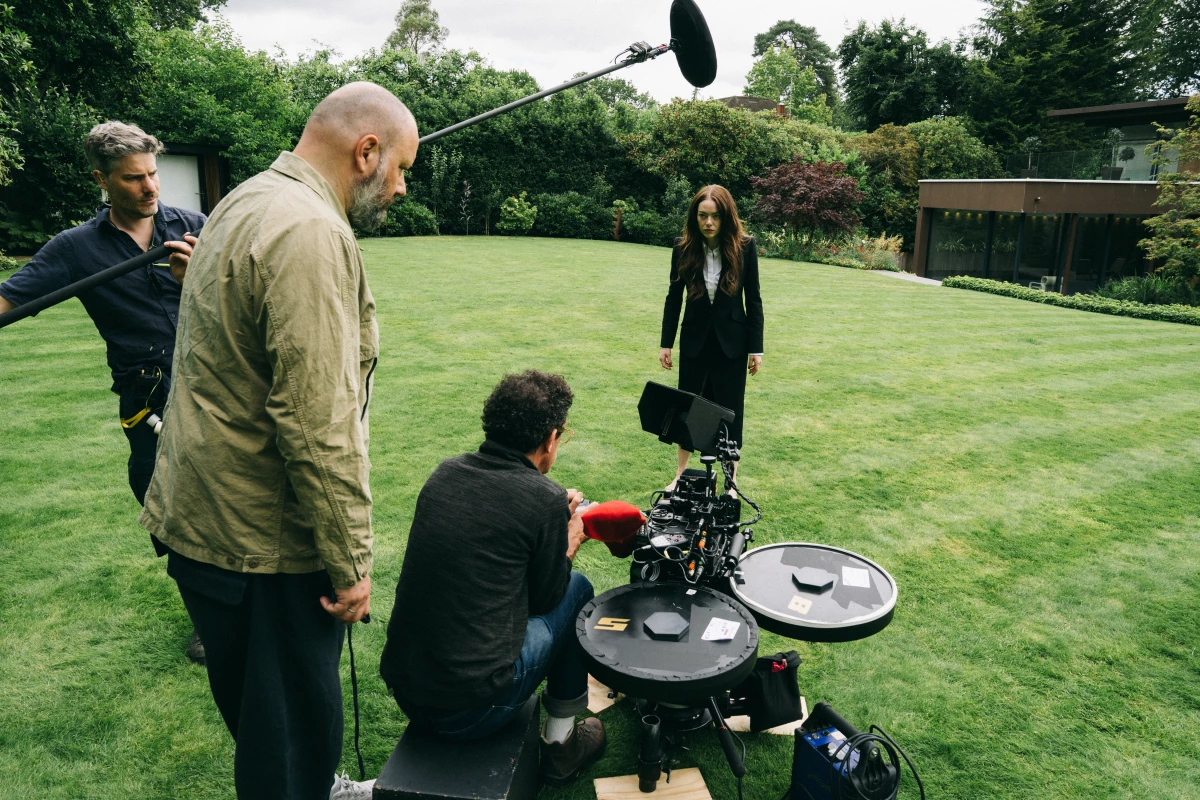
Making cramped scenes feel grand
These cramped scenes still manage to feel grand because Lanthimos shot much of the film on VistaVision, a format that is usually especially desirable for large vistas.
Directors like Brady Corbet (The Brutalist) and Paul Thomas Anderson (One Battle After Another) have also turned to this vintage format debuted by Paramount Pictures in 1954.
Cinematographer Robbie Ryan tracked down a rare Wilcam 11 camera to shoot on Vistavision, which is fed horizontally rather than vertically, resulting in a crisper image than standard 35mm film.
“The juxtaposition of filming closeups of faces in a very limited space with that kind of format kind of made them iconic,” Lanthimos said. “So all this confrontation between these people is kind of elevated to a different level just by the depth and the tonality that the medium provides.”

And a note, Focus Features provides financial support to NPR.
The broadcast version of this story was produced by Phil Harrell and edited by Olivia Hampton. The digital version was edited by Majd Al-Waheidi.
Transcript:
A MARTÍNEZ, HOST:
In the new film “Bugonia,” Emma Stone plays the CEO of a pharmaceutical bioengineering company. Michelle Fuller is powerful and ruthless. One of her employees is a conspiracy theorist, and his research has led him to the conclusion that she is an alien who wants to destroy planet Earth, and he kidnaps her with help from his cousin.
(SOUNDBITE OF FILM, “BUGONIA”)
EMMA STONE: (As Michelle Fuller) Where is my hair?
JESSE PLEMONS: (As Teddy Gatz) Your hair has been destroyed.
STONE: (As Michelle Fuller) You shaved off my hair?
PLEMONS: (As Teddy Gatz) Yes, we’ve shaved off your hair.
STONE: (As Michelle Fuller) Why have you shaved off my hair?
PLEMONS: (As Teddy Gatz) To prevent you from contacting your ship.
STONE: (As Michelle Fuller) My ship?
PLEMONS: (As Teddy Gatz) Your ship.
STONE: (As Michelle Fuller) What ship?
PLEMONS: (As Teddy Gatz) Your mother ship.
MARTÍNEZ: Our co-host Leila Fadel spoke with director Yorgos Lanthimos.
LEILA FADEL, BYLINE: You know, “Bugonia” felt particularly relevant to this sort of fractured, some describe as a post-truth world that so many live in today, with the amount of information and misinformation online. A lot of that is personified in Teddy, who’s played by Jesse Plemons. What does he represent in this film?
YORGOS LANTHIMOS: Well, that’s the thing. I think the structure of the film kind of has you believe that Teddy represents one specific thing that you…
FADEL: Yeah.
LANTHIMOS: …You think might immediately recognize. And I think the same is for Michelle, Emma’s character.
FADEL: The CEO of the company. So Teddy is this kind of menial labor employee at her company, and she’s this all-powerful CEO.
LANTHIMOS: And you kind of – you know, immediately, they’re, like, archetypes and you kind of know who they are and what they represent, and you know, how they think. But I think you realize that things might not be exactly as we thought, and, you know, it challenges all these biases that we have about people in today’s society.
FADEL: There’s a particular scene where Emma Stone in her CEO way – except she’s being held in a basement…
LANTHIMOS: (Laughter).
FADEL: …Is lecturing her kidnapper. I’m just going to play that scene for you.
(SOUNDBITE OF FILM, “BURGONIA”)
STONE: (As Michelle Fuller) I think you’re in a kind of echo chamber.
PLEMONS: (As Teddy Gatz) Echo chamber? Right now?
STONE: (As Michelle Fuller) Mm-hmm.
PLEMONS: (As Teddy Gatz) Echo? Yeah, I read the same 5,000 think pieces about that, too.
STONE: (As Michelle Fuller) You’re consuming content on the internet that is reinforcing this sort of warped subjective idea of reality.
PLEMONS: (As Teddy Gatz) This is your best shot at me, some rabbit hole [expletive] you read in the Times? Come on. Come on.
STONE: (As Michelle Fuller) Can we have a dialogue, please?
PLEMONS: (As Teddy Gatz) Don’t call it dialogue. This isn’t “Death Of a Salesman.”
FADEL: Oh, my gosh, this is such a familiar…
LANTHIMOS: (Laughter).
FADEL: …Sort of talking point in the world today. So the one line when he goes, you know, I don’t get my news from the news. As a journalist. I was like, oh, no.
LANTHIMOS: (Laughter).
FADEL: But so true.
LANTHIMOS: You have to be thorough. You have to look everywhere.
FADEL: Yeah.
LANTHIMOS: (Laughter).
FADEL: Just walk me through what’s…
LANTHIMOS: Yeah.
FADEL: …Happening in this scene and why it’s so important.
LANTHIMOS: You know, at this point, Michelle realizes that, you know, Teddy’s way more sophisticated than what she thought. And she realizes, I think that it’s not gonna be easy to change his mind…
FADEL: Right.
LANTHIMOS: …No matter how crazy it is what he thinks.
FADEL: Right. I mean, ’cause Teddy’s convinced that he’s saving the world.
LANTHIMOS: Yeah.
FADEL: This is the fourth feature film you’ve made with Emma Stone after the favorite “Poor Things,” and “Kinds Of Kindness.” You also made a short film together. What’s at the core of your creative partnership? What works about it and keeps this collaboration going?
LANTHIMOS: You know, before, you know, I worked with her, I really admire her work as an actor and her presence. And, you know, as soon as we worked together on “The Favourite,” we discovered that we get along as people as well, and the way that we work has a lot of synchronicity, and, you know, it just makes it much more pleasurable. And then we also have built a team around us. So it’s like a – almost like a theater group that, you know, meets every year or – I mean, lately we’ve been doing many films back to back, so it’s even less than a year.
FADEL: The film really focuses on three people, right? So there’s Michelle Fuller, there’s Teddy, who’s the brains behind the kidnapping, and there’s also Aidan Delbis, who plays Teddy’s cousin, and he’s this very sweet, younger cousin who kind of takes whatever Teddy says and believes him.
LANTHIMOS: Yeah. And Aidan is autistic. He’s – that’s the way he prefers to be referred to. I kind of worked with him the same way like I did with Jesse and Emma. I wanted him to bring his very special sensibility and understanding of the world and how he saw the character.
FADEL: There’s some pretty intense and honestly maybe possibly traumatic scenes. I’m just wondering if working with Aidan, who has maybe different sensitivities, if there was anything else, anything you did differently, or he did differently or he required or asked for.
LANTHIMOS: Yeah. I mean, we always had an access coach with him. So…
FADEL: Yeah.
LANTHIMOS: …She would walk through everything with him beforehand. And if there was anything that, you know, we felt that was particularly sensitive, we would try and, you know, not involve him as much as we could. But Aidan is like – he loves horror films, and I think he understood, you know, how it functioned. I mean, he’s so honest – has no filter. He was like really…
FADEL: So he’ll just tell you how he feels about everything.
LANTHIMOS: Yeah, he’ll just tell you. Like, if he gets bored – like with you’re trying to explain something and you’re mid-sentence, he’d go like, OK, OK, I got it, and he’d walk away.
FADEL: (Laughter).
LANTHIMOS: Like, it was – yeah, really reinvigorating to have someone like Aidan on set.
FADEL: Every time I watch one of your films, I leave feeling, like, extremely uncomfortable with what you’ve just said about society. I’m like, I don’t know if I want to look in this mirror. Why are you drawn to these types of films, this deep, disconcerting examination of who we are?
LANTHIMOS: Why? Yeah, that’s a good question.
FADEL: (Laughter).
LANTHIMOS: It’s just a natural curiosity for me, like observing, you know, humans, the society, its rules, what’s going on in the world and, you know, creating these little paradigms or experiments to reveal more things or ask more questions more than understand things and then, you know, keep going further and further until maybe you’ll understand certain things at some point (laughter).
MARTÍNEZ: That was Leila speaking with director Yorgos Lanthimos. His new film is called “Bugonia.” And a note, Focus Features is a financial supporter of NPR.
(SOUNDBITE OF RADIOHEAD SONG, “SUBTERRANEAN HOMESICK ALIEN”)
