


CHICAGO — Eric Harvey is furious about the deployment of the National Guard to Illinois, the city of Chicago, and his neighborhood.
“That’s a publicity stunt, man!” Harvey, who lives in the south side, said.
This summer Chicago’s homicide rate was the lowest since the 1960s. So, Harvey can’t believe hundreds of troops have arrived in Illinois to make the city any safer. President Trump has called Chicago a “war zone” and has claimed the city’s crime rate is unsustainable.
Under Trump’s orders, National Guard troops from Illinois and Texas are tasked with protecting federal government employees such as Immigration and Customs Enforcement agents, and federal property.

Harvey said Trump is doing this to appear like he’s keeping the city safe from undocumented immigrants. This hits close to home. Harvey lives in a neighborhood that recently had a big ICE raid in a residential building.
“You snatching kids and people that get up and go to work every day — that’s who you grab, you not grabbing no criminals,” Harvey said.
Trump’s pressure is met with resistance
Last month, the Trump administration ramped up its immigration enforcement operations in Chicago. According to the Department of Homeland Security, the mission dubbed “Operation Midway Blitz” has led to more than 1,000 arrests of migrants without legal status.
Chicago residents have taken to the streets to push back. They have recorded — and published — the ICE arrests, and have created ICE watch groups.
On Wednesday night, hundreds of people marched in downtown Chicago to protest the deployment of the troops and the presence of ICE.
Jessica Urbina, 26, came to march by herself because she felt it was important to join her community to repudiate Trump’s actions.
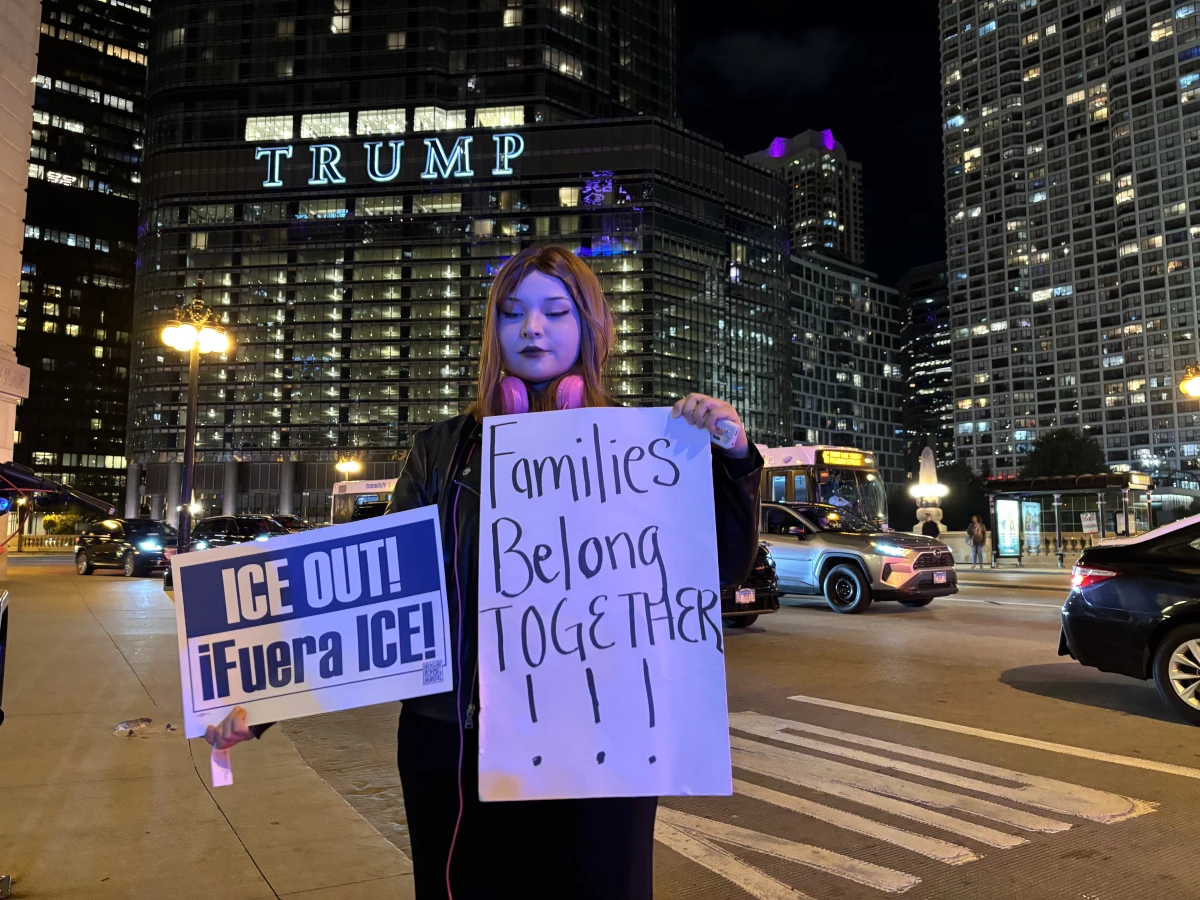
“I feel empowered,” she said. “I don’t know these people, but we all have a lot in common and we all have the same motive to help each other, lean on each other.”
Chicago Mayor Brandon Johnson told NPR Wednesday his office will do whatever it takes to resist Trump’s attacks on his city. He says Congress and the Supreme Court are complicit.
“They’re aiding and abetting the dismantling of our democracy and our Constitution,” Johnson said. “We’ll use every single tool that’s available to me. This is going to play out in the courts. It’s going to play out on the streets.”
A federal judge in Chicago will hear arguments Thursday afternoon on whether the deployment is legal or not.
It’s unclear what exactly Johnson will do. So far, he’s used executive orders to make it harder for ICE to operate in the city — including a ban on the use of city-owned or operated space by federal agents.
He said it’s the first time a mayor has had to fight off what he calls a federal invasion.
Johnson’s defiance has irked Trump, who has called for the arrests of Illinois Gov. JB Pritzker and Johnson for “failing to protect ICE officers.”
“This is not the first time Trump has accused or insisted on a Black man being arrested,” Johnson said. “A president that is threatening to jail his political opponents is clear — yet another example of authoritarianism.”

All of this has caused a lot of fear in the Chicago neighborhoods where many immigrants live. Census data shows about one in five residents in Chicago are foreign born.
Jackson, a Venezuelan immigrant who is only using his first name because of his immigration status, said he’s terrified of walking the streets of Chicago with so much federal law enforcement presence.
“And now with the National Guard things will be even more complicated,” Jackson said in Spanish, his eyes filled with tears. “It’s super scary to even go grocery shopping.”
He has three kids and a wife. 39-year-old Jackson says they have had conversations about what to do if he gets picked up by ICE.
Jackson works in construction, but recently he has not been going to work.
He talked to NPR reporters while waiting at a bus stop right across the street ICE raided last week in a military-style operation. He was en route to meet an attorney to file for asylum.
“I’m trying to show that I’m working, that I have not committed any crimes,” Jackson said. “Maybe I’ll be given a chance.”
Transcript:
LEILA FADEL, HOST:
Hundreds of National Guard troops are staging outside of Chicago under orders from President Trump.
A MARTÍNEZ, HOST:
It’s in response to recent protests against immigration and customs enforcement operations in Chicago. Trump has said the city is a war zone. And now the president is calling for the arrest of Illinois Governor JB Pritzker and Chicago Mayor Brandon Johnson.
FADEL: NPR’s Sergio Martínez-Beltrán joins me now from Chicago. Good morning, Sergio.
SERGIO MARTÍNEZ-BELTRÁN, BYLINE: Good morning, Leila.
FADEL: I mean, it’s pretty unprecedented to hear a U.S. president call for the arrest of a duly elected city mayor and state governor. What is he saying about why?
MARTÍNEZ-BELTRÁN: I mean, President Trump says they should be arrested for, quote, “failing to protect ICE officers.” But it’s unclear what actions he’s actually referring to. Now, Mayor Johnson says he is protecting the residents of Chicago and that he will fight the Trump administration over this National Guard deployment. I sat down with Mayor Johnson yesterday. And this is what he told me about being threatened with jail time.
BRANDON JOHNSON: This is not the first time Trump has accused or insisted on a Black man being arrested. A president that is threatening to jail his political opponents is a clear yet another example of authoritarianism.
MARTÍNEZ-BELTRÁN: And Johnson is also pushing back on Trump’s claims that Chicago is a dangerous city or a war zone. This summer, Chicago has had the lowest number of homicides since the 1960s.
FADEL: And that’s something that Trump has not acknowledged. Now, the National Guard have been in Chicago before. Under what circumstances were they deployed before?
MARTÍNEZ-BELTRÁN: Most recently during the protests after the police killing of George Floyd in 2020. And it’s always been at the request of state officials. This time it’s different, though. They don’t want it here. And that’s why the anger, frustration, and at times, despair of residents is so palpable here. Last night, hundreds of people peacefully marched in downtown Chicago protesting the deployment of the troops. And the folks we’ve talked to here, Leila, like Eric Harvey (ph), a construction worker, do not want ICE agents around. And they certainly do not want the National Guard patrolling the streets.
ERIC HARVEY: That’s a publicity stunt, man. That’s just some stuff he doing so that people can say, oh, Trump is doing this about immigration. You snatching kids and people that get up and go to work every day. That’s who you grabbing. You’re not grabbing no criminals.
MARTÍNEZ-BELTRÁN: Harvey lives in a neighborhood that recently saw a big ICE raid at a residential building. He and other residents we talked to in this area say the Chicago Police Department is doing its job and that they don’t see how the National Guard or ICE can make the city safer.
FADEL: And what about immigrants in Chicago? What are they telling you?
MARTÍNEZ-BELTRÁN: For immigrants, this is terrifying. About 1 in 5 residents in Chicago are foreign-born, according to the census. So this has been a city where immigrants have created a community and have contributed to it big time. But now they feel unsafe.
JACKSON: (Speaking Spanish).
MARTÍNEZ-BELTRÁN: Jackson (ph) is a Venezuelan migrant who says he feels even more scared with the National Guard around. He’s worried about being detained by immigration enforcement. That’s why we’re only using his first name. Now, Jackson has three kids and a wife. And he says they’re even afraid of leaving the house to buy food. And he has not been able to work lately because of the presence of federal enforcement agencies in the city.
Now, Leila, there is still a possibility that the troops are legally blocked from being deployed into Chicago. A federal court later today will hear and perhaps decide whether Trump can do this or not. Meanwhile, in a different courtroom, but at the same time, a panel of judges will hear whether the National Guard will be allowed into Portland.
FADEL: That’s NPR’s Sergio Martínez-Beltrán. Thank you.
MARTÍNEZ-BELTRÁN: You’re welcome.
