


QUARTZITE, Ariz. — Rachele Adair had a problem.
The van that she lived in as a nomad had broken down. But she needed to be hundreds of miles away in a matter of days to volunteer at the Rubber Tramp Rendezvous, an annual meetup of nomads who live in their vehicles. So the retired nurse scrounged up $500, bought a truck in California, threw some clothes and a mattress in the back and drove off to the dusty Arizona desert.
She planned to sleep in the unheated vehicle at the January event.
Instead, a small group of her friends at the RTR offered her a heated trailer to stay in for a few days while they chipped in money, time and expertise to help build out her truck. Many of them did so anonymously so she couldn’t know who to pay back.

“It will literally be a small cabin on the bed of my truck that goes 8 feet out and will be an amazing home. Exactly what I wanted,” she said.
Adair’s story is far from unique at the gathering organized by the Homes on Wheels Alliance, a nonprofit that helps those living a “mobile lifestyle.”
The movement
Rather than a quirky band of drifters, the people behind the Rubber Tramp Rendezvous are each other’s support systems, safety nets and security blankets. And they’re organized.
Bob Wells set up the first RTR back in 2011. It was a meeting place for people who travel across the U.S. in vans, buses, cars and RVs and typically camp, untethered from a physical address.
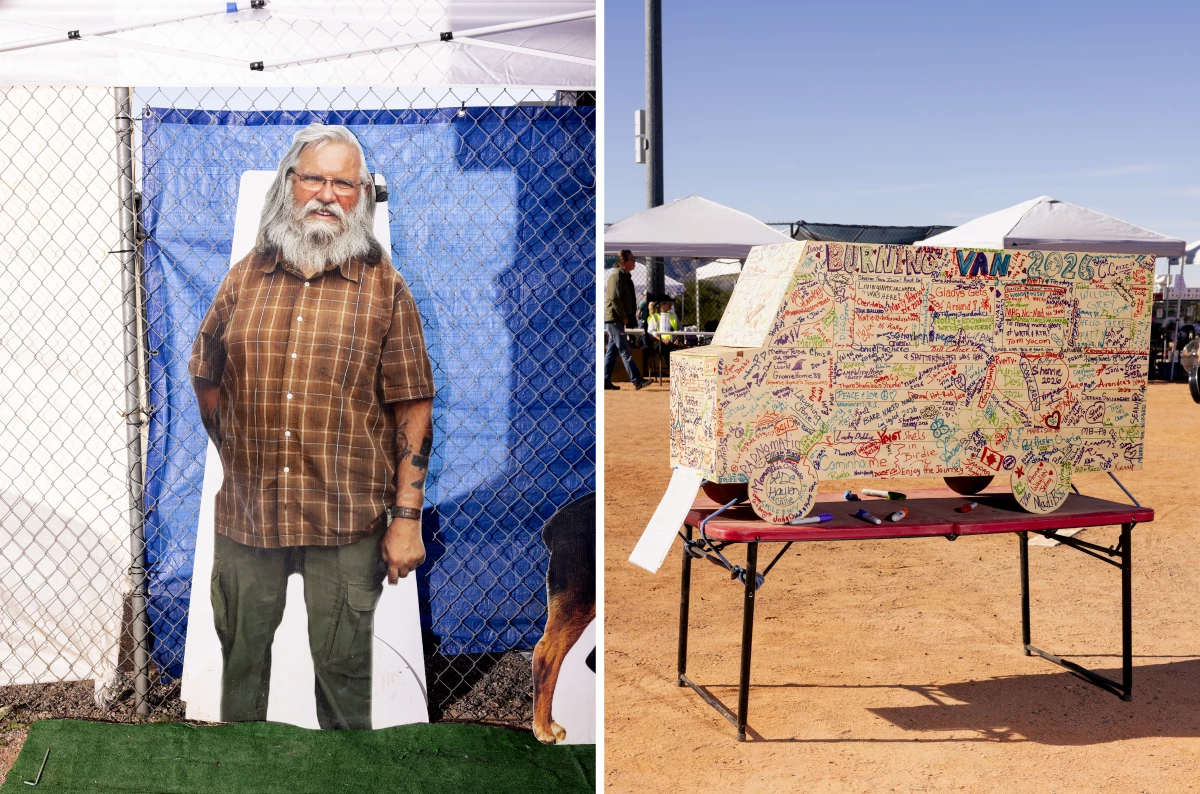
Some of them live in their vehicles out of necessity — homelessness is the alternative. “They’re looking at moving into a vehicle as a way to find shelter and to thrive rather than consider themselves homeless on the street,” said Suanne Carlson, who co-founded the alliance with Wells.
Others are drawn to a lifestyle that allows them the freedom to explore North America and live minimally. Wells was hugely influential in setting a philosophy built on community support and small living.
The gatherings had two goals in mind, said Carlson: to offer a venue where people can build community, and to help people learn how to be successful in the lifestyle.
“How do you actually live on the road? … Because it’s not like just porting over a house into a vehicle. It really is more like camping than it is like living in a house,” she said.
The event
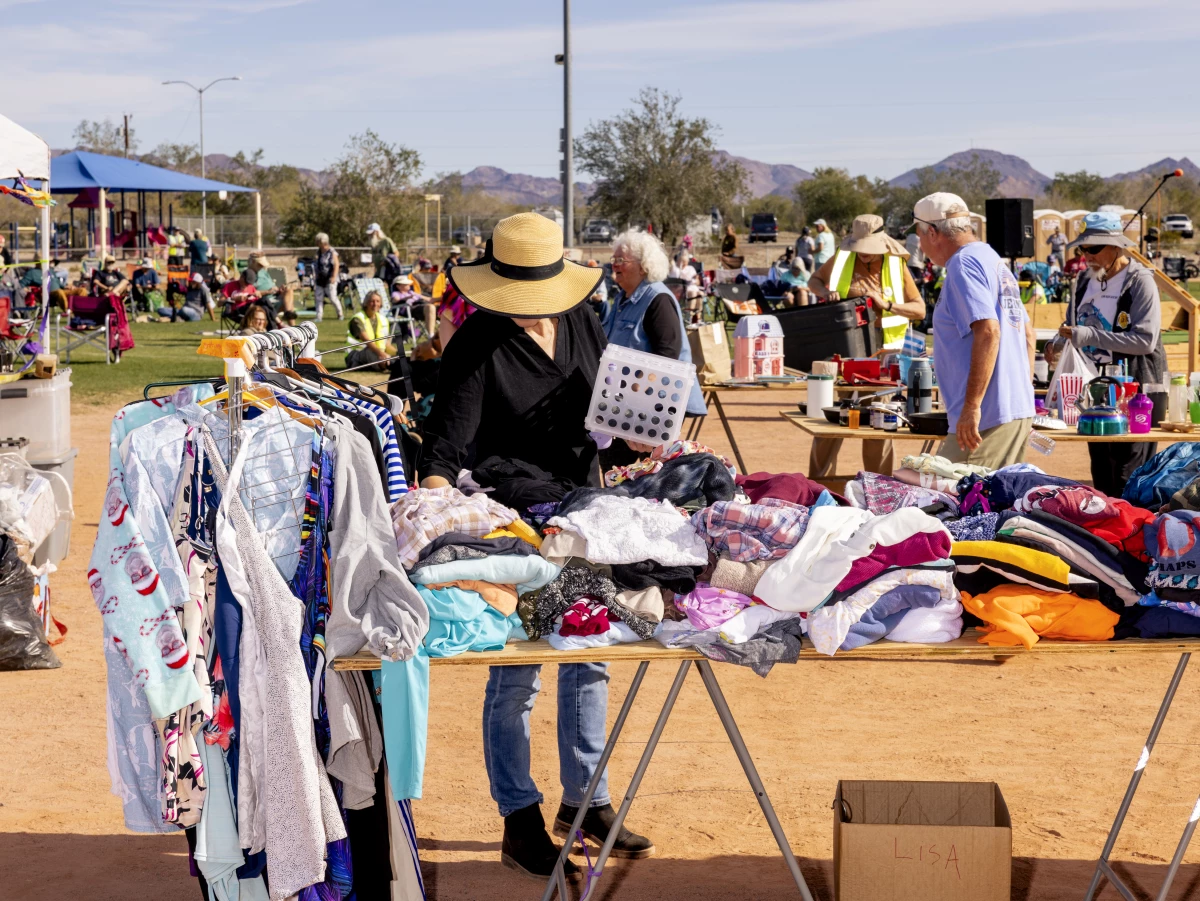
Hundreds of volunteers descend on a baseball field in Quartzsite, a small town near the California border, over about a week in the middle of January. They don safety vests and guide cars into parking spots, buzz around the grounds picking up trash and chirp back and forth to each other on walkie-talkies.
Thousands of people attend the event — which is free, although donations to the alliance are welcome. People can set out items they no longer need for others to take, like books, clothes and cookware. A small sewing circle gathers to mend clothes.
People write their needs and offer up skills on index cards posted on billboards. “Need tent zipper repair ideas/skills,” one card reads.
There’s also a raffle: Attendees can enter to win a $10,000 cash prize alongside a kitted-out ambulance designed by Bob Wells himself.
The community
It’s taco Tuesday in the open air of the Arizona desert. Music blares as the sun slips below jagged mountains. A couple dozen volunteers are eating after a full day working at the RTR.
The food was made by Derrick Hansler, better known in the community as D Rock, as part of his project he calls, “Smell what D Rock is Cooking.”
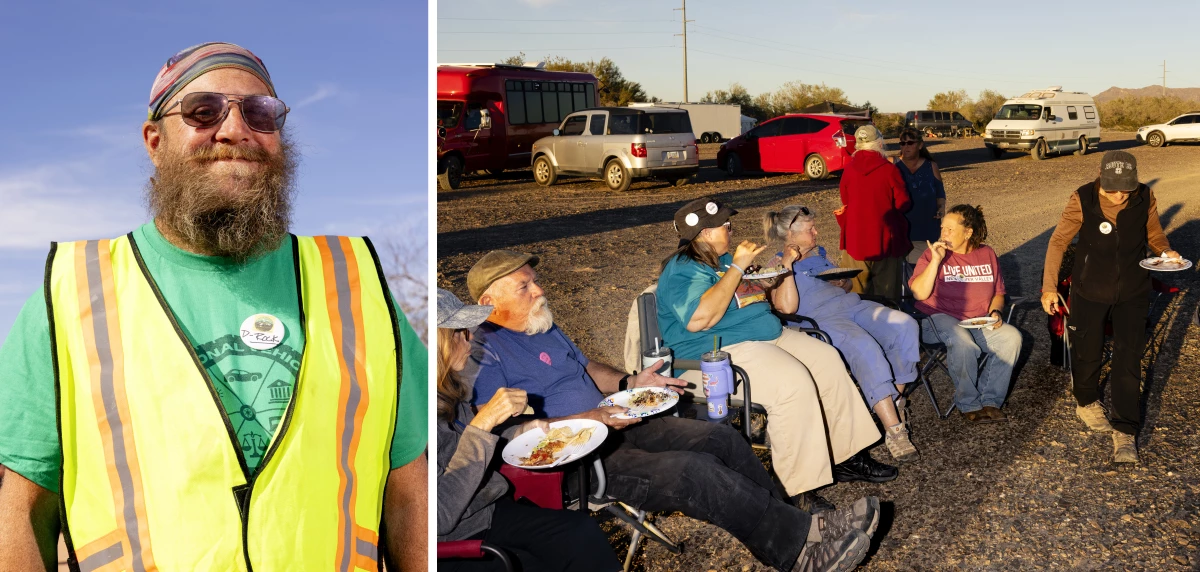
“I have built a little chuckwagon. And I pull it around to all kinds of nomadic gatherings and put out food, beer, for donations or whatever you have,” he said.
The dinner is emblematic of the deep community ties among the nomads. Many have stories to tell like Rachele Adair’s.
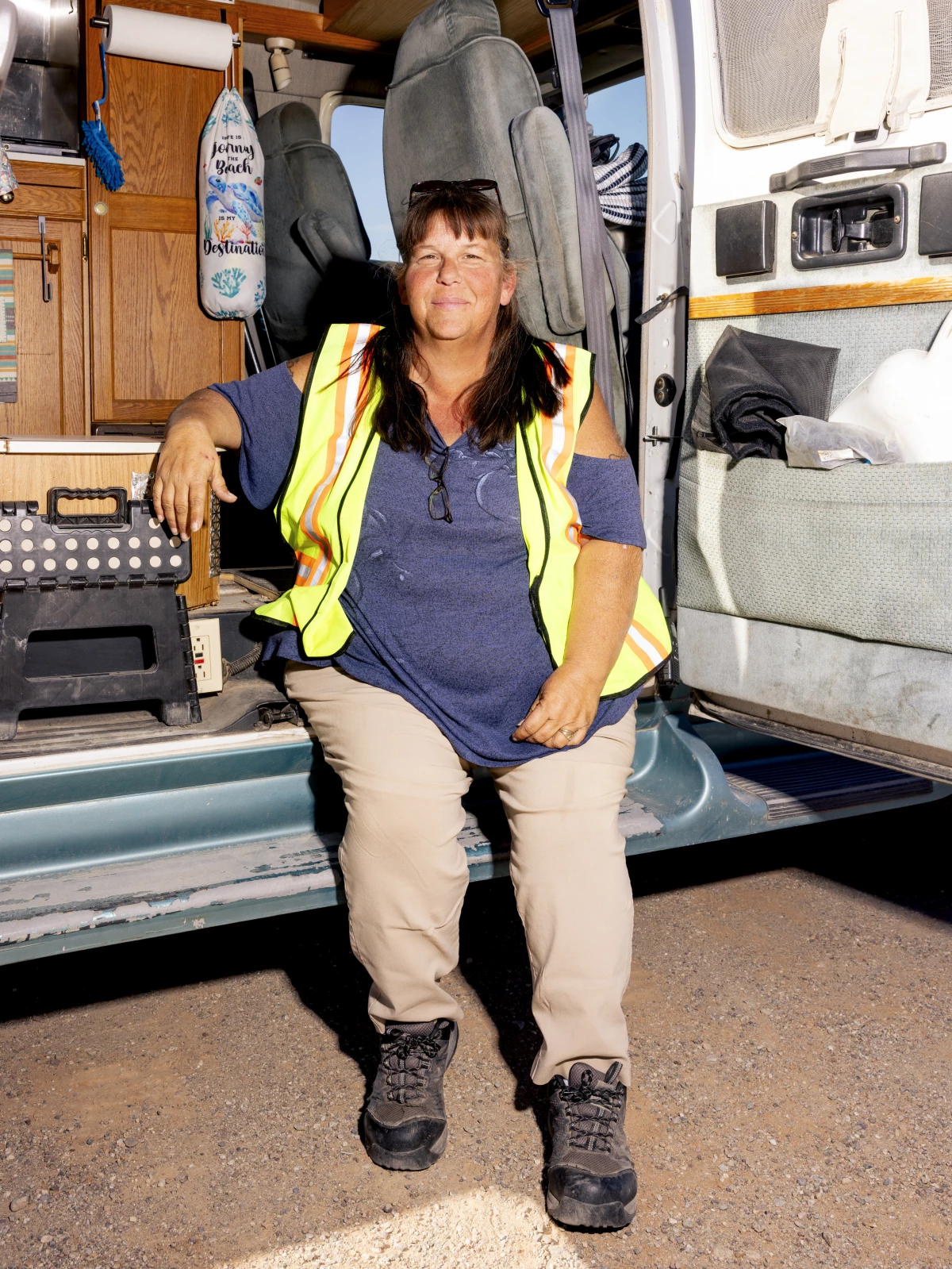
April Craren was on the brink of homelessness when she applied to a program run by HOWA that provided her with a van.

“They will give you the shirt off their back, even if they don’t have one,” said Craren. “They’ll do anything for you.”
When Tracey Power was involved in a serious car crash that sent her spiraling mentally, other nomads were there for her.
“Within 24 hours of the situation, I had a volunteer therapist. A week later, I had a second therapist. The community just really rallied around me, not just my little tribe, but the whole community. And it’s what saved my life,” said Power.
Home proud
Attention to detail is huge among the nomads. The “rigs” — the lingo for their vehicles — are as unique as their owners. They’re both practical and beautiful. Some are bedecked in antiques and artwork; others are minimalist and pristine.
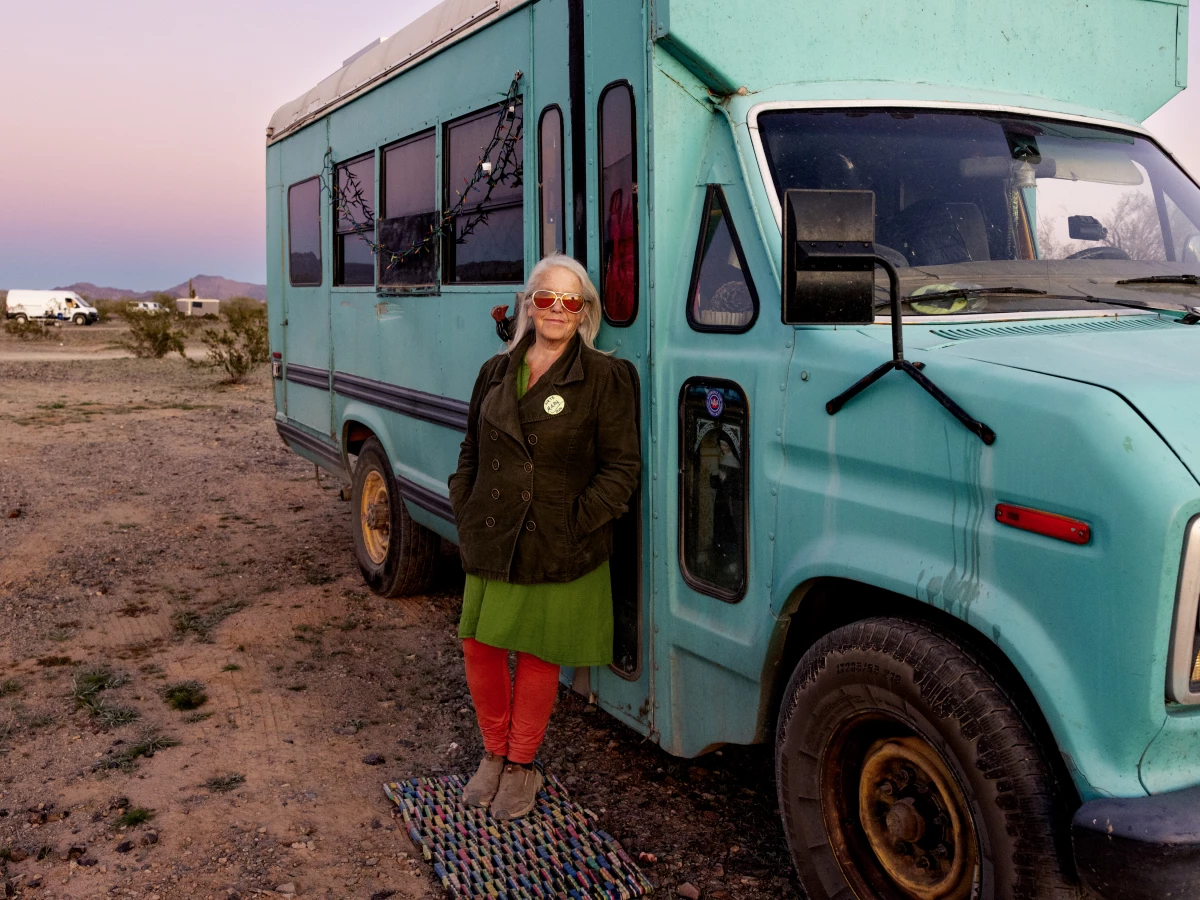
In Mary Feuer’s teal school bus, the kitchen cabinet doors are made from 1920s fruit crates. Her bed has a wooden headboard from the ’30s. Out front, a shrine is embedded into the wall next to the door.

“That’s Saint Rita. She is the patron saint of improbable causes. And that’s why she’s the patron saint of this bus. Because this bus has had its highly improbable moments,” she said.
Lori Gaskill has modified the interior of an ambulance with a rustic feel. She has wood cabinets, a custom-made tambour door that slides up to reveal her closet and live edge oak countertops.
“I wanted it to look like a log cabin, barn type of environment. I’m kind of a freak when it comes to woodworking … so everything’s wood,” she said.
Off the back is a flagpole where she can hoist the Stars and Stripes. Gaskill has also outfitted the ambulance to help with search and rescue efforts.

“If I’ve got to pull somebody over the side of a cliff or something, I can take my rear winch or my front winch and put my A-frame on it, let it hang off the back and be like a little crane,” she said.
Vanessa, who runs a popular YouTube channel, chose black, orange and gold as her color scheme in her van. (She only uses her first name on her channel because of previous online harassment and asked that her last name not be used for this story.) She wiped down the glossy black floor before showing off the interior, where even the kitchen block knife set has gold handles to match the other gold accents throughout.
She’s also got a four-burner stove and a deep sink so she can cook herself homemade meals.
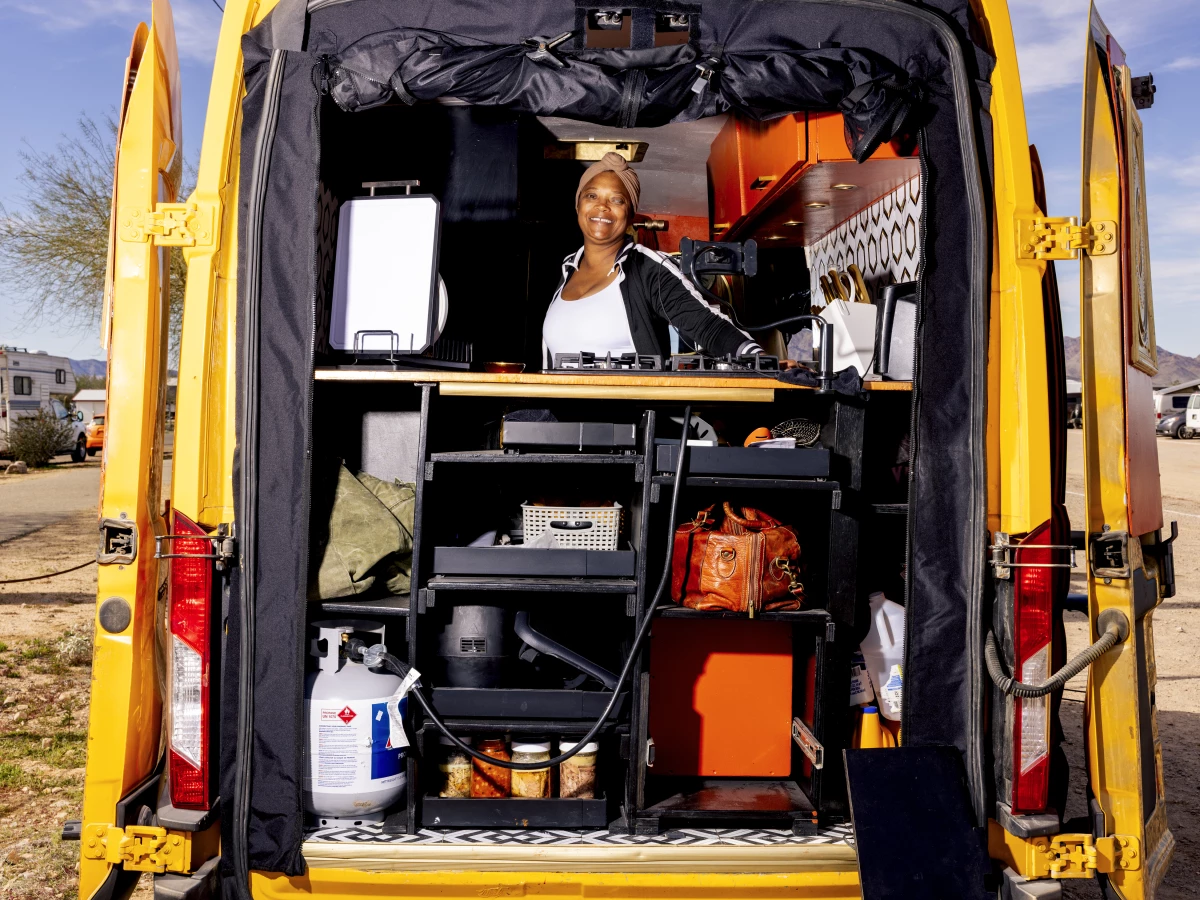
“My kitchen is going to always be the main focal point for me because I am the oldest of six children and I’ve been cooking my whole life,” she said.
Adair’s new home on wheels is taking shape, too. The contractor who is helping with the build has put up walls with insulation and windows in her Toyota Tundra’s bed. Adair calls it a “cabin on wheels.”
Adair said she came to the event with a truck, but she’s leaving with a home.

Cassidy Araiza contributed to this story.
Transcript:
MARY LOUISE KELLY, HOST:
Every January, a group of self-described nomads meet in Quartzsite, Arizona, for the Rubber Tramp Rendezvous. It’s a gathering where people who live a lifestyle on the open road can meet, can swap practical tips. NPR’s Alina Hartounian went along and reports it is not the #vanlife you might be thinking of.
ALINA HARTOUNIAN, BYLINE: It’s Taco Tuesday in the open air of the Arizona desert. A couple dozen volunteers are eating after a full day working at the RTR. The food was made by Derrick Hansler, better known in the community as D Rock.
(SOUNDBITE OF MUSIC)
DERRICK HANSLER: I have built a little chuck wagon, and I pull it around to all kinds of nomadic gatherings and put out food for just donations or whatever you have. And yeah, that’s my part in helping this community.
HARTOUNIAN: The dinner is emblematic of the deep community ties among the nomads, many of whom have been coming to the rendezvous for years. The first gathering was held back in 2011. It was a meeting place for people who travel across the U.S. in vans, buses, cars and RVs. They typically camp untethered from a physical address. Some of them live in their vehicles out of necessity. They say that homelessness is the alternative. Others are drawn to a lifestyle that allows them the freedom to explore North America and live minimally.
APRIL CRAREN: And I get to travel. I get to go places, and I love that.
HARTOUNIAN: April Craren is one of the many people here who has stories to tell.
CRAREN: I did try running a place, and it was such a dump, and there were so many drug addicts and stuff all around. I couldn’t do it.
HARTOUNIAN: Craren moved into a van, but the transmission died. She was on the brink of homelessness when she was given a van in 2020 by the Homes on Wheels Alliance. It’s the nonprofit that puts on the Rubber Tramp Rendezvous.
CRAREN: They’ll give you the shirt off their back, even if they don’t have one. They’ll do anything for you. I’ve got a friend that’s fixing women’s solar – you know, helping them with their electrical and stuff, and they do it for free.
HARTOUNIAN: Mary Feuer also benefited from nomad community kindness. Her home is a teal school bus. She shows me a shrine she built next to the front door.
MARY FEUER: Yeah, that’s St. Rita. She is the patron saint of improbable causes. And that’s why she’s the patron saint of this bus ’cause this bus has – you know, it’s had its improbable moments (laughter).
HARTOUNIAN: Two years ago, it rolled over on a highway in Texas.
FEUER: I could drive it away. The engine was fine and everything, but the inside was just tossed like a salad.
HARTOUNIAN: But then her fellow nomads helped her rebuild. Feuer’s kitchen cabinet doors are made from 1920 fruit crates. Her bed has a wooden headboard from the ’30s.
FEUER: Yeah. I had an antique store before I got on the road.
HARTOUNIAN: Other rigs are more minimalist. Lori Gasaill (ph) has modified the interior of an ambulance with a rustic feel.
LORI GASAILL: Yeah, that’s actual reclaimed barnwood.
HARTOUNIAN: Gasaill has also outfitted the ambulance to help with search and rescue efforts.
GASAILL: I also like to assist in wildland fire fighting situations, where I can be a resting station, whatever they need me to be.
UNIDENTIFIED PERSON: Amazing restoration.
GASAILL: I’ve had it three years. It’s – I got it gutted, got the measurements.
HARTOUNIAN: It’s her first time at the RTR, and she’s showing off her rig to curious nomads.
GASAILL: Oh, they’re all very genuine – live and let live, respect each other’s privacy, come by, say hi.
HARTOUNIAN: Gasaill recently retired and has big plans. Mexico, Canada and the Yukon are just some of her destinations over the next year or so. And she says if there are more events like this one, she’ll definitely go. Alina Hartounian, NPR News, Quartzsite, Arizona.
(SOUNDBITE OF KILLA KYLEON SONG, “DUPPY FREESTYLE”)
