Honeybees, which are tasked with pollinating many of the agricultural crops in the United States, are dying off in record numbers.
Commercial beekeepers are reporting losses this year ranging between 60 and 100%, Washington State University’s Honey Bees and Pollinators Program reported in March.
Bee losses are not new — previous years have seen losses between 40 and 50%. Researchers know that honeybees are under pressure from pesticide use, habitat loss and mite infestations, but they can’t yet explain why 2025 has been such a lethal year.
But the honeybee is not the only bee that can work in the fields. Today, most farmers use honeybees to pollinate their crops, even though they are, in fact, terrible at pollinating, says David Hunter, CEO of Crown Bees in Woodinville, Wash., who sells a different type of bee.
Instead of spreading pollen from flower to flower, the honeybee carries most of the pollen back to the hive.
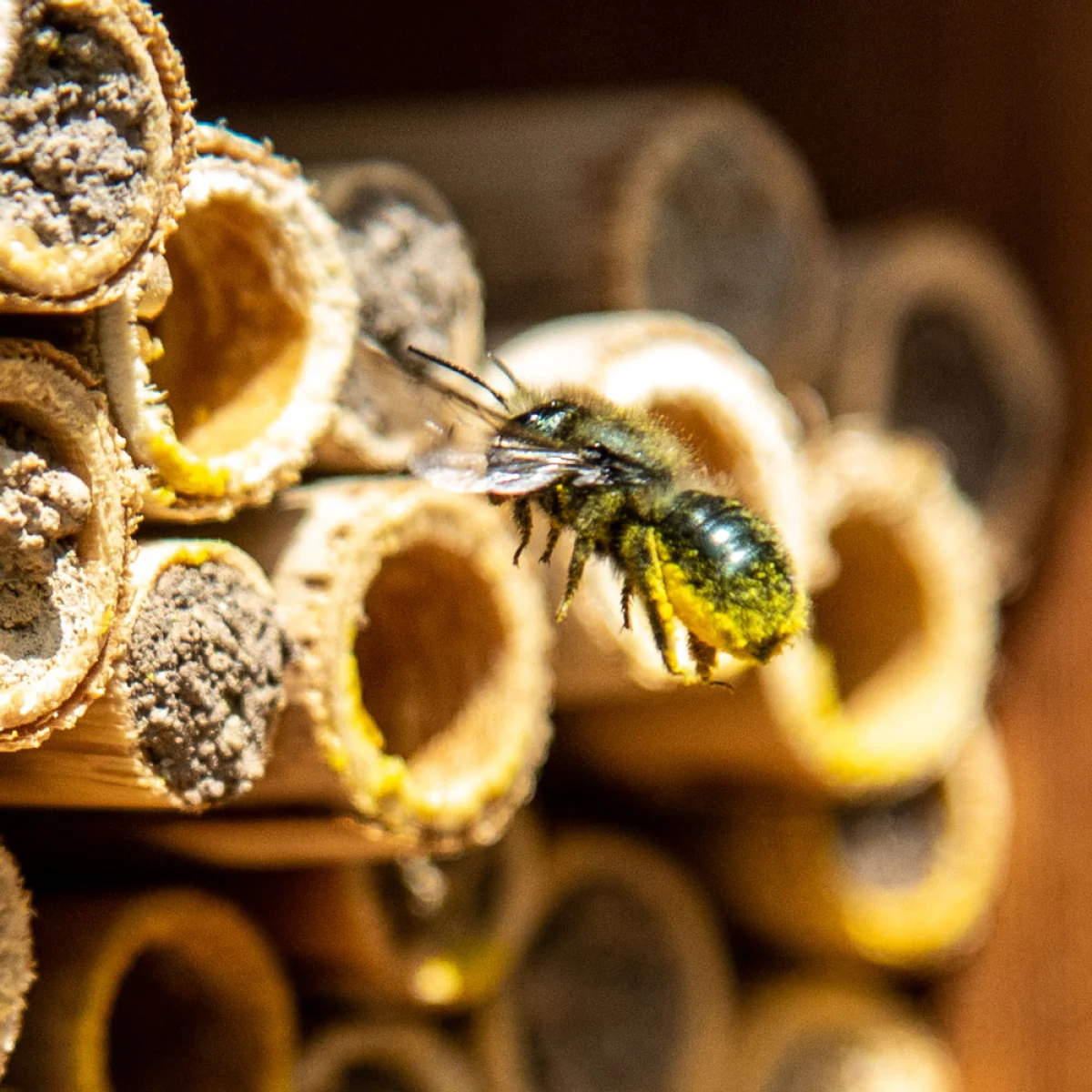
But behold the humble mason bee! Also called the blue orchard bee, it inelegantly “belly flops” onto a flower, Hunter says. It flings pollen everywhere. Covered in pollen, the hairy mason bee then goes to the next flower and bellyflops again, which gives it a higher pollination success rate.
This is well-known in the bee world and backed up by the U.S. Department of Agriculture research. (In fact, the USDA named the mason bee a “pollinator-of-the-month.”)
But farmers still rely on the honeybee, in part because these bees live in large hives that can be picked up and moved to different fields. Hunter says there is also an “only one bee mentality, and this is helping create the pollination mess we find ourselves in today.”
Mason bees are among the 4,000 types of bees native to the U.S. The honeybee isn’t one of them — they were brought to the U.S. from Europe in the 1600s.
Mason bees don’t live in hives and they don’t make honey. There is no queen bee and there are no worker bees. “All females are queens,” says Hunter.
Female mason bees lay their eggs in cavities or tubes, and then seal the entrance with mud to protect them from predators. Because they build chambers inside the tubes, they were given the name mason bees.
“It’s an interesting life cycle,” says Hunter. “Through the summer, they become big larvae, spin a cocoon, and metamorphose to an adult. And in the fall, it’s an adult bee in a cocoon that just hibernates through the winter.”
Hunter, who is on the board of directors of the Planet Bee Foundation, is an evangelist for the mason and the leafcutter bee, which also nests in cavities. He is trying to spread the word about native bees because, like the honeybee, they are under pressure.
Hunter started his company, Crown Bees, which builds and sells bee hotels, to get more native species into backyards as well as onto commercial farms. Today, he sells and ships bees and bee hotels all over the country.
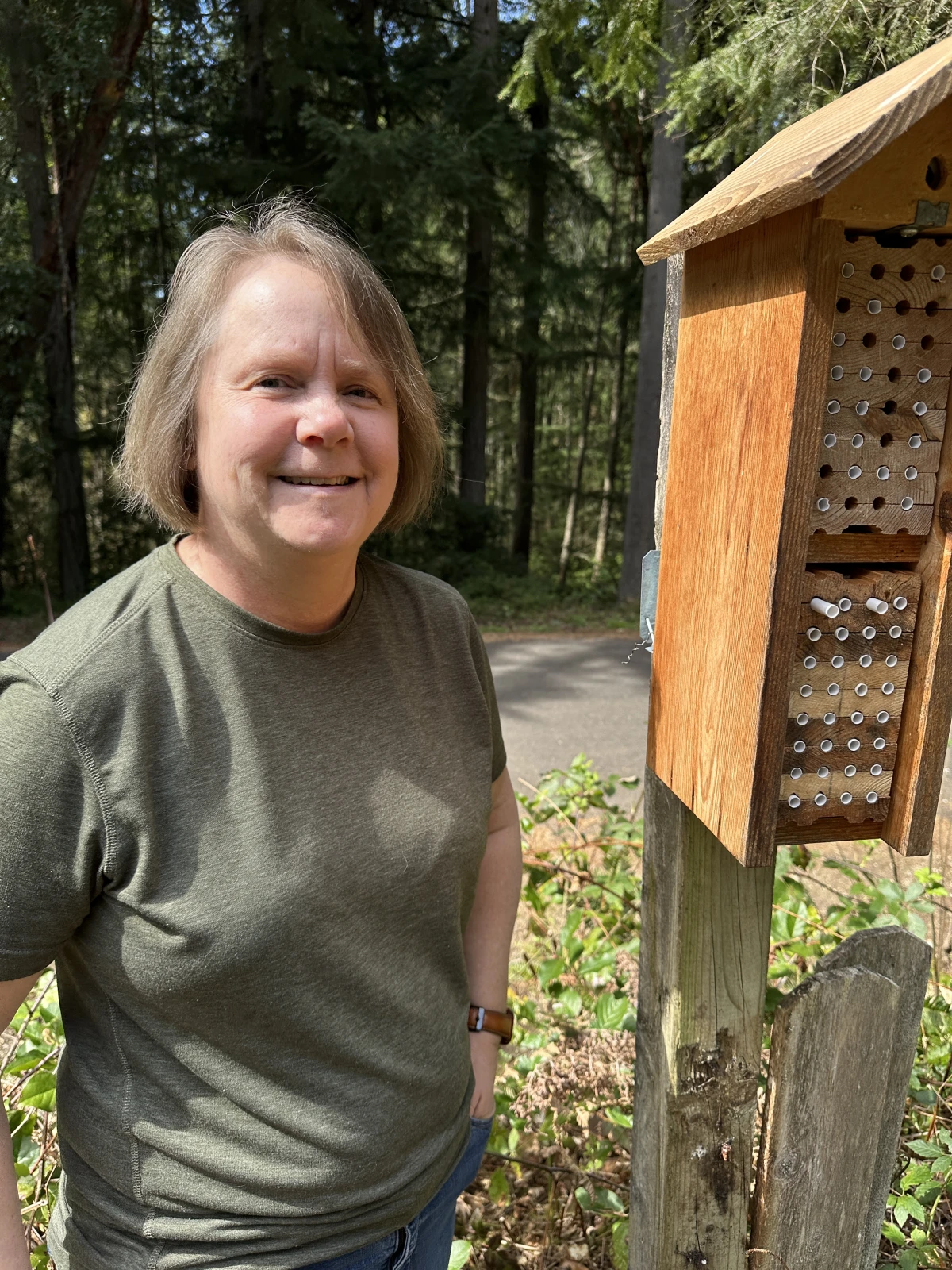
Beth Cummings, a retired college professor in Gig Harbor, Wash., first tried mason bees after her fruit trees burst into bloom in the spring, but they actually produced only a few pieces of fruit.
“We were obviously missing some pollinators,” says Cummings, who now orders bees in their cocoon stage to arrive in the mail each spring, which then hatch as temperatures warm. “You give them a place to live, a way to make mud since they don’t hive, and you never really see them. It’s a pretty hands-off sort of deal.”
Mason bees are a shy bee and rarely sting. That means the garden isn’t dangerous for Cummings’ elderly father, who is allergic to bees.
And when summer is over? After a bit of work scraping out the cocoons, they can be stored in the refrigerator. But Cummings prefers to mail the slender tubes back to Crown Bees, which will care for them over the winter. Next spring, her bees will be mailed back to her, and she’ll slide them back into place in her bee hotel.
The results, says Cummings, have been “very fruitful.”
Transcript:
SCOTT SIMON, HOST:
Commercial beekeepers say there are huge die-offs of their bee colonies. Washington State University researchers expect that this year the losses will be between 60 and 75%. Fewer honeybees means fewer crops are pollinated, and that, of course, threatens food production. It’s apparently well known in the bee world that honeybees are not particularly good at pollinating. Other bees are more accomplished. David Hunter owns Crown Bees in Woodinville, Washington, and is an evangelist for the native mason bee. Mr. Hunter, thanks for being with us.
DAVID HUNTER: I’m glad to be here.
SIMON: First, let me ask, why are so many honeybees dying off?
HUNTER: There’s a lot of stressors that are impacting not only the honeybee, but just worldwide insects. And you could say that the top three would be climate change, and then the lack of habitat where these insects used to live and get their foods. And then probably also at the top of that list would be the chemical onslaughts, whether that’s in pesticides or herbicides or various -cides. I think the coalescion (ph) of all of this mess is hurting the entire honeybee industry.
SIMON: With regard to their losses and contribution to agriculture that benefits us all, you don’t, I gather, believe the honeybee is actually well-equipped for pollination.
HUNTER: It’s a well-used pollinator, but most of the pollen gets stuck to their hind legs. They’re very fastidious. Ninety-five percent of the pollen heads back to the hive. The 5% – they have so many numbers in the field. That 5%, that does help pollinate. But when you look at the solitary bee, every female is a queen, and if she’s out there buzzing, they’re just unsophisticated, belly-flopping into a flower. Pollen is kind of held all over their bodies, next flower, belly-flopping into that flower and most the pollen stays in the flower and in the field.
SIMON: The U.S. Department of Agriculture has named the mason bee pollinator of the month.
HUNTER: I’ve been working alongside them for, oh, about 15 years, and there’s been a lot of research that’s shown when you add the mason bees to cherries, you’re doubling your yield. The gardeners across the country, when they put these bees in their yards, you’re just getting more berries and cherries and apples and beans and melons in the summer.
SIMON: I gather your company ships bees all over the country. How does that work?
HUNTER: So we raise our bees in backyards across North America. We help these people raise these little solitary bees in little bee hotels. In the fall, people open their little nesting holes up, and they’ve got cocoons in their hands. They keep some, share some with friends, and send the rest out here in Washington state. So we then clean them up, put them in bins, and when people want to try these bees out in their yards the next spring, we’re putting them in FedEx two-day air envelopes and just mailing cocoons.
SIMON: Wow.
HUNTER: So I just think the importance that people need to realize is everyone can do something about it. In their backyard, can they think through, what is an oasis from a bee’s perspective? I have pollen and nectar available from early spring, deep into late summer. I’m trying not to spray chemicals if I can. And then, I’ve got a bee hotel. That’s my industry. You’re able to stand in front of this hotel without any fear of getting stung and just watch nature pollinate your yard.
SIMON: David Hunter owns Crown Bees. He’s also on the board of directors of the Planet Bee Foundation. Thank you so much, Mr. Hunter. Good luck to you.
HUNTER: Thank you much.
(SOUNDBITE OF MORT GARSON’S “PLANTASIA”)