


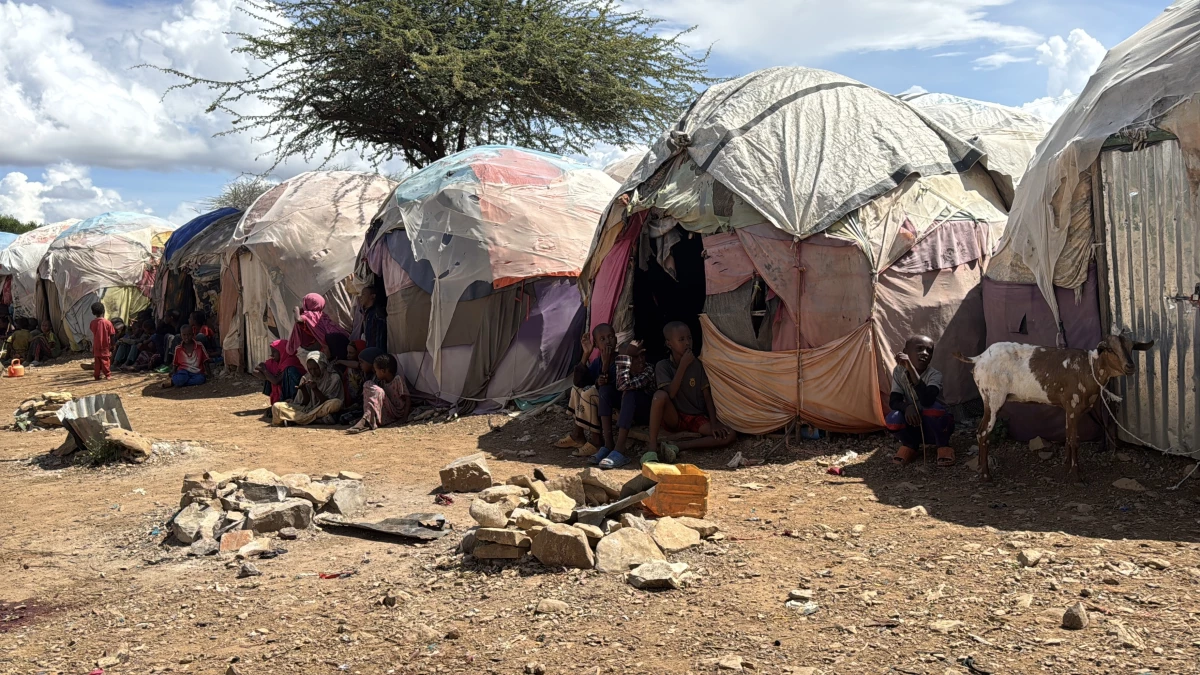
Fadumo Abdi Sheikh and her children lost everything about a decade ago when famine and drought forced them to leave their village in Somalia and flee to the city of Baidoa.
The family struggled to get by until Abdi Sheikh participated in an anti-poverty program in 2021. The initiative taught her how to save money and build a livestock business. As part of the program, she was given 5 goats, which she was able to increase into a herd of 15.
Her family can now drink fresh milk and she makes and sells butter, increasing her income up to $50 a month.
The program that helped her was a successful poverty alleviation effort but that is typically implemented in rural communities in low-income countries.
Now, research shows it works even in incredibly difficult circumstances, like in the southwestern city of Baidoa. Half of the city’s 1.2 million people are internally displaced, driven from their homes by extreme drought and violence by the militant group al-Shabab.
“They’re living in particularly challenging conditions with very limited access to services, often very low levels of human capital, still facing violence,” says Jessica Leight, a senior research fellow at the International Food Policy Research Institute, in Washington, DC, and lead author of the study based on the Somalia intervention. “Many households don’t even have a single adult who finished primary school.”
The lack of security and infrastructure in the country make it difficult for organizations to help the most impoverished people.
“We haven’t seen that many studies in contexts that are as difficult as Somalia to work in, for the very reason it’s difficult to work in,” says Dean Karlan, an economist and expert on poverty interventions at Northwestern University, who was not involved in the Somalia study.
Starting in 2021 until it was dismantled, the United States Agency for International Development funded what’s known as the graduation approach, that helps ultra-poor people “graduate” out of poverty. Most participants show an income increase even several years after it ends.
“The program, by its very nature, recognizes that the problem with poverty is multifaceted, and so the solution needs to be multifaceted,” says Karlan.
“Most graduation programs include some cash support, some help to generate an income, usually assets or training, and some encouragement to save money,” Leight says.
In Baidoa, around 5,000 households received 6 monthly unconditional cash transfers, each valued at $42.50. They also got coaching from the aid group that ran it — World Vision — on how to build sustainable income.
Households were then given the option to receive either a one-time asset transfer, in the form of cash (about $370) or livestock, such as goats. Or, they could enroll in a six-month vocational training course.
“Among the roughly half of households who chose assets, they overwhelmingly chose goats,” Leight says.
The program ended in December of 2024, and Leight and her research team continued to collect data and recently released their final findings.
“The surprise is that the findings are less different than we expected,” Leight says. “We often think that displaced populations face really intractable challenges, and that’s true in many contexts. For this displaced population, an intervention very similar to what’s been effective elsewhere was very effective.”
The results show that 68% of participating households are now earning more, and less likely to be in extreme poverty. It means they are able to feed their children and send them to school.
“The biggest, most influential part of this work was in showing that even in Somalia, this worked, and changed lives in really remarkable ways over several years,” Karlan says, adding that the results are in the upper end of the spectrum for what the program typically delivers.
“When the markets are failing and there’s lots of challenges across many different facets, it could very well be that a program like this has a bigger treatment effect because the needs are that much more stark,” he says.
The results also showed an interesting dynamic that hadn’t come out in other studies, according to Leight.
“When we looked at households that benefited the most, we found that it was disproportionately households that had smaller numbers of dependents, fewer children and elderly,” she says.
Both Leight and Karlan said further research is needed to understand more about this aspect of the findings.
Karlan was the chief economist of USAID until its dismantling in early 2025. He says the agency had planned $150 million of funding for this type of intervention in Somalia, but the funding was shut down by the Trump administration.
“The good news is we have some really good evidence of a way of dealing with a very difficult problem, and that’s going to contribute to better policy for others,” he says.
Even if the US doesn’t build on the evidence from this work, Karlan says, others will.
Transcript:
MARY LOUISE KELLY, HOST:
There’s a tried-and-true program that helps people get out of extreme poverty. It’s typically implemented in rural communities across many low-income countries. New research shows it works even under incredibly difficult circumstances, as NPR’s Fatma Tanis explains.
FATMA TANIS, BYLINE: In Baidoa, many people are in a tough situation. The southwestern Somalian city has a population of over 1.2 million people. About half of them are internally displaced, driven from their homes due to extreme drought and violence by the militant group, Al-Shabaab. Jessica Leight is a senior research fellow at the International Food Policy Research Institute.
JESSICA LEIGHT: They’re living in particularly challenging conditions with very limited access to services, often very low levels of human capital, still facing violence.
TANIS: The lack of security and infrastructure in the country overall has made it really difficult for organizations to help them. Starting in 2021, until it was dismantled, the U.S. Agency for International Development funded what’s known as the graduation method that helps push people out of extreme poverty. It has a high success rate based on a number of studies. Leight is the lead author on the study of the Somalia intervention.
LEIGHT: Most graduation programs include some cash support, some help to generate an income, usually assets or training, and some encouragement to save.
TANIS: Around 5,000 households in Baidoa received six monthly unconditional cash transfers, each valued at $42.50. They also got coaching from the aid group that ran it, World Vision, on how to build a business. Households were then given the option to receive either a one-time asset transfer – that could be cash, about $370, or livestock like goats – or they could enroll in a six-month vocational training course.
LEIGHT: Among the roughly half of households who chose assets, they overwhelmingly chose goats.
TANIS: The program ended in 2025, and Leight and her research team continued to collect data for two years and recently released their final findings.
LEIGHT: The surprise is that the findings are less different than we expected. So we often think that, you know, displaced populations face really intractable challenges, and that’s true. At the same time, for this displaced population, an intervention very similar to what’s been effective elsewhere was very effective.
TANIS: Sixty-eight percent of participating households are now earning more. They’re able to feed their children and send them to school. For example, a 70-year-old woman chose to receive five goats as her asset and then was able to increase them to a herd of 15. Her family can now drink fresh milk. She makes and sells butter, increasing her income up to $50 a month. Dean Karlan is an economist and expert on poverty interventions at Northwestern University. He was not involved in the study.
DEAN KARLAN: The biggest, most influential part of this work was in showing that, like, even in Somalia, this worked and just it changed lives in really remarkable ways over several years.
TANIS: In fact, Karlan says the results are in the upper end of the spectrum for what the program typically delivers.
KARLAN: When the markets are failing and there’s lots of challenges across many different facets, it could very well be that a program like this has a bigger treatment effect because the needs are that much more stark.
TANIS: Researcher Leight says there was an interesting dynamic that really hadn’t come out in other studies.
LEIGHT: When we looked at households that benefited the most, we found that it was disproportionately households that had smaller numbers of dependents, so fewer children and elderly.
TANIS: Which she and Karlan say needs further research – Karlan was the chief economist of USAID until it was dismantled. He says the agency had planned $150 million of funding for more of this type of intervention in Somalia, but that all got shut down by the Trump administration last year.
KARLAN: The good news is, though, we have some really good evidence of a way of dealing with a very difficult problem, and that’s going to contribute to better policy for others.
TANIS: Even if the U.S. doesn’t build on the evidence from this work, Karlan says others will. Fatma Tanis, NPR News.
