


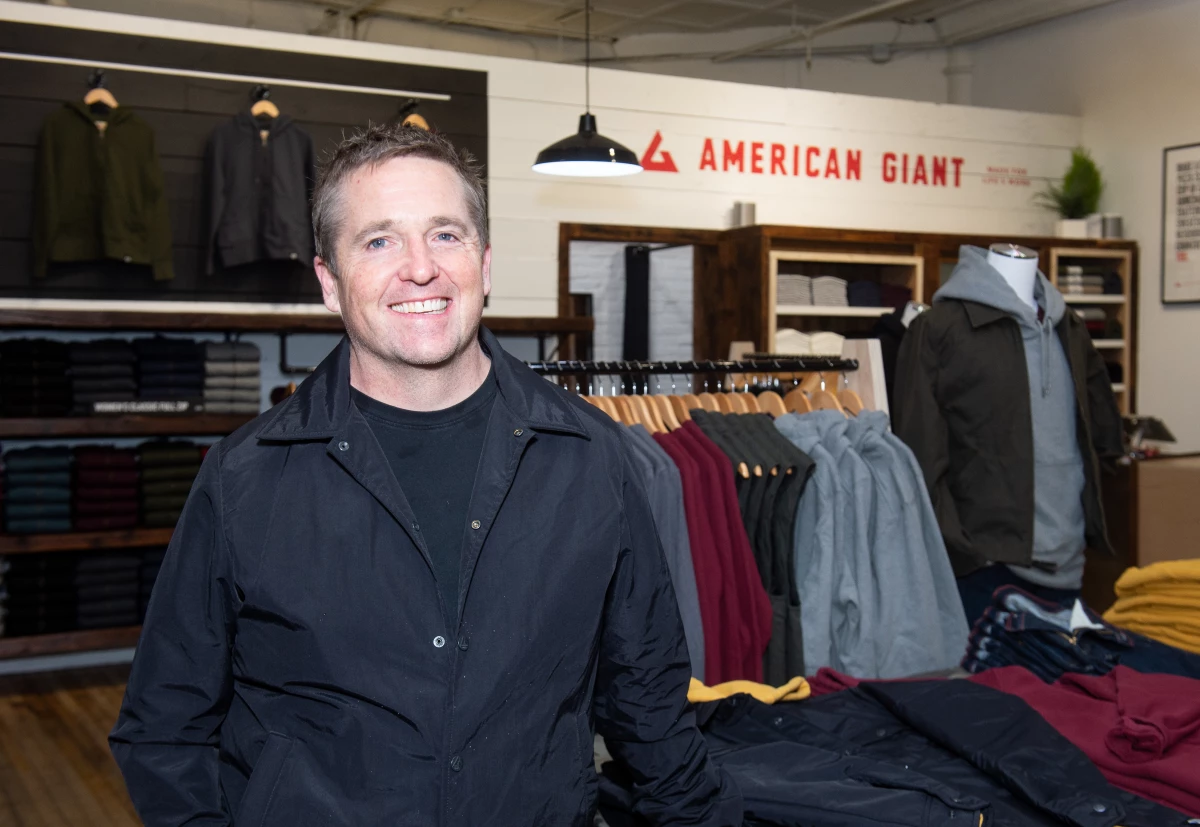
Bayard Winthrop, founder and CEO of the apparel company American Giant, built his brand on the promise of selling U.S.-made clothing.
Winthrop’s company sources and manufactures almost all its products in the U.S., from cotton to the final stitch. While that drives up costs, he said one of his business’ principles is to make good quality U.S.-made products that are affordable to average U.S. consumers.
In 2023, American Giant partnered with Walmart to sell $12, fully U.S.-made T-shirts.
His business is the kind that President Trump might say the sweeping global tariffs are meant to help.
While Winthrop supports some of the tariffs, he said the Trump administration’s approach is too broad and poorly targeted.
“The breadth of this move — that kind of captures up everybody — I don’t agree with,” Winthrop said. “But I certainly think in the case of China particularly, it was long overdue.”
Here are three takeaways from his conversation on Morning Edition:
On how the tariffs help his business:
“Let’s see where they land, but they certainly begin to move in that direction with China,” he said. “I mean, the situation with China is really bad in the textile industry.”
He added: “For people that are not in the middle of trade negotiations, if you stared at some of the nature of how we trade with them in textiles in particular, it’s terrible, and it really hurts facilities like ours and communities that really need good work, that need work in Gaffney, S.C. and Middlesex, N.C., and places that good, vibrant towns that need jobs, that are working, are getting really hit by what I view as a totally out of whack trading relationship with China, and so some of them really do.”
Are others in his industry worried about any tariffs?
“Most apparel brands, big and small, are really dependent on a globalized supply chain, and in many cases, very dependent on places like China and Vietnam,” Winthrop said. “And I think for those people, it’s a scary time, because – particularly in regards to China – if the tariffs roll in and hold… I think that’s going to fundamentally change the posture.”
Winthrop said there are purchasing cycles in the clothing industry and that apparel companies are currently buying for fall and the holidays. Some companies, he added, may be feeling confused about the textiles supply chain.
“And so you’ve got to make calls right now about whether this is — this is it? Do we have to lock in and move? Can we wait for a little bit?” Winthrop said. “Do we have to create an alternate supply chain?”
His advice to policymakers:
“I think the key thing is that the administration needs to strike the balance between good decisive action, beginning to really address some things that are long overdue, but understanding at the same time that this is – it’s fragile, and the supply chain is fragile,” Winthrop said.
“And we have allowed ourselves to get so dependent on cheap goods imported from overseas that unwinding that is going to take partnership and time and communication and leadership and clarity.
“I think giving some time to allow countries to adjust and businesses to adjust would be helpful, to give people the opportunity to begin to think a little bit about: Where are we heading? And how are we going to adjust to it?”
The story was adapted for the web by Majd Al-Waheidi and edited by Obed Manuel, with the radio version edited by Reena Advani.
Transcript:
LEILA FADEL, HOST:
Bayard Winthrop built his brand on the Made in America label. The CEO and founder of the casual clothing company American Giant supports some tariffs but wishes the Trump administration had rolled them out more slowly and that they were more targeted and strategic. I asked him about how making his products in the U.S. affects his price point and his customers.
BAYARD WINTHROP: We’ve been pretty committed to having it all from the United States. So from the cotton in the ground, through the yarn and the knitting and the dyeing and finishing and sewing, all the way through, it was sort of a principled stand of ours, in part just ’cause we wanted to prove that we could do it and it would allow us to stay very close to the products and the people that were making the things that we were selling. There’s some exceptions to that. Like, if we sold a merino wool program, for example, there’s not a lot of merino wool in the United States, but effectively, everything we make, all inputs are domestically sourced.
The second part of the question about how do you do it and maintain reasonable prices. The brand is a premium brand. Our T-shirts sell from 35 to $55. That’s an expensive price point. And for me, I started the company in part to allow average Americans to be able to afford good quality American-made stuff. And I’d reached the point where I began to feel like that might be out of reach. And I – I’ve spoken out a lot about how in service of things like this that I think should be broadly held by Americans, there are examples like Walmart who have actually made fairly large commitments to committing to American-made or grown or assembled products. And Walmart reached out to us about two years ago and said, hey, we’re trying to get textiles figured out domestically. And that conversation ended up in a partnership that launched last Fourth of July, and we now sell a $12 T-shirt in Walmart. It’s entirely made in the United States, and it’s at a price point that works for just average Americans.
FADEL: Do the tariffs level the playing field for you and your business?
WINTHROP: Well, we – let’s see where they land, but they certainly begin to move in that direction with China. I mean, the situation with China is really bad in the textile industry for people that are not in the middle of trade negotiations. If you stared at some of the nature of how we trade with them, in textiles in particular, it’s terrible. And it really hurts facilities like ours and communities that really need good work, that need work in Gaffney, South Carolina, and Middlesex, North Carolina, and places that, you know, good, vibrant towns that need jobs that are working are getting really hit by what I view as a totally out of whack trading relationship with China. And so some of them really do. I think, you know, the breadth of this move that kind of captures up everybody, I don’t agree with it. I think it does not need to be such a broad-based, generalized approach. I think it needs to be more precise than that. But I certainly think that in the case of China, particularly, it was long overdue.
FADEL: What are you hearing from others in your industry about these tariffs and about the heightened risk of a recession?
WINTHROP: Most apparel brands – big and small – are really dependent on a globalized supply chain and, in many cases, very dependent on places like China and Vietnam. And I think for those people, it is a – it’s a scary time because if – particularly in regards to China, if the tariffs roll in and hold – and I think they’re way more likely to hold there than they are in a place like Vietnam, for example – I think that’s going to fundamentally change the posture.
The thing that maybe people don’t appreciate is there are buying cycles in industry, and so, you know, apparel companies today are buying for fall and holiday. They’re making decisions right now about what’s coming in the fall and holiday. And so you’ve got to make calls right now about whether this is it. Do we have to lock in and move? Can we wait for a little bit? Do we have to create an alternate supply chain? So I think there’s a lot of that confusion happening in textiles particularly. And I think some exploring of, you know, can we get a domestic supply chain that we can have at least some anchor to windward here if we need it?
FADEL: And, you know, as somebody – you’re this American business that uses American products. I mean, you talked about cotton from the ground all the way to the T-shirt all here in the U.S. I mean, you’re the type of business that the administration is talking about. What would your advice be to administration officials who might be listening to you right now?
WINTHROP: I think the key thing is that the administration needs to strike the balance between good, decisive action, beginning to really address some things that are long overdue, but understanding at the same time that this is – it’s fragile, and the supply chain is fragile. And we have allowed ourselves to get so dependent on cheap goods imported from overseas that unwinding that is going to take partnership and time and communication and leadership and clarity. I think giving some time to allow countries to adjust and businesses to adjust would be helpful to give people the opportunity to begin to think a little bit about where are we heading and how are we going to adjust to it.
FADEL: Bayard Winthrop is the CEO of American Giant. Thank you so much for your time and your insights.
WINTHROP: Thanks, Leila.
