


KWIGILLINGOK, Alaska – When the remnants of Typhoon Halong hit this Alaska Native village last month, Ryan David was at home with his four children. They felt the house shake in the wind, then as floodwaters came, the building floated away.
“I yelled at my kids to get up and group up here, on the stairs, just in case we tip over,” David said when he talked with public broadcaster KYUK. He and his children were still trapped inside. David says the home stopped floating when it hit a bridge. He talked with a KYUK reporter as he waited for rescuers to arrive.
A month later, as villages across the Yukon-Kuskokwim Delta clean up from the storm and make repairs, hundreds of residents remain evacuated to cities such as Anchorage and Bethel. Now they face another loss. One of the few sources of local news and native language programming — public radio and television station KYUK — has lost federal funding that was up to 70% of its budget and plans to make cuts in January.
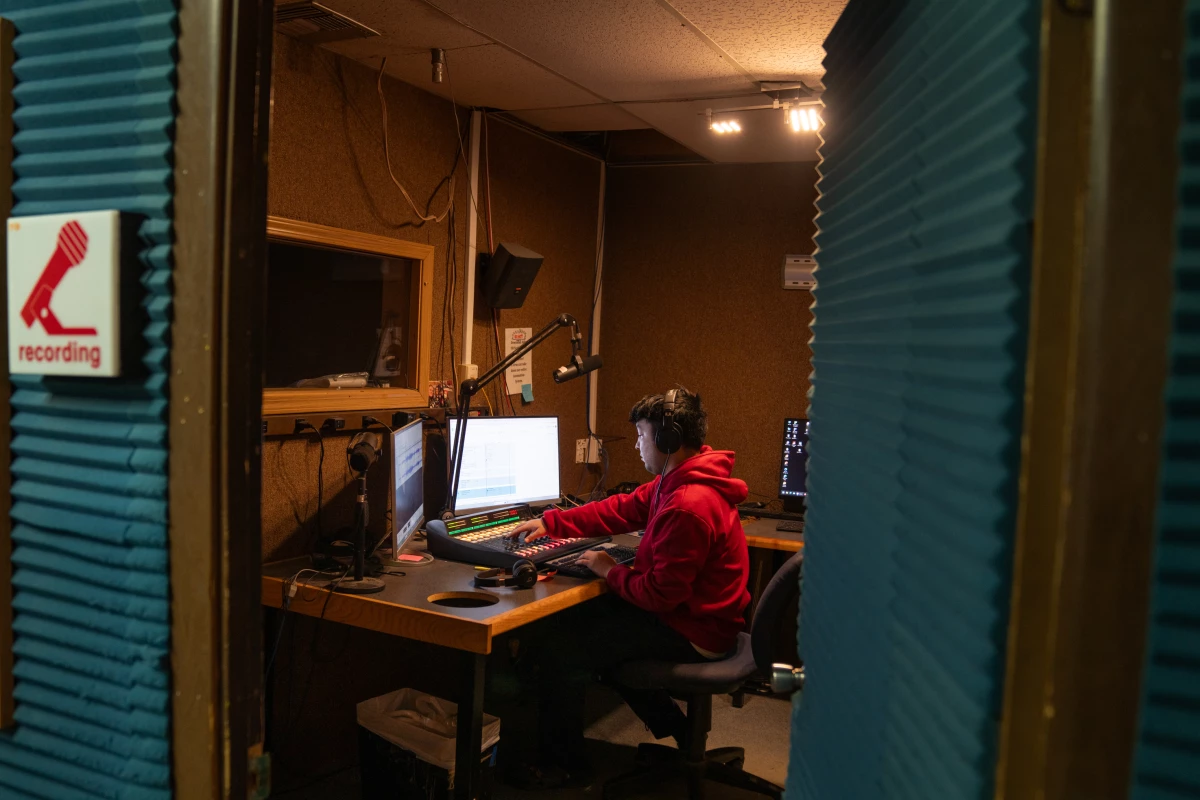
The station plans to severely cut staff and some programming as it tries to raise money to fill the budget gap.
The broader public media landscape is also experiencing a loss of federal funding, including at least some money for improving emergency alert systems, as human-caused climate change from burning fossil fuels is heating the planet and increasing risks from extreme weather.
In remote villages KYUK is “crucial”
KYUK broadcasts out of a small tan building at the base of a tall tower in Bethel, Alaska — about 400 miles west of Anchorage. Bethel is a hub community for 56 tribes spread across 48 communities. The station says its coverage area is about the size of Louisiana.

KYUK has been on the air since 1971 and “is a Native American initiated public broadcasting joint licensee” – that means it has both a public radio and television stations. It also has a digital news website and serves a predominantly Yup’ik population of less than 30,000 people in the Yukon-Kuskokwim Delta. Many residents, especially elders, primarily speak the Yup’ik language Yugtun.
“It’s very crucial to have that KYUK network,” says Darrel John, a lifelong resident of Kwigillingok. He says the news in Yugtun is especially valuable. “A lot of great advice we listen to from the elders… Any updates from any other communities — you know what to look out for — and the upcoming events.”
Each weekday, as Morning Edition ends, there’s local news and the weather forecast in Yugtun.
“Weather is definitely one of the things that KYUK focuses on because it’s life or death,” says Sage Smiley, KYUK news director. In a place where there are few roads, residents sometimes drive on frozen rivers and need to know where it’s safe to do that. “Getting from community to community in a boat, on a snow machine, in a bush plane, the weather matters almost more than anything else,” Smiley says.
When it became clear the remnants of Typhoon Halong were headed toward the Yukon-Kuskokwim Delta. Smiley says reporters started including that in their reports to warn residents. She says fall storms and even flooding are common in the region, but Halong was different from most.
“This storm took a track that was unexpected, hit south of where it was expected to and in an area that was less prepared for the storm to hit,” Smiley says. “I think all of those factors went into what made it so devastating.”

Three people in Kwigillingok died because of the storm. Nearly every building in the village was damaged. Overall more than 1,600 people were displaced, many of them evacuated in helicopters.
Smiley also coaches the high school swim team and was at a meet in another city when the storm arrived.
“I was working remotely from a minivan with the swim team while the rest of the [news] team was working on the ground here,” Smiley says in the news department studio in Bethel. “And we had collaborators in Anchorage who were helping draft scripts and call communities to figure out what was happening.”
That’s part of being a news director at a small station, but soon KYUK will try to report the news with a third less staff, because in January Smiley’s position will be among those cut.
KYUK loses funding and makes cuts
KYUK was already navigating a loss in funding from the state of Alaska when President Trump targeted public media and Congress eliminated funding this summer. It was a big hit to the station’s finances because federal funding has been up the bulk of its budget.
Loading…
The federal money essentially paid for employee salaries and benefits.
“It’s a little over $1 million that we’re receiving each year from the Corporation for Public Broadcasting. Our salaries and benefits in FY 25 [fiscal year 2025] was also a little over $1 million,” says Kristin Hall, KYUK’s general manager.
The station had 10 full- time employees and 13 part-time or on-call workers, says Hall. “Beginning in January, KYUK will transition to four full-time employees and ten part-time and on-call employees.”
In deciding where to make programming cuts, Hall says preserving Yup’ik language programs was a priority. A daily interview program, Coffee at KYUK, will lose three episodes a week in English, but keep its weekly Yugtun episode.

The station’s technical director’s hours will be cut from 40 to 10 hours a week, something Hall says she’s particularly concerned about because that person trouble shoots engineering problems and helps the station manage power outages.
To bring in more revenue, Hall says the station is applying for grants, trying to sell more underwriting announcements and will hold two pledge drives each year instead of just one. The station also expects to receive one-time funding through a Trump administration promise to provide $9.4 million for tribal broadcasting.
Hall says the station will re-evaluate in March 2026 whether the workload is sustainable for the smaller staff. So, more cuts could still come.

“My employment here was hanging on by a hair,” says Sam Berlin, a long-time host of the Yugtun language talk show Yuk to Yuk. “But the people, God bless them, they got together and we raised over $100,000 with our fundraiser.”
Just before Typhoon Halong hit the region, KYUK raised the money during its fall fundraiser. “It was our most successful we have ever seen in the history of KYUK,” Hall says. That helps, but doesn’t fill the funding gap.
Raising money in a region with fewer than 30,000 people and with a poverty rate that’s twice the national average is difficult. Hall says many people live a subsistence lifestyle, which means they may not have money to give.

“The encouragement that we get from local folks aren’t always in dollars,” Hall says. She says one person baked blueberry muffins to support the fundraiser and someone else dropped off salmon strips. Hall says an elder came to the station, and in an act of generosity, poured out her purse on the break room table. “And everything that fell out was less than $3. And she said, ‘I want you to have it.’ And it was literally everything in her purse.”
Hall says the station hopes its funding strategy will be enough to support the smaller team after January. If KYUK doesn’t exist, there’s no one else doing the station’s level of journalism in the Yukon-Kuskokwim Delta. “In terms of local news and information, and especially local news and information in Yup’ik, No, there is no one else,” Hall says.
Disclosure: This story was written and reported by NPR Climate Correspondent Jeff Brady. It was edited by Managing Editors Vickie Walton-James and Gerald Holmes. Under NPR’s protocol for reporting on itself, no corporate official or news executive reviewed this story before it was posted publicly.
Transcript:
AILSA CHANG, HOST:
Alaska Native communities are still cleaning up after Typhoon Halong devastated two villages last month. Hundreds are still evacuated, and now they face another loss. One of the few sources for local news and information, public radio and television station KYUK, says it plans to cut its staff and its programming. That’s after President Trump and Republicans in Congress eliminated money for public media, wiping out much of the station’s funding. NPR’s Jeff Brady has this story.
JEFF BRADY, BYLINE: When the remnants of Typhoon Halong hit the village of Kwigillingok on Alaska’s rural southwest coast, David Ryan’s (ph) house floated away with him and his four children inside. While waiting for rescuers, he talked on the phone with KYUK.
(SOUNDBITE OF ARCHIVED NPR CONTENT)
RYAN DAVID: The flood lifted us up, and I didn’t think it was going to happen. And I’m like, I yelled at my kids to get up and group up here on the stairs just in case we tip over.
BRADY: The house did not tip over. It hit a bridge and stopped. About four dozen homes floated away like this in the storm, thankfully inland with the storm surge and not out to sea. In this isolated village with no roads to the outside world, all-terrain vehicles are how people get around. In Kwigillingok, KYUK is a crucial source of information, especially as a hotter climate from humans burning fossil fuels makes storms like Halong more intense. Lifelong resident Darrel John says the station’s Yup’ik language programs are especially valuable.
DARREL JOHN: A lot of great advices we listen to from the elders, any updates from any other communities, you know, what to look out for or any upcoming events.
BRADY: Over more than 50 years, KYUK has become a connecting resource for this sparsely populated region, which is about the size of Louisiana. The station broadcasts from a small building at the base of a tall tower in the town of Bethel. Each weekday, as Morning Edition ends, there’s local news and, very important in a place where people drive over frozen rivers in the winter, the weather forecast in the Yup’ik language.
(SOUNDBITE OF ARCHIVED NPR CONTENT)
UNIDENTIFIED REPORTER: (Speaking Yup’ik).
BRADY: KYUK was already navigating funding cuts from the state of Alaska when President Trump targeted public media and Congress eliminated funding this summer. KYUK General Manager Kristin Hall says federal money essentially paid for the staff.
KRISTIN HALL, BYLINE: It’s a little over $1 million that we were receiving each year from the Corporation for Public Broadcasting. Our salaries and benefits in FY25 was also a little over $1 million.
BRADY: Federal funding has been up to 70% of KYUK’s budget. Hall says the station had 10 full-time employees, but after January, that’ll be down to four. As the station transitions to more part-time and on-call workers, it’s cutting a daily interview program to two days a week and may have to end other programs next year.
HALL: Essentially, the news director position is being cut.
BRADY: Sage Smiley is currently KYUK’s full-time news director. She’s also the local high school swim coach and was at a meet in another city when the remnants of Typhoon Halong arrived.
SAGE SMILEY, BYLINE: I was working remotely from a minivan with the swim team while the rest of the team was working on the ground here, and we had collaborators in Anchorage who were helping draft scripts and call communities and figure out what was happening.
BRADY: In January, Smiley says her hours will be reduced to about five per week, essentially cutting the newsroom staff by a third. The station has prioritized keeping Yup’ik language programs, such as the weekly talk show Yuk to Yuk with longtime host Sam Berlin.
SAM BERLIN, BYLINE: My employment here was hanging on by a hair, but the people – God bless them – they got together. And we raised over 100,000 with our fundraiser.
BRADY: That helps but doesn’t fill the gap. Raising money in a region with fewer than 30,000 people and with a poverty rate that’s twice the national average is difficult. The station is applying for grants, trying to sell more underwriting announcements and will hold more pledge drives. The station hopes that will raise enough to keep KYUK on the air with a smaller staff. Jeff Brady, NPR News, Bethel, Alaska.
(SOUNDBITE OF MUSIC)
