


Sophy Romvari’s new film Blue Heron opens with a voice-over that sets the tone for the movie: “It’s true I spent most of my life being angry at him. The older I get, the more I feel like I never even knew him at all. My image of him now, I know falls flat compared to reality. Thank you for your memories. They’re all I have now.” In Romvari’s moving debut feature, the writer and director sets out to understand a painful past.
Sandwiched between that past and the present, Blue Heron revolves around a Hungarian family — a couple with four kids — who move to Vancouver Island in the 1990s in hopes of getting a fresh start. The film largely focuses on 8-year-old daughter Sasha (Eylul Guven), whose memories of this tumultuous time in her childhood are often more observant than they are judgmental. Jeremy (Edik Beddoes), their teenage son, is the only child from the mother’s previous relationship. He regularly displays erratic and self-destructive behaviors, at times as drastic as smashing his hand through a window, and at others, as belittling as repeatedly bouncing a basketball against the house while ignoring his mother’s pleas for him to stop.
But in Sasha’s memories, and even in her parent’s eyes, Jeremy is not the enemy. He is often sweet, and above all, always loved, even in his most difficult moments. By playing with both sonic and visual details, Romvari effectively crafts a world that is viewed both objectively and empathetically. In some scenes, cinematographer Maya Bankovic captures events at a distance, through windows or obstructed behind trees, emulating what feels like an intrusive window into Sasha’s parents’ stresses and Jeremy’s behaviors. In others, the camera hesitantly scans a room before shifting between the perspectives of its characters, often using tight shots to magnify the family’s frustrations and their constant state of unease.

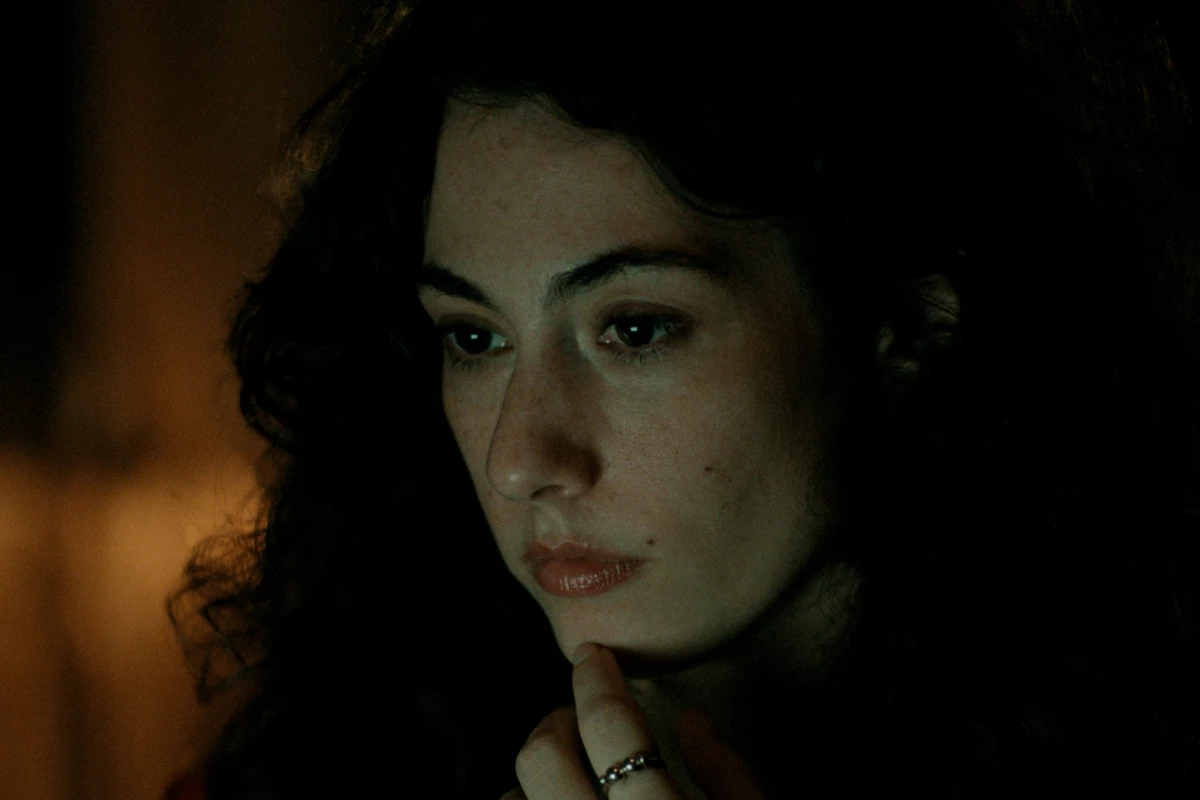
Blue Heron‘s most impressive quality is its ability to build trust with the viewer while telling a story through the lens of a famously unreliable narrator: memory. Romvari has been lauded in the festival circuit in recent years for her short films, namely her affecting 2020 personal documentary, Still Processing, about going through family photos and home videos after the deaths of two of her brothers. Her interest in playing with analogue, archival techniques continues throughout the semi-autobiographical Blue Heron, whether it’s using hand-drawn sketches to roll out credits or peppering scenes with what appears to be the family’s home video footage and black and white film photos. In the film, Sasha’s father also spends a considerable amount of time in his own dark room. In a scene with his children, he compares the process of developing photos to going back in a time machine, a nod to the director’s use of art as a form of emotional access.
Blue Heron’s most impressive quality is its ability to build trust with the viewer while telling a story through the lens of a famously unreliable narrator: memory.
In the latter half of the film, Blue Heron takes us to the present, when Sasha, played by Amy Zimmer, is making a film that attempts to grapple with Jeremy and this period in her youth. Searching for answers, she revisits Jeremy’s case file and finds the social worker who was assigned to her family at the time. It’s clear in the film: Sasha is a version of Romvari herself, and in these scenes, as in an unscripted group conversation with social workers, Blue Heron drifts toward documentary. There’s a surety throughout that Romvari knows exactly what she wants to say with the film’s 90 minute run-time, unafraid to confront a difficult truth: What if someone told you how things were going to play out? What if nothing could be done? What if it’s nobody’s fault?
The gnawing fear that one’s best efforts might not always be enough is not lost on Sasha’s mother, who, in one scene, says she feels cursed. “Have you ever heard about a family like this? How come nobody has to give their children away? Just alcohol addicts or people beating their children. I don’t understand why.” It’s the lament of two undoubtedly loving and kind parents trying to grapple with why their son turned out the way he did. In the same conversation, Sasha’s father says that the two are exhausted from having tried seemingly every resource at their disposal to help Jeremy, but there are no good options left. The film observes the same efforts, as we see Sasha’s parents experiment with a mix of both gentle guidance and more forceful scolding in their interactions with him, desperate to see what will resonate. Ultimately, nothing really does.
Through scenes rendered as imagined reconstructions of the past, present-day Sasha inserts herself into earlier periods of her life. In one such reimagining, an older Sasha and younger Jeremy take a walk by the water. It’s one of the few moments in the film that carries with it a sense of peace, made possible only through Romvari’s and in turn, Sasha’s, willingness to surrender.
