


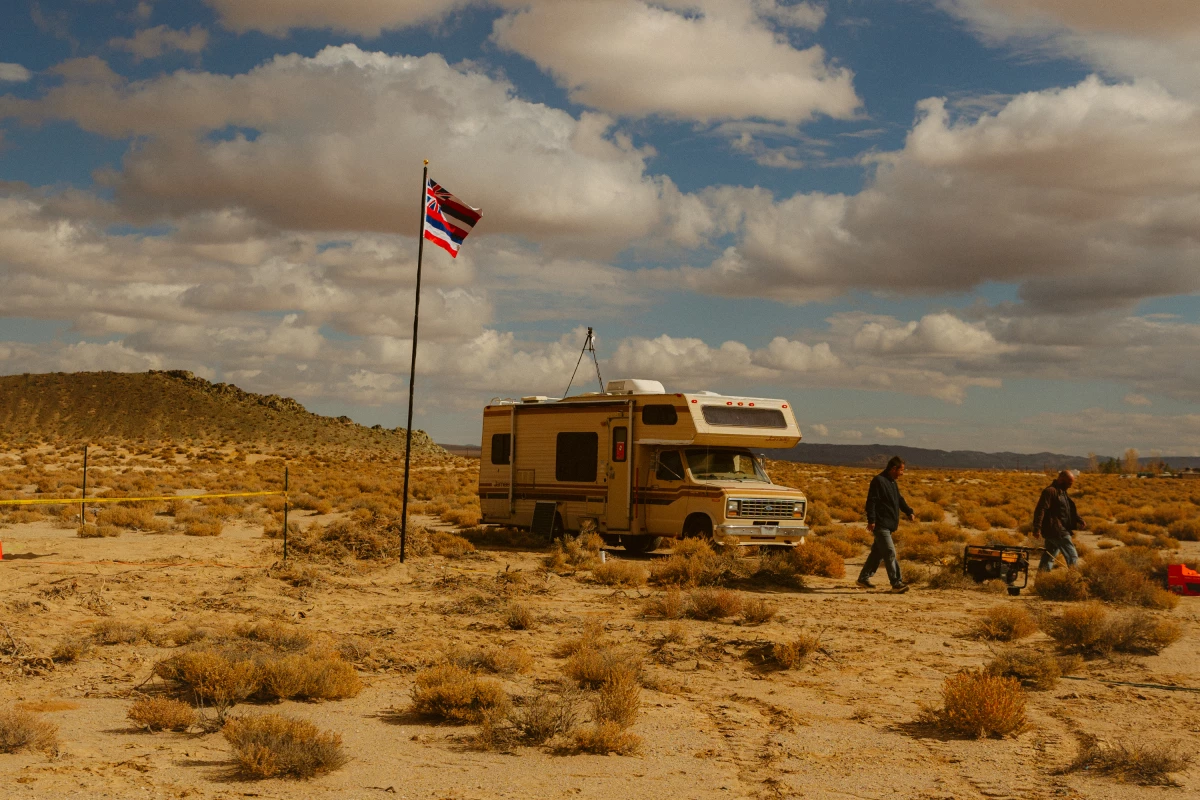
In a windy patch of desert outside Barstow, Calif., a 700-pound planetary rover named Helelani is churning its thick tires through a flour-like dust. Seven teams from around the world are taking turns steering this dune-buggy-like rover through the course. And as the rover weaves through a slalom course of cones, NASA technologist Rob Mueller explains that this silty dry lakebed is a pretty good analog for adventures on another planet.
“It’s an extreme environment. That’s why we’re here,” Mueller says. “It’s blowing dust. It gets hot in the day, cold at night. We even have dust devils, small tornadoes coming through once in a while. So it’s very Mars-like.”
Mueller is outfitted in a heavy tan work jacket and a NASA baseball cap, and though it’s bitterly cold and windy for us humans, he says the robots don’t mind. Even if they did, pushing them to their limits is the whole point.
“The unexpected happens out here – dust jamming into a mechanism is not going to happen in a lab,” he says. “We want to break the robots many times. Fix them, run them again. By the time they get to the moon and Mars, they’ll work.”


This rover race is part of a new festival Mueller dreamed up called RoboPalooza. It has some of the trappings of other desert festivals, like live rock bands, food trucks and portable toilets. The difference here is that this one is sponsored in part by the Institute of Electrical and Electronics Engineers – and it’s focused on building a future for humanity in space. So the star performers at this festival are not musicians, but space robots and the people who spend their lives building them.
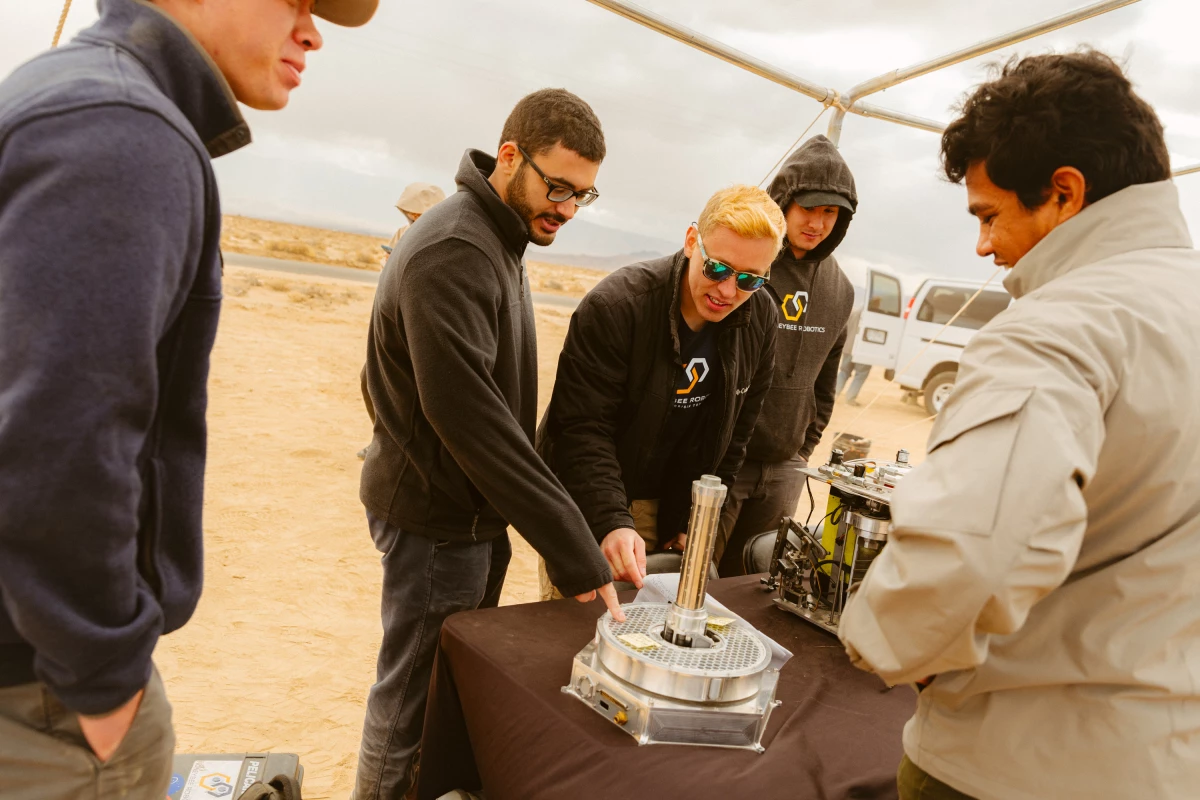
In the exhibit area, the company Astrolab is showing off its squishy all-metal tire, meant for roving on the moon. The company’s business development manager, Kelly Randell, explains that the tire is intended to conform to the moon’s surface, to hug the lunar dirt – and it’s missing the inflatable rubber part for a reason.
“There’s no AAA on the moon,” she says. “So if we pop a tire on our rover, we can’t just go fix it.”
Nearby, the University of Alabama Astrobotics team is demonstrating what a robot nicknamed “Turbo” can do. It’s about the size of a large dog with four metal wheels and built to dig moondust. As it lowers its digger head to the ground – essentially a conveyor belt of tiny buckets – it excavates a small hole and dumps a pile of powder behind the rover.
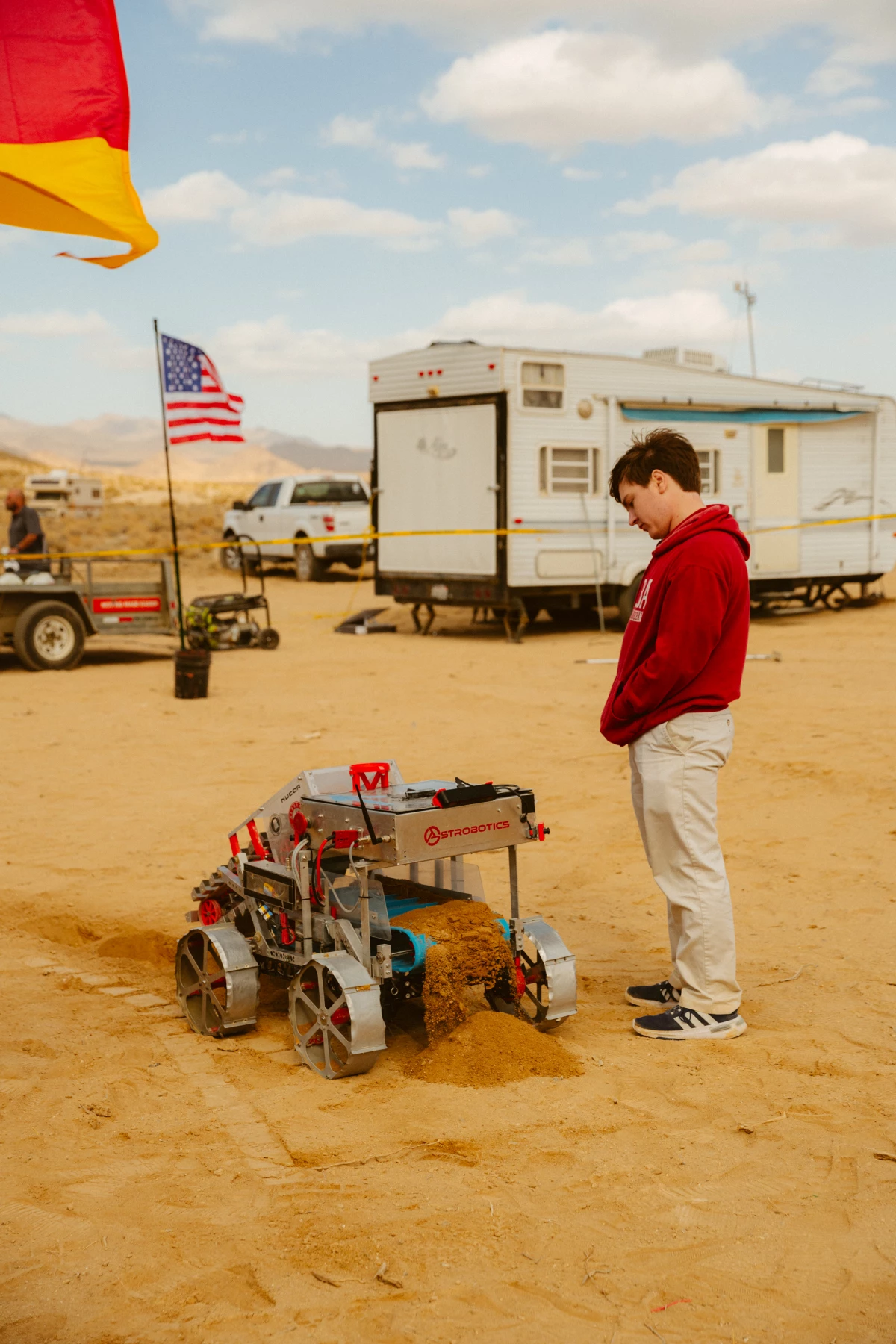
“Turbo was designed to collect a bunch of moon dirt and drive around and build a berm, which is basically just a big pile of dirt,” team member Randie Jo Evans said.
This, on a much larger scale, might someday be the way space agencies and private companies build structures for astronauts on the moon – and beyond.
“There’s massive radiation in space that will give you cancer,” Mueller says. “So we need shelter, we need radiation shielding.”
Mueller imagines that in the not-too-distant future, the moon will be a rest stop – a sort of gas station in space – as people travel from the Earth to Mars and the asteroid belt. Some people may just stop by the moon, but others, he says, will want to work and play there. “Imagine playing basketball on the moon,” he says.
But someone has to build the basketball courts, the roads and the housing. Mueller says that’s where the robots come in – swarms of them.
“The robots will build the infrastructure,” he says. “They are good at building infrastructure. They don’t complain. They work 24 hours a day.”
Robots can also be built to withstand the damaging radiation in space. The problem is, the space robots we have today are slow — incredibly slow. NASA’s Opportunity rover, which has traveled farther than any other rover on Mars, rolled about 28 miles over roughly 14 years. Average it out, and that’s a ground speed of about 2 miles per year.
Or, as Mueller puts it: “They literally drive at a snail’s pace.”
And if a snail were to race one of NASA’s science rovers, Mueller guesses the snail would win – because it doesn’t need to wait for instructions.
“The robot needs instructions from people. The crew in mission control sends instructions to the robot, and there’s a time delay on Mars…up to 40 minutes,” he added.
Long distances in space mean communication delays because information can’t travel faster than the speed of light. For teams controlling robots on Mars, that might mean sending a command one day, waiting for the rover to respond, and sending a new command the next day.

True, Rome wasn’t built in a day. But with construction delays like this, it would never have been built.
“You can’t do it at a snail’s pace,” Mueller says. “You have to move faster. But to move faster, you need a higher level of autonomy. And so that’s what we’re trying to do here in the desert, is test these robots.”
In an old trailer near the rover racecourse, a couple of students from Cal Poly Pomona are hunched over their laptops, sending commands to the Helelani rover. They can’t even see the racecourse from where they’re seated inside a trailer, relying solely on live video feeds from the rover to steer it through the dust. It’s slow work, and the rover travels in fits and starts. It takes a while for the team to figure out where to go next and to transmit a new command to the rover. The team’s halting progress demonstrates the types of delays that would hinder construction in space.
But there’s a certain magic to this race, too. Six other teams are running the rover through the same race, and they’re doing it from thousands of miles away, in places as far as Chile and Australia. After all, if we can control robots in space, why not try to control them from the other side of the planet? It’s the team from Western Australia that wins the competition, with a finishing time of 20 minutes 10 seconds.


They’re getting a $5,000 prize for their effort. But the lessons for the engineering community – and the insights about designing more autonomous machines – might be worth more.
“Giving the rover the opportunity to go off on a longer leash is scary,” says Brad Dixon, an engineer from the winning team. “But the more this becomes popular —when people are familiar with controls and hazards — those risks become smaller.”
As a local rock band blares on at the stage, half-drowned out by the desert wind and the hum of generators, Mueller leans back against an old RV – his home for the last few days – and gazes at the desert. Even as a space evangelist, he says he won’t be the first in line to make a home in space.
“I don’t really want to live on the moon,” he says. “I love this blue planet, this pale blue dot. It’s just so beautiful.” But he says humanity’s motivations are different.
“It’s our human spirit to be explorers,” Mueller says. “We don’t know why we’re going or what will happen. That’s why we go. If we did know, we wouldn’t have to go.”

Transcript:
AILSA CHANG, HOST:
People love going to festivals in the desert, right? Like, think Burning Man or Coachella. But, you know, there is one desert festival that not many people know about, tucked away in a windy spot near Barstow, California.
(SOUNDBITE OF ARCHIVED RECORDING)
UNIDENTIFIED MUSICAL GROUP: (Singing) Lay down, Sally…
ROB MUELLER: Thanks for coming. Welcome. Welcome to the Mojave Desert.
CHANG: (Laughter).
It’s got all the trappings of any old desert fest. You got the live bands, the food trucks, the dusty people. But the stars of this show are not the humans.
Ooh. Come here. Come here. Come here. Oh, my God. You’re so cute. OK, sit. Sit. No, that’s down. Come on. Come on.
I mean, they’re not dogs, either – at least not furry dogs. The main performers here are robots. That’s why they call this RoboPalooza. And this doggy robot is named Go1.
Oh, my God, he’s wiggling his butt. That’s amazing (laughter).
And Go1 even has his own robot human named Hector.
Is he trying to hug me right now?
UNIDENTIFIED PERSON #1: Yeah, we can…
CHANG: Hi, Hector. We’re embracing.
RoboPalooza isn’t just some rock concert with some robots sprinkled in. This whole thing is actually about the future of space. It’s sponsored by the Institute of Electrical and Electronics Engineers. And this festival is exploring how humans and robots can work together, with one of the goals being settling the moon and Mars one day with robots like Turbo, who’s learning how to dig moon dust here.
UNIDENTIFIED PERSON #2: As you can see, the belt spins up.
CHANG: He can bury the – oh.
UNIDENTIFIED PERSON #2: Yep.
CHANG: The belt is going – dig, dig, dig, dig, dig.
Students at the University of Alabama designed Turbo to one day be able to extract resources on the moon. And somehow, they actually trusted me to drive him.
Will it go forward? Let’s try up. Uh-oh. Oh, no…
UNIDENTIFIED PERSON #2: Oh, there we go.
CHANG: Oh, good. I thought I broke…
UNIDENTIFIED PERSON #2: It might have got a little stuck.
CHANG: …Turbo for a second…
UNIDENTIFIED PERSON #2: Oh, no.
CHANG: …There (laughter).
UNIDENTIFIED PERSON #2: He’s very strong.
CHANG: But breaking Turbo and other bots like him – well, that’s the whole point of this festival. You see, RoboPalooza is one massive stress test for these machines. That’s why the festival’s mastermind, NASA technologist Rob Mueller, picked this very location.
MUELLER: It’s an extreme environment. That’s why we’re here. There’s blowing dust. It gets hot in the day, cold at night. Today’s cold.
CHANG: So if a robot can survive this, it can definitely survive Mars.
MUELLER: We want to break the robots.
CHANG: (Laughter).
MUELLER: Many times.
CHANG: What I don’t understand is hasn’t humanity, including NASA, gotten a good amount of experience driving rovers on Mars in recent decades? Like, what more is there to learn? Explain that to people.
MUELLER: The rovers that have driven on Mars are science rovers. They’re very good at what they do. They’re very expensive. They have a lot of instruments on them, and they drive very, very slowly. They literally drive at a snail’s pace.
CHANG: Literally?
MUELLER: Literally. You can’t do it at a snail’s pace. You have to move faster. But to move faster, you need a higher level of autonomy. And so that’s why we’re here. It’s basically to learn and to build better robots.
CHANG: And what they’re doing today is a competition between the humans who operate these robots. They’re holding a rover race. Rob shows me the race course.
MUELLER: We’re at the starting line. We have two…
CHANG: This fluorescent…
MUELLER: …Traffic cones.
CHANG: …Green line right here…
MUELLER: Yes.
CHANG: …Is the starting line? OK.
MUELLER: Yes.
CHANG: Yeah.
MUELLER: So imagine you’re at the top of a mountain on a ski race, and you’re just going through the starting line.
CHANG: And then seven teams slalom a 700-pound dune buggy of a rover named Helelani through a sandy, hilly race course, with all these cones marking the route to the finish line.
MUELLER: You have to drive around the cone without hitting it.
CHANG: This is like a dog agility competition.
MUELLER: Something like that.
CHANG: (Laughter).
Now, some of the teams competing today are physically located thousands of miles away – in Virginia, Chile, Australia – and they are relying solely on the rover’s on-board cameras to steer the machine through the course.
Did it just spin around?
MUELLER: It just spun, which means they issued a command.
CHANG: Oh, it’s rolling.
(SOUNDBITE OF ROBOT WHIRRING)
CHANG: There is one local team here from Cal Poly Pomona, and Rob takes us over to their mission control.
MUELLER: It’s a mobile command trailer.
CHANG: Wait, mission control is this RV?
MUELLER: Yes, it’s just a trailer. And we have everything set up – an antenna and all the computers – about four of these going on at once.
CHANG: So this is like your Houston. Houston, Houston – this is…
MUELLER: Yes.
CHANG: All right. Let’s go in (laughter).
And inside, Cal Poly team members are hunched over their laptops, steering Helelani by watching video feeds transmitting from her.
UNIDENTIFIED PERSON #3: Turn left 20 degrees. Move forward 20. So around and 14 on our left. And we’re headed straight for the finish line.
CHANG: This whole race happening here today – it’s just a tiny step towards humanity’s future in space. At least that’s how Rob sees it.
MUELLER: It’s not just the moon. It’s the whole solar system.
CHANG: OK.
MUELLER: There’s huge abundance in our solar system of resources – energy, water ice – which is hydrogen and oxygen – metals, minerals. If we want to evolve as a species, we have to harness the energy and the resources in our solar system.
CHANG: Tell me what you would like to see or what you do see happening on the moon one day, a century from now.
MUELLER: The moon will be a staging point for transportation into the solar system. Think of it as a gas station. You go to the moon, and you refuel your rocket, and then you go on to the asteroid belt. You go on to Mars.
CHANG: So you see humans one day bopping around space and using the moon as a rest stop.
MUELLER: That will be part of it, but it will be a very interesting place. And some people will want to live there. Some people will want to work there. And some people will want to play there. Imagine playing basketball on the moon.
CHANG: So in order to get to this idea – this reality of the moon becoming a place where people can rest, work, play, live, where do robots enter the picture? Why are robots necessary to make that vision a reality?
MUELLER: If you went to paradise in the South Pacific and there was no hotel waiting for you, and there was no resort and no entertainment, you wouldn’t want to go to…
CHANG: I’d be like, it’s hot…
MUELLER: Yes.
CHANG: …And there are a lot of mosquitoes.
MUELLER: Exactly. And…
CHANG: So you need infrastructure.
MUELLER: We need infrastructure.
CHANG: And to build that infrastructure, I’m imagining you need the robots.
MUELLER: The robots will build the infrastructure. They are good at building infrastructure. They don’t complain. They work 24 hours a day. They…
CHANG: You don’t need to feed them. Well, I guess…
MUELLER: You don’t need to feed them.
CHANG: …You might need some battery.
MUELLER: You do need power.
CHANG: (Laughter).
MUELLER: There’s a lot of power in space from solar power from our sun, and we also can generate nuclear power.
CHANG: But the robots are going to be the construction crew.
MUELLER: Exactly. And it will be many robots, swarms of robots, hundreds of robots.
CHANG: Why is it important to you and to so many of these other scientists, these other people involved in this effort, to one day colonize parts of space?
MUELLER: It’s our human spirit to be explorers. We’re always looking for the next frontier. And we don’t know why we’re going or what will happen. That’s why we go. We don’t know what will happen, so we have to go. And it will be completely unpredictable and unexpected. And we will have things that make money and give you a thriving prosperity that we can’t even imagine yet. That’s why we go. If we did know, we wouldn’t have to go.
CHANG: It’s the urge to explore…
MUELLER: Yes.
CHANG: …What’s unknown. That’s what’s driving you and your work.
MUELLER: I think that’s what’s driving humanity.
CHANG: And if Rob is right, it’s the robots who will lead the way.
(SOUNDBITE OF MUSIC)
