


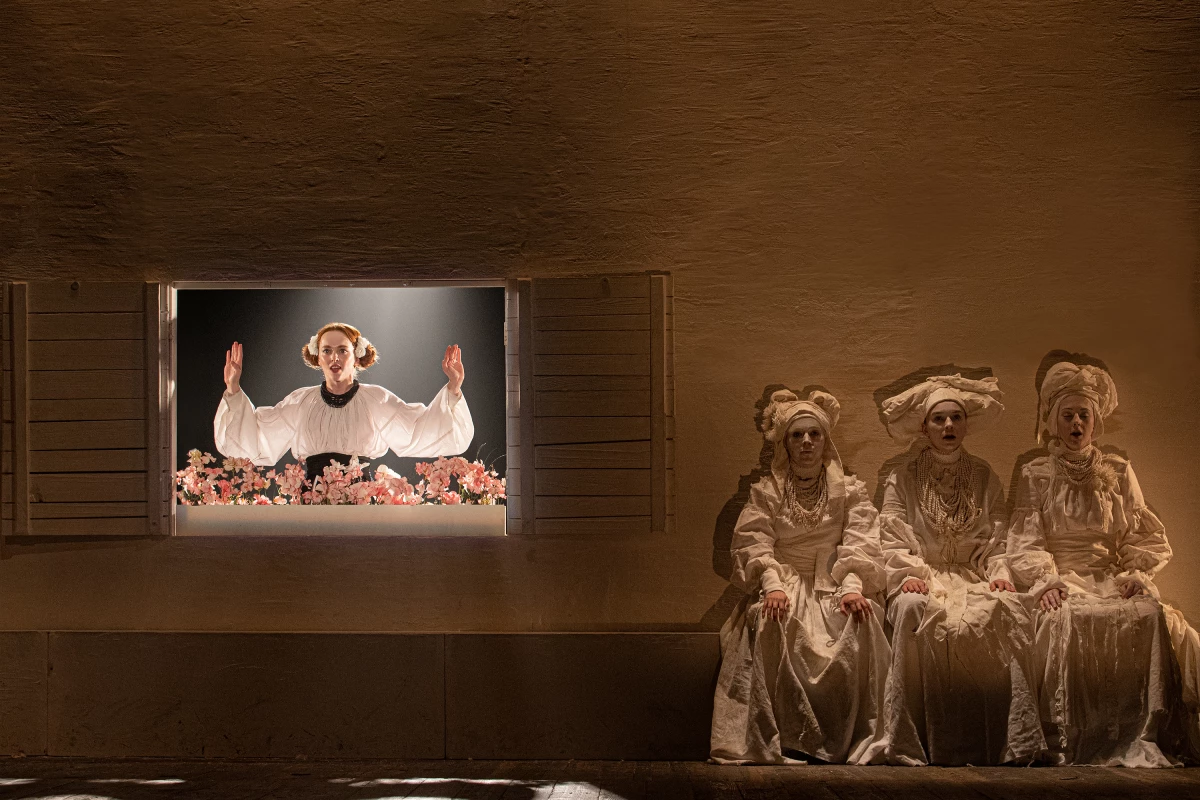
KYIV, Ukraine — Witches are having a moment in Ukraine. Both feared and revered, these beings are thought to possess supernatural powers that can be used for good and bad. Over the centuries, witches have been blamed for all kinds of things happening to Ukrainians: droughts, floods, diseases — even falling in love and starting wars.
Now they have taken center stage in a dark musical comedy titled The Witch of Konotop, with performances selling out all summer at the historic Ivan Franko Theater in the capital Kyiv.
Folklore brought to life
Based on the 1833 satirical fiction by Ukrainian writer Hryhorii Kvitka-Osnovianenko, the story pokes fun at Ukrainian literature’s tendency to focus on sadness and tragedy. It takes place in the 1600s and follows the main character, Zabryokha, a Cossack military leader, in his unsuccessful journey to do away with witches whom he blames for his misfortunes.
Throughout the fast-paced, witty hour-and-a-half production, the audience is treated to beautifully detailed Ukrainian folk costumes and stunning vocals set to traditional Ukrainian music.

There is rejection, there is love.
And there is, of course, a witch hunt.
Additionally, in a twist that echoes today, the main characters receive orders to join a campaign to fend off an overreaching czarist Russia.
One play, many takeaways
Life under a sinister Russian threat might be the most obvious theme from this play. Yet, a quick survey of the cast and audience at a recent performance reveals the production’s true flexibility.
“Don’t kill women, don’t mess with women,” says actress Kateryna Artemenko, who plays one of the townswomen mistaken for a witch. She spoke to NPR backstage before the show.
“No, it is not a joke, of course,” Artemenko says. “The main message is about people trying to fool their destiny, but destiny will find them.”
Actor Nazar Zadniprovskyi, who plays the ill-fated Cossack commander Zabryokha, views this play as a lesson in avoiding responsibility. The two lead characters avoid going to military drills so they don’t have to go to war, he says, and many people see a parallel with Ukrainian men dodging conscription today.
Zadniprovskyi also attributes the play’s popularity to the clips that have gone viral on social media. There, Ukrainians from all walks of life weigh in.
Audience member Markian Halabala of Kyiv says seeing buzz about the play online is what first piqued his interest. He says it was difficult to get tickets because the play sells out so quickly. When he finally saw it, he felt the message was that you shouldn’t interfere in God’s will — like Zabryokha does in the play when he asks a witch to cast a spell on a woman to make her fall in love with him, even though she loves someone else. Halabala likens it to Russian President Vladimir Putin trying to interfere in Ukraine’s path forward as an independent nation.
However, theatergoer Olha Vasylevshka of Kharkiv says she thinks the play is about love.
“Of course if the love is true, it doesn’t need any outside assistance,” she says, laughing. “But if the love is not true, nothing can help it, not even a witch.”
Sold-out shows
Critics say audiences’ many interpretations of The Witch of Konotop are just one reason it’s been so popular.
Ivan Franko Theater press liaison Olena Kyrychenko-Povolocka told NPR the production has filled their nearly 800-seat house for every performance this summer and she expects to continue that success. The play has dates on its website through mid-September.
Another reason for the play’s popularity may be its ties to not only Ukrainian folklore, but also to Ukraine’s real-life town of Konotop known for witches.
Near the beginning of Russia’s full-scale invasion in 2022, a video surfaced online of a woman shouting at a Russian soldier sitting atop a tank.
“Do you even know where you are?” the woman shouts in a raspy voice. “You’re in Konotop — every second woman here is a witch.”
She goes on to warn the soldier he will never get an erection again.
The video went viral in Ukraine, not just because of the woman’s defiance, but also because the video was from Konotop and Ukrainians immediately got the reference.

There’s been an overall push to celebrate Ukrainian culture and literature since Russia’s invasion. Putin has repeatedly said victory means nothing short of Ukraine not just losing its sovereignty — but also its identity.
Ukrainians’ renewed interest in their own culture has driven them back to theaters. Almost all functioning theaters in the country have returned to selling tickets to full houses, according to Olha Baibak with the National Union of Theater Workers of Ukraine.
“There is a growing interest in the theater throughout the country,” Baibak wrote in an email to NPR. “New audiences have come, people go for communication, for therapy, to live some kind of experience.”
She says they also come to get away from reality.
Performing also offers actors an escape.
Actor Mykhailo Kukuyuk, who plays the character Pistryak, the main character’s cunning assistant, says it’s sometimes difficult to block out the challenges and horrors of war happening outside the theater. But performing is an honor that reminds him what he believes Ukrainians are fighting for.
“For theater, for good-looking, beautiful women. It’s the details, the sparks that make us alive — it’s hard to put into one sentence,” he says.
Polina Lytvynova contributed to this report from Kyiv.
Transcript:
A MARTÍNEZ, HOST:
A play about witches is a sensation in Ukraine’s capital, Kyiv. It’s selling out every performance at the historic Ivan Franko Theater. Here’s NPR’s Ashley Westerman.
ASHLEY WESTERMAN, BYLINE: In the early days of Russia’s full-scale invasion of Ukraine, a video surfaced online – a woman shouting at a Russian soldier sitting atop a tank.
(SOUNDBITE OF ARCHIVED RECORDING)
UNIDENTIFIED PERSON #1: (Speaking Russian).
WESTERMAN: “Do you even know where you are? You’re in Konotop,” shouted the woman off-screen. “Every second woman here is a witch.”
She goes on to say the soldier will be cursed with impotence.
(SOUNDBITE OF ARCHIVED RECORDING)
UNIDENTIFIED PERSON #2: (Laughter).
WESTERMAN: The video went viral in Ukraine, not just because of the woman’s defiance, but also because Konotop, a city in the country’s far northeast, is a place associated with witches.
KHRYSTYNA FEDORAK: (Speaking Ukrainian).
WESTERMAN: “Witches are a part of Ukrainian culture and Ukrainian tradition,” says Khrystyna Fedorak, so you can rely on something having to do with witches going viral. This is one of the reasons the play Fedorak is currently starring in at the Ivan Franko Theater in the capital, Kyiv, has become a summer blockbuster. Fedorak plays the witch in the dark musical comedy “The Witch Of Konotop.”
(SOUNDBITE OF ARCHIVED RECORDING)
UNIDENTIFIED ACTORS: (As characters, singing in Ukrainian).
WESTERMAN: Based on the 1833 satirical fiction by Ukrainian writer Hryhorii Kvitka-Osnovianenko, this story leans hard on the stereotype that Ukrainian literature is full of sadness and tragedy. Taking place in the 1600s, the audience follows the main character, Zabryokha, a Cossack military leader in Konotop, pursuing the lovely Olena, but she rejects his proposal. She loves someone else. In this scene, Pistryak, Zabryokha’s cunning assistant, tries to confuse Olena’s love interest by accusing him of crimes he didn’t commit.
(SOUNDBITE OF ARCHIVED RECORDING)
MYKHAILO KUKUYUK: (As Pistryak, speaking Ukrainian).
WESTERMAN: Fighting, swearing, beating up other people and drinking – all reasons, Pistryak says, the guy should get lost. Then, in a twist of events that sounds a lot like today, Zabryokha receives an order to join a military campaign to help the Cossacks fend off an overreaching Tsarist Russia.
(SOUNDBITE OF ARCHIVED RECORDING)
KUKUYUK: (As Pistryak, speaking Ukrainian).
WESTERMAN: “They order us,” Pistryak says, “to take our Cossacks in Konotop to join the main army. There may be drills, or there may be war.”
But Zabryokha refuses to go, saying he needs to stay in Konotop to root out the witch problem – the root, he says, of everyone’s problems. What ensues is a string of ridiculous, funny and very human moments. Spells are cast, couples are wed and, of course, there’s a witch hunt, meaning a swim test. If you’re not a witch, you drown. If you are a witch, you don’t.
(SOUNDBITE OF ARCHIVED RECORDING)
UNIDENTIFIED ACTOR: (As character, cackling).
WESTERMAN: All with a larger threat looming over everything – Russia. But while that might be the most obvious takeaway from “The Witch Of Konotop,” the cast has some of their own ideas.
KATERYNA ARTEMENKO: Don’t kill women (laughter). Don’t mess with women.
WESTERMAN: Before a recent performance, actress Kateryna Artemenko sits in a tiny dressing room deep in the heart of the Ivan Franko Theater. She’s getting ready with the other actresses. They’re putting on makeup, having their hair braided and curled and putting on their costumes. Artemenko plays one of the townswomen mistaken for a witch.
ARTEMENKO: No, it’s not a joke, of course. I just – the main message is about people who – they’re trying to fool their destiny, but destiny will find them.
WESTERMAN: Nazar Zadniprovskiy, who plays the ill-fated Cossack commander, views this play as a lesson in avoiding responsibility.
NAZAR ZADNIPROVSKIY: (Speaking Ukrainian).
WESTERMAN: “The two leading characters are avoiders,” he says. “They avoid going to drills so they don’t have to go to war.”
Zadniprovskyi says many people see a parallel with Ukrainian men dodging conscription today.
(APPLAUSE)
WESTERMAN: As the play ends and the theater’s mustard-yellow felt curtain drops to a thunderous applause, producer Polina Lytvynova and I ask a few audience members what parallels they drew. Olha Vasylevska is from Kharkiv, the northeastern Ukrainian city currently fending off an intense Russian offensive. She thinks the play is about love.
OLHA VASYLEVSKA: (Through interpreter) If the love is true, it doesn’t need any outside assistance (laughter), and – but if the love is not true, nobody and nothing can help it, even the witch.
WESTERMAN: Markian Halabala, from Kyiv, says the message he took away is that you shouldn’t interfere in God’s will.
MARKIAN HALABALA: (Through interpreter) This is like Putin. He interfered in natural Ukraine’s way of independence. And Russians, they try to stop and prevent, like, natural way of Ukrainian history with this war.
WESTERMAN: Critics say the many takeaways “The Witch Of Konotop” offers its audiences is one reason it’s been so popular – the Ivan Franko Theater says the production has been sold out all summer, and they expect to continue that success. But another reason is the overall push to celebrate Ukrainian culture and literature – Putin has repeatedly said victory, to him, means nothing short of Ukraine losing not just their sovereignty, but also their identity.
KUKUYUK: As Churchill said, why we are fighting?
WESTERMAN: Mykhailo Kukuyuk plays Pistryak.
KUKUYUK: For theater, for good-looking, beautiful women – it’s the details, the sparks, that make us alive. (Speaking Ukrainian).
WESTERMAN: “It’s very hard to put into one sentence,” he says in Ukrainian.
And while it’s sometimes difficult to block out the events happening outside of this theater, Kukuyuk says it’s an honor to perform for his country.
Ashley Westerman, NPR News, Kyiv.
(SOUNDBITE OF ARCHIVED RECORDING)
UNIDENTIFIED ACTORS: (As characters, singing in Ukrainian).
