


A Chinese scholar who studies the United States has some opinions about the early moves of the second Trump administration.
Da Wei spoke with NPR last year. He told us then that his decades of studying China’s rival gave him some idea of what made America strong, including a “mature political system,” stable institutions and immigration, among other things.
Now the U.S. has a new president, so we asked to meet Da Wei again to hear what he’s thinking now.
Da, who’s a professor at Tsinghua University in Beijing, lives in a country where expression is limited, especially on sensitive topics. But American specialists in China have found him a useful interlocutor, offering a window into the thinking inside the United States’ great geopolitical rival.
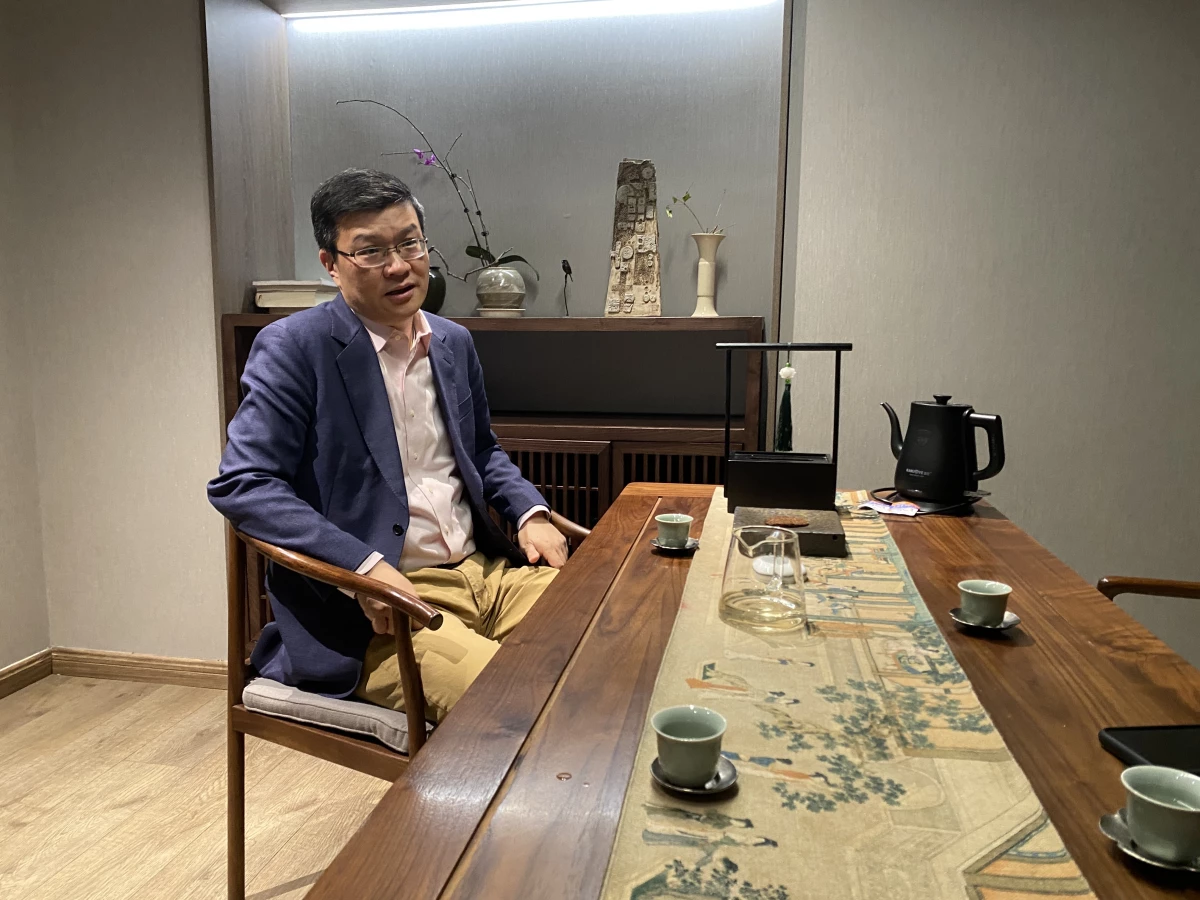
He met us in a Beijing tea shop. We drank Dragonwell tea, which is said to be freshest at this time of year–and several points emerged. Here’s what he had to say about shifting U.S. foreign policy approaches and how changes may benefit China.
He says he’s witnessing “something big”
Da has followed the Trump administration’s firing of many U.S. federal workers and dismantling of some agencies. As a past visitor to Washington, he knows people who have been fired.
“Having said that,” he added, “I don’t want to be too critical to the Trump administration just from this personal level. As a scholar I try to be neutral. I think there is something big happening in the U.S. It could be bad. It could be good.”
He says modern forms of government rose with the Industrial Revolution. Now technology is changing, and the government may change too.
He says some American friends compare it to China’s Cultural Revolution
The Chinese scholar mostly dismisses the comparison, but not entirely. From 1966 to 1976, Chinese Communist leader Mao Tse-tung led an assault on suspected capitalist sympathizers–closing universities, sending professors and intellectuals to work in the fields, purging government workers, and encouraging his supporters to harass or attack their elders. It was “the most chaotic period of modern China,” the professor says.
“What is happening in the US is still far from the Cultural Revolution. It’s maybe one or two percent. But you can sense that smell. The populist sentiments … [that] common sense is good, [and] sophisticated thoughts are something bad.”
He learned English listening to Voice of America
“It was so sad,” he said, when news spread that the administration planned to shutter VOA, the U.S.-funded broadcaster that delivers news and cultural programming in countries where access to news is limited or isn’t available. He said he learned some of his English in college while listening to VOA broadcasts–and also learned news that wasn’t reported on Chinese media.
Da Wei acknowledges that in recent years, VOA was less important as the internet spread. But he says another agency mattered more: the U.S. Agency for International Development.
The “majority view” in China sees some of Trump’s moves as an “own goal”
He asserts that most Chinese he talks with viewed USAID, the foreign aid agency, as one of America’s strengths, improving its image and influence in the developing world. Virtually eliminating the agency was “in China’s interest.”
With that said, China itself does not distribute foreign aid in the way that USAID did, and analysts do not expect it to start doing so.
He sees U.S. alliances as a strength
“The alliances of the U.S. we believe [are] an important source, probably one of the most important sources of the U.S. strength,” he said.
He spoke of Europe’s widespread feeling that they have lost American protection, and also spoke of events in South Korea and Japan.
China has long tried to improve its relations with the U.S. allies near its borders. The Chinese scholar said his country might soon be able to do that “with smaller resistance.”
The radio version of this story was edited by Reena Advani and produced by Milton Guevara.
Transcript:
STEVE INSKEEP, BYLINE: In China last year, we met a Chinese scholar who studies the United States. Da Wei developed some ideas of why America has succeeded as a country.
(SOUNDBITE OF ARCHIVED NPR BROADCAST)
DA WEI: Obviously, U.S. have a quite mature political system, which run for more than 200 years.
INSKEEP: The Chinese scholar said the U.S. gained from a stable political system, strong regulations, lots of immigrants. Since we spoke last year, a new U.S. administration has taken office. So we met Da Wei again this week, and it was a chance to see how America looks to an outsider. He said to meet us at a teahouse.
Good to see you again.
DA: Yeah, good to see you.
INSKEEP: Thank you for coming.
DA: Thank you for coming over.
INSKEEP: Thank you.
He rushed in wearing a blue blazer, dressed to teach a class that day at Tsinghua University.
What kind of tea did we order?
DA: Green tea, the…
INSKEEP: Oh.
DA: …Dragon Well, so…
INSKEEP: OK.
Dragon Well tea, which is best when harvested before April 5.
DA: Anyway, the tea after that – after April 5 – will be less expensive.
INSKEEP: So this is prime tea season.
DA: Yeah, yeah, exactly.
INSKEEP: The server poured into tiny cups.
(SOUNDBITE OF TEA POURING)
INSKEEP: I just want to say this looks like just hot water almost.
DA: Yeah, yeah, yeah.
INSKEEP: But there’s so much flavor to it.
DA: Yeah. So if you make it at home, you put the tea leaves in this kind of glass. You can see the tea leaves, you know…
INSKEEP: Yeah, they float up.
DA: …Yeah – flow up and down. So it’s beautiful. It’s kind of philosophical, I will say. You can try to read the tea leaves (laughter).
INSKEEP: He tried to read the tea leaves about the United States. He’s followed the Trump administration’s firing of federal workers and dismantling of some agencies. He’s traveled often to Washington and knows many people there.
DA: I live in the think tank world and also government world. Some of them left their office or lost their job.
INSKEEP: Oh, you know people who’ve been fired…
DA: Yeah, yeah. Sure, sure, sure.
INSKEEP: …In the United States.
DA: Yeah, yeah.
INSKEEP: OK.
DA: And from this personal level, I feel sad or bad about what is happening in the United States. Having said that, I don’t want to be too critic to Trump administration just from this personal level. As a scholar, I try to be neutral. I think there’s something big happening in the U.S. It could be bad. It could be good.
INSKEEP: He says modern forms of government rose with the Industrial Revolution. Now technology is changing, and government may change, too. This is what he thinks about when watching a billionaire tech bro promising to move fast and break things, alongside a president who seems to make hourly pronouncements on social media.
DA: So I will say this is very revolutionary.
INSKEEP: Da Wei says some of his American friends compare this to a different revolution – China’s Cultural Revolution in the 1960s and ’70s.
DA: Cultural Revolution is basically the most chaotic period of modern China history.
INSKEEP: China’s leader, Mao Zedong, encouraged supporters to root out elites and intellectuals suspected of being a kind of deep state. Radical groups harassed or attacked people at businesses and universities.
DA: That’s organized and mobilized by Chairman Mao his self and also his political allies.
INSKEEP: I just want to say this out loud. There’s a charismatic leader…
DA: Yeah.
INSKEEP: …Who, for his own purposes…
DA: Yeah.
INSKEEP: …Gets ordinary people to get out there and attack the intellectuals and the elites…
DA: And smash the establishment.
INSKEEP: …And the universities…
DA: Yeah, government officials.
INSKEEP: …And supposed closet capitalists in this communist…
DA: Yeah, yeah, yeah.
INSKEEP: …Society and – yes (ph).
DA: But I have to say what is happening in the U.S. is still far from the Cultural Revolution. It’s maybe 1- or 2% of the – but you can sense that smell. The populist sentiments – you know, basically, everything the people have correct. Common sense is good. So those sophisticated thoughts are something bad.
INSKEEP: In the Cultural Revolution, universities were shut down, the professors sent to work in the fields, and business owners were forced to surrender their homes. Da Wei says he doesn’t want to take this analogy too far.
DA: I’m still confident to some institutions and the laws – rule of law of the U.S. So I don’t think the situation could become so bad, but a chaotic populist political movement – I think, yeah, it’s alike.
INSKEEP: And Da Wei says Trump’s movement has devastated parts of the U.S. government that gave the U.S. an advantage in its competition with his country, China. The administration moved to shut down Voice of America and other broadcasters like Radio Free Asia.
DA: So the first reaction was, oh, it’s so sad because when we were in college, we learn English through Voice of America. Voice of America have a special English program. It spoke very slowly.
INSKEEP: They were famous for this, yes.
DA: Yeah, yeah, yeah. So we learn English through that. I still remember, you know, when I was a freshman in college for the first time, I listened to the Voice of America special English.
INSKEEP: He says he heard news that Chinese media didn’t cover. Da Wei acknowledges that in recent years, VOA was less important as the internet spread, but he says another agency mattered more – the foreign aid agency USAID, which spread American influence in the developing world.
DA: I think it’s important. And also, it’s part of so-called competition between China and the U.S.
INSKEEP: I’m thinking of a soccer term – own goal…
DA: Yeah.
INSKEEP: …Where you score…
DA: Yeah.
INSKEEP: …For the other team accidentally.
DA: Yeah.
INSKEEP: Are foreign policy specialists here looking at the Trump administration moves as an own goal?
DA: Yeah, you can say that. You can say that. To be honest, I think the majority view here is this is in China’s interest.
INSKEEP: He says it would also be in China’s interest for the U.S. to lose its alliances with European nations, or South Korea or Japan.
DA: The alliances of the U.S. is – we believe also it’s a important source – one of the most important sources of the U.S. strength.
INSKEEP: I noticed a news item in the South China Morning Post…
DA: OK.
INSKEEP: …A famous newspaper out of Hong Kong. And they noted that the Chinese government – the foreign minister, in recent days, had a meeting with officials from Japan and South Korea, longtime…
DA: Yeah.
INSKEEP: …U.S. allies, and said, in this time of chaos, you U.S. allies need to be closer with us, China.
DA: Yeah. Yes. I think – I don’t want to give our listener an impression that China tried to, you know, drag away U.S. allies. For China, it’s a long time ago to have good relations with Japan or Korea. These two countries are our neighbors and also very, you know, important economies.
INSKEEP: China would want that, regardless.
DA: Of course. You can say China is utilizing this opportunity. You can also say China just doing – China has done in past two decades, but now with smaller resistance. This is what is happening here.
INSKEEP: Da Wei, the Chinese scholar, finished his tea and hurried off to teach his class. He’d offered a view of the news from the United States as it looks from a Beijing teahouse.
