


LAGOS, Nigeria — Sudan’s largest refugee camp — which hosts at least half a million people, thousands of whom are suffering from famine — has been attacked by artillery shelling almost daily for two weeks. More than 80 people have been killed and close to 400 injured in the Zamzam camp in Sudan’s besieged western region of Darfur, according to local media.
Displaced people residing in the camp and aid groups including Doctors Without Borders (MSF) have blamed the constant shelling on the Rapid Support Forces or RSF, the Sudanese paramilitary group locked in a brutal civil war with Sudan’s army since April 2023.
The siege has sparked a new humanitarian catastrophe, with the attacks preventing already very limited quantities of aid into Zamzam, and leaving its few medical facilities overwhelmed. It marks an alarming turning point in a region overrun by violence and atrocities against civilians, with mounting evidence from local and international human rights groups of ethnic cleansing committed by the RSF in Darfur.
Although it is overshadowed by wars in the Middle East and Ukraine, Sudan’s 20-month conflict has killed as many as 150,000 people, according to some estimates. It has led to the world’s worst displacement crisis, affecting 1 in 5 of the country’s prewar population. The U.S. is among those accusing the RSF of ethnic cleansing, and also accuses Sudan’s military of war crimes. In a statement last December, Secretary of State Antony Blinken said: “Since the outbreak of fighting on April 15, the Sudanese Armed Forces (SAF) and the Rapid Support Forces (RSF) have unleashed horrific violence, death, and destruction across Sudan. Civilians have borne the brunt of this needless conflict.”
Sudan is meanwhile facing unprecedented levels of hunger, with the United Nations saying 26 million people are at “crisis levels.” The Zamzam camp is the only place in the world where famine has been officially declared.
On Friday, U.N. Secretary-General António Guterres called for an “immediate ceasefire” in Sudan. Peace talks have failed up to now. At a U.N. Security Council meeting on Thursday, Sudan’s representative accused the United Arab Emirates of backing the RSF, something the UAE has strongly denied.
Only 2 international aid groups are functioning in Zamzam
Before last year, 120,000 people resided in the Zamzam camp. Since then, its population has soared to at least 500,000, with potentially up to a million people, the aid group Relief International says. Most of those killed and injured in the camp have been victims of shelling, aid groups and experts investigating the attacks say. Doctors have treated children as young as four years old for gunshot wounds and trauma.
“Patients and medical staff are leaving the camp and trying to run for their lives,” MSF said in a statement earlier this month. “Not only have people been starving, but they are also now being bombarded.”
MSF and Relief International are the only two international aid organizations still permanently based in the camp.
“We can’t manage complicated trauma cases that require surgery,” said Melanie Kempster, global health and nutrition director at Relief International. Several critical cases are going untreated, she said.
“We have to refer those cases to the only functional hospital in El Fasher,” a besieged city nine miles away, she said. “But doing so is really dangerous. Conflicting parties are holding positions close to the camp entrance and on the only exit road to that hospital.”
A Relief International driver was killed making the journey to the hospital earlier this year.
The RSF has denied attacking the humanitarian camp, which would constitute a war crime. But RSF proxies have justified engaging in conflict around Zamzam, insisting the fight is against armed groups operating alongside Sudan’s army.
In footage posted earlier this month by local Sudanese media, and verified by NPR, displaced people reacted in anguish after an attack on the camp which left cars and huts destroyed.
“This is not a military camp,” one person cried. “It’s not a camp for armed movements. This is the home of a displaced citizen. An innocent person’s blood.”
Current attacks have compounded Zamzam residents’ desperation
Zamzam camp was formed 20 years ago to shelter tens of thousands of people who’d been displaced during the genocide in Darfur, where largely Arab militias, backed by the Sudanese government, launched an offensive against rebel groups in the region. More than 200,000 people, mostly Darfuri civilians, were killed between 2003 and 2005, according to Human Rights Watch. The dominant militia group responsible for atrocities was the Janjaweed Arab militia, which later evolved to become the RSF.
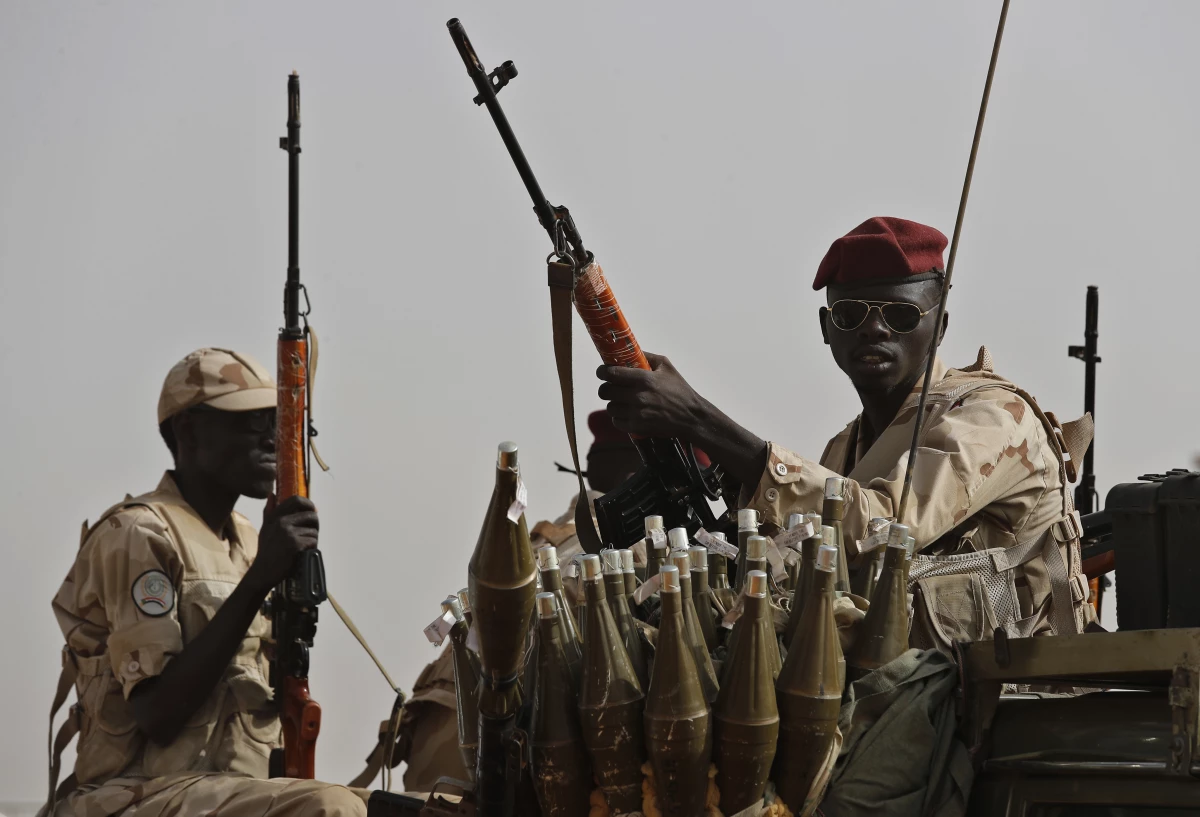
Since the war broke out last year, the RSF has swept through Darfur, controlling almost the entire region. It is accused of widespread atrocities, including sexual violence, against local ethnic groups, mirroring violence seen during the genocide.
Over decades, the site has evolved into a form of city, permanently hosting refugees from the Darfur genocide and people displaced from more recent violence. Tents and shelters have gradually been replaced by permanent structures, including homes, hospitals and schools.
But with the current war, the humanitarian situation in the camp has deteriorated, leading to the official confirmation of famine in August. Tens of thousands are suffering starvation and malnutrition, with children dying almost daily, according to aid groups. Many have been forced to eat peanut shells and animal fodder known as “abbaz,” largely made up of grass.
The shelling in recent weeks has compounded the desperation. Doctors working for MSF and Relief International spoke to NPR from the camp and El Fasher on condition of anonymity, fearing reprisals from the RSF. One doctor in Zamzam said the soaring injuries were overwhelming the little medical assistance they could provide.
“We lack basic equipment, even iodine,” he said.
Another doctor described the current situation as “a disaster.”
“I want the world to hear us, to get a fast response to us, to help us to get out from this crisis,” this doctor said.
People trying to escape the area around Zamzam are often trapped
Last week, the same doctor fled the shelling in Zamzam to El Fasher, the last major city in the Darfur region not under the control of the RSF. It is home to nearly 1 million people. The attacks on Zamzam are an extension of a prolonged siege on El Fasher, most of whose perimeter RSF fighters have blockaded for several months. The city’s sole functioning hospital has been repeatedly attacked, most recently by a drone strike blamed on the RSF, killing at least nine people.
The assault on the region has led thousands to flee both El Fasher and Zamzam, attempting perilous journeys on foot, risking being caught in the conflict to reach safer towns more than 40 miles away. But most are effectively trapped, as RSF forces are stationed on most major roads.
“It’s a ‘kill box,'” said Nathaniel Raymond, executive director of Yale University’s Humanitarian Research Lab, which has been monitoring the conflict. People from Zamzam have been forced to escape either south, toward RSF positions, he said, or into desert-like surroundings, where they risk starvation.
“We can see from space people camping under trees, on the side of the road,” he said, referring to satellite imagery analyzed by his group. “They’re going out of the frying pan and into the fire.”
Most of those fleeing are already suffering extreme physical challenges, he said.
“You have to visually think of what these people look like,” Raymond said. “They’re immunocompromised. The children, many of them have started to develop conditions where their bodies are starting to absorb their own muscle. You have a situation where even a skin infection can kill them.”
There’s new evidence of possible UAE support of the RSF
Evidence of the RSF’s assault continues to emerge, including the influence of foreign powers alleged to be fueling the war, including Russia, Iran and Saudi Arabia. A flow of arms into Sudan has continued despite a U.N. Security Council arms embargo on the country until September 2025.
But criticism has centered in particular over the alleged role of the UAE. In a report published last week by the Yale Humanitarian Research Lab, researchers found Zamzam camp and El Fasher were being shelled by artillery guns stationed 22 miles northeast of Zamzam. The exact weapon being used is an AH4 155 mm Howitzer, produced by a weapons manufacturer in China, the researchers said. According to U.S. Defense Department records reviewed by Yale HRL, the UAE is the only known country to have purchased this weapon.
“This is one of the most major clues to date of potential direct UAE support to the RSF,” Raymond said. “Nobody else other than China is known to have this.”
This week, White House Coordinator for the Middle East and North Africa Brett McGurk told U.S. Sen. Chris Van Hollen, a Maryland Democrat and member of the Senate foreign relations committee, that the UAE has informed the Biden administration that “it is not now transferring any weapons to the RSF and will not do so going forward.”
Transcript:
STEVE INSKEEP, HOST:
A paramilitary group in Sudan has been firing artillery shells into the country’s largest refugee camp. What? The group is fighting a civil war against Sudan’s army. OK, but now they are also blasting this refugee camp, where people were already starving. And the shelling has killed about 80 people, forcing others to flee. NPR’s Emmanuel Akinwotu has been following all of this. Welcome, sir.
EMMANUEL AKINWOTU, BYLINE: Good morning.
INSKEEP: Why would the paramilitary group do this?
AKINWOTU: Well, the official line is that they’re not doing it. But at the same time, people close to the RSF or supporting them have been justifying this by saying that armed groups aligned with the army are in there. And even if that were true, to strike at a refugee camp would – is a shocking development and would be illegal. This paramilitary group in question is the Rapid Support Forces, or RSF. And according to local reports, according to refugees and NGOs at the camp like Doctors Without Borders, they have been striking the camp with artillery for the last two weeks. RSF used to partner with the army. Now they’re at war, and they’ve been at war for the last 20 months. And this camp’s called Zamzam, and it’s located in the western region of Darfur, where there was a genocide 20 years ago.
INSKEEP: Yeah.
AKINWOTU: And the situation there, as you can imagine, has become dire.
INSKEEP: OK, when you put the camp in Darfur, I begin to get some idea of it. But who’s living there?
AKINWOTU: Well, for decades, it’s been this place where hundreds of thousands of people have resided there who fled the genocide. It holds people who fled the genocide 20 years ago and people who’ve fled recent waves of violence since then. But that violence has gotten worse since the war started. The RSF control most of Darfur now. Nathan Raymond is the executive director at Yale University’s Humanitarian Research Lab. And he has a team that’s been monitoring this via satellite imagery.
NATHAN RAYMOND: Zamzam is in a posture that we call a kill box. The RSF largely has these people surrounded.
AKINWOTU: So basically, the entire region around this camp is under siege, and at least hundreds of people there are just trying to escape.
INSKEEP: OK. So if you’re a refugee and in a refugee camp that has become a kill box, where do you flee to?
AKINWOTU: Well, they’re trying to escape to towns that are some distance away, most by donkey carts or on foot, essentially in desertlike areas where they’re likely to be more vulnerable. Their fear is that if they aren’t attacked on the road, they could die of starvation. I spoke to Melanie Kempster. She’s the global director of health and nutrition at Relief International, which has a presence in the camp.
MELANIE KEMPSTER: The rate of malnourished children that we’re seeing in Zamzam is so alarming. More than 1 in 3 children that we’re screening are malnourished. And it’s not just small numbers either. We’re talking about screening thousands of children.
AKINWOTU: It’s important to remember the camp is the only site in the world currently where famine has been officially declared, and there are reports of people resorting to eat grass, even animal fodder.
INSKEEP: Is the rest of the world saying anything about this?
AKINWOTU: Well, the outgoing U.S. envoy to Sudan, Tom Perello, condemned the attacks by the RSF yesterday. And he also urged armed groups aligned with the army not to put the camp at risk. NGOs and experts there say that even if those armed actors are there, to do this is an incredibly shocking development that needs to stop.
INSKEEP: NPR’s Emmanuel Akinwotu reporting from Lagos, Nigeria, thanks very much for your insights.
AKINWOTU: Thank you.
(SOUNDBITE OF GIBRAN ALCOCER’S “IDEA 22”)
