


GREENBRIER, Ala. — Among the benefits that new employees of Mazda Toyota Manufacturing in northern Alabama can receive on their first day: Health care. Paid time off. And as much as $250 a month to help pay for child care.
To understand why, consider the makeup of the workforce. It’s 33% female. Median age: 29 years old.
“We’re talking about young families. We’re talking about moms who end up working and being primary caregiver,” says external affairs specialist Jessica Luther.
When the joint-venture auto plant went into full production in 2022, its leaders considered what was needed to lure a modern-day workforce. Child care was near the top.
“It’s a very different workforce than your grandfather’s or your father’s manufacturing,” says Luther.
Child care, long an issue left to mothers to deal with on their own, has now become a pressing concern for many employers, especially those needing workers around the clock and in person.
While women with young children have come roaring back into the workforce since the pandemic, many challenges remain for workers in manufacturing, health care and other sectors whose jobs span nontraditional hours and cannot be done from home.
In Alabama, which has a thriving auto industry, labor force participation among women still ranks among the lowest in the country.
A focus on getting more women into jobs has spawned fresh ideas about how to make child care more affordable for families and easier to find.
A billboard touting child care benefits caught her eye
Mazda Toyota put up a billboard along a busy road promising job seekers a range of benefits, including money for child care. It caught the eye of D’Koya Mathis, a former social worker who was looking for exactly that sort of help.
“I’m a single mom,” says Mathis, who has a 2-year-old and two older children. “I just needed a little extra support.”
The benefit is 30% of an employee’s child care costs, up to $250 a month.
Mathis still has to come up with the rest — about $700 a month, but she says the stipend has made a big difference.
In her previous job, Mathis couldn’t manage the high cost of child care on her own. She made the tough decision to send her youngest to live with her mother in Louisiana for periods of time. Now, she’s relieved that’s over.
“She can come and be home with me,” says Mathis.
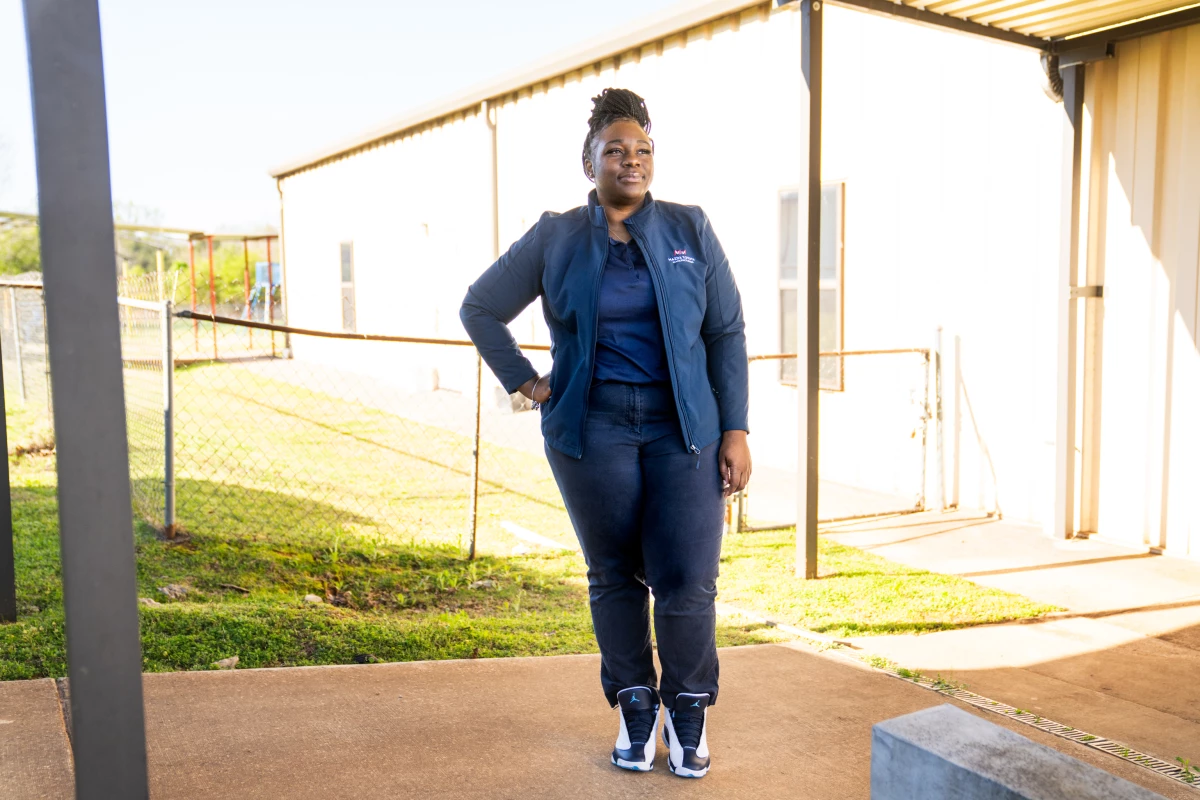
Mathis’ work impressed her bosses, and she quickly snagged a promotion from an assembly job to the people team. Nowadays, she spends her days and nights talking to workers on the production floor, helping them with their needs, including child care.
“I love talking to people, getting their feedback, and knowing that I can help and provide resources for them,” she says.
12% of employers offer child care assistance
This kind of support for child care is not common. According to the Labor Department, only about 12% of U.S. employers offer some kind of child care assistance.
But since the pandemic, interest has grown among companies who have found themselves competing for talent.
Toyota, one of the parent companies of the Alabama plant, was a pioneer in this space, building on-site child care centers at its plants in Kentucky and Indiana decades ago.
But building an on-site center can cost millions of dollars. Keeping it open overnight is costly and complicated. Employers have found many workers prefer to have their children cared for closer to home. If a shift runs long, they can call on a family member or neighbor to help with pickup.
Taking all of this into account, Mazda Toyota decided against building on-site child care and instead went with the $250-a-month stipend. The company calculated that even if every eligible employee received the full benefit, the cost would still be significantly less than building a center on-site.
“We think it puts more money in the pocket of our team members, and we feel like it gives them the flexibility that they want and desire,” says Jason Pickering, Mazda Toyota’s general manager of administration.
“It’s not free child care, so it doesn’t solve all problems, but we feel it puts them in a much better position.”
Tech company seeks to simplify child care
As interest in employer-sponsored child care is rising, so too are companies like Tootris, whose tech platform brings together employers, working parents and child care providers, allowing them to connect and transact.
Think of it as Airbnb meets a benefits management platform. Employers who offer child care assistance can process the benefit through Tootris. Employees get access to a database of more than 200,000 child care providers across the country, from large child care centers to small home-based operations, giving workers choice.
“Every family has different age requirements, cultural requirements, language requirements, faith-based or non-faith-based,” says Tootris’ founder and CEO Alessandra Lezama.
A single mom, Lezama had the idea for the company after seeing many of her own female employees quit their jobs after having children.
“I lost a lot of incredible talent,” says Lezama.
Since launching in 2019, Tootris has signed on hundreds of employers, including Mazda Toyota and its rival Hyundai Motor Manufacturing in Montgomery, Ala., the semiconductor manufacturer Micron, and public entities like the City of San Diego and the Memphis Area Transit Authority.
Finding child care to cover the overnights
Mazda Toyota assembly worker Sadie Storey discovered how valuable the service can be last year, when her team moved to rotating shifts. Suddenly, her child care needs changed. She began working overnights four weeks at a time. The caregiver she had been using only took children during the day. Her kids’ father is a pipefitter who travels all the time.
“I’m not from here. I don’t have family here, so it’s hard,” she says.
Storey was able to find Krystal Sanders, who cares for children out of her two-bedroom apartment about 20 minutes from the auto plant. Sanders had created a profile on Tootris after connecting with another Mazda Toyota employee.
Her flexible hours have made her a family favorite.
“I pretty much make my availability open. I’m 24 hours,” says Sanders, who worked in a child care center for almost a decade before starting her own business.

She knows what it’s like to raise a child while juggling nontraditional work hours. For five years, Sanders worked for Waffle House. During summers, on weekends, and even for a short time on overnights, her daughter would just come to work with her.
“Go to sleep in the car. Yup, she did that,” says Sanders. “I did that, because I didn’t have child care.”
About half the children she now cares for come through Mazda Toyota and Tootris. The hope is, with ties to big employers like Mazda Toyota, small businesses like hers can thrive, creating more child care options for working parents.
Attrition among women fell dramatically
As of this spring, 112 Mazda Toyota employees were receiving the company’s child care stipend. That could rise over the summer once school’s out.
“Our hope is that it enables more people to come into the workforce, especially here in north Alabama,” says Pickering. “We’re here waiting for them.”
Already, the benefit appears to have had a positive effect, slowing the rate of attrition.
Over the first year it was offered, attrition dropped by 11% overall and 20% among women.
While the company believes that decline was due to many factors, including wage increases, Luther in external affairs says the especially large drop among female employees suggests the child care benefit is doing something for moms.
“Maybe when they hit a hard point in the job or their life, that benefit helps them push through and stay with us,” she says.
A new Alabama tax credit stands to make supporting child care even more attractive to companies like Mazda Toyota. For three years starting in 2025, large employers can claim 75% of child care-related expenses, while those with fewer than 25 employees can claim 100% of expenses, up to $600,000 a year.
Transcript:
AILSA CHANG, HOST:
Child care has long been viewed as a problem for parents to solve, but increasingly, employers are realizing that they can be part of the solution, especially in sectors like manufacturing, which need workers round the clock. NPR’s Andrea Hsu looks at how an auto plant in Alabama is stepping up to help.
D’KOYA MATHIS: Can you say hi?
ZHARIA: Hi.
MATHIS: Hi.
ANDREA HSU, BYLINE: For D’Koya Mathis and her daughter, Zharia, morning drop off at Ms. Pat’s Child Care Center is short and sweet – quick temperature check at the door and then…
UNIDENTIFIED PERSON: You’re good.
MATHIS: All right.
UNIDENTIFIED PERSON: You’re good.
MATHIS: Bye-bye, girl.
HSU: Mathis takes comfort knowing while she’s at work, her toddler is having a ball.
MATHIS: You know, I hear from her teachers all the time. They tell me, hoo (ph), she’s a character. I know.
HSU: Mathis works at the Mazda Toyota Plant outside Huntsville, Ala. It’s a joint venture that makes small SUVs. When the company started recruiting workers a few years ago, they had women like her in mind. Jessica Luther in external affairs says Mathis very much represents the workforce of today.
JESSICA LUTHER: We’re, like, 33% women. Median age is 29 years old. It’s a very different workforce than your grandfather’s or your father’s manufacturing. We’re talking about young families. We’re talking about moms who end up working and being primary caregiver.
HSU: Just like D’Koya Mathis – she took a job on the assembly line just last year, drawn by the benefits – and one in particular – money for childcare.
MATHIS: I actually heard about it on a – it was a advertisement on a billboard.
HSU: It’s something she had been seeking in a job.
MATHIS: I’m a single mom, and it’s pretty expensive for the infants to come in, so I just needed a little bit extra support and help.
HSU: Which is what Mazda Toyota offers – the company will pay 30% of an employee’s childcare costs up to $250 a month, which still leaves Mathis with a lot to cover on her own.
MATHIS: Roughly, on my end, $700.
HSU: A month – but she says the 250 made a big difference. In her last job, Mathis didn’t have a child care benefit. She made the tough decision to send Zharia to live with her mother in Louisiana.
MATHIS: So when they offered this benefit, it was definitely great for me to go ahead and jump in.
HSU: And she made a splash. Just a few months into the job, Mathis got a promotion to the people team. Nowadays, she spends her days and nights talking to workers on the production floor, helping them with their needs, including child care.
MATHIS: I love talking to people, getting their feedback and knowing that I can help and provide resources for them. We’re one of the few companies that do offer child care.
HSU: According to the labor department, only about 12% of U.S. employers offer child care assistance. Toyota has done it for decades, building on-site childcare centers at its plants in Kentucky and Indiana. But building centers on-site is costly. Keeping them open overnight is complicated, and many workers prefer to have their kids closer to home anyway. So Mazda Toyota, the joint venture, decided to offer the stipend instead. Jason Pickering is general manager of administration.
JASON PICKERING: Who are we to say what’s important to your family, right? We want our team members to be able to make those decisions for themselves.
HSU: Mazda Toyota is working with a company called TOOTRiS, which both administers the stipend and helps employees find care providers – kind of like Airbnb but for child care.
PICKERING: Our hope is that it enables more people to come into the workforce. It’s not free child care, so it doesn’t solve all problems, but we feel like it puts them in a much better position.
HSU: As of the spring, 112 employees were receiving the child care benefit. That could rise over the summer when school’s out. The company is studying the effect the benefit is having on workers. Jessica Luther says they did see a decline in attrition over the first year it was offered.
LUTHER: Overall, attrition had dropped by 11%, which was great, but it was a result of many, many different things.
HSU: Including raises. But what was interesting was that attrition among women dropped 20%. That made her think this child care benefit is doing something for moms.
LUTHER: Maybe when they hit a hard point in the job or their life, that benefit helped them push through and stay with us, you know?
HSU: Alabama recognizes that benefits like this can get more people working, and that’s good for the economy. In fact, Governor Kay Ivey just signed a new child care tax credit into law. For the next three years, Alabama employers can enjoy some of the biggest tax incentives for subsidizing care anywhere in the country. Andrea Hsu, NPR News, Huntsville, Ala.
